What Is Property Equity and How Can You Use It?

So, what exactly is property equity?So, what exactly is property equity? In simple terms, it's the slice of your home that you actually own, free and clear of the bank.
Think of it as the real-world difference between what your home is worth today and the amount you still owe on your mortgage. This stake in your property is often one of the most valuable assets a person can build over their lifetime.
Understanding Your Real Ownership Stake

When you first buy a property, especially with a mortgage, you don't own it outright. You're just starting the journey. Your equity is the measure of how far you've come. It’s a powerful indicator of your financial health and shows how well your real estate investment is performing.
Here’s a helpful way to picture it: Imagine your home is a piggy bank. Every mortgage payment you make is like dropping a coin inside, building up your savings. And if the property's value goes up? That’s like earning bonus interest on everything you've saved.
The Key Components of Equity
To really get a handle on property equity, it helps to understand the two moving parts that create it.
For a quick reference, here’s a simple breakdown of the core concepts that define the value you hold in your property.
The Core Components of Your Property Equity
| Component | Simple Definition | What It Means for You |
|---|---|---|
| Current Market Value | The price your home could realistically sell for today. | This is the "asset" side of the equation. It's influenced by your location, the home's condition, and broader market trends. |
| Mortgage Balance | The amount of money you still owe the lender. | This is the "liability" side. It's the remaining principal on your loan that needs to be paid off. |
These two elements are intertwined, and their relationship is what builds your wealth over time.
The formula is simple but powerful: as your mortgage balance goes down and your property's value goes up, your equity grows. This is how a house transforms from just a place to live into a significant financial asset.
For anyone looking to buy property abroad, especially in sought-after European spots like Spain or Portugal, grasping this concept is absolutely crucial. Equity isn't just financial jargon; it's the tangible value you're building with every single payment. It's the wealth you can tap into later for your next big move, whether that's renovating a Tuscan farmhouse or buying a second holiday home in France through a platform like Residaro.
How to Calculate Your Property Equity

Alright, let's get practical. Knowing what equity is in theory is one thing, but figuring out how much you actually have is what really matters. Thankfully, you don't need a degree in finance to do it.
The calculation itself is incredibly simple. It's the key to understanding your true financial stake in your home.
Current Market Value – Outstanding Mortgage Balance = Your Property Equity
That’s it. To get started, you first need to know what your property is worth on the open market today—not what you originally paid for it. To dig deeper into how that number is determined, check out our guide on what is a property valuation.
Once you have a realistic market value, just subtract the remaining balance on your mortgage. Let's walk through a few scenarios across Europe to see how this plays out in the real world.
Example 1: The New Buyer in Spain
Let’s say you’ve just bought a beautiful villa near Málaga for €500,000. You put down 20% (€100,000) and financed the remaining €400,000 with a mortgage.
- Current Market Value: €500,000
- Outstanding Mortgage: €400,000
- Calculation: €500,000 - €400,000 = €100,000 in Equity
On the day you get the keys, your equity is precisely the amount of your down payment. This is your starting block—the foundation you’ll build your wealth on.
Example 2: The Long-Term Owner in Italy
Now, fast forward ten years. Imagine someone bought a rustic farmhouse in Tuscany for €350,000. Over the last decade, they've consistently paid their mortgage, bringing the outstanding balance down to just €150,000. On top of that, the area has become much more popular, and the property has appreciated nicely.
- Current Market Value: €550,000
- Outstanding Mortgage: €150,000
- Calculation: €550,000 - €150,000 = €400,000 in Equity
Look at that! Their equity has ballooned into a serious asset, a powerful combination of their own payments and a rising market.
Example 3: The Market Dip in France
Finally, a more cautious example. A couple bought a country home in France a few years ago for €400,000. They've paid down their loan to €320,000. Unfortunately, a temporary dip in the regional market has lowered the home’s current value slightly.
- Current Market Value: €380,000
- Outstanding Mortgage: €320,000
- Calculation: €380,000 - €320,000 = €60,000 in Equity
Even though the home's value dropped below the original purchase price, they still have positive equity. Why? Because they've paid down more of their mortgage than the value has decreased. This is a perfect illustration of how equity is a living number, constantly shifting with the market and your loan balance.
The Two Engines That Grow Your Property Equity

Growing your equity isn't something that just happens; it's an active process driven by two very different forces. Think of them as two engines working together to power your investment forward. One is about your own financial discipline, and the other is about the wider market. Understanding how both work is the key to getting the most out of your property.
The first engine is completely in your hands: mortgage principal reduction. Imagine a seesaw. On one side sits the bank's claim to your home, and on the other sits your stake. Every mortgage payment you make, especially the part that goes toward the principal, pushes your side down a little more, steadily increasing your ownership.
This is the most straightforward and reliable way to build equity. It’s a slow and steady grind, but your consistency directly translates into a bigger piece of the pie, month after month.
The Power of Market Appreciation
The second, and often more powerful, engine is market appreciation. This is where outside forces, like supply and demand, give your property's value a serious boost over time. Your home’s location and the health of the local economy are everything here. If demand is high, housing supply is tight, and the local area is thriving, your property's value is likely to climb.
This is a huge factor in sought-after European markets. A great property in a prime spot in Portugal or Austria can see its value climb much faster than you could ever build equity through mortgage payments alone.
We’re seeing a strong recovery in real estate right now. After a recent market correction, property values are back on the rise in many countries, helped along by solid rental growth. In fact, European commercial real estate transactions recently hit €188.8 billion, which is a 13.7% jump in just one year. You can dive deeper into these real estate trends on Nuveen.com.
When both engines are running at full steam—your consistent payments and a rising market—your equity growth can be truly impressive. It’s this one-two punch that turns a house into a genuine wealth-building asset.
In the end, it all comes down to a smart strategy. It’s not just about paying your mortgage on time, but also about picking the right property in a location with real growth potential. For international buyers using a platform like Residaro, pinpointing these high-demand spots across Europe is the first step to putting both of these powerful engines to work for you.
How to Unlock and Use Your Property Equity
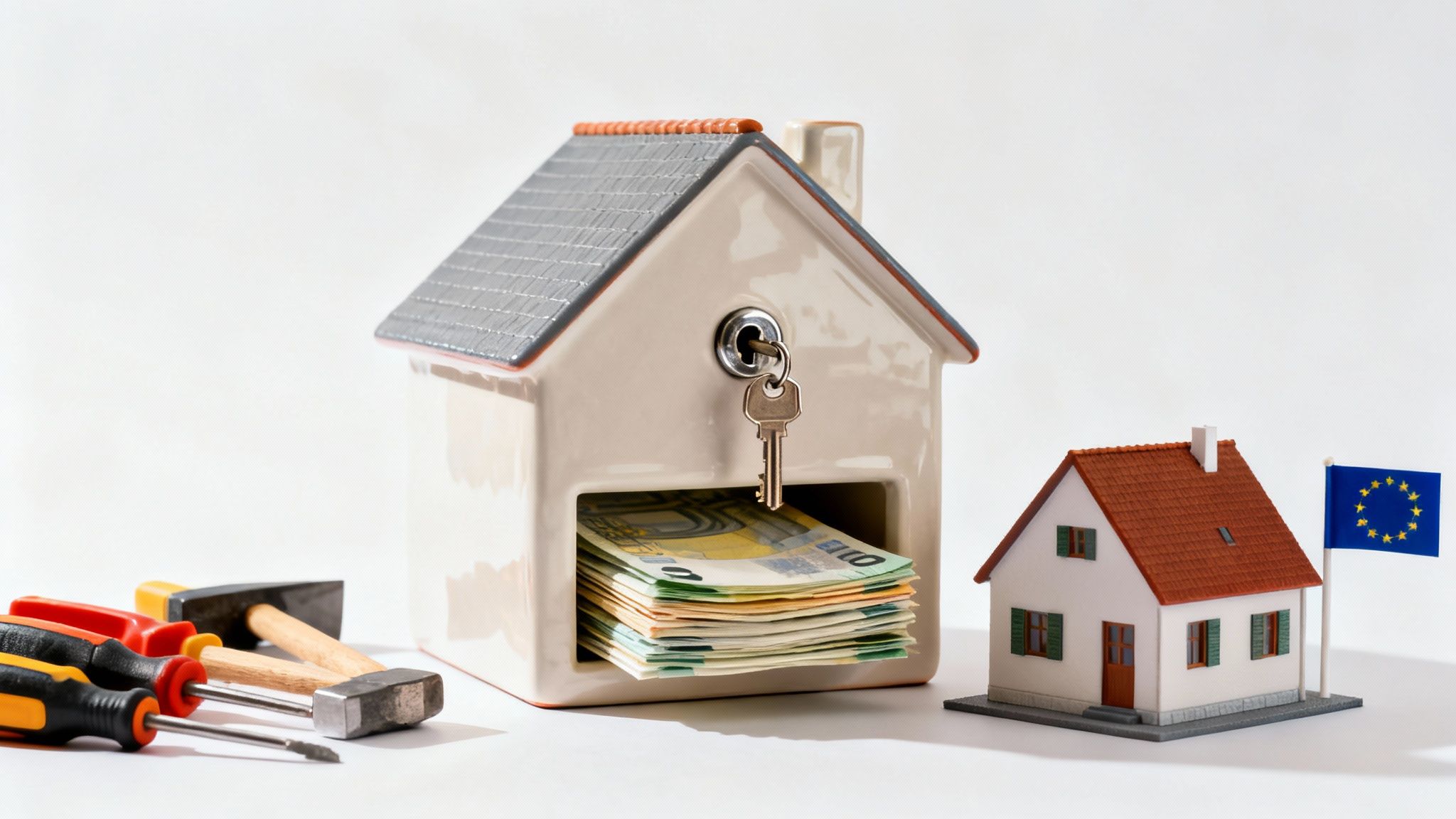
The equity you've patiently built in your home isn't just a number on a spreadsheet. Think of it as a financial resource you can actually use. Once you've got a handle on what equity is and how it grows, the next step is learning how to put it to work. For anyone owning property abroad, this stored value can be the key to funding new projects or even buying that next dream home.
In a way, your equity is like a locked savings account. But you hold the key. Instead of letting that value sit idle, you can borrow against it, often securing much better interest rates than you would with a typical personal loan. This opens the door to several smart financial moves.
Accessing Equity Without Selling Your Home
One of the most popular ways to tap into your home's value is by using it to secure a loan. These financial tools are designed specifically for homeowners who need cash but have no intention of selling their property.
You'll generally find two main options:
-
Home Equity Loan: This is pretty straightforward. You borrow a lump sum against the equity you've built up. You get the cash all at once and then pay it back through fixed monthly payments over an agreed-upon term. It’s a great fit for big, one-off expenses like a major renovation or putting a down payment on a second property.
-
Home Equity Line of Credit (HELOC): A HELOC is more like a flexible credit card. A lender approves a credit limit based on your equity, and you can draw money from it as you need it. You can borrow, repay, and borrow again. This makes it perfect for ongoing projects with unpredictable costs or simply as a financial safety net.
The bottom line is that both of these options turn your property's "paper wealth" into real, usable cash. But it's vital to remember your home is the collateral. Always borrow responsibly.
If you're managing property across borders, taking the time to explore all the available second home financing options is crucial for making the smartest financial decisions.
Using Equity for Your Next Big Move
While loans are great for accessing cash, sometimes your goal is much bigger—a new home, a new country, a new life. In that case, selling your property is the most direct way to unlock its full financial potential.
When you sell, the money from the buyer first pays off your remaining mortgage balance and any selling costs. Whatever is left over is your realised equity. It's cash in your pocket. This lump sum can be an absolute game-changer, especially if you're looking to buy another home.
For instance, the equity from selling a property in one country could provide a massive down payment for a new place in Spain, Italy, or Portugal. This is exactly the kind of international move that platforms like Residaro help with. Walking in with a substantial cash down payment from your previous home's equity puts you in an incredibly strong position as a buyer.
Whether you decide to borrow against it, refinance, or sell, your property equity is far more than a simple measure of ownership. It’s a powerful tool that, when used wisely, can help you achieve your biggest financial and lifestyle goals across Europe.
Navigating Property Equity in European Markets
Understanding property equity in theory is one thing. Putting that knowledge to work across Europe’s diverse property markets? That's a whole different ball game. Every country has its own unique mix of banking norms, tax laws, and real estate regulations that directly shape how you build and use your equity. If you're an international buyer, getting a handle on these local details is absolutely critical for making a smart investment.
One of the first hurdles you'll encounter is the Loan-to-Value (LTV) ratio. This simply dictates the maximum percentage of a property's price a bank is willing to lend you. A bank in Spain, for instance, might demand a larger down payment from a non-resident buyer than a bank in Sweden would. This means your starting equity position—your initial stake in the home—can vary wildly depending on where you decide to buy.
Local Rules and Your Bottom Line
Beyond the initial financing, local laws have a huge impact, especially when it’s time to sell. The equity you see on paper isn't always the cash you walk away with.
Here’s what you need to watch out for:
- Capital Gains Taxes: Most countries tax the profit you make when you sell a property. The tax rates and potential exemptions can be wildly different between, say, Italy and Portugal, which directly cuts into your net profit.
- Transaction Costs: Don't forget the fees. Costs for real estate agents, notaries, and property registration can take a significant bite out of your realised equity, as they're often calculated as a percentage of the sale price.
- Inheritance Laws: Some European nations have very specific succession laws that dictate how a property—and the equity tied up in it—can be passed on to your heirs.
Overlooking these financial details can lead to some nasty surprises and a much smaller return on your investment than you were banking on.
Cross-Border Financing and Your Equity Profile
The good news is that having solid equity in one property can be a powerful asset when you’re looking to buy in another country. It’s a clear signal of your financial stability and can seriously boost your credibility with lenders.
While getting a mortgage for a foreign property has its complexities, showing a bank you have significant, debt-free equity in another home makes you a far more appealing borrower.
Building equity is a long-term wealth strategy, but remember that its value isn't static—it moves with the market. Recent downturns have shown that even significant equity can take a temporary hit, which really underscores the need for a long-term view.
Property equity is the tangible wealth you build as a homeowner. While market shifts have caused some ups and downs lately—with the average homeowner seeing a temporary dip in some regions—the long-term power of real estate to create wealth is undeniable. In fact, despite recent headwinds, the average homeowner still holds a substantial amount of equity, proving just how resilient property is as a core asset.
This is exactly where a platform like Residaro comes in. We help you make sense of these market dynamics so you can confidently plan your international real estate journey.
Common Questions About Property Equity
Once you get the hang of what property equity is, you'll naturally start wondering about the specifics—the "what if" scenarios. This is especially true when you're buying a home in another country. We've tackled some of the most frequent questions we hear to give you clear, practical answers.
Think of this as your field guide to navigating the finer points of equity. Getting these details straight will help you make smarter moves as you build your property wealth across Europe.
Can My Property Equity Go Negative?
It's a scary thought, but yes, your equity can become negative. This happens when the market value of your home drops below what you still owe on your mortgage. In real estate circles, this is often called being "underwater" or having an "upside-down mortgage."
For example, say you still owe €300,000 on your mortgage. But after a sudden downturn in the local property market, your home is now only worth €270,000. Just like that, you’d have -€30,000 in equity. This is a real risk, especially for buyers who purchase at the peak of a market with a very small down payment.
While it sounds like a disaster, it's usually only a major problem if you’re forced to sell right away. If you can keep up with your mortgage payments and hang on, you can often ride out the market dip. As you continue to pay down your loan and the market (hopefully) recovers, you’ll eventually climb back into positive territory.
How Quickly Can I Build Equity in a European Property?
There's no single answer here—the speed at which you build equity is a mix of your own financial strategy and what the market is doing. The good news is you have more control than you might think. By actively managing a few key things, you can seriously speed up how quickly your wealth grows.
Here's what really moves the needle:
- Your Down Payment: Think of this as your head start in the race. Putting down 30% instead of 10% means you instantly own a much larger chunk of your home from day one.
- Mortgage Terms: The length of your loan makes a huge difference. A shorter-term loan, like a 15-year mortgage, forces you to pay down the principal much more aggressively than a standard 30-year one. It’s a fast track to building your ownership stake.
- Extra Payments: Every extra euro you can throw at your mortgage principal is a step forward. Even small, regular extra payments can shave years off your loan and build your equity that much faster.
- Market Appreciation: This is the one factor you can’t directly control, but you can certainly plan for it. Choosing a property in a high-demand area—like a sunny coastal town in Portugal or a growing suburb near Vienna—can supercharge your equity as property values rise.
The winning combination? A solid down payment, a shorter loan term if you can manage it, and a smart location in a strong local market.
Ultimately, building equity is a marathon, not a sprint. A disciplined approach to your finances, combined with a savvy choice of location, is what will turn your European property into a powerful financial asset over the long run.
What's the Difference Between Equity and a Down Payment?
This is a really common point of confusion, but the difference is actually pretty straightforward.
Your down payment is the lump sum of cash you put in at the very beginning when you buy the property. It’s your initial investment to secure the home and reduce the amount you need to borrow.
Your property equity, on the other hand, is the total value of your stake in the home at any point in time. It starts with your down payment, and then grows from there.
Let's walk through it with an example. Imagine you’ve found a charming house in France for €400,000.
- You make a 20% down payment of €80,000. On the day you get the keys, your equity is exactly €80,000.
- Fast forward five years. You've been diligent with your payments and have paid off an additional €50,000 of your mortgage principal.
- In that time, the local market has been buzzing, and your property’s value has climbed to €450,000.
Now, your total equity is a combination of all three things: your original down payment, the principal you’ve paid off, and the appreciation in value. It has grown far beyond your initial investment.
In short, your down payment is the seed. Your total equity is the tree that grows from it over the years.
Ready to find a property where you can start building your own equity? With Residaro, you can explore beautiful homes across Europe and take the first step toward your international real estate goals. Discover your dream home today on Residaro.com.