What Is a Property Valuation - A Buyer's Essential Guide
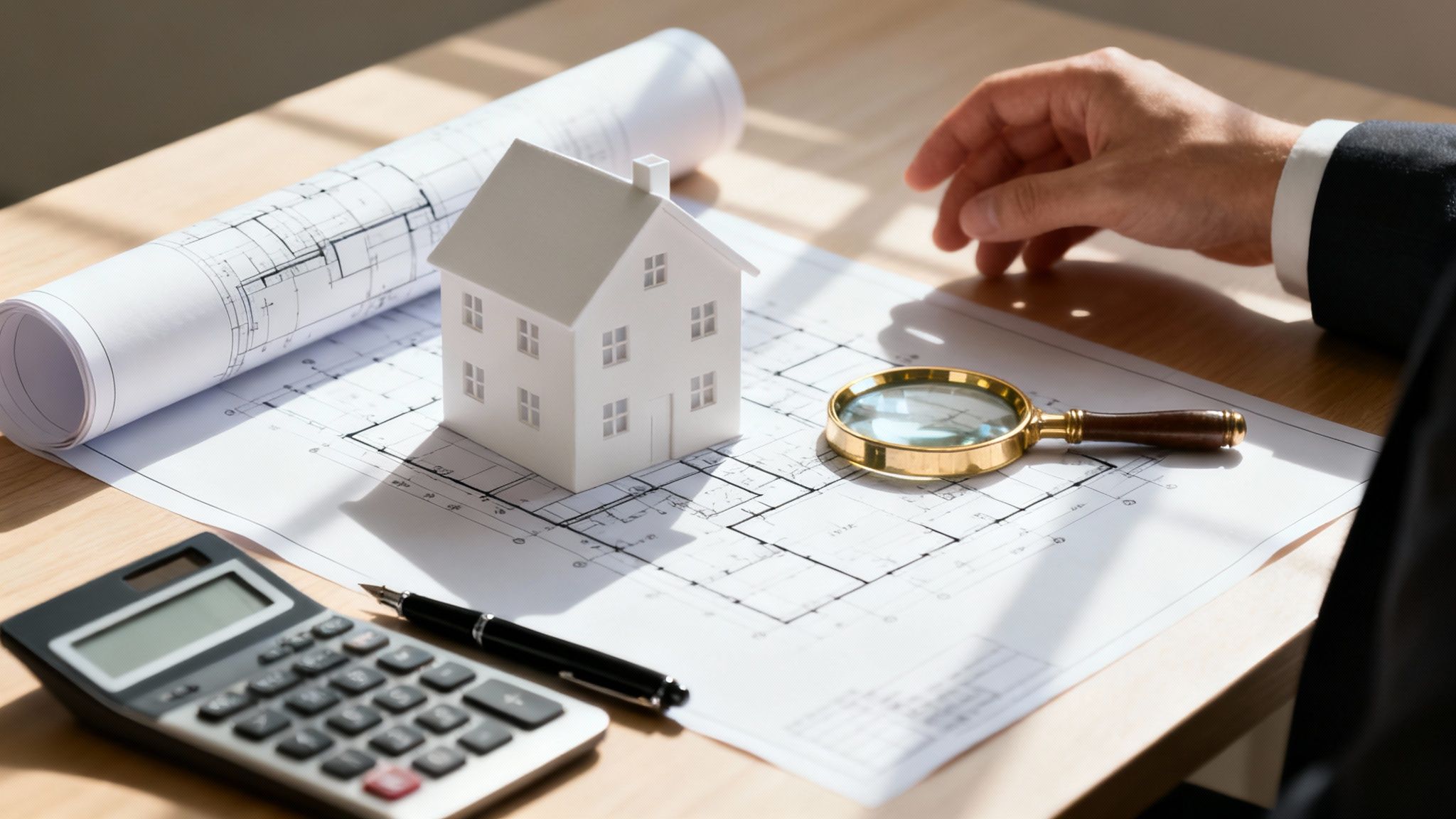
A property valuation is simply an expert’s professional and impartial opinion on what a property is worth on the open market. It's not just a quick guess; it’s a thorough financial health check that digs into hard data, market trends, and the valuer’s own seasoned judgment, all wrapped up in a formal report. This single document is the bedrock of almost every property deal you'll ever encounter.
What's a Property Really Worth?
Think about buying a classic car. You wouldn't just take the seller's word on the price. You'd bring in a specialist mechanic to look under the hood, check the chassis, and review its history to figure out what it's actually worth. A property valuation does exactly that, but for a much bigger asset—your home or investment. It cuts right through the sales pitch and your own emotional attachment to give you a clear, objective number.
This process is absolutely vital for keeping the property market stable and transparent. After all, real estate is the world's single largest asset class, with a global value sitting at a staggering $393.3 trillion. That's more than all stocks, bonds, and even gold put together. Valuations provide the solid financial ground needed to trade these huge assets with confidence. You can dig deeper into this in the global real estate market research from The Super Prime.
Why a Valuation Is So Much More Than Just a Price Tag
It's easy to get confused and think a valuation is the same as the asking price or an estate agent's "appraisal." They're related, sure, but they serve very different purposes. An agent's price suggestion is often a marketing tool designed to get a property sold. A formal valuation, on the other hand, is an independent analysis that has to stand up to scrutiny.
The final number on that report is a make-or-break figure for everyone involved:
- For Buyers: It's your safety net. A valuation confirms you aren't about to overpay and gives you powerful leverage to renegotiate if the value comes in lower than the offer you've made.
- For Lenders: Banks won't lend a cent without one. They need to know the property is worth enough to cover the loan if things go wrong.
- For Sellers: It grounds your expectations in reality. A professional valuation helps you set a competitive asking price that attracts genuine buyers and avoids having your property sit on the market for months.
- For Insurers: It ensures your property is covered for its true replacement cost, so you're not left out of pocket in a disaster.
To get a clearer picture, let's break down the essential components of a property valuation.
Key Elements of a Property Valuation at a Glance
This table provides a quick look at the core components that make up a property valuation and highlights why it's a non-negotiable step in the real estate world.
| Component | Description |
|---|---|
| Objectivity | An unbiased, independent assessment of worth, free from the influence of buyers, sellers, or agents. |
| Data-Driven | Based on concrete evidence like recent comparable sales, market trends, and property-specific details. |
| Professional Expertise | Conducted by a qualified and accredited valuer with deep knowledge of the local market. |
| Formal Report | A detailed, legally recognized document that outlines the methodology and justifies the final value. |
| Risk Mitigation | Protects buyers from overpaying, lenders from risky loans, and sellers from unrealistic pricing. |
Each element plays a crucial role in providing a reliable and defensible figure that all parties can trust.
A property valuation isn't just about finding a number—it’s about gaining clarity and managing risk. It turns what can be a highly emotional decision into a smart, well-informed financial move.
Ultimately, a professional valuation gives you a clear, objective snapshot of a property’s worth at a specific point in time. Armed with that knowledge, you can make confident decisions, whether you’re buying, selling, or simply planning your financial future. It’s the essential first step toward understanding the true value of what you're dealing with.
The Three Core Methods of Property Valuation
Professional valuers don’t just pull a number out of thin air. Their final figure is a carefully calculated assessment based on one or more established techniques. Once you understand these core methods, the whole valuation process starts to make sense, showing you the logic behind that final number. Each approach looks at the property from a different angle, and the right one depends entirely on the type of property we're talking about.
This diagram helps illustrate what a property valuation really is: an unbiased, expert assessment to pin down its true market worth.

Ultimately, a good valuation blends professional judgement with hard data. It’s this combination that produces a reliable figure you can base major financial decisions on.
The Sales Comparison Approach
The most common method you'll encounter, especially for residential homes, is the Sales Comparison Approach. It's a lot like figuring out the price of a used car. You wouldn't just look at one listing; you'd see what similar models with comparable mileage and in similar condition have actually sold for recently. Valuers do the exact same thing with houses.
They hunt for several properties that have recently sold in the same area and are as close as possible in style and features to the one being valued. In the industry, we call these "comparables" or just "comps."
The real skill comes in the adjustments. A valuer will tweak the value based on the differences between your property and the comps. For instance, if your place has a brand-new kitchen but the comp has an old one, your property’s value gets adjusted upwards. If a comparable property has a two-car garage and yours only has a driveway, your value is adjusted downwards. The final figure is a reconciled value based on these careful, data-backed adjustments.
This method is so powerful because it’s grounded in reality. It directly answers the most important question: "What are real buyers actually paying for a home like this, in this neighbourhood, right now?"
The Cost Approach
Now, let's switch gears. What if you're looking at a brand-new building, or something unique like a school or a fire station? There probably aren't any similar, recent sales to compare it to. This is where the Cost Approach shines.
This method works on the principle of substitution. It asks a pretty straightforward question: what would it cost to build an identical property from the ground up today, at current prices?
The process is broken down into a few clear steps:
- Estimate the Land Value: First, the valuer figures out what the plot of land would be worth if it were empty.
- Calculate Replacement Cost: Next, they calculate the total cost to construct the building today, factoring in materials, labour, and all other expenses.
- Deduct Depreciation: Finally, they subtract any loss in value. This could be from physical wear and tear, an outdated design, or other functional issues.
The formula is simple: Value = (Cost to build new) - (Accumulated Depreciation) + (Land Value). It's the go-to method for new constructions and special-use properties where sales data just isn't available.
The Income Approach
What if the property's main purpose is to make money? Think of an apartment complex, an office tower, or a retail strip. For these, the Income Approach is the only one that truly matters. This method doesn't care what it cost to build or what the house next door sold for. It focuses purely on the property's ability to generate a profit.
An appraiser using this approach thinks like an investor. They want to know the return on investment. They'll dig into the numbers—current rental income, operating expenses like maintenance and taxes, and vacancy rates—to calculate the property's Net Operating Income (NOI).
From there, they apply what's called a "capitalisation rate" or "cap rate" to the NOI. The cap rate is a percentage that reflects the expected return for similar investment properties in that market. A lower cap rate suggests lower risk and therefore a higher property value, and vice versa. For anyone in commercial real estate, this method is the gold standard because it directly reflects how investors judge a property's worth.
To help you see how these methods stack up, here’s a quick comparison.
Comparing Property Valuation Methods
This table breaks down the three main valuation methods, showing you what they are, when they’re used, and their biggest strengths and weaknesses.
| Valuation Method | Best For | Key Advantage | Potential Limitation |
|---|---|---|---|
| Sales Comparison | Residential homes, condos, and properties in areas with lots of recent sales activity. | Reflects current market sentiment and what buyers are actually willing to pay. | Can be difficult to use in slow markets or for unique properties with no direct "comps." |
| Cost Approach | New construction, public buildings (schools, libraries), and unique or special-use properties. | Provides a clear value when comparable sales data is non-existent. | Can be less accurate for older buildings where calculating depreciation is highly subjective. |
| Income Approach | Commercial real estate like apartment buildings, office towers, and retail centres. | Directly ties the property's value to its income-generating potential, which is what investors care about. | Relies heavily on market forecasts (like future rent and vacancy rates), which can be speculative. |
As you can see, there isn't one "best" method. A skilled valuer knows which tool to use for the job, and for complex properties, they might even blend elements from all three to arrive at the most accurate and defensible valuation.
Finding and Vetting Your Property Valuer
A property valuation is only as good as the person who signs off on it. That final number on the report carries serious weight—it can make or break mortgage approvals, shape negotiations, and define your entire investment strategy. So, finding a qualified, independent expert isn't just another box to tick; it’s the bedrock of a smart property deal.
Think of it like choosing a specialist for a medical procedure. You wouldn't just pick a name out of a hat. You’d check their credentials, their experience, and their reputation. The same level of care is needed here. Your valuer's job is to be an impartial referee, delivering a neutral, data-driven opinion of value that serves the buyer, seller, and lender alike.
Key Qualifications to Look For
As you start your search, you'll see titles like appraiser, valuer, and surveyor. The exact term often changes depending on the country, but the essential qualifications for a top-tier professional are universal. Their skills have to be backed by serious credentials and a solid commitment to ethical conduct.
Here’s what you absolutely must look for:
- Official Certification: A credible valuer will have a recognized professional designation. Across Europe and many other regions, accreditation from the Royal Institution of Chartered Surveyors (RICS) is the gold standard. It tells you they’ve gone through demanding training and follow strict global practices.
- Proven Local Expertise: Real estate is all about location, location, location. A valuer who lives and breathes your target neighborhood—who knows its sales trends, zoning quirks, and future development plans—will deliver a far more accurate report than an outsider ever could.
- Complete Independence: This is non-negotiable. The valuer cannot have any financial interest in the outcome of the sale. Their fee is their only payment, which guarantees their final number is objective and not skewed by pressure from anyone involved.
The Importance of Ethical Standards
A true professional works under a strict code of conduct that demands objectivity and transparency. They aren't on your team to help you lowball an offer, nor are they there to rubber-stamp a seller's wishful thinking. Their only job is to determine a property's fair market value based on cold, hard evidence.
A valuation is a statement of professional opinion, not a tool for negotiation. Its purpose is to provide an objective, defensible figure that all parties can rely on to make informed decisions.
Getting this distinction is key. It helps you view the valuation report for what it is: a crucial piece of due diligence, not a bargaining chip. This expert opinion is a critical part of a wider investigation, as we detail in our real estate due diligence checklist, which helps ensure you’ve covered every angle before you buy.
Ultimately, vetting your valuer is about protecting yourself from expensive errors and giving you the solid footing you need to move forward with confidence.
How to Read and Understand Your Valuation Report
Getting your hands on a property valuation report can feel a bit overwhelming. It’s usually a dense document, packed with technical jargon, and it all boils down to one very important number. But don't be intimidated. The best way to think about it is as a detailed biography of the property, telling the complete story of how its value was determined.
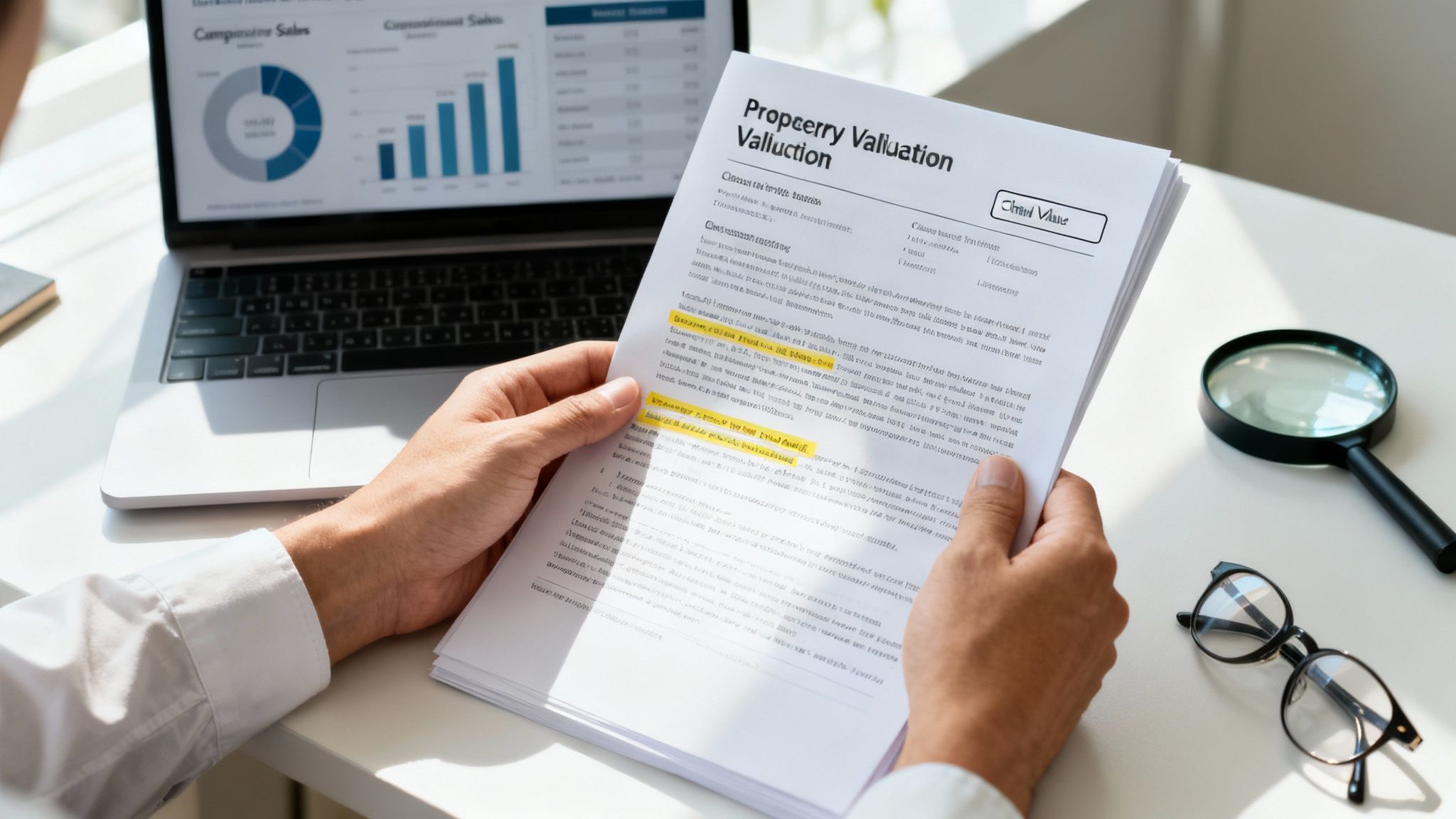
The report isn’t just about that final figure; it’s about the evidence and the expert reasoning behind it. Once you know how to break it down into its core parts, it becomes a powerful tool that helps you ask the right questions and make informed decisions.
Deconstructing the Report: Key Sections
Every valuation report follows a logical path, starting with the big picture and slowly narrowing its focus to the final value. While the layout might differ slightly from one firm to another, you’ll almost always find these key components.
Here’s a look at what you can expect to find inside:
- Property Description: This is the factual rundown of the property's physical characteristics. Think square footage, number of rooms, age, overall condition, and any special features or outbuildings. It’s the foundational inventory of what’s being valued.
- Market Analysis: Here, the valuer puts on their economist hat. They’ll give you an overview of the local real estate scene, commenting on current trends, how strong buyer demand is, and where prices have been heading lately. This section provides the economic backdrop for the valuation.
- Comparable Sales (Comps): For most residential properties, this is the heart of the report. It’s a list of similar homes nearby that have sold recently. The valuer will detail how they've adjusted the prices of these "comps" to account for differences—things like one having a renovated kitchen or another having an extra bathroom.
- Valuation Methodology: The report will clearly state which approach was used—whether it was the Sales Comparison, Cost, or Income method. Crucially, it will also justify why that method was the most appropriate for this specific property.
A valuation report is more than just a number; it’s a transparent account of the valuer's professional judgment. Your goal is to follow their trail of logic, from the basic property details all the way to the final figure.
What to Focus On and Red Flags to Spot
When your report arrives, resist the temptation to just flip to the last page. The real insights are buried in the details. Pay very close attention to the valuer's comments, especially any notes about the property's condition or potential problems they observed.
Be on the lookout for phrases that could signal trouble. For example, things like "evidence of damp," "structural movement noted," or "requires significant modernisation" are clear red flags. These observations don’t just drag down the property's value; they could also point to major expenses waiting for you down the line. Remember, a valuation isn't the same as a deep physical inspection. You can learn more about the differences in our guide on what is a property survey.
Market forces play a huge role here, too. The U.S. property market, for instance, shows how external factors can hit home. Fluctuations in home equity, shifts in the number of homes for sale, and even rising escrow payments for taxes and insurance can all add financial pressure and directly affect a property's value. A good valuer considers all of this. You can discover more insights about the U.S. property market's dynamics from Cotality.
Understanding Assumptions and Reconciliations
Finally, find the section on assumptions and limiting conditions. This is where the valuer lays out any constraints they had to work with. For example, they might have assumed the property has a clean legal title or that all construction work was done with the proper permits. These are important footnotes to their assessment.
If the valuer used more than one valuation method, there will be a section called "reconciliation." This is where they explain how they weighed the different results from each approach to land on a single, final figure. This part of the report is a fantastic window into their expert reasoning and provides the ultimate justification for the value they've assigned. When you can read and understand your report, you gain the confidence to move forward, armed with a clear picture of what the property is truly worth.
Getting a Property Valued in Europe? It's Not the Same Everywhere.
Thinking of buying property in Europe? Great! But here's a crucial piece of advice: don't assume a property valuation works the same way it does back home. Every country has its own way of doing things, shaped by local laws, banking rules, and even unique market quirks.
What's standard procedure in Spain could be completely unheard of in Sweden. Knowing these differences isn't just helpful—it's essential. It saves you from confusion, manages your expectations, and ultimately protects your investment. A valuation from one country simply doesn't translate to another, which is why having a local, accredited expert on your side is non-negotiable.
On the bright side, global property markets are starting to find their footing again after a recent cool-down. We're seeing steady value increases in major countries and a healthy bounce-back in the number of sales. With inflation easing and interest rates stabilizing, the path forward for property valuation is becoming clearer. If you want to dive deeper into these trends, the global insights page from Nuveen is a great resource.
A Quick Tour of Valuation Practices in Europe
Let's take a look at how property valuations are handled in a few popular European destinations. You'll quickly see how different the local flavor can be.
Spain In Spain, if you need a mortgage, you'll need an official valuation called a tasación. This isn't just any appraisal; it has to be done by a certified appraiser (tasador) from a firm that's regulated by the Bank of Spain. One thing to know about Spanish tasaciones is that they're notoriously conservative. They often come in just a touch below the sale price to give the bank a safety cushion.
France Over in France, the professional you’re looking for is an expert immobilier. While the system isn't as tightly regulated for private sales as in Spain, a formal valuation is absolutely necessary for getting a mortgage. French valuers really zoom in on the property's physical condition, its energy efficiency rating (DPE), and prime location factors like how close you are to shops, schools, and transport.
Italy The Italian valuation process is typically handled by a professional called a geometra or an architect. Their report, the perizia di stima, is a must-have for any bank loan. What’s unique here is the intense focus on legal compliance. They meticulously check that the property's registered floor plans perfectly match its actual layout—a common hiccup, especially with Italy's beautiful historic buildings.
Who's Who and What's What: Rules and Professionals
The person signing off on your valuation and the rulebook they follow can change dramatically as you cross borders. This directly shapes what the final report looks like and what it focuses on.
- Titles and Credentials: In Sweden, a fastighetsvärderare handles the job, often working directly for a bank. Head to Austria, and you'll be dealing with a Sachverständiger. Each title carries its own set of local qualifications and professional standards.
- Regulatory Oversight: Some countries have very strict government oversight. In Portugal, for instance, valuers must be registered with the Comissão do Mercado de Valores Mobiliários (CMVM), which holds them to a rigorous code of conduct.
- Favorite Methods: While the three main valuation methods are used everywhere, some are favored more than others depending on the market. In a dense city like Paris, valuers lean heavily on comparing recent sales. But out in rural Portugal where comparable sales are scarce, they have to get more creative and blend different approaches.
When you enter a foreign property market, you're playing by a new set of rules. A property valuation isn't just a number on a page; it's a direct reflection of that country's legal and financial culture.
Getting your head around these differences is the first step toward a smart international purchase. The takeaway is simple: never, ever assume the process will be a carbon copy of what you're used to.
Always find a qualified, local valuer who lives and breathes the regional market. Their expertise is the single best tool you have to understand what a property is truly worth, giving you the confidence to make a solid investment abroad.
Your Pre-Valuation Checklist for Buyers
Heading into a property valuation can feel a little daunting, but a bit of prep work can make all the difference. Think of it less as a test and more as your chance to get a clear, unbiased picture of what you're buying. This checklist is your road map to making sure you're ready for the valuer's visit and know exactly what to do with the report once it lands in your inbox.
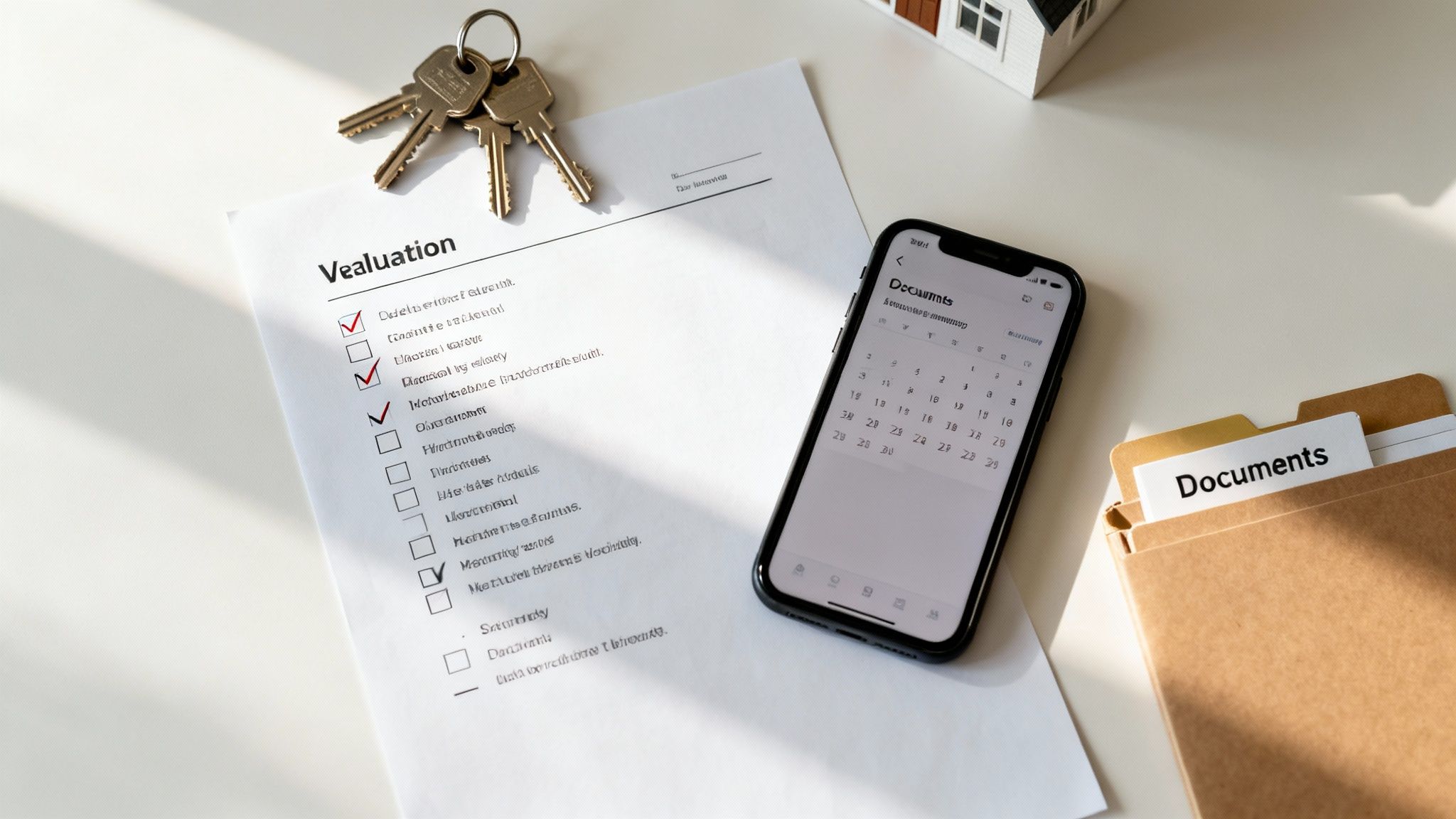
Getting organized ahead of time ensures the whole process runs smoothly. It gives you the confidence and clarity you need to make a smart move.
Phase 1: Before the Valuation
The groundwork you lay before the valuer even steps through the door is crucial. This is where you get all your ducks in a row for an accurate and efficient assessment.
-
Gather Key Documents: Pull together all the essential paperwork. This means the property's title deed, recent utility bills, floor plans, and a clear list of any major renovations done in the last five years, including the dates and costs.
-
Verify Ownership Details: Double-check that all ownership records are correct and current. Any confusion here can really slow things down. If you need a hand, our guide on how to verify property ownership walks you through the essential checks.
-
Research Qualified Valuers: Don’t just go with the first name you're given. You want a certified professional who genuinely knows the local area or the specific type of property you’re buying. Look for credentials like RICS in Europe—it's a good sign they know their stuff.
Phase 2: During the Valuation
On the day itself, your job is to be a helpful guide, not a helicopter parent. Let the expert do their thing, but be on hand to provide information if they need it.
- Be Available, Not Overbearing: Welcome the valuer, make sure they can access every part of the property (including attics and basements), and then step back. Give them the space to do a proper inspection.
- Have Your Questions Ready: It's smart to have a few questions prepared. Ask about recent sales in the neighbourhood or which features they think add the most value. It shows you’re engaged.
- Point Out Hidden Gems: Don't assume they'll see everything. Casually mention any significant upgrades that aren't obvious at first glance, like new plumbing, upgraded insulation, or a brand-new roof.
Phase 3: After Receiving the Report
This is the moment of truth. What you do with the valuation report can shape your entire negotiation and final purchase decision.
A property valuation isn't just a formality; it's your financial safety net. If the number doesn't match the asking price, see it as powerful new information, not a problem.
What if the valuation comes in lower than your offer? Don't panic. This is actually a golden opportunity. You can now go back to the seller with a powerful, impartial report from an expert. It's the best leverage you can have to negotiate a fairer price, protecting you from overpaying and making sure your investment is solid right from the start.
Got Questions About Property Valuations? We've Got Answers.
Even with the basics down, you probably still have a few questions rolling around in your head. That's perfectly normal. Let's tackle some of the most common things buyers wonder about, so you can walk into this process with your eyes wide open.
We'll clear up the confusion and make sure you're ready for what's ahead.
Valuation vs. Agent Appraisal: What's the Difference?
This is a big one, and the source of a lot of mix-ups. The distinction is crucial, though. Think of a real estate agent's "appraisal" (often called a comparative market analysis or CMA) as a sales pitch. It’s designed to suggest a competitive asking price to get a property sold, and let's be honest, it’s often influenced by the agent's desire to win the listing.
A property valuation, however, is a different beast entirely. It's a formal, legally binding assessment of a property's true market value, carried out by a certified, impartial professional. It's built on strict, evidence-based methods and is a critical risk-management tool for lenders. When you're getting a mortgage, the bank wants a formal valuation, not an agent's opinion.
How Long Is a Valuation Good For?
A property valuation is essentially a snapshot in time. It captures the property's value on the day the valuer inspected it, based on the market conditions at that exact moment. Because real estate markets are anything but static, most lenders and banks consider a valuation to be valid for 90 days.
If your deal drags on longer than three months, or if something big happens in the market (like a sudden jump in interest rates), don't be surprised if your lender asks for an updated valuation before they sign off on the loan.
It's easy to think of a valuation as a permanent price tag, but it's not. It’s a dynamic assessment that has an expiration date. Picture it like a weather forecast—it's incredibly reliable for the next few days, but you wouldn't bet on it being right three months from now.
What If I Don't Agree with the Valuation?
Getting a valuation back that's lower than what you offered can feel like a punch to the gut, but it's not necessarily a deal-killer. If you're convinced the number is just plain wrong, you have a couple of moves.
First, go through the report with a fine-tooth comb. Did the valuer get the square footage wrong? Did they miss the brand-new kitchen or the extension you know was just finished? If you spot a factual error, you can formally challenge the valuation by sending evidence to the valuer or the bank.
If there are no obvious mistakes, that low valuation just became your new best friend in negotiations. You now have a formal, expert document showing the property might be overpriced. Use it to go back to the seller and negotiate a lower price. It's the ultimate proof that you're not just trying to lowball them.
What Kinds of Problems Drag Down a Property's Value?
Valuers have a keen eye for red flags that can tank a property's worth. Knowing what they look for can help you spot potential issues when you're viewing homes.
Here are some of the usual suspects:
- Structural Problems: Things like cracks in the foundation, signs of damp, or a sagging roof are immediate value-killers.
- Poor Condition: A kitchen from the 70s, worn-out bathrooms, peeling paint, and general signs of neglect will definitely lower the number.
- Location Flaws: Is it right on a noisy main road, next to a loud commercial building, or in a neighborhood with few amenities? That'll take a toll on the value.
- Legal or Title Issues: Any confusion over property lines, unpermitted work, or messy ownership history can seriously reduce what a property is worth.
Ready to find your perfect property in Europe? With thousands of listings across Spain, Italy, France, and beyond, Residaro makes discovering your dream home simple. Start your search on Residaro today!