A Guide to Spanish Property Taxes for Foreign Buyers

Thinking about buying a place in Spain? It’s a fantastic dream, but it's important to go in with your eyes wide open, especially when it comes to taxes. The journey involves more than just a single payment when you pick up the keys. You'll face taxes at the very beginning when you buy, annually while you own it, and finally, when you decide to sell.
The big one upfront is either the Property Transfer Tax (ITP) for a pre-owned home or Value Added Tax (VAT) if you're buying a brand-new build. Depending on where you buy, this can be anywhere from 6% to 10% of the purchase price, and sometimes even a little more.
Your Essential Roadmap to Spanish Property Taxes
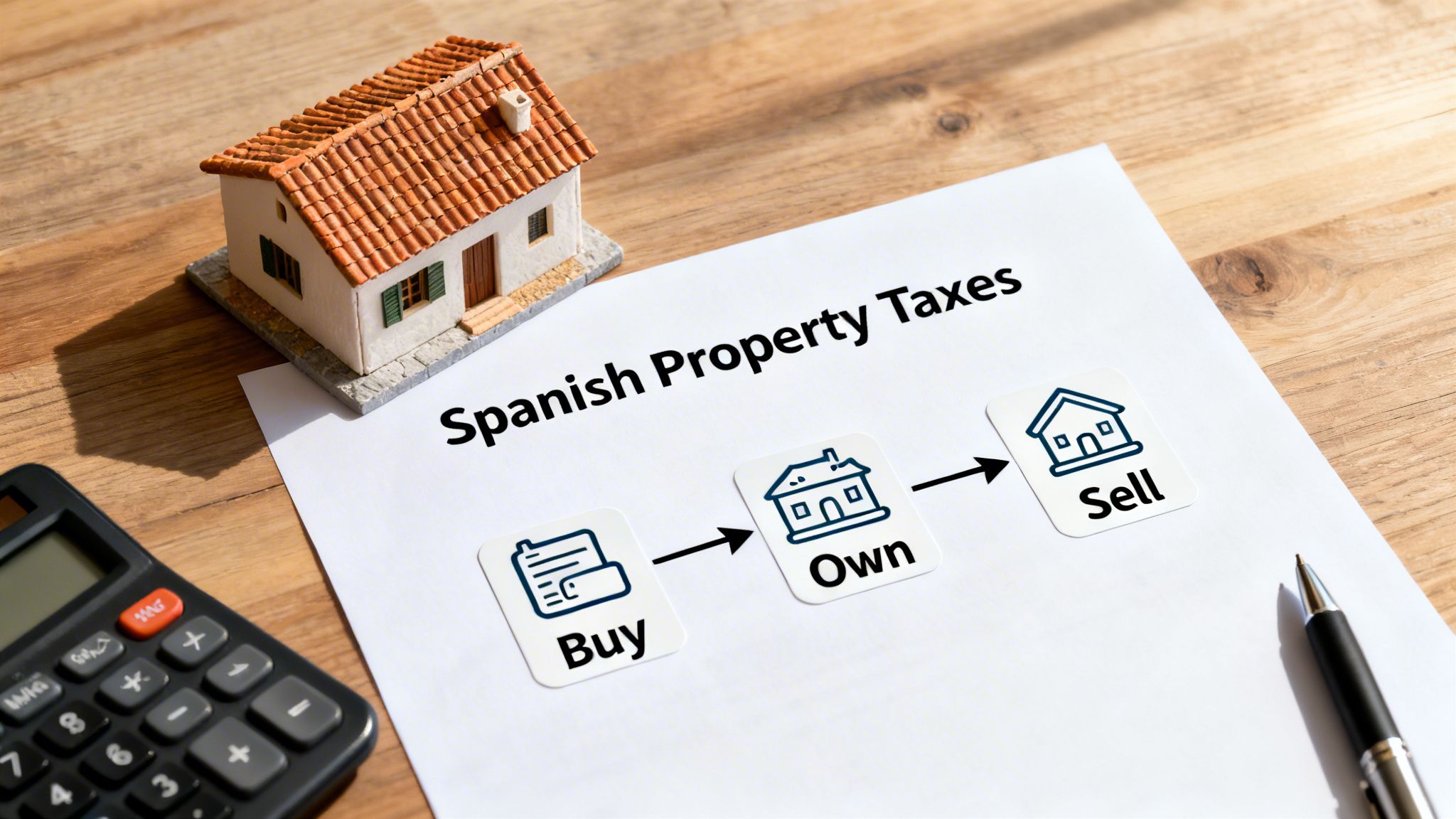
Welcome! Let's get you properly prepared for the Spanish property tax system. For anyone buying from abroad, getting a handle on these financial responsibilities is just as crucial as finding that perfect villa with a sea view. This guide is your roadmap, designed to walk you through the three distinct stages of the tax journey: buying, owning, and selling.
Think of it this way: each phase has its own unique set of rules and vocabulary. As a buyer, you'll quickly become familiar with ITP (Impuesto sobre Transmisiones Patrimoniales) for resale homes, or IVA (the local name for VAT) for new properties. Once you're the proud owner, the annual IBI (Impuesto sobre Bienes Inmuebles)—which is basically Spain’s version of council tax—becomes a regular part of your financial calendar.
The Three Stages Of Property Taxation
To get our heads around this, let's break down the entire lifecycle of Spanish property taxes. Knowing what's coming at each step is the key to avoiding nasty surprises and budgeting like a pro right from the start. For a look at the bigger picture, our complete guide on how to buy property in Spain covers the entire purchasing process in detail.
Here's a quick summary table to give you a bird's-eye view.
The Three Stages of Spanish Property Taxation
This table offers a snapshot of the main tax phases you'll encounter as a property owner in Spain.
| Tax Stage | Key Taxes Involved | Who It Affects |
|---|---|---|
| At Purchase | ITP (resale) or VAT (new build), Stamp Duty (AJD) | All buyers |
| During Ownership | IBI (local tax), Non-Resident Income Tax, Wealth Tax | All owners, with variations for residents and non-residents |
| Upon Sale | Capital Gains Tax, Plusvalía Municipal | All sellers |
This breakdown helps frame the discussion as we dive deeper into each category.
Every one of these taxes has its own rulebook, rates, and, crucially, regional differences that can seriously affect the total cost of your investment.
The Spanish tax system is highly regionalised. A property in Madrid might have a 6% transfer tax, while an identical one in Valencia could be 10%. Understanding these local differences is critical for making an informed investment decision.
Now, let's dig into each of these stages. We’ll break down the details with clear explanations, real-world examples, and some practical tips I've picked up over the years. By starting with this solid overview, you’ll build the confidence you need to manage the financial side of your Spanish property adventure.
Taxes When Buying Property: ITP vs VAT
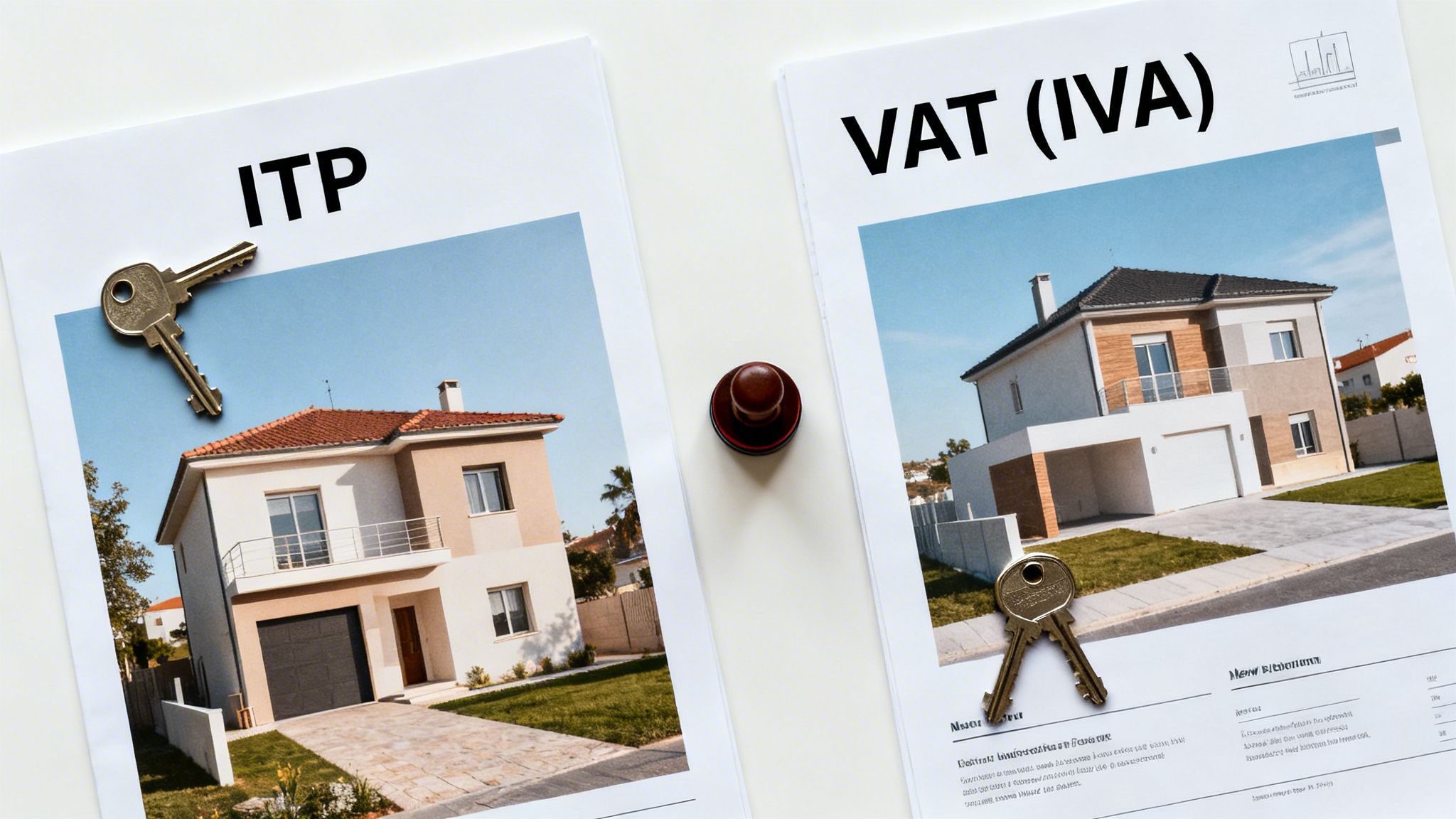
When you're ready to buy property in Spain, the first major cost you'll run into is the purchase tax. But here’s the thing: it’s not one single tax. The path you take depends entirely on one simple question: are you buying a brand-new home or a pre-owned one?
Think of it like buying a car. A shiny new model straight from the showroom comes with VAT. A second-hand car from a private seller? That involves a different transfer tax. Spanish property works on the exact same principle, and making the right choice can save you a serious amount of money.
ITP: The Tax on Resale Properties
If you’re buying a resale home—a property that’s had a previous owner—you'll pay the Impuesto sobre Transmisiones Patrimoniales (ITP), which is the Property Transfer Tax. For most international buyers, this is the tax you’ll get familiar with, as the vast majority of properties on the market are pre-owned.
ITP isn't a straightforward national tax with one set rate. It’s managed by Spain’s autonomous communities, which means the rate changes quite a bit depending on where you buy. This is a huge detail to keep in mind, as the difference can easily add thousands of euros to your initial budget.
For instance, these upfront taxes can eat up anywhere from 8% to 13% of the property’s price. For resale homes, the ITP rate swings wildly: it’s just 6% in Madrid but jumps to 10% in places like Catalonia and Valencia. Over in the Basque Country, it can be as low as 4%.
To put that in perspective, a €300,000 resale property in Andalusia, with its 7% rate, would land you with a €21,000 tax bill. You can find more specific regional insights on property portals like idealista.com.
A Quick Word of Warning: The ITP is calculated on the purchase price listed in the official deeds. Some buyers are tempted to under-declare the value to lower their tax bill, but this is a very risky game. Regional tax authorities can—and often do—re-evaluate property values and will hit you with a hefty penalty if they find you’ve paid too little.
VAT and AJD: The Taxes on New Builds
Now, if you've got your heart set on a brand-new, never-lived-in property straight from the developer, the tax situation is completely different. Instead of ITP, you'll be paying Value Added Tax (VAT), known locally as IVA (Impuesto sobre el Valor Añadido).
For new residential properties, the IVA is a standard 10% across mainland Spain. (The Canary Islands have their own special tax system, where it’s just 4%). This flat national rate makes budgeting a little more predictable than with the fluctuating ITP.
But hold on—VAT isn't the only tax you'll face. It almost always comes with a partner tax called Actos Jurídicos Documentados (AJD), which is essentially Stamp Duty. This tax covers the legal paperwork and administrative costs of documenting a new property.
Just like ITP, AJD is a regional tax with rates that vary:
- It usually falls somewhere between 0.5% and 1.5% of the purchase price.
- Let’s say you buy a new €200,000 apartment in Madrid. You’d pay €20,000 in VAT (10%) plus €1,500 in AJD (0.75%), for a total of €21,500.
- In many cases, this VAT + AJD combo can make buying a new build more expensive in terms of upfront tax than buying a resale in a low-ITP region.
Making the Right Financial Choice
The decision between a resale and a new build has a lot of moving parts, but the tax impact is one of the biggest. A €400,000 resale home in Valencia would come with a €40,000 ITP bill (at 10%), while that same property in Madrid would only require €24,000 in ITP (at 6%). That’s a massive difference.
On the flip side, a new build for €400,000 would have a fixed €40,000 VAT bill no matter where it is, plus the AJD on top, which could be another €6,000 (at 1.5%), pushing the total to €46,000. To really get to grips with how this works, take a look at our guide on what is property transfer tax.
The key is to do your homework and run the numbers for your specific situation. This will help you budget accurately and make a smart investment.
ITP vs VAT: A Regional Cost Comparison
Let’s put this into a real-world context. The table below shows the upfront tax you would pay on a hypothetical €350,000 property in several popular regions, depending on whether it's a resale or a new build. As you'll see, your choice of location can dramatically alter your final bill.
| Autonomous Community | Resale Property (ITP Rate) | Total ITP Cost | New Build (VAT + AJD) | Total New Build Tax |
|---|---|---|---|---|
| Andalusia | 7% | €24,500 | 10% VAT + 1.2% AJD | €39,200 |
| Catalonia | 10% | €35,000 | 10% VAT + 1.5% AJD | €40,250 |
| Madrid | 6% | €21,000 | 10% VAT + 0.75% AJD | €37,625 |
| Valencia | 10% | €35,000 | 10% VAT + 1.5% AJD | €40,250 |
| Balearic Islands | 8% | €28,000 | 10% VAT + 1.2% AJD | €39,200 |
| Canary Islands | 6.5% | €22,750 | 7% IGIC + 1% AJD | €28,000 |
Note: The IGIC is the Canary Islands' equivalent of VAT.
This comparison makes it crystal clear: in a low-ITP region like Madrid, buying a resale property is significantly cheaper from a tax perspective. However, in high-ITP regions like Valencia or Catalonia, the cost difference between a resale and a new build is much smaller, which might make a brand-new home a more attractive option.
Annual Taxes for Owning Property in Spain
Once the champagne has been popped and you’ve got the keys in your hand, your financial responsibilities shift. The big one-off payments are done, and now it's about getting into the rhythm of the annual costs. Getting a handle on these ongoing Spanish property taxes is absolutely crucial for budgeting and making sure your dream home doesn't bring any nasty financial surprises down the road.
These yearly holding costs are just part of the deal for every property owner here, whether you're living in Spain full-time or just visiting for a few weeks a year. Let's walk through the main taxes you'll need to factor in, starting with the big one everyone pays.
IBI: The Cornerstone of Annual Property Tax
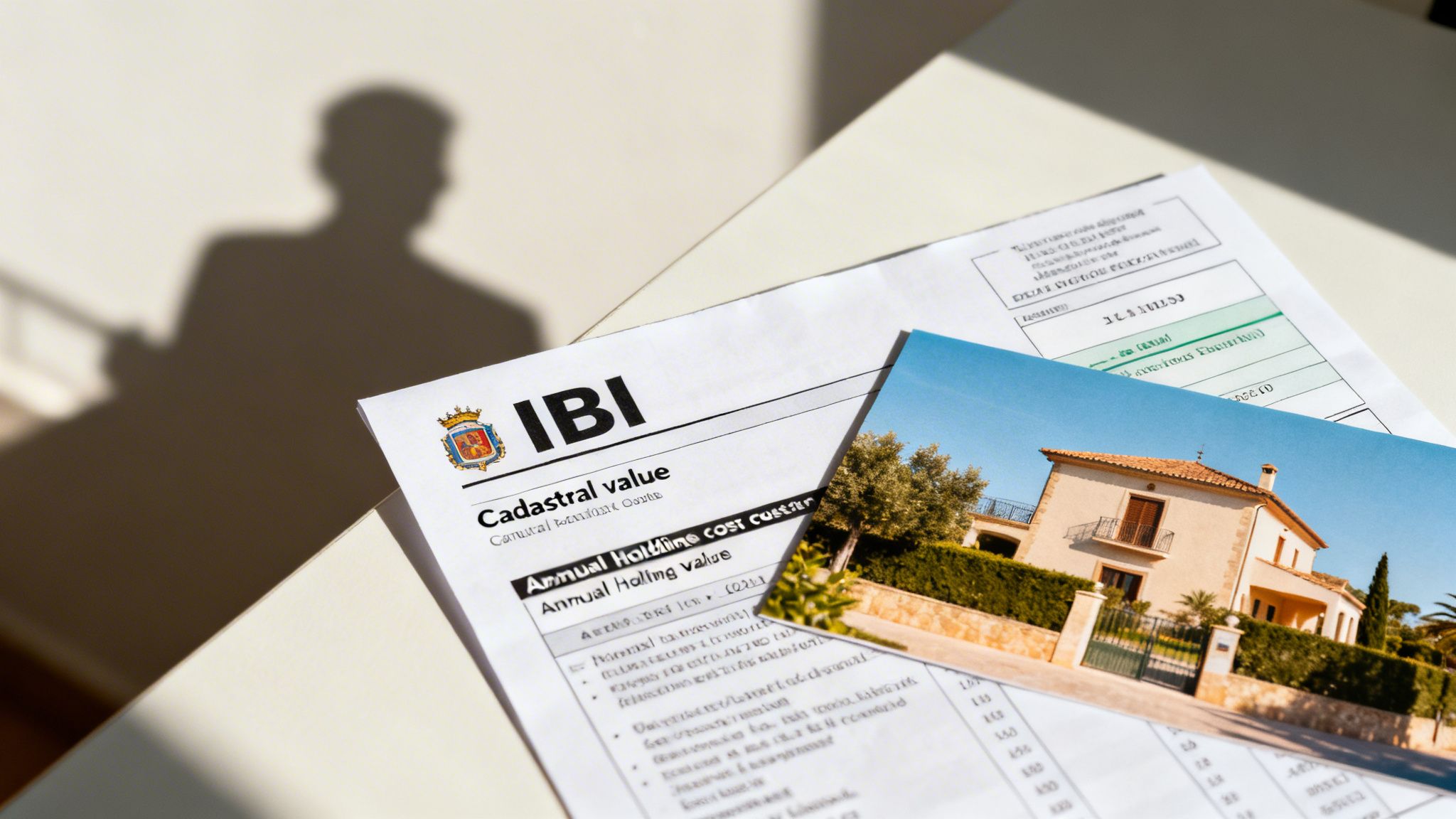
The first and most important annual tax to get familiar with is the Impuesto sobre Bienes Inmuebles (IBI). Think of it as the Spanish equivalent of council tax or property rates. Every single property owner in Spain, resident or not, pays this tax to their local municipality every year.
Your IBI bill is calculated based on the property’s valor catastral, or cadastral value. This isn't the price you paid for the property; it's an official administrative value set by the local town hall (ayuntamiento). In almost all cases, it’s significantly lower than the actual market value.
The valor catastral is the bedrock of your annual IBI calculation. It's a conservative figure, often updated every few years, that takes into account things like the size of your plot, the build quality, location, and the age of the property.
The actual tax rate applied to this value is decided by the local municipality, which means it can vary quite a bit from one town to the next.
Spain's IBI is the foundation of annual property taxes, a municipal charge every owner must pay based on the property's cadastral value, which is often 30% to 60% below market price. Rates typically sit around 0.4% for urban properties and 0.3% for rural ones, though municipalities can increase these up to 1.1% and 0.9% respectively. Studies show IBI can make up 25-35% of a property's total holding costs, yet its low percentage rate keeps it among Europe's more manageable annual taxes.
As a real-world example, the IBI on a luxury villa in a prime Marbella neighbourhood will likely be calculated at a higher rate than a modest apartment in a quiet Barcelona suburb, even if their market values are similar.
Taxes Specifically for Non-Residents
If you don't live in Spain full-time and aren't a tax resident, you have a couple of extra annual taxes to be aware of on top of the IBI. The Spanish tax authorities see the ownership of a property as a benefit that needs to be taxed, which creates two different scenarios for non-resident owners.
1. Imputed Income Tax for Personal Use
This one catches a lot of people by surprise. Even if your property stays empty all year and you never rent it out, you still have to pay a non-resident income tax. It's known as imputed income tax (Renta Imputada de Inmuebles Urbanos).
The logic here is that the government assumes you're getting a personal benefit just by having the property available for your own use—like a holiday home ready whenever you want it. So, the tax is calculated on a theoretical, or "imputed," income.
Here’s a quick breakdown of how it works:
- The tax base is a percentage of the cadastral value (1.1% if the value has been updated in the last 10 years, or 2% if it's an older valuation).
- A flat tax rate is then applied to that figure. For citizens of the EU/EEA, the rate is 19%. For everyone else, it's 24%.
It's essentially a tax on the potential to use your property, not actual cash in your pocket, and it’s a common point of confusion for new foreign buyers.
2. Rental Income Tax
Now, if you do decide to rent out your Spanish property, you’ll need to declare that income and pay tax on it. This is the Non-Resident Income Tax (Impuesto sobre la Renta de no Residentes, or IRNR).
You're taxed on your net rental income, which is the total rent you've received minus certain allowable expenses. The tax rates are the same as for imputed income: 19% for EU/EEA residents and 24% for all other non-residents.
There's a huge advantage here for EU/EEA residents. You can deduct a whole host of property-related expenses to lower your taxable income, such as:
- Mortgage interest payments
- IBI and other local taxes
- Community fees (gastos de comunidad)
- Home insurance premiums
- Maintenance and repair costs
Unfortunately, non-EU citizens usually get taxed on the gross rental income, with no option to deduct these expenses. This makes the tax burden significantly higher. For a broader perspective on the financial side of real estate, a detailed guide explaining the taxes on investment property can offer a solid foundation. These annual costs are a critical piece of the puzzle for your long-term financial planning.
Wealth Tax and Other Levies You Should Know About
Beyond the usual annual taxes, Spain has a couple of other levies that can pop up, especially if you're dealing with higher-value property. The big one to get your head around is the Wealth Tax, or Impuesto sobre el Patrimonio.
It’s easy to get this one wrong. Think of it less as a property tax and more as a tax on your total net worth in Spain. It's progressive, so the more your Spanish assets are worth, the higher the rate you pay. For anyone buying from abroad, figuring out how this might affect you is a critical part of long-term financial planning.
The tax is calculated on the net value of everything you own in Spain – property, cash in the bank, investments, even valuable art or cars. But here's where it gets interesting: while there's a national framework, each region gets to play by its own rules.
Wealth Tax Thresholds and Rates: A Moving Target
At a national level, the government gives everyone a tax-free allowance of €700,000. If your net assets in Spain fall below this line, you’re in the clear. Spanish residents often get an extra €300,000 allowance for their main home, but this generally doesn't apply if you're a non-resident buying a holiday property.
If you cross that threshold, a sliding scale of tax rates kicks in. The national rates for Spain's Net Wealth Tax (Impuesto sobre el Patrimonio), which was brought back in 2015, climb from 0.2% to 3.5%. However—and this is a big however—the regional governments can and do change these rates and allowances. You can dig into the finer details of these Spanish tax costs on globalpropertyguide.com.
This regional power creates a patchwork quilt of tax rules across the country, making your choice of location a central part of your tax strategy.
The Bottom Line: Wealth Tax is not a one-size-fits-all deal in Spain. The autonomous community where your property is located has the final word on what you pay, which can make a huge difference to your annual costs.
How Regions Can Make or Break Your Wealth Tax Bill
The differences between regions aren't just minor adjustments; they can be night and day. Some communities have essentially scrapped the tax, while others enforce it rigorously. This has created "tax-friendly" and "tax-heavy" zones within Spain.
Knowing the difference can save you a serious amount of cash every single year.
- Andalusia & Madrid: These regions are magnets for high-net-worth buyers because they offer a 100% relief on the Wealth Tax. You still have to file the paperwork if you’re over the limit, but your final bill is zero. Simple as that.
- Galicia: This region takes a middle-ground approach, offering a 50% reduction in your final tax bill—a pretty significant saving compared to the national standard.
- Catalonia & Valencia: These regions are on the opposite end of the scale. They tend to have higher rates and lower personal allowances (Catalonia’s is just €500,000), which can mean a hefty annual bill if you own valuable property there.
The real-world impact is stark. An investor with a €2 million property portfolio in Malaga (Andalusia) would pay exactly €0 in Wealth Tax. That same portfolio in Barcelona (Catalonia) could easily trigger a tax bill of several thousand euros.
The Small Stuff: Other Charges to Look For
While Wealth Tax gets most of the attention, you’ll likely see a few other small charges tacked onto your IBI bill. The most common one is the rubbish collection fee, known as the tasa de basuras.
This is just a small annual fee that your local town hall charges for waste disposal. It’s not going to break the bank—usually somewhere between €50 and €200 a year—but it’s another one of those little costs you need to budget for to avoid any surprises. It's always a good habit to scan your IBI receipt to see exactly what you’re paying for.
The Taxes You Face When Selling Your Spanish Home
When you decide it’s time to sell your property in Spain, the financial journey isn’t quite finished. Just like buying, selling comes with its own set of tax obligations. Understanding these final hurdles is the key to a smooth, profitable sale.
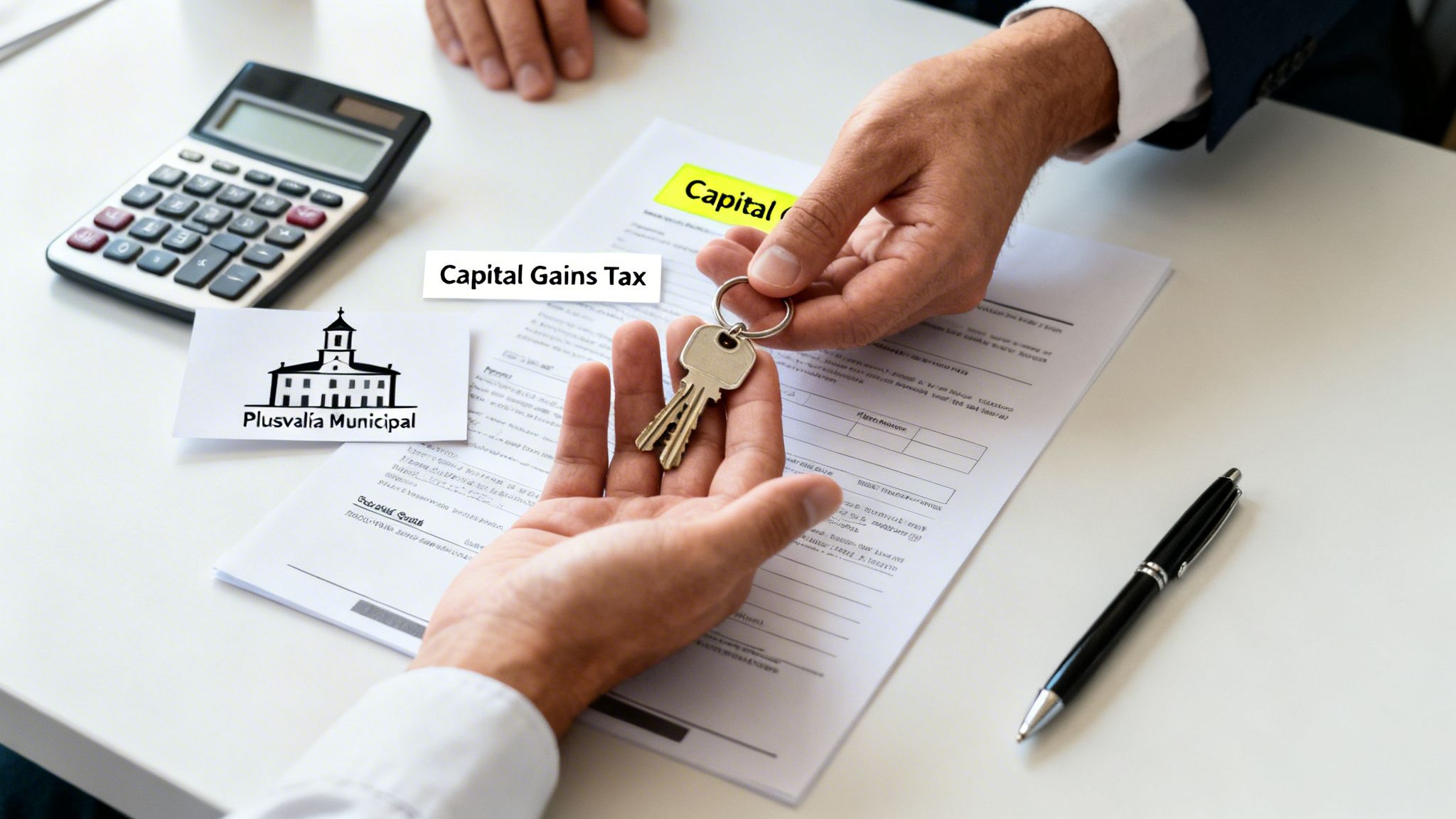
Two main taxes come into play at this final stage: a national tax on your profit, known as Capital Gains Tax, and a local tax on the increase in the land's value, called the Plusvalía Municipal. Let's break down what each one means for your bottom line so you can avoid any unwelcome surprises.
Capital Gains Tax: The Main Event
The biggest tax you'll encounter is Capital Gains Tax. For residents, it's the Impuesto sobre la Renta de las Personas Físicas, and for non-residents, it's the Impuesto sobre la Renta de No Residentes. Put simply, it’s a tax on the profit you’ve made.
The "gain" is the difference between your final sale price and what you originally paid. But it’s not quite that simple.
To get to your real taxable gain, the Spanish tax system allows you to deduct a whole host of expenses you incurred along the way. This reduces your official "profit" and, consequently, your tax bill.
Deductible costs typically include:
- The original price you paid for the property.
- All the taxes you paid during the purchase (like ITP or VAT).
- Fees for the notary and property registry.
- Legal fees and estate agent commissions from both the purchase and the sale.
- The cost of major improvements—think adding a swimming pool or a brand-new kitchen, but not routine maintenance.
Once you have that final profit number, a tax rate is applied based on your residency status.
- For Non-Residents: It’s straightforward. The tax is a flat 19% for EU/EEA citizens and 24% for everyone else, applied to the entire gain.
- For Residents: It works on a sliding scale. For 2024, the rates are 19% on the first €6,000 of profit, 21% on profit up to €50,000, 23% up to €200,000, and 26% on anything above that.
A Crucial Note for Non-Resident Sellers: The buyer of your property is legally required to withhold 3% of the total sale price and pay it directly to the tax office for you. This acts as a security deposit against your Capital Gains Tax bill, ensuring sellers don’t leave the country without settling their accounts.
Plusvalía Municipal: The Local Land Tax
The second tax to plan for is the Plusvalía Municipal. This is a much smaller tax handled by the local town hall (ayuntamiento). It’s not a tax on the building itself, but purely on the increase in the value of the land it sits on from the day you bought it to the day you sell it.
The calculation is based on the land's official value (valor catastral) and how many years you've owned it. This tax used to be pretty controversial, as town halls would often charge it even if the seller lost money on the sale.
Thankfully, a major court ruling changed that. If you can prove you sold your property for less than you paid, you are now completely exempt from paying the Plusvalía.
Sellers also now get two ways to calculate the tax and can pick whichever one results in a lower bill:
- The Objective Method: The old-school way, based on the cadastral value multiplied by a coefficient set by the town hall.
- The Real Gain Method: A newer option that calculates the tax based on the actual profit you made on the land, which is a huge help if your real gain was small.
A Worked Example: Putting It All Together
Let's see how this works in practice. Imagine you're a non-resident from the EU. You bought a property for €300,000 and, ten years later, sold it for €450,000.
- Sale Price: €450,000
- Total Purchase Cost: €300,000 (price) + €30,000 (taxes & fees) = €330,000
- Capital Gain: €450,000 - €330,000 = €120,000
- Capital Gains Tax (at 19%): €120,000 x 0.19 = €22,800
Your total Capital Gains Tax bill is €22,800. The buyer will have already paid the 3% retention on the sale price (€13,500) to the tax office. You would then file a tax return to pay the remaining balance of €9,300. For a more detailed look, you can explore the specifics of capital gains tax on foreign property in our dedicated guide.
On top of this, you would also need to settle your separate Plusvalía bill with the local town hall.
Smart Tax Planning for International Buyers
When it comes to Spanish property taxes, getting it right isn't about finding secret loopholes. It's all about smart, forward-thinking planning. If you make the right calls from the very beginning, you can seriously reduce your tax bill and make your investment work that much harder for you.
Let’s start with a common mistake I see people make: under-declaring the purchase price to shave a little off the initial Property Transfer Tax (ITP). It sounds tempting, I know. But the Spanish tax authorities are all over this, constantly checking property values. Get flagged, and you're looking at fines and back-taxes that will dwarf whatever you thought you were saving. It's a high-risk gamble that almost never pays off.
Foundational Strategies for Tax Efficiency
The biggest savings often come from the big decisions you make right at the start. How you structure the ownership and how well you keep your records will have a ripple effect for years to come.
One of the first things to consider is who, exactly, will own the property. Buying jointly with your spouse or partner is often a fantastic move. Why? Because it can help manage future Wealth Tax and Capital Gains Tax. By splitting the property's value, you can each use your own individual tax-free allowances, which could be enough to keep you both below certain tax thresholds altogether.
Next, you need to become a meticulous record-keeper. Seriously, from day one, save every single official piece of paper. This includes:
- The original purchase deed (the escritura)
- Receipts for all the taxes and fees you paid upfront (ITP/VAT, notary fees, etc.)
- Invoices for any major home improvements or reformas, like that new kitchen you installed or the pool you put in.
These documents are pure gold. When you eventually sell, the cost of those major improvements can be deducted from your profit, which directly lowers your Capital Gains Tax. No official receipts, no deduction. It's as simple as that.
Professional Guidance and Regional Advantages
Honestly, one of the best investments you can make is hiring a local tax advisor (a gestor) from the get-go. Their knowledge of the regional tax differences is invaluable, and they’ll point you toward local incentives and reliefs you’d never find on your own.
A good tax advisor does more than just file your annual returns. They’re your strategist. They’ll help you structure the purchase for maximum tax efficiency, walk you through the implications of residency, and keep you compliant, saving you from headaches and costly mistakes down the road.
Finally, never forget that Spain is not a monolith when it comes to taxes. The differences between regions like Andalusia and Catalonia can be night and day, especially for ITP, Wealth Tax, and inheritance tax. Your choice of location is, in itself, a powerful tax planning tool. For those with more complex financial situations, it's worth exploring advanced high net worth tax strategies to get a fuller picture of preserving wealth across international borders.
Your Top Questions About Spanish Property Taxes, Answered
Stepping into the Spanish property market, especially from overseas, naturally comes with a lot of questions about the financial side of things. It’s completely normal. To help clear things up, I’ve put together answers to the most common queries I hear from international buyers, so you can move forward with confidence.
Let's dive into the specifics that often trip people up.
Do I Still Pay Spanish Property Taxes If I'm a Non-Resident?
Yes, you absolutely do. Owning property in Spain means you have tax obligations here, regardless of where you live. As a non-resident owner, you'll be on the hook for two main annual taxes.
First, there's the local council tax, known as IBI (Impuesto sobre Bienes Inmuebles). Every single property owner in Spain, resident or not, pays this. Second is the national non-resident income tax. The tricky part here is that you have to pay this even if you don't rent out your property. In that case, the government calculates a fictional or "imputed" income based on your property's value and taxes you on that.
What's the Difference Between 'Valor Catastral' and Market Value?
This is a really important one to get your head around. The 'valor catastral' is the official value the government puts on your property for tax purposes—it’s what they use to figure out your annual IBI bill. Crucially, this value is almost always much lower than what the property is actually worth.
The market value, on the other hand, is simply what your home would sell for if you put it on the market today. The good news is that your annual IBI is calculated on the lower 'valor catastral', not the higher market price, which keeps the ongoing tax bill pretty reasonable.
A simple way to think about it: the 'valor catastral' is the taxman's conservative valuation, while the market value is the real-world price tag on your investment.
Are There Any Tax Breaks for Retirees Buying in Spain?
While there isn't a blanket "pensioner discount" just for buying a property or for your annual taxes, some very attractive benefits can kick in, especially if you become a tax resident.
For example, if you become a tax resident and later sell your main home, you could be completely exempt from paying any Capital Gains Tax if you are over 65 and meet a few other conditions. This is a massive saving that could put thousands back in your pocket. As always, this is where a good tax advisor earns their keep—get personalised advice.
How Can I Pay My Spanish Taxes from Abroad?
Paying your tax bills from another country is actually quite simple once you're set up. For those recurring annual taxes like IBI, the easiest and safest way is to set up a direct debit from a Spanish bank account. It just takes the stress out of it and ensures you never miss a deadline.
For the big, one-off taxes—like the ITP you pay when you buy or the Capital Gains Tax when you sell—your legal representative or 'gestor' in Spain will almost always handle the payment for you. They’ll do the calculations and make sure the right amount gets paid to the right place, on time.
Ready to find your perfect home in the sun? At Residaro, we simplify the process of discovering beautiful properties across Spain and Europe. Start your search today and make your dream of owning a European home a reality. Explore listings on Residaro.