How to Buy Property in Spain: A Practical Guide for Buyers
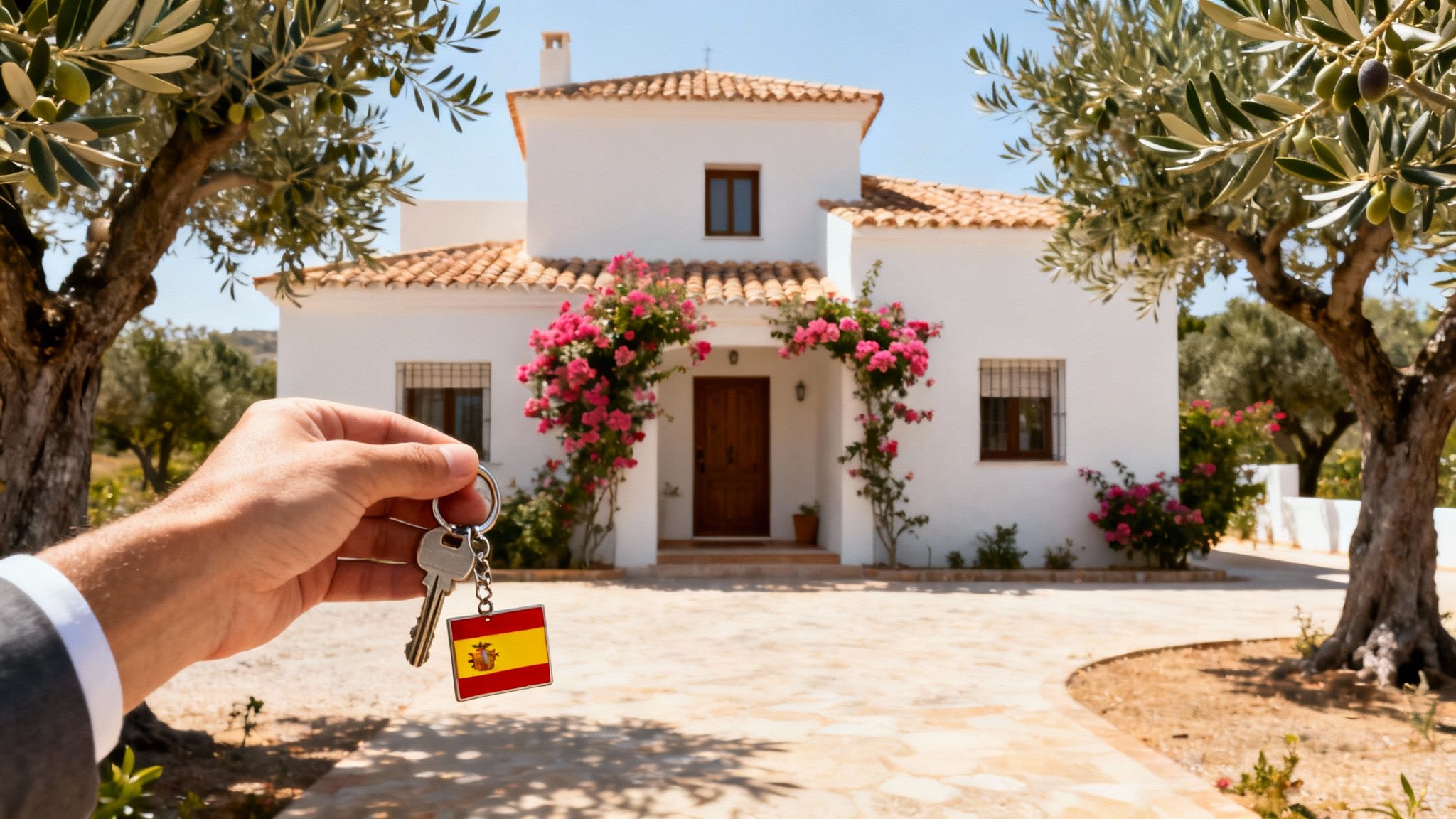
So, you're dreaming of a sun-drenched villa or a historic city apartment in Spain? You're not alone. I've guided countless international buyers through this exact journey, and I can tell you it's an exciting one.
In a nutshell, the process boils down to getting a Spanish tax number (the NIE), opening a bank account, finding your perfect spot, making an offer, doing your legal homework, and finally, signing the deed at the notary. We'll walk through every phase together, so you'll know exactly what to expect and can move forward with total confidence.
Your Spanish Property Journey Begins Here
Embarking on the quest for a Spanish home is a thrilling adventure. Every year, thousands of international buyers are drawn in by the promise of a Mediterranean climate, a more relaxed pace of life, and incredible value for their money. Spain really does offer an unbeatable quality of life.
But before you get lost picturing yourself sipping sangria on a sun-drenched terrace, it's wise to get a lay of the land.
Buying a property here is about more than just falling in love with a beautiful house. It means navigating a different legal system, understanding the local market, and knowing all the costs involved. This guide is designed to pull back the curtain on the entire process, making sure you’re fully prepared for what’s ahead.
Here's a quick look at the major milestones you'll hit:
- The Hunt: Pinpointing your ideal location and the type of property you want.
- Getting Official: Sorting out your NIE and opening a Spanish bank account—these are non-negotiable first steps.
- Making It Yours: Putting in an offer and signing a preliminary contract to lock it down.
- The Legal Deep Dive: This is where your lawyer earns their keep, checking for any hidden debts or legal skeletons in the closet.
- The Final Handshake: Signing the final deed (the Escritura) and getting the keys.
To give you a clearer picture of the entire timeline, here’s a high-level overview of the process.
Overview of the Spanish Property Buying Process
This table breaks down the key stages you'll go through from starting your search to holding the keys in your hand.
| Phase | Key Action | Estimated Timeline |
|---|---|---|
| Preparation & Search | Researching areas, obtaining your NIE number, and opening a bank account. | 1-3 months |
| Offer & Reservation | Making an offer and signing a reservation agreement with a small deposit. | 1-2 weeks |
| Due Diligence | Your lawyer conducts legal checks on the property's status, debts, and ownership. | 2-4 weeks |
| Private Purchase Contract | Signing the Contrato de Arras, which legally commits both parties, and paying a 10% deposit. | Within 30 days of offer |
| Completion | Signing the final deed (Escritura de Compraventa) at the notary's office and making the final payment. | 1-3 months after the private contract |
| Post-Purchase | Registering the property, setting up utilities, and arranging tax payments. | Ongoing |
While every purchase is unique, this gives you a solid framework for what to expect along the way.
Understanding The Current Market
The Spanish property market has been on quite a run, showing incredible resilience and growth since recovering from the 2008 crisis. Much of this momentum is fueled by international buyers just like you.
Recent figures tell a compelling story. In Q2 2025, average national house prices hit around €2,093 per square metre. That’s a 10.4% jump from the previous year—the fastest growth spurt we’ve seen since 2006. For a bit of perspective, a standard 90 m² apartment now averages about €188,000. Keep in mind, though, that prices in prime coastal spots and major cities can easily be 20–50% higher.
For buyers, this signals a competitive market. Desirable properties in sought-after areas don't hang around for long. If you want to dive deeper into the trends, the Spanish property price history on Global Property Guide is an excellent resource for historical data.
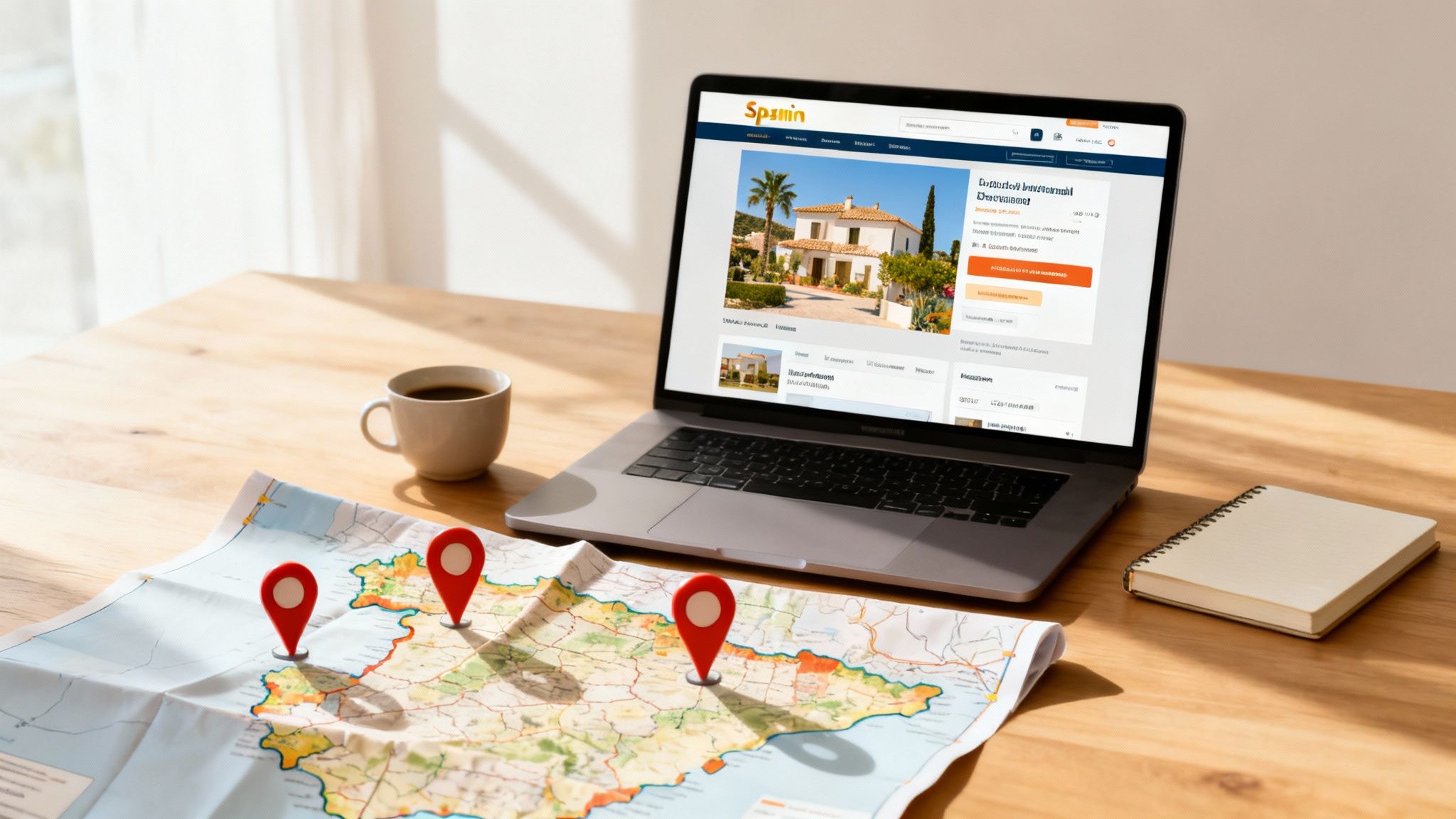
When you're ready to start your search, platforms like Residaro are a fantastic starting point. They have extensive listings that cover all of Spain’s most popular regions.
Their search tools let you filter by location, property type, and price, which really helps you get a feel for what your budget can buy in different parts of the country. This initial online exploration is a crucial first step—it’s where your dream starts to take shape.
Finding and Securing Your Dream Spanish Home

Alright, this is where the real fun begins. You've done the prep work, your finances are lined up, and you're ready to move from daydreaming on property portals to actively hunting for your home in the sun. It’s the hands-on phase where your vision starts to become a reality.
This is the perfect time to use a platform like Residaro to your advantage. It lets you slice and dice the market with precision, filtering by the exact location, property type, and budget you’ve decided on. Whether you're chasing a modern villa with sea views on the Costa del Sol or a classic apartment in Barcelona's Gothic Quarter, a good search tool will help you cut through the noise and create a shortlist of genuine contenders.
Finding a Region That Fits Your Life
Choosing the right region is just as crucial as picking the right house. Spain is incredibly diverse, and where you land will define your day-to-day experience. Think about what you truly want.
- Sun, Sea, and Social Life? The Costa del Sol and the Balearic Islands (think Mallorca and Ibiza) are classics for a reason. They boast vibrant expat communities, stunning beaches, and an endless social calendar.
- Culture and City Buzz? If you crave art, history, and world-class food, the big cities like Barcelona, Madrid, or Valencia deliver an incredible urban lifestyle packed with energy and convenience.
- Authentic Charm and Better Value? Head inland in Andalusia, or explore regions like Murcia and parts of the Costa Blanca. Here you'll often find a more traditional Spanish way of life and, frankly, more property for your money. For a closer look at affordable spots, our guide on cheap houses in Spain is a great resource.
It's also smart to get a feel for the market's pulse. Spain is experiencing a persistent supply-demand imbalance, which definitely affects your search and negotiating power. In the first eight months of 2025 alone, 469,960 homes were sold—that's a 16.1% jump from the previous year. While new-build sales shot up 26.1%, construction is still racing to keep up with demand from locals and the 50,000 annual net purchases by non-residents. In hot spots, this means you need to be ready to move decisively when you find the right place.
Making an Offer and the Reservation Agreement
You've found it. The one. What's next? You make a formal offer, or 'oferta'. This is almost always done through the real estate agent, who relays your price and any conditions to the seller. Don't be shy about negotiating; it's a completely normal part of the process.
Once your offer is accepted, you’ll typically sign a reservation agreement ('contrato de reserva') to secure the property. This involves paying a small holding deposit, usually between €3,000 and €6,000, which takes the property off the market. This gives your lawyer a crucial window to start their due diligence.
Insider Tip: The reservation deposit is usually held by the agent or the seller's lawyer. Make absolutely sure the agreement states that your deposit is fully refundable if the legal checks turn up any deal-breaking issues.
The All-Important Private Purchase Contract
The next major milestone is signing the private purchase contract, known in Spain as the 'contrato de arras' or 'contrato privado de compraventa'. This isn’t just a formality; it's a legally binding agreement that locks in the terms and commits both you and the seller to the sale.
When you sign this contract, you'll pay the main deposit—almost always 10% of the purchase price, less the reservation fee you’ve already paid.
The 'contrato de arras' contains a powerful clause called the 'arras penitenciales'. This is designed to protect both parties, and it has real teeth:
- If you, the buyer, back out of the deal for reasons not covered in the contract, you lose your entire 10% deposit.
- If the seller backs out, they are legally obligated to pay you double your deposit back as compensation.
This contract nails down every critical detail—the final price, the completion deadline, and a full description of the property—giving everyone the security they need to proceed to the final step: signing at the notary.
Getting Your Spanish Paperwork and Finances in Order
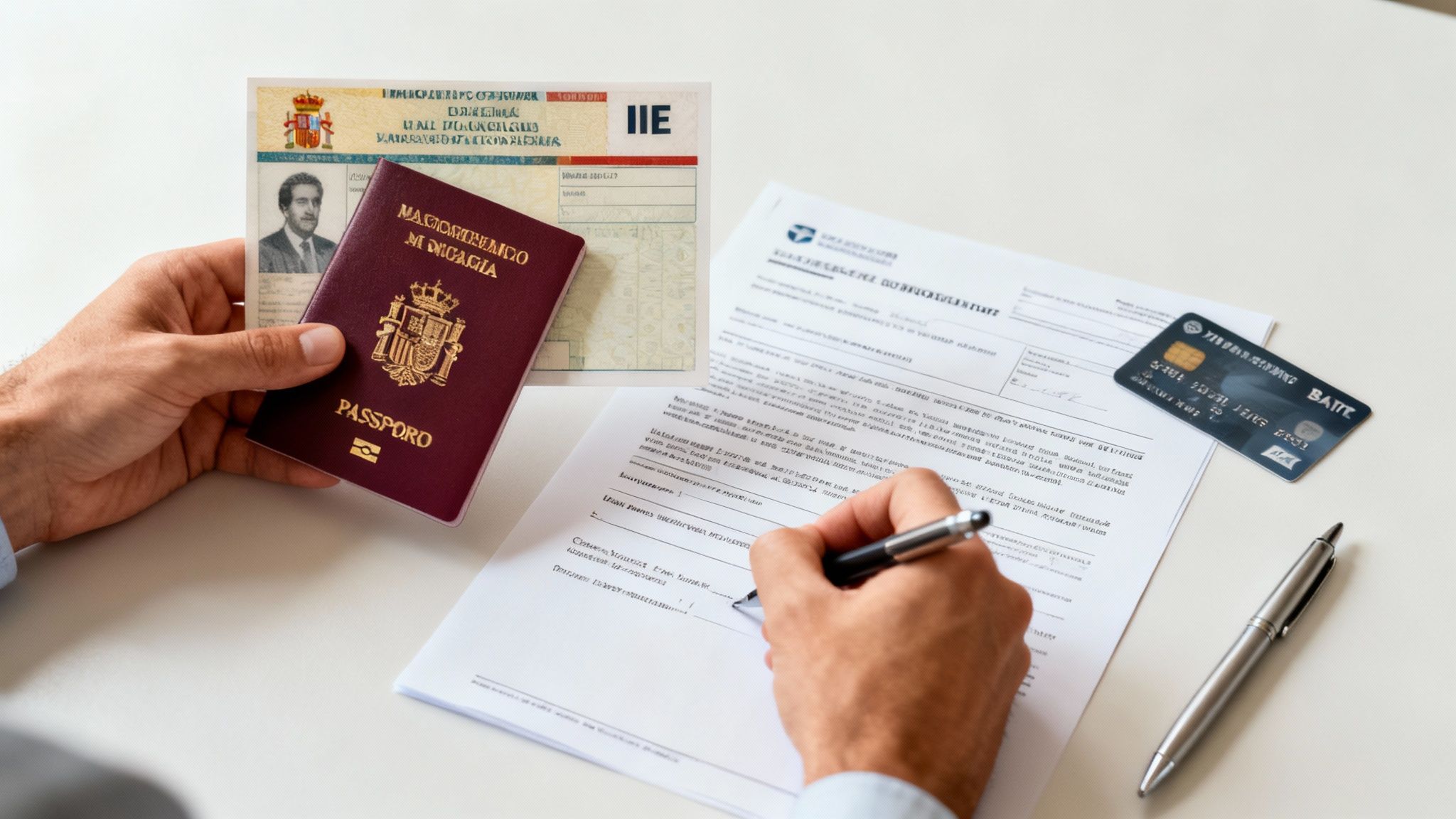
Once you've found a property you love and have a reservation agreement in place, the real work begins. The focus shifts from viewings and negotiations to the nitty-gritty of legal and financial prep. This is where being organised really pays off, turning a potentially complex process into a smooth path to getting your keys.
Before any major contracts are signed or large sums of money change hands, there are a few foundational pieces you absolutely must have in place.
The Essentials: Your NIE and Bank Account
First things first: you need a Número de Identificación de Extranjero (NIE). This is your unique foreigner identification number, and it’s non-negotiable. Without it, you can't buy property, sign contracts, pay taxes, or even get utilities connected. Think of it as your golden ticket for any official business in Spain.
Getting your NIE should be your top priority, as delays here can bring everything to a halt. You've got a few ways to get it done:
- Apply from home: The easiest way to get ahead is to apply at your nearest Spanish Consulate or Embassy before you even travel.
- Apply in Spain: You can do this at a designated national police station (Oficina de Extranjería), but you'll need an appointment (cita previa), and the wait times can be notoriously long.
- Use a representative: This is often the most painless route. You can grant Power of Attorney (Poder) to a lawyer in Spain, who can then handle the entire application for you.
You'll also want to open a Spanish bank account. While not a strict legal requirement for the purchase itself, it's a practical necessity. It makes transferring funds, paying taxes, and setting up direct debits for things like water and electricity infinitely simpler down the line.
Sorting Out Your Financing
Unless you're a cash buyer, securing a mortgage is the next major hurdle. Spain’s mortgage market is open to foreigners, but the rules are different if you're not a resident.
The biggest difference for non-resident buyers is the loan-to-value (LTV) ratio. Spanish banks play it safe with international clients and will typically only finance 60-70% of the property’s appraised value or purchase price—whichever is lower. This means you need a hefty cash deposit of 30-40%, plus another 10-15% on top to cover taxes and fees.
Expert Insight: It’s critical to understand that Spanish banks lend based on the lower of two figures: the official purchase price or their independent valuation (tasación). If the bank's valuation comes in below what you agreed to pay, they'll only lend against that lower number, and you'll have to make up the difference.
When you apply, be ready for a deep dive into your finances. The bank will want to see everything. For a closer look at what to expect, check out our guide to mortgage rates in Spain.
You’ll almost certainly be asked for:
- Your shiny new NIE certificate
- Proof of income (recent payslips, tax returns)
- A current credit report from your home country
- Several months of bank statements
- The property reservation agreement
Why a Good Lawyer is Your Best Investment
Hiring an independent lawyer (abogado) who lives and breathes Spanish property law is the smartest money you'll spend. They work for you and you alone, protecting your interests and making sure your purchase is legally sound and free from nasty surprises.
Their main job is to perform thorough due diligence. This is a deep investigation into the property's legal status, and it includes a few critical checks:
- Checking for Debts and Ownership: Your lawyer will pull a 'Nota Simple' from the Land Registry (Registro de la Propiedad). This document confirms who legally owns the property and, more importantly, reveals if there are any mortgages, liens, or debts attached to it. In Spain, debts follow the property, not the owner, so this step saves you from inheriting someone else's problems.
- Verifying Planning Permissions: They’ll check with the local town hall (Ayuntamiento) to ensure the property was built legally and doesn't have any planning violations. This is absolutely essential for rural homes or properties that have been extended.
- Confirming Taxes are Paid: They will also verify that all property taxes, like the annual IBI, are paid up to date.
Your lawyer will also review every contract, translate the legal jargon, and stand by your side at the notary when you sign on the dotted line. Their expertise is what provides true peace of mind, ensuring your Spanish dream doesn't become a legal headache.
Understanding the Costs Beyond the Purchase Price
When you’re buying property in Spain, one of the biggest shocks for international buyers is realizing the price on the listing is just the starting point. It’s easy to focus on that big number, but the reality is you'll need to account for a whole slew of taxes and fees on top.
A good rule of thumb I always give my clients is to budget an extra 10-15% of the property's purchase price to cover everything. Overlooking this can throw a serious wrench in the works right when you’re about to close.
The Two Big Property Taxes: Resale vs. New-Build
The single largest cost you'll face is the property tax, and what you pay hinges on one simple question: are you buying a pre-owned home or one straight from a developer?
-
Resale Properties (Segunda Mano): For any existing home, you're looking at the Property Transfer Tax, or Impuesto de Transmisiones Patrimoniales (ITP). This tax is set at the regional level, so the rate changes depending on where you buy. It typically falls between 6% and 10%. For instance, Andalusia currently has a flat 7% rate, while Valencia uses a sliding scale that can go up to 10%.
-
New-Build Properties (Obra Nueva): If you’ve got your eye on a brand-new home, you'll pay a national rate of 10% VAT (Impuesto sobre el Valor Añadido, or IVA). But that's not all. You'll also have to pay Stamp Duty (Actos Jurídicos Documentados, or AJD), another regional tax that usually adds another 1% to 1.5%.
Budgeting for this is more critical now than ever. The Spanish property market is heating up, with some reports showing national resale prices grew by 12.7% year-on-year in the second quarter of 2025—the strongest growth we've seen in nearly two decades. If you're looking in a hot market like Madrid or Valencia, that means a €300,000 budget could buy you 10-15% less property in just a year's time. You can read more about these Spanish property market forecasts on propertyfinder.bg.
Other Essential Fees You Can't Forget
Once you've factored in the main tax, there are several other professional fees you need to plan for. They might seem small individually, but they add up fast.
Here’s what else you need to have covered:
- Notary Fees (Notaría): The notary is a public official who legally witnesses the signing of the final deed (Escritura). Their fees are set by a government scale based on the property's price, usually coming in between 0.5% and 1%.
- Property Registry Fees (Registro de la Propiedad): After you sign, the deed needs to be officially registered in your name at the local Land Registry. This fee is also tied to the property price and typically costs between 0.4% and 0.8%.
- Legal Fees (Abogado): Honestly, hiring a good, independent lawyer is the best money you'll spend. They handle all the due diligence, check the contracts, and make sure your investment is safe. Expect their fees to be around 1% to 1.5% of the purchase price.
For a deeper dive into these costs, check out our complete guide to property taxes in Spain, where we break down every single expense you can expect.
A Real-World Example: On a €300,000 property, you can expect to pay between €3,000 and €4,500 for your lawyer. It might feel like a lot, but it’s a small price for the peace of mind you get knowing an expert has your back and your new home is free of any nasty surprises.
To give you a clearer picture of how these costs stack up, let’s compare a resale and new-build purchase for a €300,000 property. We'll assume the region has an 8% ITP rate for resales and a 1.5% AJD for new-builds.
Estimated Buying Costs for a €300,000 Spanish Property
| Cost Item | Resale Property (ITP @ 8%) | New-Build Property (IVA @ 10% + AJD @ 1.5%) |
|---|---|---|
| Main Tax | €24,000 | €30,000 (IVA) + €4,500 (AJD) = €34,500 |
| Notary Fees (est. 0.75%) | €2,250 | €2,250 |
| Registry Fees (est. 0.6%) | €1,800 | €1,800 |
| Legal Fees (est. 1.2%) | €3,600 | €3,600 |
| Total Closing Costs | €31,650 | €42,150 |
| Total Outlay | €331,650 | €342,150 |
As you can see, the final bill for the same priced property can differ by over €10,000. Getting these numbers straight from the start means you’ll walk into the notary's office on closing day with confidence, not last-minute financial panic.
The Final Steps and Life After Purchase
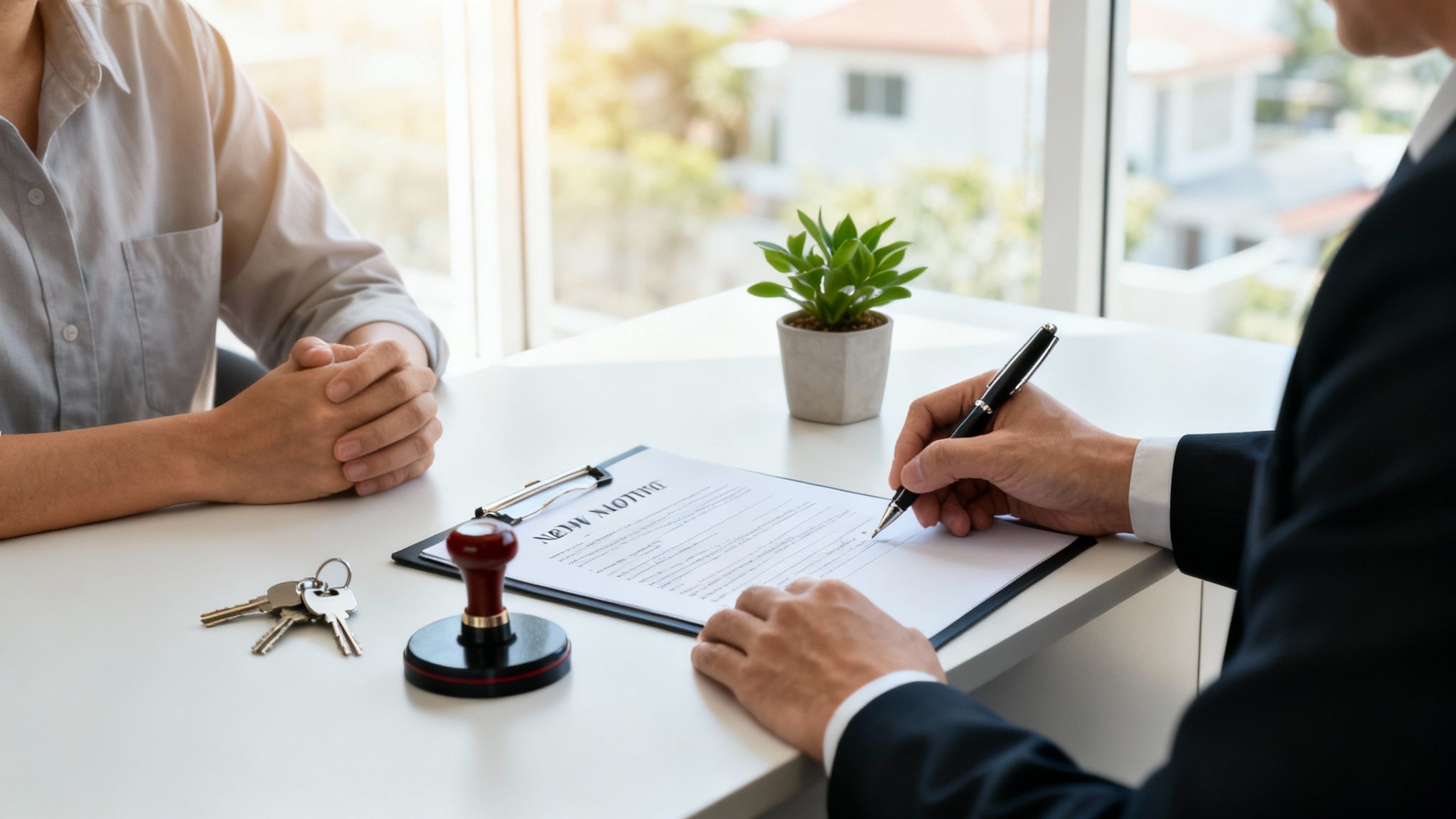
After what can feel like an eternity of searching, negotiating, and navigating paperwork, the day you’ve been waiting for finally arrives: completion day at the notary's office. This is where your dream of owning a home in Spain becomes a legal reality.
It's a formal affair. You (or your lawyer with power of attorney), the seller, and often a bank representative will all gather to sign the final deed.
Sealing the Deal at the Notary
The central figure here is the public notary (notario). They aren't just a witness; they are a state-appointed legal expert who ensures the entire transaction is above board. The notary confirms everyone's identity and verifies that the sale complies with all Spanish laws.
They will read the final deed, the 'Escritura de Compraventa', out loud to make sure every detail is perfect before anyone signs. Once all the signatures are on the page, you'll make the final payment to the seller, usually with a Spanish banker's draft.
And just like that, the keys are in your hand. You are officially a homeowner in Spain.
Your New Responsibilities as a Homeowner
That incredible feeling of holding the keys is a major milestone, but a few crucial steps remain. Your lawyer will immediately get to work paying the necessary property taxes and, most importantly, registering your new title at the Land Registry (Registro de la Propiedad). This is the final act that officially secures your ownership in the eyes of the law.
Now, your attention needs to shift to the recurring costs of homeownership. It's vital to understand these from the get-go to avoid any surprises down the line.
Here are the main ongoing expenses you'll need to budget for:
- Community Fees (Gastos de Comunidad): If you've bought an apartment or a villa in an urbanización with shared amenities, you'll have monthly or quarterly fees. These cover the maintenance of common areas like pools, gardens, elevators, and hallways.
- Annual Property Tax (Impuesto sobre Bienes Inmuebles - IBI): This is a local tax paid every year to your town hall (Ayuntamiento). The amount is calculated based on the property’s official cadastral value (valor catastral) and typically ranges from 0.4% to 1.1% of that value.
- Non-Resident Income Tax (Impuesto sobre la Renta de no Residentes - IRNR): This one often catches new owners by surprise. Even if you don't rent out your property, the Spanish tax authorities consider you to have an "imputed income" just from owning it. This is taxed annually at a rate of 24% (for non-EU/EEA residents) on a tiny percentage (1.1% to 2%) of the cadastral value.
Key Takeaway: Budgeting for these ongoing costs is just as important as budgeting for the purchase itself. I always recommend clients work with a local accountant (gestor) who can handle these annual tax filings and ensure you stay compliant. It's a small price to pay for peace of mind.
Settling In and Managing Your Property
With the legal side wrapped up, it's time for the fun part: making the house a home. The first practical task is getting the utilities switched over. Your lawyer or real estate agent can be a huge help here, assisting with transferring the electricity (luz), water (agua), and gas contracts into your name. You'll need your NIE and a Spanish bank account to set up the required direct debits.
You’ll also need to register for the rubbish collection tax (tasa de basura), another small annual fee paid to the town hall. Don't forget to schedule your internet and phone installation—it can sometimes take a few weeks to get an appointment.
For anyone who won't be living in Spain full-time, a property management company is an absolute game-changer. These services are designed to give you complete peace of mind when you're not around.
A good property manager will:
- Keep a spare set of keys for emergencies.
- Perform regular property checks for security and maintenance issues.
- Arrange cleaners, gardeners, and pool maintenance.
- Manage rental bookings and guest relations if you decide to let the property.
Hiring a manager transforms your property from a potential source of stress into a true-to-life holiday home. You can simply land in Spain, unlock the door, and start enjoying your time, confident that everything is being professionally handled. This smooth landing is the final piece of the puzzle in mastering how to buy property in Spain.
Common Questions from Foreign Buyers in Spain
Buying property in another country always comes with a learning curve, and Spain is no exception. Over the years, we've helped countless international buyers navigate the process, and we've noticed the same key questions pop up time and time again. Here are the answers to some of the most common queries we hear.
Do I Need to Be in Spain to Get an NIE Number?
Not at all. This is a common misconception that can add a lot of unnecessary stress to the process. You can actually get a major head start from your home country.
The most direct route for many buyers is to apply for your Número de Identificación de Extranjero (NIE) at the nearest Spanish Consulate. Just book an appointment, and you can get the paperwork rolling before you even pack your bags for a viewing trip.
An even more efficient method, and one I often recommend, is granting a Power of Attorney ('Poder') to your lawyer in Spain. This simple legal document allows them to handle the entire NIE application on your behalf. It’s a fantastic way to save a trip and let an expert deal with the bureaucracy while you focus on finding the right home.
What's the Real Difference Between Buying a Resale and a New-Build?
When you’re weighing a resale property against a brand-new one, it really boils down to two things: the taxes you’ll pay and the condition of the home.
-
Resale Property ('Segunda Mano'): With a pre-owned home, you'll pay the Property Transfer Tax (ITP). This tax is set by the regional government, so it varies across Spain but generally falls between 6% and 10% of the purchase price. The big advantage here is that you're often buying into established neighborhoods with unique character, though you might need to budget for some updates.
-
New-Build Property ('Obra Nueva'): If you buy a sparkling new home directly from a developer, you're looking at a national rate of 10% VAT (IVA), plus 1% to 1.5% in Stamp Duty (AJD). In exchange, you get a modern, turnkey property built to the latest codes, often with a structural guarantee—a huge plus for peace of mind.
Ultimately, your choice depends on what matters most to you: the charm and location of an older home or the modern convenience of a new one.
Can I Rent Out My Spanish Property? And What About Taxes?
Absolutely! Renting out your property is a great way to generate income, but it's vital to get the tax side of things right from the start.
How your rental income is taxed depends on where you're a tax resident. For EU/EEA citizens, the tax rate is a manageable 19% on the net rental income (meaning you can deduct eligible expenses like maintenance and community fees). For non-EU/EEA citizens, the rules are much stricter: you'll be taxed at 24% on the gross rental income, with no deductions allowed.
It's also critical to know that these tax returns must be filed quarterly, not annually. To avoid any headaches, I always advise clients to work with a local Spanish accountant, or 'gestor'. They know the system inside and out and can save you a world of trouble.
What Is a Nota Simple and Why Is It So Important?
Think of the 'Nota Simple' as the official biography and health check for a property, all in one document. It’s a report issued by the Spanish Land Registry (Registro de la Propiedad) that gives you a complete legal picture of the property you want to buy. Your lawyer getting and scrutinizing this document is one of the most crucial parts of the entire purchase.
The Nota Simple confirms several non-negotiable details:
- Who actually owns it: It verifies that the seller is the legally registered owner.
- What you're buying: It provides the official description, registered size, and boundaries.
- If there are hidden problems: Most importantly, it exposes any outstanding mortgages, debts, or liens attached to the property.
Remember, in Spain, debts follow the property, not the owner. Without this check, you could unknowingly inherit the previous owner's mortgage or unpaid taxes. The Nota Simple is your best defense to ensure you’re buying a clean, problem-free asset.
Ready to turn your dream of owning a home in Spain into a reality? Start your search with Residaro. Our platform offers an extensive selection of properties across Spain's most desirable regions, making it easy to find your perfect match. Discover your future home today.