A Guide to Mortgage Rates in Spain for Expats
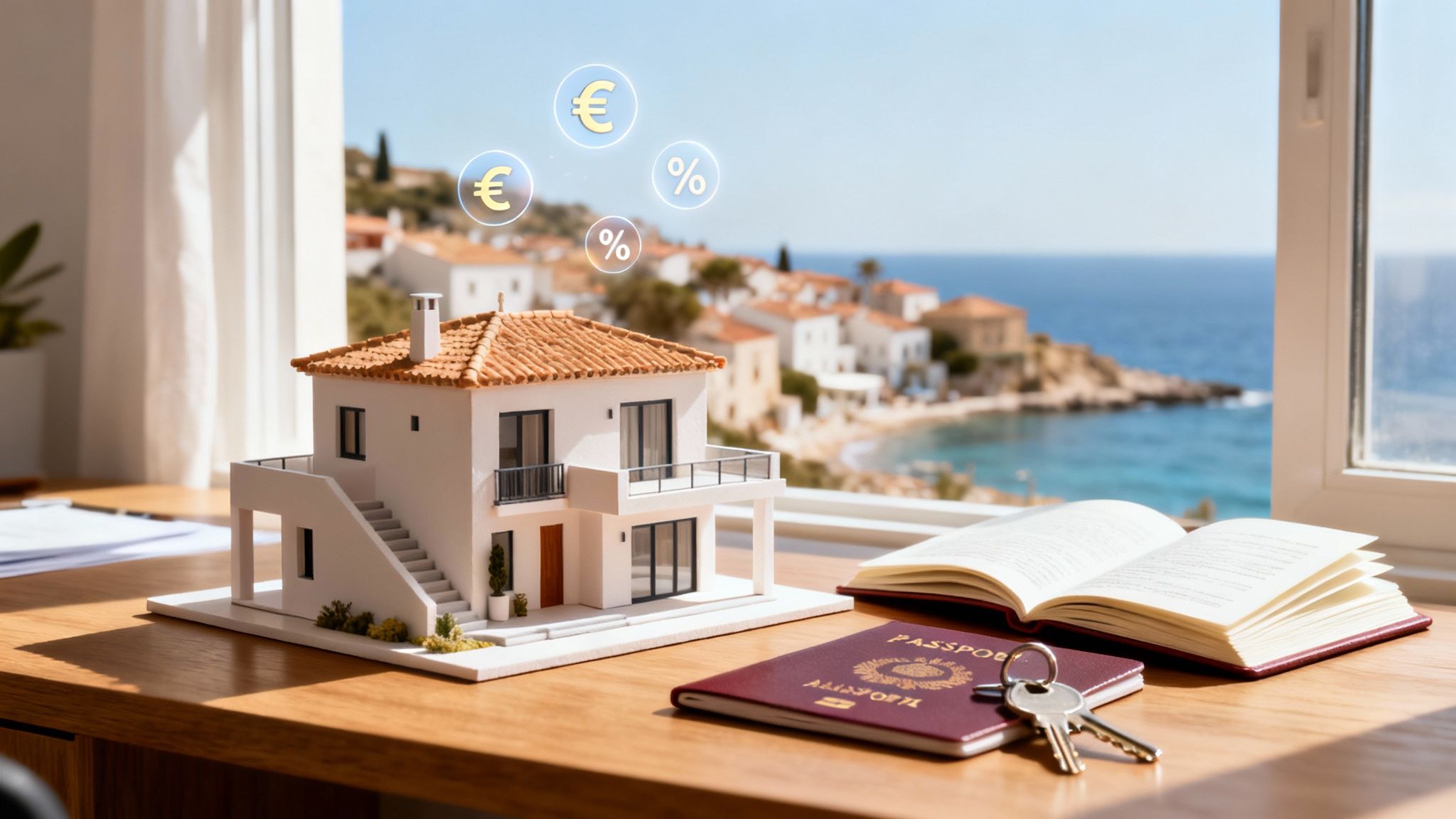
Right now, if you're looking for a mortgage in Spain, you can expect to see rates hovering somewhere between 3.0% and 4.5% for fixed-rate deals. Of course, variable rates are a different story, as they move up and down with the Euribor index, plus whatever margin the bank adds on.
Ultimately, the choice between locking in a predictable payment and betting on future savings comes down to your own financial outlook and how much risk you're comfortable with.
Understanding the Spanish Mortgage Landscape

Picking a mortgage in Spain is about more than just chasing the lowest percentage. It's about figuring out which type of loan fits your life and long-term plans. The Spanish market really boils down to three main choices: fixed, variable, and mixed-rate mortgages.
Think of it like this: a fixed rate is like paying for an all-inclusive holiday. You know exactly what it will cost from day one, which makes budgeting a breeze. A variable rate, on the other hand, is more like a pay-as-you-go plan—your costs could drop, but they could also climb.
A Look at Recent Trends
The mortgage scene in Spain has been on a bit of a rollercoaster, thanks to wider European economic shifts. We saw rates dip below an incredible 1.5% near the end of 2021. Then, as inflation kicked in, they shot back up, averaging 3.46% by the second quarter of 2024. For international buyers using tools like Residaro to navigate the market, this uncertainty has made the stability of fixed-rate mortgages much more appealing.
If you're a data person, you can dig into the historical numbers with Statista's analysis of Spanish mortgage rates.
This constant movement really drives home how crucial it is to choose the right mortgage type from the start. What you decide now will shape your monthly budget for years to come.
Here's a simple way to frame it: A fixed rate buys you peace of mind. A variable rate offers a gamble on potential future savings if market rates fall. Your choice really says a lot about whether you prefer certainty or are willing to play the odds.
To make that decision easier, let's unpack the core options you'll find. Getting a handle on these is the first real step in your property journey.
Comparing Your Mortgage Options
The table below gives you a quick, at-a-glance comparison of the main mortgage types you'll come across in Spain. Use it to get a feel for their basic mechanics and see which one aligns best with your financial personality.
Spanish Mortgage Types at a Glance
| Mortgage Type | How It Works | Best For |
|---|---|---|
| Fixed Rate | The interest rate is locked in for the entire loan term. Your monthly payment never changes. | Buyers who crave predictability and want to protect themselves from any future interest rate hikes. |
| Variable Rate | The interest rate is made of two parts: the Euribor index plus a fixed bank margin. It’s reviewed every 6 or 12 months. | Buyers with a higher risk tolerance who are betting that interest rates will eventually go down, lowering their payments. |
| Mixed Rate | It’s a hybrid. You get a fixed rate for an initial period (usually 3-10 years), then it switches to a variable rate. | Buyers who want stability for the first few years but are okay with rates changing later on in the loan's life. |
Each option has its place, and the best one for you depends entirely on your financial situation and how you see the future unfolding.
What Really Drives Mortgage Rates in Spain
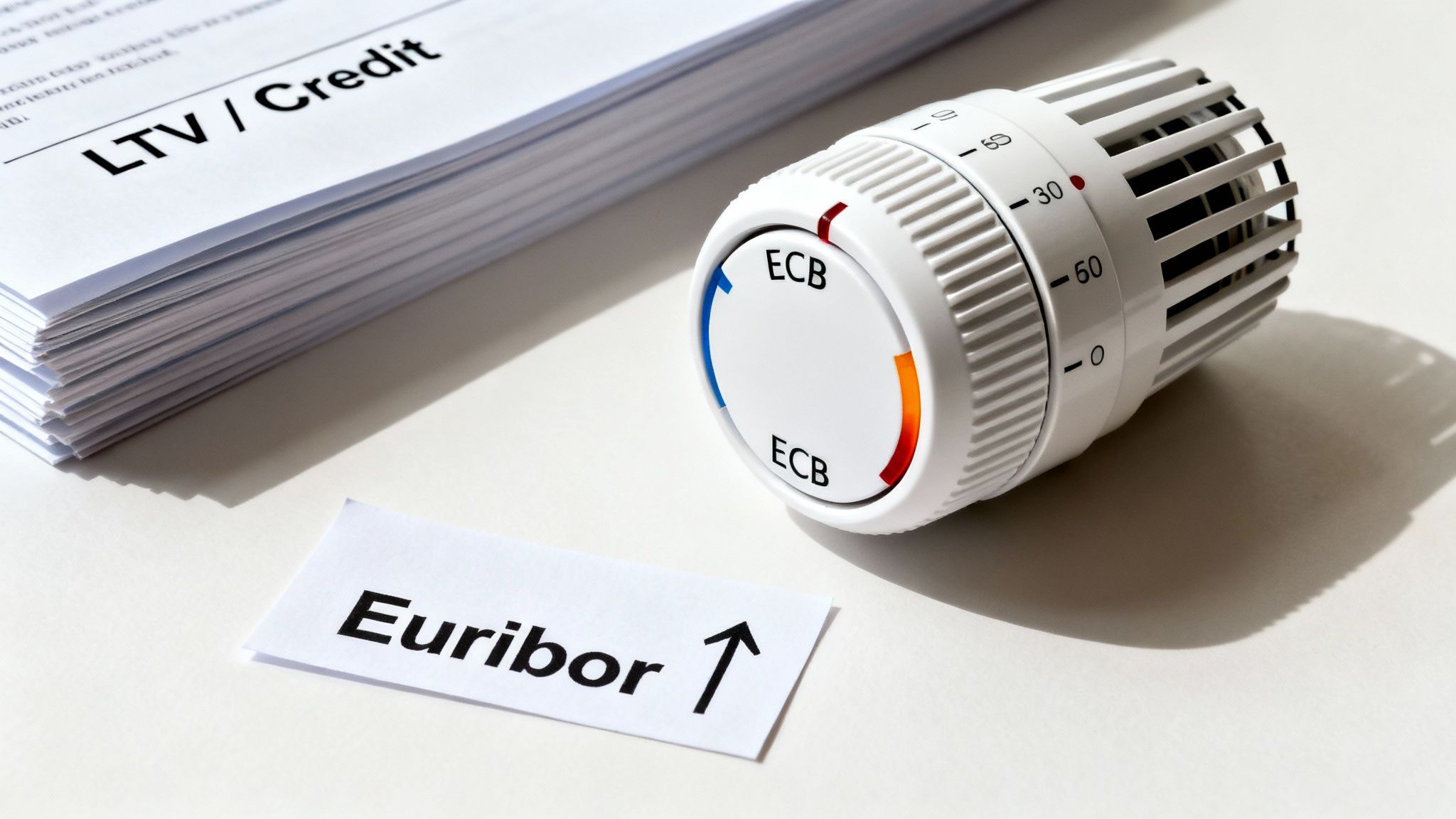
Trying to figure out why mortgage rates in Spain go up and down can feel a bit like trying to predict the weather. One minute it’s calm, the next it’s stormy. The secret is to look past the final number a bank offers you and understand the powerful forces at work behind the scenes.
It really boils down to three main things: a massive European benchmark rate, the economic policies coming out of the European Central Bank (ECB), and, of course, your own financial situation. These three elements come together to create the exact rate you’ll be offered.
Euribor: The Heartbeat of Spanish Mortgages
The single most important factor for variable-rate mortgages here is the Euribor, which stands for the Euro Interbank Offered Rate. Just think of it as the wholesale cost of money for banks in the Eurozone. It’s the interest rate at which major European banks lend cash to one another.
So, when that wholesale cost goes up, the price that Spanish banks charge you for a variable mortgage goes up, too. And when Euribor drops? Your monthly payments can get cheaper. This is exactly why anyone with a variable mortgage in Spain keeps a close eye on Euribor updates—it hits their wallet directly.
Because so many mortgages in Spain are tied to this rate, our housing market is especially sensitive to its every move.
The European Central Bank: Setting the Economic Temperature
If Euribor is the market's pulse, then the European Central Bank (ECB) is the one controlling the thermostat for the entire Eurozone economy. The ECB's main job is to keep prices stable, which usually means keeping inflation in check.
When the economy is running too hot and inflation is climbing, the ECB steps in and raises its key interest rates. This makes borrowing more expensive for commercial banks, which pushes up the Euribor and, you guessed it, the mortgage rates offered to you and me.
On the flip side, when the economy needs a jump-start, the ECB cuts rates to make borrowing cheaper, encouraging spending and investment. This typically leads to lower mortgage costs.
The ECB doesn't set your mortgage rate directly, but its policy decisions create a massive ripple effect. An ECB rate hike is like turning up the heat under a pot of water—it gradually raises the temperature of the entire financial system, eventually boiling over into the loan rates we all see.
This is exactly what happened recently. Those sharp rate hikes from 2022 onwards were a direct response to soaring inflation across Europe.
Your Financial Profile: The Personal Factor
While big market forces set the general range for mortgage rates in Spain, the specific offer you get comes down to one thing: you. At the end of the day, banks are just assessing risk. How likely are you to pay back the loan?
They’ll look at your financial health from a few different angles:
- Income Stability: Lenders want to see a steady, reliable income that can easily cover your mortgage payments each month.
- Credit History: A clean credit report from your home country goes a long way in proving you’re financially responsible.
- Existing Debt: If you’re already carrying a lot of other debt, it can limit how much more a bank is willing to lend you.
A strong financial profile makes you a low-risk borrower in the bank’s eyes, and they’ll be much more likely to offer you a better deal.
The Power of Your Down Payment
One of the most important personal factors is your Loan-to-Value (LTV) ratio. It’s a simple concept: the size of your mortgage compared to the property's official appraised value.
Let's say you're buying a €300,000 apartment.
- If you put down €60,000 (a 20% deposit), your loan is €240,000. Your LTV is 80%.
- But if you put down €120,000 (a 40% deposit), your loan is only €180,000. Now your LTV is 60%.
A lower LTV means you have more "skin in the game." It shows the lender that you're a serious, less risky borrower. As a reward for taking on more of the risk yourself, banks will almost always offer you a more competitive interest rate, which can save you a small fortune over the life of the loan.
Choosing Your Mortgage: Fixed, Variable, or Mixed?
Picking the right mortgage is a lot like choosing a path for a long hike. The trail you select—be it flat and predictable or steep and adventurous—will define your journey. Your choice between a fixed, variable, or mixed-rate mortgage really comes down to your financial comfort zone and how much certainty you need for your property investment in Spain.
Each option offers a completely different experience. A fixed-rate mortgage is the steady, well-paved path. A variable rate is the scenic but unpredictable trail. And a mixed rate? That’s the hybrid journey, giving you a taste of both.
Let's break down what that means for you.
The Path of Predictability: Fixed-Rate Mortgages
A fixed-rate mortgage (or hipoteca a tipo fijo) is as straightforward as it gets. The interest rate you lock in on day one is the rate you'll have for the entire life of the loan—whether that's 15, 20, or 25 years. This means your monthly payment is the same, every single month, until the mortgage is paid off. No surprises.
This consistency is a huge relief for anyone who wants to budget precisely and sleep well at night. You’ll never have to lose sleep over the Euribor climbing or economic news cycles impacting your housing costs. Even if market rates shoot up, your payment stays put, shielding you from financial shocks.
Interestingly, while variable rates used to be the default choice in Spain, there's been a major shift. Homebuyers have become more cautious, with many now opting for the stability of a fixed rate, especially for long-term plans like buying a retirement villa. You can dig deeper into financing options for a second home in our detailed guide.
The Path of Opportunity: Variable-Rate Mortgages
On the flip side, a variable-rate mortgage (hipoteca a tipo variable) is for those with a bit more appetite for risk—and the optimism that interest rates might head south over time. Your interest rate here has two components: the Euribor index plus a fixed margin the bank adds on top (for example, Euribor + 0.8%).
This rate is typically reviewed and adjusted every six or twelve months. If the Euribor has dropped since your last check-in, your monthly payment will go down. Great news! But if the Euribor has risen, your payment will climb, sometimes by a significant amount. This path offers a shot at savings but comes with the very real risk of unpredictable costs.
It’s really a bet on where you think the economy is headed. If your budget can comfortably absorb higher payments during volatile times, the potential long-term savings could be well worth it.
The Hybrid Journey: Mixed-Rate Mortgages
Can't decide between stability and opportunity? The mixed-rate mortgage (hipoteca a tipo mixto) might be your answer. This structure offers a compromise by giving you a fixed interest rate for an initial period, usually somewhere between three and ten years.
During this introductory phase, you get all the perks of a fixed-rate loan: predictable payments and a buffer against market swings. Once this period is over, the mortgage automatically converts to a variable rate for the rest of the term, linking your payments to the Euribor.
This option is perfect for buyers who want that initial stability to get settled into their new home but are okay with potential rate changes further down the road.
Spain's mortgage landscape is always shifting. While over 70% of new home loans were historically variable, the recent spike in the Euribor pushed many buyers toward the safety of fixed-rate deals. By Q2 2024, the weighted average rate on new mortgages reached 3.46%, though it began trending down toward 3.05% as the year progressed. You can find more data on the structure of the Spanish mortgage market.
To make this all a bit more concrete, let's look at how these choices play out with real numbers.
Example Monthly Payments Fixed vs Variable Rate
To see how these different paths can impact your wallet, let’s run a simple scenario. Imagine you're taking out a €250,000 mortgage with a 25-year term.
| Scenario | Fixed Rate (e.g., 3.5%) | Variable Rate (Euribor + 1%) |
|---|---|---|
| Initial Payment | €1,252 / month | Depends on Euribor at signing |
| If Euribor is Low (e.g., 0.5%) | €1,252 / month (Unchanged) | €999 / month (Total rate: 1.5%) |
| If Euribor is High (e.g., 4.0%) | €1,252 / month (Unchanged) | €1,461 / month (Total rate: 5.0%) |
As the table shows, the trade-off is crystal clear. The fixed rate is your rock—solid and dependable. The variable rate, on the other hand, can save you a significant amount of money in a low-rate environment but leaves you exposed to much higher costs when rates climb.
Ultimately, the best path for you depends on what you value more: the guaranteed stability of a predictable payment or the potential savings that come with riding the market waves.
The Expat's Playbook for Getting a Spanish Mortgage
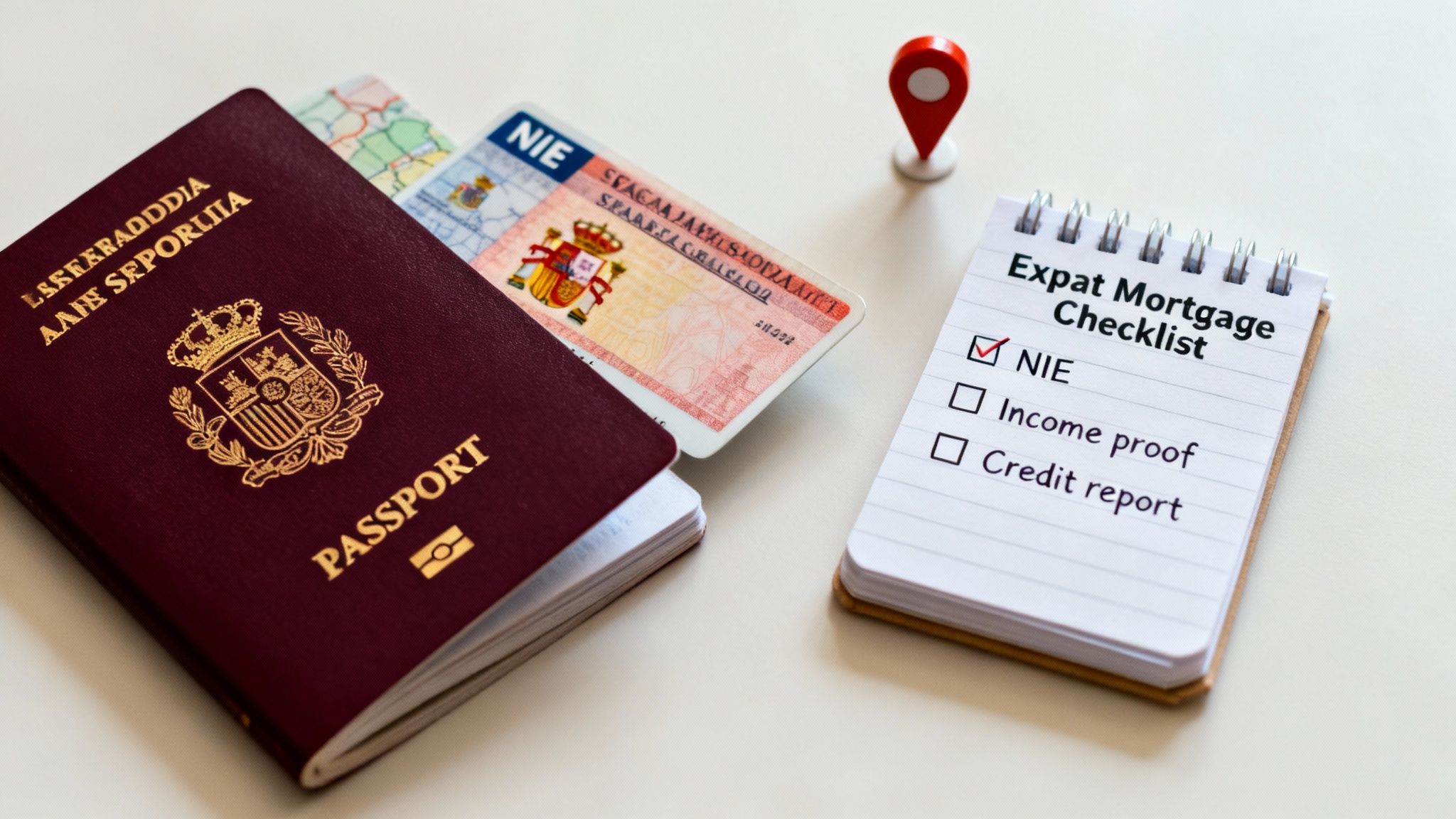
So, you're an expat looking to secure a mortgage in Spain. The good news is that the core process is very similar to what Spanish residents go through. The main difference? Banks will look at your application through a slightly more cautious lens.
It’s nothing personal. Lenders simply see a bit more risk when your income and assets are based in another country. This caution translates directly into one of the most important numbers you’ll encounter: the Loan-to-Value (LTV) ratio.
While a local resident might secure a mortgage for up to 80% of the property’s price, as a non-resident, you should realistically expect a lower ceiling—typically somewhere between 60% and 70%. This means you’ll need a larger down payment. For a €300,000 property, for instance, you'd need to bring between €90,000 and €120,000 to the table, plus extra for taxes and fees. Knowing this from the start is half the battle.
Your Essential Document Checklist
Nothing says "I'm a serious buyer" like being prepared. Walking into a bank with all your paperwork perfectly organized builds instant trust and dramatically speeds up the application process.
Before you even start talking to lenders, make it your mission to gather these documents:
- NIE (Número de Identidad de Extranjero): This is your unique Foreigner's Identity Number. It's an absolute must-have for any major financial transaction in Spain, especially buying property.
- Proof of Employment and Income: Be ready with your last few payslips, your most recent tax returns (which must be translated into Spanish by a sworn translator), and an official letter from your employer confirming your role and salary.
- International Credit Report: The bank needs to see your financial track record. A credit report from your home country (from an agency like Experian or Equifax) is essential.
- Bank Statements: Have at least six months of statements from your primary accounts ready to demonstrate your financial stability and cash flow.
- Property Details: Once you've found a place, you'll need the nota simple (the property's official registry file) and the preliminary purchase agreement, known as the contrato de arras.
Getting your NIE sorted is the crucial first step. You can get a better handle on what's involved by checking out our guide to Spain residency requirements.
Understanding Vinculaciones: The Key to a Better Rate
As you start comparing mortgage offers, you'll keep hearing the word vinculaciones. What are they? Essentially, they are extra products the bank wants you to sign up for in exchange for a lower interest rate. It's their version of a bundle deal.
By bundling services, the bank deepens its relationship with you, making you a more valuable customer. In return, they shave points off your mortgage rate. It's a trade-off between convenience and cost that you'll need to evaluate carefully.
The most common vinculaciones you'll see are:
- Home Insurance (Seguro de Hogar): This is almost always mandatory.
- Life Insurance (Seguro de Vida): Often required to cover the loan amount if something happens to you.
- Direct Deposit of Your Salary (Nómina): The bank may ask you to open an account with them and have your salary paid into it.
These bundles can definitely lower your headline interest rate, but you need to do the math. Are the insurance policies competitively priced, or are they inflated? Sometimes, what you save on the mortgage interest you end up overpaying on an expensive policy. Always calculate the total cost of the package to make sure it's a genuine saving.
How to Navigate the Mortgage Application Process
Buying a property in Spain is an exciting prospect, but the mortgage process can feel like a maze. Let's break it down into a clear, step-by-step roadmap. Think of it less as a single, overwhelming task and more as a series of manageable stages that take you from initial planning to finally holding the keys to your new home.
The whole system is designed to make sure everyone—you, the seller, and the bank—is making a sound financial decision. It’s a methodical journey that protects all parties involved.
Stage 1: The Pre-Approval and Document Hunt
Before you fall in love with a property on Residaro, your first move should be to get pre-approved for a mortgage. This isn't a final, binding offer, but it’s an incredibly powerful first step. It gives you a realistic budget to work with and signals to sellers that you’re a serious, qualified buyer.
At the same time, start gathering your documents. Being prepared is the single best way to keep things moving and build confidence with the bank. Having everything ready to go shows them you’re organized and reliable.
Here’s your essential document checklist:
- Your NIE (Número de Identidad de Extranjero): This Foreigner's Identity Number is absolutely essential for any major transaction in Spain.
- Proof of Income: Typically your last three payslips and most recent tax returns, which will need to be officially translated into Spanish.
- Employment Verification: A formal letter from your employer confirming your role, salary, and how long you've been with the company.
- Credit History: A fresh credit report from your home country.
- Bank Statements: At least the last six months of statements to demonstrate your financial habits and savings.
Stage 2: Finding Your Property and Securing an Offer
With your pre-approval sorted, the fun part begins: the property search. Once you find a place and the seller accepts your offer, you'll sign a preliminary purchase agreement, known as a contrato de arras, and put down a deposit—usually 10% of the sale price.
This agreement takes the property off the market while you finalize your mortgage. Now, the bank will order an official valuation, or tasación. This is a critical step. A professional appraiser assesses the property’s market value, and the bank will only lend against the lower of the purchase price or this official valuation.
A strong tasación is the green light your bank is waiting for. It confirms the property is a solid asset and provides the final figure used to calculate your Loan-to-Value (LTV) ratio, which directly impacts your final mortgage amount.
Stage 3: From Binding Offer to Final Signature
Once the valuation is in and all your paperwork checks out, the bank will issue its binding offer. In Spain, this formal document is called the FEIN (Ficha Europea de Información Normalizada). It lays out every single detail of the loan: the interest rate, all fees, the full repayment schedule, and any linked products (vinculaciones) you've agreed to.
You'll then have a mandatory ten-day "cooling-off" period to review the FEIN. This is your chance to go over everything with a fine-tooth comb. A notary will also walk you through the document to ensure you understand every clause before you commit.
The final step is la firma—the signing. This happens at a notary's office where you, a bank representative, and the seller all sign the official deeds. Once the ink is dry and the funds are transferred, the keys are yours. For international buyers, understanding all the nuances of getting a mortgage for a foreign property is key to a smooth closing day.
And don't forget to budget for the closing costs! These typically add an extra 10-15% on top of the property price and cover things like:
- Property Transfer Tax (ITP): Varies by region, but usually 6% to 10%.
- Notary and Registry Fees: Standardized fees for the official legal work.
- Bank Arrangement Fees: A one-off fee for setting up the mortgage loan.
Actionable Tips for Securing the Best Rate
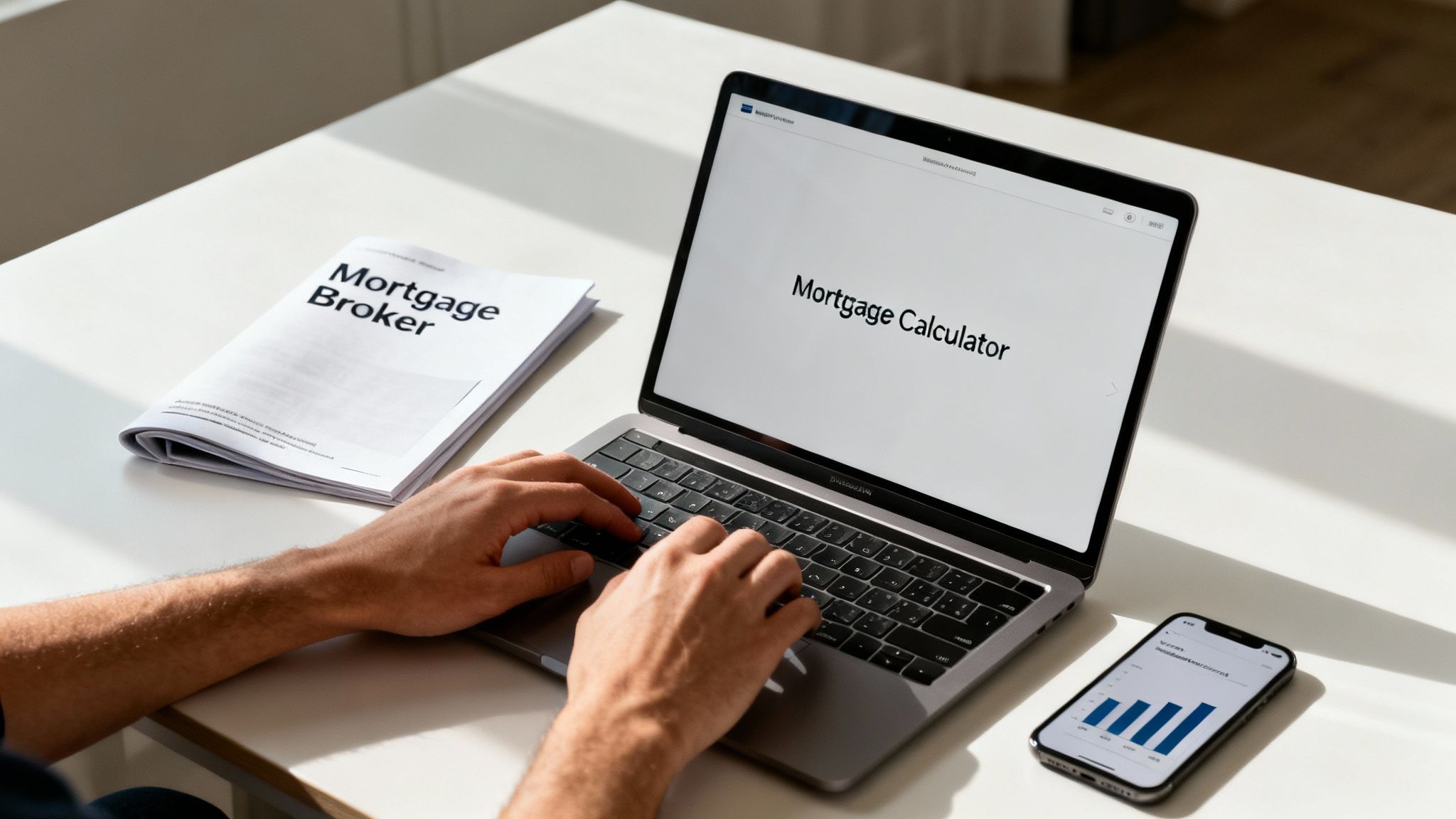
Knowing the market is one thing, but actually getting the best mortgage rates in Spain is where the real work begins. This is your chance to move from theory to practice and find a deal that truly fits your financial future. The key is to be proactive—don’t just settle for the first offer a bank slides across the table.
Your prep work can start right from your own home with a good online mortgage calculator. These are fantastic tools for running the numbers on different scenarios. See for yourself how a slightly lower interest rate or a bigger down payment changes your monthly payments and the total interest you'll pay over the life of the loan. This initial homework gives you a solid idea of what's affordable before you even start talking to lenders.
Leverage Professional Expertise
If you're an international buyer, trying to figure out the Spanish banking system on your own can feel overwhelming. This is where a mortgage broker becomes your biggest asset. Think of them as your local guide on a tricky mountain trail—they know the terrain, speak the language, and can point out the shortcuts to the best deals you’d never find on your own.
A great broker brings a few key things to the table:
- Wider Access: They have relationships with a whole network of banks, including smaller or more specialized lenders who are often more open to working with non-residents.
- Negotiating Clout: Brokers manage a high volume of applications, giving them leverage to negotiate better terms than an individual applicant ever could.
- A Smoother Ride: They know the paperwork inside and out, helping you dodge the common pitfalls that can delay or even derail an application.
This kind of expert help is especially important for expats who aren’t up to speed on local banking quirks or Spanish financial regulations.
Smart Shopping and Negotiation Tactics
Getting a great rate isn't just about hiring a broker; you need to be a savvy shopper yourself. The golden rule? Never take the first offer. When you apply with several different banks, you create competition for your business. That simple step immediately puts you in a much stronger position to negotiate.
Also, keep a close eye on the bundled products, known in Spain as vinculaciones. Banks will often offer a lower headline interest rate if you sign up for their home insurance, life insurance, or other products. But you need to do the math carefully.
Always focus on the Total Equivalent Annual Rate (TAE), not just the Nominal Interest Rate (TIN). The TAE gives you the true cost of the loan because it includes all the fees and mandatory extra products. A tempting low TIN can be a smokescreen for expensive, overpriced insurance.
Ultimately, your best advantage is being an informed and prepared buyer. By running the numbers with calculators, working with a broker, shopping around, and always analysing the total loan cost, you'll be in a great position to land a mortgage that makes your Spanish property dream a reality.
Got Questions? We've Got Answers
Once you've wrapped your head around the basics, a whole new set of practical questions usually pops up. Let's tackle some of the most common ones we hear from international buyers, so you can get the clarity you need to keep moving forward.
Can I Get a Spanish Mortgage as a Non-EU Citizen?
Absolutely. Spanish banks are definitely open to lending to non-EU citizens, but be prepared for a thorough financial review. They'll want to see detailed proof of your income and will likely ask for a credit report from your home country.
The main difference is that you'll probably be offered a lower Loan-to-Value (LTV) ratio—think around 60% of the property price. You might also see a slightly higher interest rate. Before you even start, getting your NIE number and opening a Spanish bank account are essential first steps.
How Long Can I Get a Mortgage For?
For residents, a 30-year term is pretty standard. For non-residents, however, banks usually shorten that runway, typically capping the term at 20 or 25 years.
Age is another factor. Most Spanish banks have a rule that the mortgage must be fully paid off by the time you turn 75. The exact term you're offered will always come down to your personal situation and the bank's specific lending policies.
Good to Know: Spain has regulations that cap early repayment fees. This means you won't get hit with massive, unexpected penalties if you decide to pay off your mortgage ahead of schedule. It's a clear, predictable system.
Are There Penalties for Paying Off My Mortgage Early?
Yes, but they are clearly defined and capped by Spanish law. These are known as comisión por amortización anticipada.
- For variable-rate mortgages: The fee can't be more than 0.15% of the amount you repay in the first five years (or 0.25% in the first three). After that, it drops to zero.
- For fixed-rate loans: The penalty is capped at 2% for the first 10 years and then drops to 1.5% after that.
Always double-check these figures in your official mortgage offer (the FEIN document) before signing. Getting familiar with these details now will save you headaches later.
Ready to put all this knowledge to use? Start exploring beautiful properties across Spain and find the perfect place to call home. Visit Residaro to begin your search today.