Spain Residency Requirements - Your Complete Guide

Getting your Spanish residency sorted means picking a visa path that fits your finances and what you want to achieve. Are you living off passive income? The Non-Lucrative Visa might be for you. Looking to invest? The Golden Visa is a popular route.
Each path has its own set of financial requirements, paperwork, and future implications. It's absolutely crucial to get a handle on your options before you dive in.
Your Essential Roadmap to Spanish Residency
So, you're planning a move to Spain. The very first step is figuring out the path to legal residency. Consider this guide your personal map, here to clear up the often confusing terrain of Spain residency requirements.
It's no secret why Spain is so popular. It calls to retirees with its laid-back lifestyle, attracts investors with a solid property market, and draws in digital nomads with buzzing cities and great infrastructure.
But that dream of living under the Spanish sun? It's built on a bedrock of solid legal and financial planning. This isn't a one-size-fits-all process; it’s a network of different routes, each designed for different people and situations.
Understanding Your Primary Options
For most non-EU citizens, the two big players are the Non-Lucrative Visa (perfect for passive income) and the Golden Visa (driven by investment). The first is ideal for anyone who can support themselves without needing to work in Spain. The second offers a quicker route for those making a significant investment.
If you're coming from the US, getting these details right is especially important. We've put together a dedicated resource on how to move to Spain from the US that digs into the specifics.
Choosing the right visa is like picking the right key for a lock. The Non-Lucrative Visa needs proof of passive income, while the Golden Visa demands a hefty investment. The single most critical step you can take is to match your financial situation with the correct visa's requirements from day one.
To help you get your bearings, the table below offers a quick comparison of the most common residency options. It outlines who each visa is best suited for and what the main financial hurdle is, allowing you to quickly see which path might be the right fit for you.
Spain Residency Pathways at a Glance
| Residency Pathway | Ideal For | Key Financial Requirement |
|---|---|---|
| Non-Lucrative Visa | Retirees and individuals with sufficient passive income or savings. | Proof of annual passive income of at least €28,800. |
| Golden Visa | Investors seeking flexibility and minimal stay requirements. | A minimum €500,000 real estate investment. |
| Digital Nomad Visa | Remote workers and freelancers with non-Spanish clients. | Proof of stable remote income of at least €2,763 per month. |
| EU Citizen Registration | Citizens from EU/EEA countries or Switzerland. | Proof of sufficient funds and healthcare coverage. |
This snapshot should give you a clearer idea of where you stand. As we go on, we’ll break down each of these pathways in much more detail.
Choosing Your Path: Non-Lucrative vs. Digital Nomad Visa

When you're dreaming of a life in Spain, two of the most popular residency paths for non-EU citizens let you live here without needing a job with a local company. These are the Non-Lucrative Visa (NLV) and the Digital Nomad Visa (DNV). At first glance, they seem similar, but they’re designed for completely different people.
Think of it this way: the NLV is like a comfortable sedan for a long, relaxed road trip—perfect for someone who has already reached their destination financially. The DNV, on the other hand, is a modern, connected SUV, built for those actively navigating their career journey from the road.
The entire decision hinges on one simple question: where does your money come from? Getting this right is the first crucial step to meeting the correct Spain residency requirements for your situation.
The Non-Lucrative Visa: The Path of Passive Wealth
The Non-Lucrative Visa is the traditional choice for people who can fully support themselves without working in Spain. It's the go-to option for retirees or anyone with significant savings or steady passive income from things like pensions, investments, or rental properties.
The whole point of this visa is proving you have enough money to live on without needing a job. The Spanish government measures this against a benchmark called the Public Multiple Effects Income Indicator (IPREM).
To qualify, a solo applicant needs to show they have access to 400% of the IPREM, which works out to about €28,800 annually. That number goes up for every family member you plan to bring with you.
It's a straightforward trade-off. You get to live in one of Europe's most incredible countries, but you are strictly forbidden from doing any professional work for a Spanish company or as a freelancer based in Spain.
The Non-Lucrative Visa is all about demonstrating financial self-sufficiency. Your application lives or dies on your ability to prove you won't be a drain on the Spanish system and can thrive without entering the local workforce.
This visa sets you on a clear track toward long-term residency. You start with a one-year permit, then renew it for two-year periods, eventually leading to permanent residency after five uninterrupted years.
The Digital Nomad Visa: For the Modern Remote Professional
Spain's Digital Nomad Visa is a much newer route, created specifically for today's global workforce. It’s tailor-made for remote employees, freelancers, and online business owners who earn their living from clients or companies outside of Spain.
Unlike the NLV, this visa is all about active income. You have to prove you have a stable remote job or consistent freelance work. Here, the financial requirement is tied to Spain's minimum wage (SMI), and you must show a monthly income of at least 200% of the SMI.
Right now, that means you need to earn a minimum of about €2,763 per month. This visa acknowledges that you are working—just not for a Spanish business.
In many ways, the DNV offers more flexibility. While it also starts with a one-year permit, it can be renewed for longer stretches, giving location-independent professionals a solid base. It also opens the door to a special tax regime that can offer significant savings. For a detailed breakdown, check out our complete guide to the Spain digital nomad visa requirements.
A Side-by-Side Comparison
The numbers are what really tell the story. For the digital nomad permit, you’re looking at that €2,763 monthly income, plus either a university degree or three years of relevant work experience, and proof of a stable work relationship for over a year. For the non-lucrative route, the focus is on proving you have €28,800 in passive income or savings, along with comprehensive private health insurance.
Here’s a simple breakdown to help you see the difference:
| Feature | Non-Lucrative Visa (NLV) | Digital Nomad Visa (DNV) |
|---|---|---|
| Primary Focus | Passive Income & Savings | Active Remote Income |
| Work Permission | No work allowed in Spain. | Remote work for foreign entities is allowed. |
| Financial Proof | ~€28,800 per year (passive) | ~€2,763 per month (active) |
| Ideal Candidate | Retirees, investors, self-sufficient individuals. | Remote employees, freelancers, online entrepreneurs. |
| Path to PR | Standard 5-year path. | Standard 5-year path. |
Ultimately, your choice boils down to your current life and financial situation. If your income flows from investments, pensions, or other established assets, the NLV is your clear path. If you're earning a salary by working remotely, the DNV was designed just for you.
The Golden Visa: An Investor's Fast Track to Spanish Residency

For high-net-worth individuals looking for a more direct and flexible path into Spain, the Golden Visa is the answer. It’s a special residency program designed to attract significant foreign investment into the country, and real estate is by far the most traveled route.
Think of it as the express lane at the airport. While other residency paths have strict rules about income or employment, the Golden Visa is built around a single, substantial financial commitment. In return for your investment, you get a residency permit with a unique set of perks that are hard to find elsewhere.
The entire program hinges on a key investment threshold. To qualify through property, you must purchase real estate with a value of at least €500,000. This figure is the bedrock of the entire application.
Understanding the Investment Requirements
That €500,000 price tag doesn't mean you have to buy a single luxury villa. You could just as easily put together a portfolio of smaller properties—a couple of city apartments, perhaps, or a mix of residential and commercial units—as long as their combined value hits that magic number.
Here's the critical detail: the first €500,000 of your investment must be mortgage-free. You have to bring that capital to the table without financing. If your dream property costs €800,000, you can absolutely get a mortgage for the €300,000 difference, but the qualifying portion must be unencumbered. This is a non-negotiable rule within the Spain residency requirements.
Naturally, this pushes investors towards prime locations. To get a feel for the market and see the kind of properties that attract Golden Visa applicants, it's worth exploring the real estate in Costa del Sol, Spain, a perennial hotspot for international buyers.
The Unmatched Benefits of the Golden Visa
What truly makes the Golden Visa stand out is its incredible flexibility. The biggest draw? The minimal physical stay requirement. Most other Spanish visas demand that you spend over six months a year in the country. The Golden Visa, however, only asks you to visit once during your permit's validity period.
This single benefit is a game-changer. It means you can secure EU residency, travel freely across the Schengen Zone, and keep your life and business centered elsewhere without automatically becoming a Spanish tax resident.
On top of that, the visa gives you and your family the right to live and work in Spain immediately. This is a massive advantage over something like the Non-Lucrative Visa, which strictly forbids any kind of professional activity.
The benefits also extend to your family members, covering:
- Your spouse or civil partner.
- Dependent children (including adult children who are financially dependent).
- Your dependent parents and even your parents-in-law.
This all-encompassing approach makes it the perfect solution for investors who want to open doors for their entire family, not just themselves.
Navigating the Application Process
Getting your hands on a Golden Visa is a clear, step-by-step process, but it requires meticulous preparation. It's as much a legal and financial project as it is a property hunt.
Interestingly, the journey doesn't start at a consulate. It starts in the Spanish property market.
-
Find and Buy Your Property: First things first, you need to identify and complete the purchase of real estate worth €500,000 or more. This involves the usual steps of working with agents, lawyers, and notaries to sign the final deeds (escritura pública).
-
Compile Your Documents: With the property secured, it's time to build your application file. You'll need proof of the investment (the deeds), clean criminal record checks from your home country, full-coverage private health insurance in Spain, and proof you have the funds to support your family.
-
Submit the Application: One of the great conveniences of this visa is that you can apply for it while you're already in Spain on a tourist visa. If that's not feasible, you can always file the application at the nearest Spanish consulate in your country of residence.
If you apply from within Spain, the initial permit is granted for three years. After that, renewals are issued in five-year increments, so long as you hold onto your investment. It’s a remarkably stable and long-term residency solution for global citizens.
Residency for EU Citizens and Family Members
If you're lucky enough to hold a passport from an EU/EEA country or Switzerland, your journey to living in Spain is much simpler than for everyone else. It's not really a visa application at all; it’s more like an official registration. You're not asking for permission—you're exercising your right to freedom of movement and simply letting the Spanish authorities know you're here.
But don't mistake "simpler" for "automatic." You still have to prove you can stand on your own two feet financially and won't become a drain on Spain's social security system. This is a critical hurdle in the Spain residency requirements, even for EU citizens.
The whole process is geared towards getting your Certificado de Registro de Ciudadano de la Unión. Locals often just call it the "green card" or residencia, and this small certificate, along with your NIE number, is the bedrock of your new life in Spain.
The Registration Process for EU Citizens
To get that coveted green certificate, you have to show that you belong to one of four main groups: you're an employee, you're self-employed, you're a student, or you're financially self-sufficient.
If you’re not planning to work, the government wants to see two things:
- Sufficient Financial Resources: You need to prove you have enough savings or a reliable passive income, like a pension, to live comfortably without needing Spanish benefits. The figure changes annually but typically means having several thousand euros in the bank.
- Comprehensive Health Insurance: A private Spanish health insurance policy is a must. It needs to offer coverage on par with the public healthcare system. The one exception is for pensioners from other EU countries, who can often use a special S1 form to access public healthcare.
Once you’ve gathered your paperwork, the final step is to book an appointment (cita previa) online and present everything at your local Foreigner's Office (Oficina de Extranjeros) or a designated police station.
Bringing Non-EU Family Members to Spain
So, what happens if you're an EU citizen moving to Spain with a spouse, partner, or child who isn't from the EU? This is where things get a bit more complex, as you'll be mixing EU free movement rights with Spanish immigration rules. Your family member will need to apply for a residence card specifically for the family of an EU citizen.
This pathway allows your non-EU relatives to join you with the full right to live and work in Spain. The definition of a "family member" is pretty strict and generally covers:
- Your spouse or registered partner.
- Your children or grandchildren under 21 (or older if they are financially dependent on you).
- Your dependent parents or grandparents.
The entire system is built on the principle of family unity. Both Spanish and EU law want to keep families together, but it's on you—the EU citizen sponsor—to prove the family relationship is genuine and that you can fully support them.
To make it happen, you, the EU citizen, must get your own residency sorted out first. Only then can your non-EU family member apply for their card. They'll need to show official documents like marriage or birth certificates to prove your connection, along with evidence that you meet the financial and healthcare requirements for the whole family. After five years of living together in Spain, they can then apply for their own permanent residence card.
To help clarify the paperwork, here’s a quick comparison of the documents you'll need.
Document Checklist EU vs Non-EU Family Members
While there's some overlap, the documentation for a non-EU family member is far more extensive, as they need to formally prove their connection to you and their right to be here.
| Document Type | EU Citizen Registration | Non-EU Family Reunification |
|---|---|---|
| Application Form | Official Form EX-18 | Official Form EX-19 |
| Passport | Valid Passport/National ID | Valid Passport |
| Proof of Funds | Bank statements or employment contract | Proof of EU sponsor's funds |
| Health Insurance | Private policy or S1 form | Private policy or proof of coverage through sponsor |
| Proof of Relationship | N/A | Marriage/birth certificate (legalized & translated) |
| EU Sponsor's Residency | N/A (this is what you are applying for) | The EU citizen's Certificado de Registro |
| Proof of Dependency | N/A (unless you are the one who is dependent) | Required for children over 21 and ascendants |
The key takeaway is that for your non-EU family, every document proving the relationship—like a marriage certificate—must be officially translated into Spanish and apostilled or legalized in its country of origin. This step alone can take weeks, so it's smart to start early. For a detailed list of document requirements, check out this guide on Spanish government procedures.
The Journey to Permanent Residency and Citizenship
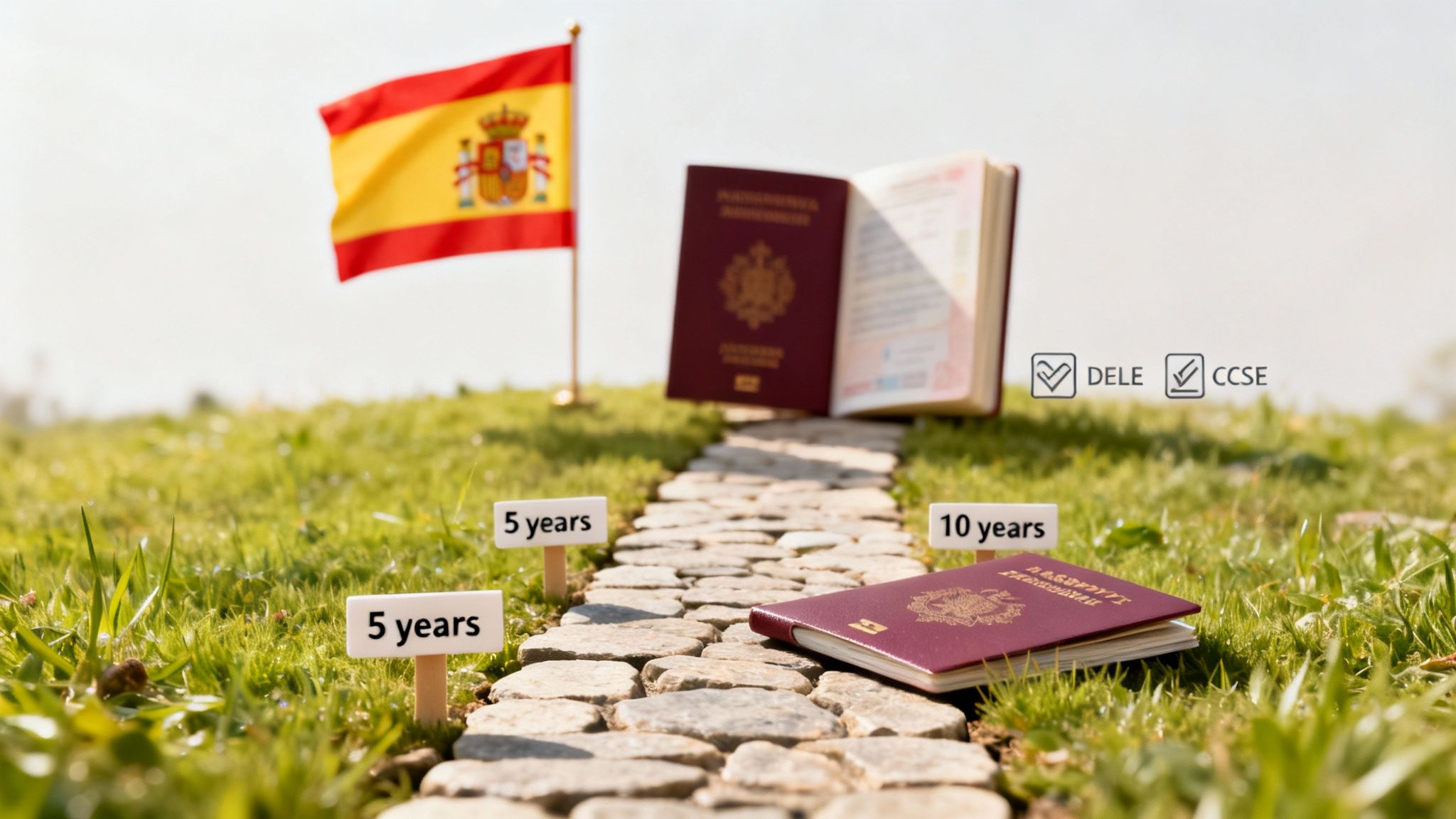
Getting your first visa is a huge step, but it’s really just the beginning of your story in Spain. Think of it as planting a seed. The next stage is all about nurturing that seed until it becomes a permanent part of the Spanish landscape. This is the path from being a temporary resident to a permanent one and, for many, the final destination of citizenship.
The first major milestone is achieving permanent residency, known locally as residencia de larga duración. This status completely changes your relationship with the country. It grants you rights nearly identical to a Spanish citizen, including the freedom to live and work anywhere in Spain without the constant hassle of renewing your permit.
To get there, you need to prove five years of continuous and legal residence in Spain. And "continuous" is the operative word here. The authorities are quite strict about how much time you spend outside the country—generally, you can’t be away for more than a total of ten months within that five-year period.
Earning Your Permanent Residency
You can look at that five-year requirement as a kind of probationary period. The Spanish government wants to see that you’ve truly made Spain your home. Every temporary visa renewal you complete, whether it's for a Non-Lucrative Visa or a Digital Nomad permit, is another step on the ladder toward this goal.
Once you’ve crossed the five-year mark, applying for permanent residency is a fairly straightforward process, as long as you’ve kept a clean record and stayed within the absence limits. This powerful status is then valid for five years at a time and is far easier to renew.
The Ultimate Goal: Spanish Citizenship
After you've settled into life as a permanent resident, the final step for many is becoming a Spanish citizen. This means getting that coveted Spanish passport, which is so much more than a travel document. It's your key to full EU rights, giving you the ability to live, work, and retire in any member state without a second thought.
The standard route to Spanish citizenship requires ten years of legal residency. The good news is that the clock starts ticking from your very first residency card, so those initial five years of temporary status count toward this decade-long commitment. It's a long game, but the rewards are immense.
Obtaining a Spanish passport is the final piece of the puzzle. It signifies complete integration and grants you the same rights and privileges as someone born in Spain, cementing your place in Europe.
But here’s a game-changer: a fast-track option dramatically shortens this timeline for some. For expats and investors from Latin America, Spain’s citizenship pathway is uniquely attractive, requiring just two years of legal residency instead of the usual ten. This is thanks to long-standing Ibero-American agreements, making it a golden ticket for citizens from countries like Argentina, Brazil, Colombia, and Mexico. You can find out more about how this accelerated timeline works on Jobbatical.com.
The Final Hurdles: Naturalization Tests
Whether you're on the two-year or ten-year path, all applicants must prove they've integrated into Spanish life by passing two specific exams. These tests are the final checkpoints on your journey and are a non-negotiable part of the Spain residency requirements for citizenship.
You'll need to demonstrate proficiency in both language and culture:
- DELE A2 Exam: This is a Spanish language test that confirms you have a basic command of the language—enough to handle simple, everyday interactions.
- CCSE Test: The Conocimientos Constitucionales y Socioculturales de España exam tests your knowledge of Spanish government, culture, and society.
Passing these exams is essential for most applicants. It's your way of showing a real commitment to becoming a fully integrated member of Spanish society. Once you've cleared these tests and completed your residency period, you can formally apply for naturalization, take your oath of allegiance, and finally claim your Spanish passport.
Your Spanish Residency Questions Answered
When you get down to the nitty-gritty of moving to Spain, a lot of practical questions pop up. Even with the main pathways laid out, real life has a way of throwing curveballs. Here, we’ll tackle some of the most common queries we get from clients and would-be expats to help you sidestep a few common headaches.
Getting these details right from the start is a game-changer. A simple mistake—like assuming you can apply from anywhere or picking the wrong insurance—can lead to frustrating delays. Let's clear up the confusion on these key points.
Can I Apply for Residency While I’m Already in Spain on a Tourist Visa?
This is probably the question we hear most often, and the answer isn't a simple yes or no. For most of the classic residency routes, like the Non-Lucrative Visa, the rule is ironclad: you must apply from a Spanish consulate or embassy in your home country or where you legally reside. Trying to start the process while you're in Spain as a tourist just won't work.
But there are a few big exceptions. The Golden Visa, for example, is built for convenience. You can absolutely come to Spain, find and purchase your property, and then file the residency application from right here. This is a huge plus for investors. A few other specific permits, like those for entrepreneurs or highly-skilled workers, also allow for this in-country application.
Bottom line: always double-check the rules for your specific visa. It's a classic mistake to assume you can apply from within Spain, and it could mean a wasted trip home to start all over again.
Does Buying a Property for Under €500,000 Help My Application?
So, buying a property for less than the €500,000 Golden Visa minimum won't get you a residency permit on its own, but it can give your application a serious leg up—especially for something like the Non-Lucrative Visa. Owning a home is probably the best way to show Spanish officials you're serious.
Think about it from their perspective. It proves two crucial things:
- You have strong ties to Spain. You’re not just passing through; you’re literally putting down roots.
- You've sorted out your housing. It ticks the box for having suitable accommodation right away.
In short, it makes you look like a stable, well-prepared applicant who is ready to build a life in Spain. That adds a lot of credibility to your file.
What Kind of Health Insurance Do I Actually Need?
This is one area where there’s zero wiggle room in the Spain residency requirements. You absolutely must have a private Spanish health insurance policy that provides coverage on par with the public system. Let me be clear: a standard travel insurance policy will get your application rejected instantly.
Your policy has to meet three key criteria:
- It must be from a Spanish provider. The insurance company has to be officially authorized to operate in Spain.
- It needs to be fully comprehensive. This means it covers everything from doctor visits to hospitalization and specialists.
- It must have no co-payments or deductibles. The policy has to be what’s called sin copagos, meaning you don’t pay out-of-pocket for covered medical services.
Finally, the policy has to be valid for your entire initial residency period, which is almost always one full year.
How Long Can I Be Out of Spain Without Losing My Residency?
To keep your residency, Spain expects you to actually live here. The rules for how long you can be away change depending on which permit you hold.
For most temporary permits, including the first-year Non-Lucrative Visa, you can't be out of the country for more than six months in any single year. If you exceed that, you risk having your renewal denied.
The rules get even tighter when you're aiming for long-term (permanent) residency after five years. Over that entire five-year stretch, your total time spent outside of Spain can't add up to more than ten months. The big outlier here is the Golden Visa, which has almost no physical stay requirement, offering investors maximum flexibility.
Planning your move to Spain starts with finding the right home. At Residaro, we specialize in connecting international buyers with stunning properties across Spain's most desirable regions. Explore our curated listings and take the first step toward your new life in the sun.