How to Negotiate Real Estate Commission

The first thing to understand about negotiating real estate commission in Europe is that almost everything is on the table. Unlike markets with more rigid, standardized fees, the European landscape is incredibly localized and, frankly, flexible. This is where an informed international buyer can really gain an edge. Your success in getting a better rate comes down to two things: knowing the local norms and having the confidence to make your case.
Getting a Feel for European Commission Norms

Before you even think about negotiating, you have to learn the local playbook. The idea of a standard, fixed commission—so common in places like the United States—is a foreign concept in most of Europe. What you'll find instead is a patchwork of customs where rates and expectations can change dramatically the moment you cross a border.
This variability is your biggest advantage. For international buyers using platforms like Residaro, comparing these different market standards provides powerful context. For example, U.S. rates often land in the 5-6% range. Compare that to the UK, where it's typically just 1-2%, or the Netherlands at around 1.5-2%. Even in pricier markets like France or Italy, where seller commissions hit 3-5%, you can use these lower European benchmarks in your conversation. Knowing the global differences in commission rates is key to building a strong argument.
Who Actually Pays the Agent?
This is one of the most critical details to figure out. The American model, where the seller usually pays both agents out of the sale price, is not the universal standard in Europe. It's much more of a mixed bag.
- Seller-Pays: This is common in places like the UK, Spain, and Portugal. The seller is almost always on the hook for the agent's fee. For you as a buyer, this is simpler because the commission is already factored into the asking price.
- Buyer-Pays: In certain situations, especially if you hire a dedicated buyer's agent to represent you, the fee might come directly out of your pocket. It’s less common but something you must clarify from the get-go.
- Split Commission: In countries like Italy and sometimes France, it's not unusual for both buyer and seller to pay a fee, either to their own agents or to the same agency. Belgium is another example, where a 3% fee is often split down the middle.
Understanding this structure is crucial. If you're in a "seller-pays" country, your leverage might be more about negotiating the overall property price, since you know the agent’s commission is a big part of the seller's bottom line.
Typical Commission Rates Across Europe
Once you know who is paying, you need to know how much is typical. This insight is what stops you from accidentally agreeing to an inflated rate and gives you a realistic starting point for any discussion. You can't walk into a meeting in Austria using Portuguese rates as your benchmark—it just won't work.
My golden rule for any international buyer: never assume. A 2% difference on a €750,000 property is €15,000. That’s a sum definitely worth a bit of research and a confident chat.
To get you started, here’s a quick look at the typical commission structures in some of the most popular European countries for property investment. Think of these numbers as a guide, not gospel. Every market has its nuances, but this overview gives you an immediate strategic advantage.
Typical Real Estate Commission Rates in Key European Countries
A comparative overview of standard commission percentages and who typically pays the agent's fee across popular European destinations for property buyers.
| Country | Average Commission Range (%) | Typically Paid By | Negotiation Notes |
|---|---|---|---|
| Spain | 3 - 6% | Seller | Highly negotiable, especially for high-value properties or exclusive mandates. |
| France | 3 - 8% | Seller | Rates are on a sliding scale; higher-value properties command lower percentages. |
| Portugal | 3 - 5% | Seller | Fairly standard, but some flexibility exists, particularly with multi-property deals. |
| Italy | 3 - 4% (total) | Split (1.5-2% each) | Buyer's portion (provvigione) is explicitly negotiated. Always confirm the rate. |
| Germany | 3.5 - 7% (total) | Varies by state; often split | Regulations changed in 2020 to enforce splitting in most cases. A hot market reduces flexibility. |
| UK | 1 - 2% | Seller | Very competitive market. High-street agents are often more flexible than online-only ones. |
Use these figures as your starting point. With this knowledge in hand, you’re no longer just a tourist—you’re an informed investor ready to have a serious conversation.
Building Your Negotiation Strategy Before the Offer

The best negotiators don’t just show up and wing it. They win the deal long before they ever sit down at the table. For an international buyer, that preparation isn't just a good idea—it's the bedrock of a successful transaction. If you want to build a solid case for a lower commission, you need to arm yourself with a deep understanding of the local market, the property itself, and your own financial leverage.
Your first move is to think like a local agent. Get your hands on the same data they use to advise their clients. These key metrics will give you an unbiased read on the market’s temperature and help you spot the leverage you need to justify a lower fee.
Arming Yourself with Market Data
Before you even think about viewings, you need to become a student of the local market stats. Most European property portals and national statistics offices publish a goldmine of data. This information tells a clear story about whether you’re walking into a buyer’s or a seller’s market. In a sluggish market with tons of inventory, agents are almost always more willing to talk terms to get a deal done.
Focus on tracking these critical numbers for your target city or neighborhood:
- Average Days on Market (DOM): How long are properties sitting unsold? A high DOM means a slow market, which puts you in the driver's seat.
- Inventory Levels: Is there a glut of homes for sale or a serious shortage? High inventory creates more competition among agents.
- Sale-to-List Price Ratio: Are properties selling for the asking price, or are sellers taking a haircut? A ratio below 100% is a clear sign that buyers have the upper hand.
A sharp investor I worked with in Lisbon spotted that apartments in his target neighborhood were sitting on the market for an average of 95 days, while the city-wide average was just 60. He used this single data point to make a compelling case for a reduced commission, arguing the agent might need to work harder to close the deal, which warranted a more performance-based fee.
Analyzing the Specific Property
Once a property catches your eye, it's time to put it under the microscope. Is it a hot new listing in a prime building, or has it been collecting dust online for months with a few price cuts? You can often find this information publicly or through some savvy online digging.
Look for these specific leverage points tied to the property itself:
- Time on Market: If a property has been listed for several months, you can bet the seller and their agent are feeling the pressure. This is a huge bargaining chip.
- Price History: Has the asking price been dropped once or twice? That’s a clear signal the initial valuation was off and the seller is motivated to sell.
- Condition: Does the property need a gut renovation? While this is mainly a tool for negotiating the purchase price, you can also bring it into the commission chat if the deal requires extra work and coordination. For more on the early stages, check out our guide on how to choose a real estate agent who can assist with this kind of analysis.
Solidifying Your Financial Position
Nothing speaks louder in a negotiation than being a serious, prepared buyer. As an international investor, proving you're ready to go financially can immediately make an agent see you differently and be more flexible on their fee.
Being a cash buyer or having pre-approval for financing from a reputable lender eliminates major hurdles and dramatically lowers the risk of the deal collapsing. That certainty is incredibly valuable to an agent whose payday depends on the deal actually closing.
When you can walk in as a low-risk, high-certainty client, you’re in a far stronger position to ask for a better commission rate. Make it crystal clear you’re ready to move fast.
Playing Your Cards as an International Buyer

As an international buyer, you're not just another name on an agent's client list. You bring a distinct advantage to the negotiating table, especially in European markets hungry for outside investment. The trick is to position yourself as a savvy, serious investor, not just a one-off buyer.
This global perspective is your secret weapon. When you can speak to commission models in other major markets, it instantly elevates the conversation. You're no longer just haggling; you're arguing for a fee structure that reflects modern, international standards. It shows the agent you've done your homework on a global scale.
Highlighting What Makes You a Prized Client
Your most potent negotiation tools are the specifics of your situation. At the end of the day, agents are running a business, and they're drawn to clean, profitable deals. Figure out what makes your offer especially attractive and use those points to open the door to a commission discussion.
Here are some of the most compelling chips you can play:
- A High-Value Transaction: On a multi-million Euro property, the agent is already looking at a significant payday. It's perfectly reasonable to suggest that a slightly lower percentage still adds up to a very handsome commission.
- Potential for Future Business: Are you an investor aiming to build a portfolio? Make that crystal clear. The promise of more deals down the line is a massive incentive for an agent to give you their best terms on this first transaction.
- An All-Cash Offer: This is the ultimate trump card. A cash offer means no financing headaches, a dramatically lower risk of the deal collapsing, and a much quicker path to closing. That kind of certainty is invaluable, and you can absolutely trade on it for a better fee.
Getting the financial logistics right is crucial for an international buyer. Knowing the best ways to transfer money overseas smooths the path and solidifies your image as a prepared, serious client.
Frame your offer as a solution. You aren't just buying a property; you are offering the agent a fast, smooth, and lucrative deal. This changes the dynamic entirely—you’re not asking for a handout, you’re proposing a smart business arrangement.
Using Global Trends to Your Local Advantage
One of the sharpest tactics I've seen is referencing shifts in other major real estate markets to justify a lower commission. The United States, for instance, has always been a key benchmark. For decades, the standard total commission hovered around 5-6%, but major legal battles are shaking that foundation.
The recent National Association of Realtors (NAR) settlement in the U.S. is a game-changer, forcing a decoupling of the buyer's agent commission from what the seller offers. For an international investor looking at a property on Residaro, this is a powerful talking point. You can point to this global trend toward transparency and unbundled services to argue for a more modern fee structure.
This shows you're not just guessing; you're basing your request on significant, real-world market changes. If you want a quick refresher on the role, our guide on what a buyer's agent is explains how their compensation models are evolving worldwide.
When you blend your unique value as a serious international investor with a smart, data-informed approach, you build an undeniable case for a commission that works for everyone.
Talking the Talk: Scripts and Tactics That Actually Work
Knowing what to say is half the battle. Knowing how to say it is what gets a deal across the line. When you're negotiating real estate commission, the right words, delivered with a bit of confidence, can save you a small fortune. This is especially true in Europe, where business culture often hinges on relationships.
The goal here isn't to be confrontational; it's to be professional. You want to frame this as a standard business discussion between partners, not an argument. After all, you and the agent want the same thing: a successful property transaction. A good agent gets it—discussing their fee is just part of setting up a professional relationship.
Finding the Right Moment to Talk Commission
Timing and tone are everything. The absolute best time to bring up the commission is before you've signed any kind of representation agreement. This is when you're still interviewing agents. At this stage, you're the prize, and they're motivated to win your business.
Try to avoid being overly aggressive. A direct, almost blunt approach that might fly in some cultures can come across as rude in others. You want to start with a collaborative, respectful tone.
Here’s a simple, professional way to open the door to the conversation:
"I’m very impressed with your portfolio and your knowledge of the local market. I’m keen to move forward, but before we finalize the agreement, I’d like to go over the fee structure just to make sure we’re completely aligned."
This little script does a few things well. It positions the fee discussion as a final detail in a new partnership, not a battle. It’s respectful, clear, and signals that you’re ready to talk numbers before you commit. From here, the conversation can naturally shift to their proposed rate and your counter.
How to Make a Confident Counter-Offer
Once the agent puts their standard commission on the table, it's your turn. This is where the research and leverage you gathered earlier come into play. Don't just pull a lower number out of thin air and ask for a discount. Justify your position with clear, logical points. It shows you’re a serious, well-prepared investor, not just someone trying to haggle.
Here are a few scenarios and scripts you can adapt:
-
For High-Value Properties: "Thank you for sharing that. For a property in this price range, a commission of [Agent's Proposed Rate]% adds up to a very significant sum. Given the deal's value, I was thinking a rate closer to [Your Proposed Rate]% would be more appropriate while still ensuring an excellent return for your work. How do you feel about that?"
-
If You Are a Cash Buyer: "As we discussed, I’m a cash buyer, ready to close quickly. That means no financing headaches and a much faster process for everyone. Given the certainty and speed I’m bringing to the table, I’d like to propose a commission of [Your Proposed Rate]% to reflect that reduced risk and workload."
-
When Proposing a Tiered Structure: "I have an idea that might incentivize the best possible outcome for both of us. What if we agreed to a base commission of [Lower Rate]% up to the asking price, with a bonus of [Higher Rate]% on any amount you secure above that? This way, we’re both rewarded for achieving a premium result."
Handling Different Scenarios with Finesse
Your approach might need a slight tweak depending on your specific situation. Whether you're working directly with the seller's agent or have your own representative, clarity and confidence are key.
Below is a quick-reference table with some opening lines for common situations you might encounter as an international buyer.
Negotiation Scenarios and Sample Responses
| Scenario | Key Objective | Sample Opening Line |
|---|---|---|
| Interviewing a Buyer's Agent | To secure a favorable rate before signing a representation agreement. | "Before we formalize our partnership, could we discuss your commission structure to ensure our expectations are aligned?" |
| Working Directly with the Seller's Agent | To see if your strong offer creates any flexibility on the total commission. | "My offer is strong and straightforward. Does the seller have any flexibility on the total commission if we can close this quickly?" |
| You Are an Investor Buying Multiple Properties | To leverage future business for a better rate on the current deal. | "This is the first of several properties I plan to acquire in this market. I’m looking for an agency partner who can offer a preferred rate for a long-term relationship." |
It might sound silly, but practicing these lines out loud can actually build your confidence. Remember, the worst they can say is no. But by asking respectfully and backing it up with solid reasoning, you dramatically increase your chances of starting a productive conversation that leads to some very real savings.
Thinking Beyond Percentages: Alternative Fee Structures
A standard percentage commission isn't your only option, and frankly, it often doesn't make sense, especially for international buyers. Bringing alternative fee arrangements to the table is a savvy move when you're negotiating real estate commission. It shows you've done your homework and are focused on creating a fair deal that aligns the agent's payday with your own success.
This isn't about lowballing an agent; it's about building a smarter, more modern compensation model. When you shift the conversation from a simple discount to a more creative structure, you open the door to real savings and a better working relationship.
Flat-Fee Agreements: The Go-To for High-Value Properties
For high-end properties, a flat fee is often the most logical approach. Let’s be realistic: on a multi-million Euro transaction, even a small percentage translates into an enormous commission check for the agent. Proposing a fixed fee gives the agent a clear, guaranteed number for their work while potentially saving you a small fortune.
Imagine you're buying a €2.5 million villa in Tuscany. A standard 3% buyer’s agent commission comes out to a staggering €75,000. You could counter with a flat fee of €50,000. The argument is simple and fair: the work involved in closing this deal isn't necessarily proportional to the sky-high price. For you, it's a €25,000 saving. For the agent, it's still a fantastic payday for a single sale.
Tiered Commissions: Rewarding a Great Deal
Another sophisticated strategy is the tiered commission. This is my personal favorite because it turns the negotiation into a true partnership. You're directly incentivizing your agent to fight for a better price for you. It’s a powerful way to show you value and will pay for top performance.
Here’s a practical way to set it up:
- The Base: Agree on a lower-than-average commission, say 2%, on the final purchase price up to a target number (like the asking price).
- The Kicker: Offer a much more generous percentage—think 5% or even 10%—on every Euro the agent saves you below that target.
If your agent negotiates the price down by €50,000, they get a handsome bonus, and the bulk of the savings goes straight into your pocket. It perfectly aligns your interests. This isn't a new concept; we've seen similar shifts globally. For instance, in the U.S., some luxury agents have seen average rates dip to 2.22% amid regulatory changes, proving the market is open to more flexible models. You can dig into these recent commission rate fluctuations and their impact to see the trends.
The 'À La Carte' Model for Hands-On Buyers
If you're an experienced investor who doesn't need someone to hold your hand through the entire process, the fee-for-service model is a game-changer. You essentially unbundle the agent’s services and pay only for the specific expertise you need.
This approach gives you maximum control. If you're skilled at finding properties online and handling initial outreach, why pay an agent for work you’re doing yourself? You can hire them just for the critical final stages.
You might pay a fixed price for individual tasks, such as:
- Conducting a professional property valuation and comparative market analysis.
- Assisting with contract review and leading the price negotiation.
- Managing the complex local paperwork and closing process.
This can be dramatically more cost-effective than a full percentage-based commission. By suggesting these alternatives, you position yourself not just as a buyer, but as a serious, well-informed partner ready to structure a fair deal.
Finalizing Your Agreement and Avoiding Costly Mistakes
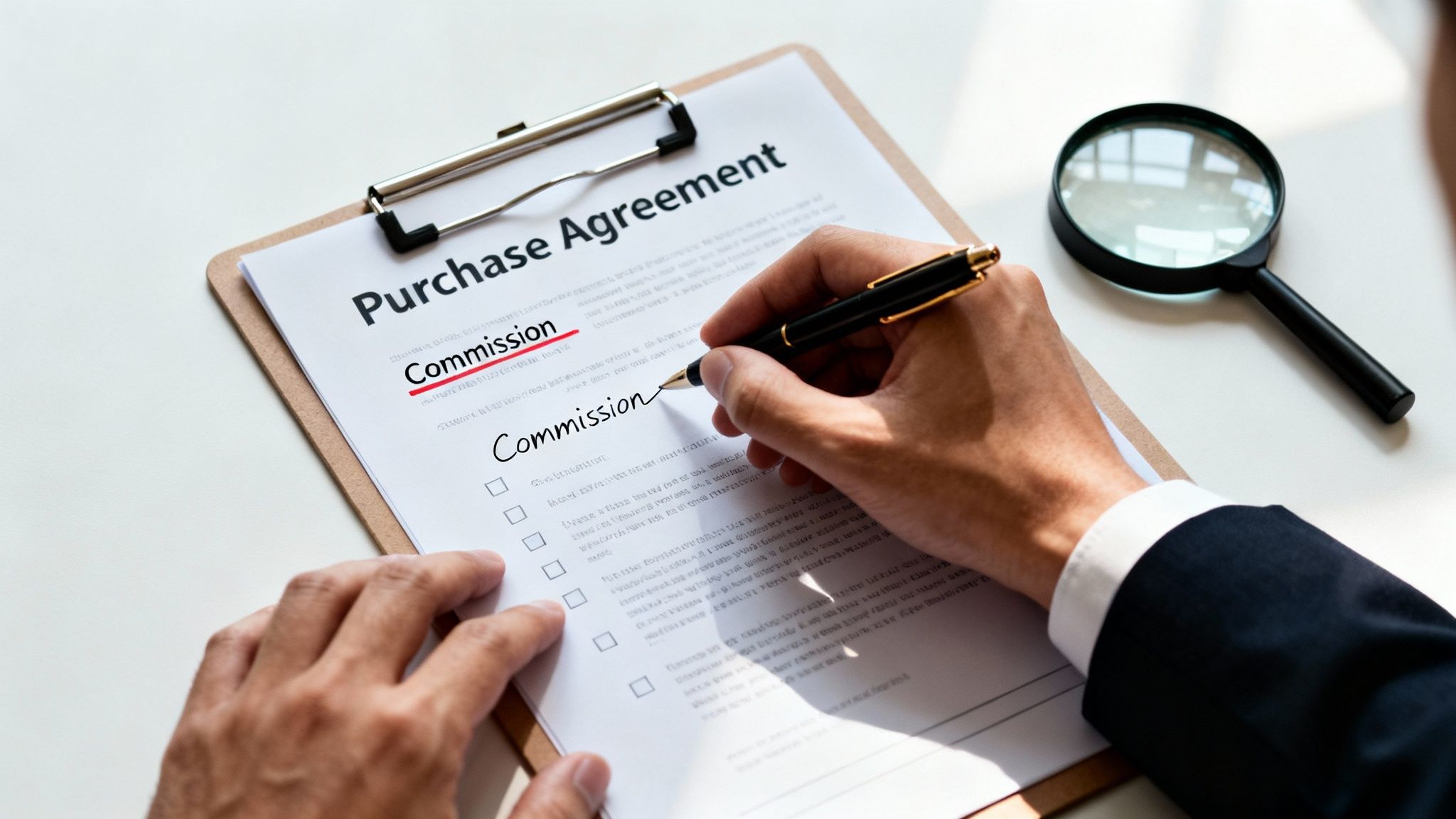
You’ve done the hard work of negotiating, but a handshake won't cut it. To lock in your savings and avoid any nasty surprises down the road, you absolutely must get the agreed-upon commission terms in writing. This isn't just a formality; it's the final, crucial step in the whole process.
This document is your legal safety net. In most of Europe, the terms will be laid out in a buyer representation agreement—what the French call a mandat de recherche, for instance—or detailed within the purchase offer itself. Whatever you do, don't move forward on a verbal promise.
What to Look for Before You Sign
It's time to put on your glasses and review every single clause. Vague language is a red flag. The contract needs to be crystal clear, spelling out the exact commission rate or flat fee you negotiated.
Keep an eye out for these common traps that can quickly erase your hard-won savings:
- Hidden Admin Fees: Some agencies love to tack on extra "dossier fees" or "administrative charges" on top of their commission. Ask about this directly and make sure the contract specifies the total, all-inclusive cost.
- VAT (Value-Added Tax): Remember, agent commissions in Europe are typically subject to VAT (TVA in France, IVA in Spain). You need to clarify if the rate you discussed is inclusive or exclusive of this tax. It can be a significant addition, often 20% or more.
- Vague Service Scope: The agreement should clearly define what services the agent will provide for their fee. This simple step can prevent major headaches later if you feel they haven't held up their end of the bargain.
The single biggest mistake an international buyer can make is signing a standard contract without ensuring their specific terms are added. Boilerplate language is designed to protect the agent, not you. Make sure your negotiated points are explicitly written in, overriding any generic clauses.
A Final Pre-Signature Checklist
Think of this as your last line of defense. A detailed review now saves a world of trouble later. Going through a complete real estate due diligence checklist will also put you in the right mindset for this final check.
Before your pen touches that paper, run through these points one last time:
- Is the Commission Rate Correct? Does the percentage or fixed amount in the contract match what you agreed on? No typos, no ambiguity.
- When is Payment Due? The agreement must clearly state the trigger for payment. This is almost always upon the successful completion of the sale—the final signing at the notary's office.
- What's the Exclusivity Clause? Be sure you understand the terms of any exclusivity period. How long are you tied to this agent, and what are the exit conditions if things don't work out?
By getting every detail documented meticulously, you cement your savings and can proceed with your property purchase in Europe with genuine confidence and full legal protection.
Common Questions Answered
When you're navigating a property deal in Europe, especially from abroad, questions are bound to come up. Trying to figure out how to handle agent commissions can feel like walking on eggshells. Let's clear up a few of the most common things international buyers ask.
Is It Considered Rude to Negotiate Commission in Europe?
Absolutely not, especially if you're a serious international investor. While the approach might change from place to place—what’s considered direct in Germany might feel a bit forward in Italy—discussing fees is just part of doing business. European agents, particularly those working on higher-value deals, generally expect to have a conversation about their commission.
The trick is to handle it professionally. Don’t just ask for a discount; come prepared. Show you've done your homework on local market rates and can justify your position. This positions you as a knowledgeable partner, not just someone trying to haggle.
Can I Negotiate After Signing an Agreement with an Agent?
This is a tough spot to be in, and I strongly advise against it. Once you've signed a buyer representation agreement (what the French call a mandat de recherche, for instance), that commission rate is pretty much locked in. It's a binding contract, and your leverage evaporates the moment your signature hits the paper.
Remember, your negotiating power is at its absolute peak before you've committed to anything. That's when agents are still competing for your business. Trying to change the terms later is messy, can damage your relationship with the agent, and often requires getting lawyers involved. Settle all the commission details first.
Will a Lower Commission Mean I Get Worse Service?
It’s a fair question, but a lower commission doesn't automatically equal poor service. A real professional's standards shouldn't dip just because you’ve negotiated their fee to a fair market rate. The aim is to land on a number that genuinely reflects the work involved for your specific purchase.
A great way to approach this is to tie the agent’s compensation to your success. Instead of just cutting the rate, you could propose a performance-based fee. For example, offer a bonus if they can secure the property below the asking price or help you close the deal faster than expected. This way, their motivation is directly linked to getting you the best possible outcome.
Ready to find your dream home in Europe? At Residaro, we provide the listings and insights you need to make a smart investment. Start your search today.