What Is a Buyer's Agent? A Home Buying Guide

Think of a buyer's agent as your personal advocate in the often-murky waters of a real estate deal. They are licensed professionals who have a legal and ethical obligation to represent your best interests—and only yours—when you're buying a property.
Your Advocate in the Property Market
Would you go into a high-stakes negotiation without an expert on your side? Probably not. It's the same principle in real estate. The agent hosting an open house works for the seller; their job is to get the highest price. A buyer’s agent, on the other hand, is your dedicated guide and negotiator.
Their entire focus is on finding you the right home at the best possible price, with the most favorable terms. It's no surprise that having this kind of expert representation is becoming the norm. A recent report found that a massive 88% of homebuyers hired an agent for their purchase, an all-time high. This statistic alone speaks volumes about the value buyers see in having a pro in their corner. You can read the full insights on real estate agent trends to see why.
Understanding Their Core Role
The relationship between you and your buyer's agent is built on a legal concept called fiduciary duty. It’s a formal way of saying they owe you complete loyalty. They're there to offer an objective, experienced perspective during what can be a very emotional journey.
Essentially, they act as a crucial buffer between you and the seller's interests. This guidance helps you sidestep common mistakes, like overpaying for a home in a hot market or missing a critical detail buried in the contract fine print.
Key Responsibilities of a Buyer's Agent at a Glance
A great buyer's agent does far more than just unlock doors. They're master coordinators, managing dozens of critical tasks behind the scenes to make sure your purchase goes smoothly from start to finish.
The table below breaks down their main duties across the different stages of the buying process.
| Phase of Purchase | Buyer's Agent Responsibility |
|---|---|
| Initial Search | Digging up properties that fit your criteria, including off-market homes you won't find on public websites. |
| Property Vetting | Running a comparative market analysis to gauge value, researching the neighborhood, and flagging potential red flags. |
| Offer & Negotiation | Structuring a compelling offer and negotiating the price, terms, and any contingencies to your advantage. |
| Due Diligence | Arranging essential property inspections and appraisals, then helping you interpret the complex reports. |
| Closing Process | Juggling all the paperwork, deadlines, and communication between lawyers, lenders, and the seller’s agent. |
In short, they're your project manager, strategist, and advocate, ensuring nothing falls through the cracks on the path to getting your keys.
Buyer's Agent vs. Listing Agent: Who's Actually on Your Side?
Figuring out the difference between a buyer's agent and a listing agent isn't just about real estate jargon—it’s about money, your money. The entire property world hinges on representation, and you absolutely need to know who is legally obligated to have your back.
Think of it this way: in a legal battle, you'd never dream of hiring the same lawyer as your opponent. Real estate is no different. Each agent has a specific, legally-binding loyalty to one side of the deal.
The Heart of the Matter: Fiduciary Duty
This all comes down to a legal principle called fiduciary duty. It’s a formal way of saying an agent must act entirely in their client's best interest, putting those interests above everyone else's—even their own.
A listing agent (or seller’s agent) owes this duty to the seller. Period. Their job is to get the highest possible price for the property on the best terms for their client. Every ad they run, every negotiation tactic they use, is aimed at that one goal.
A buyer's agent, on the other hand, owes their fiduciary duty only to you, the buyer. Their entire mission is to get you the right property for the lowest possible price and on terms that favor you. They're your strategist, your negotiator, and your advocate from start to finish.
This diagram shows how a buyer's agent puts you at the center of the universe, guiding everything from the first search to handing over the keys.
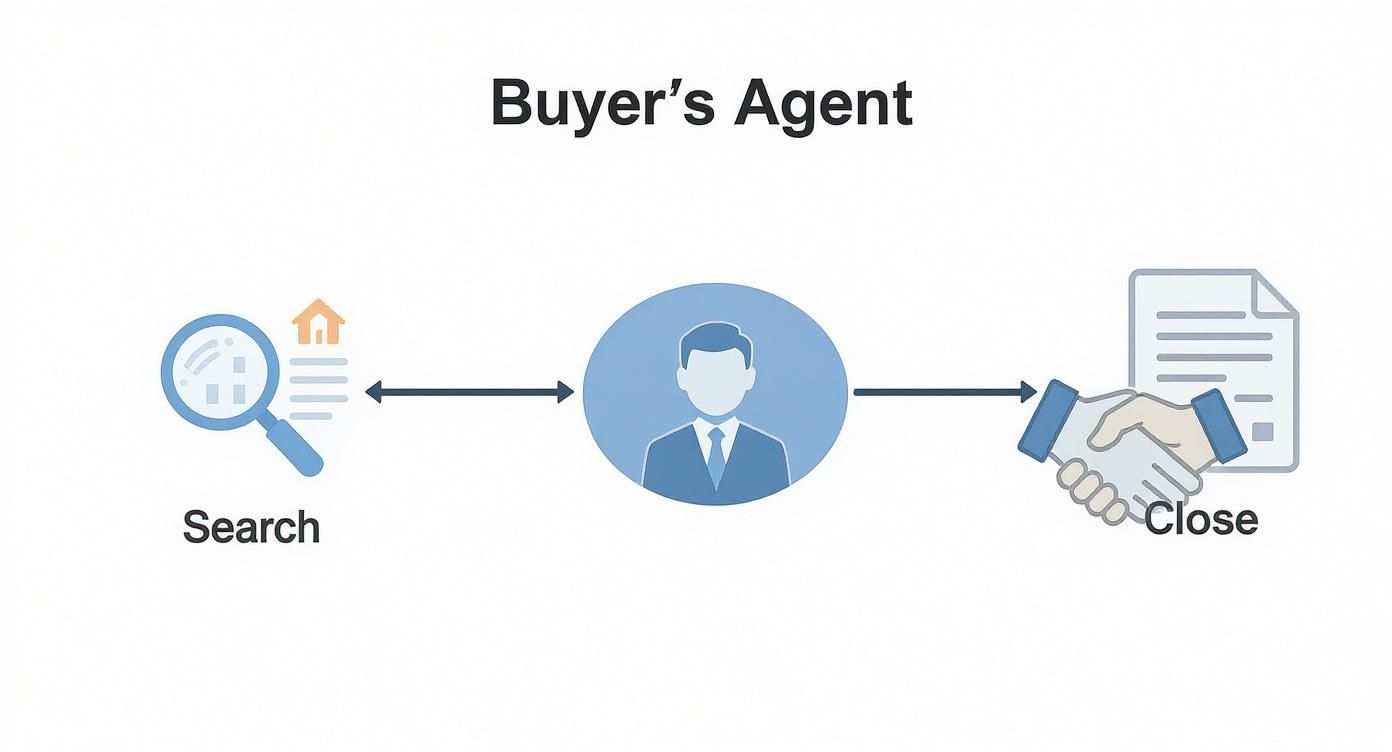
As you can see, their role is to wrap a complete cycle of support around you, making sure you’re protected every step of the way.
The Problem with "Dual Agency"
This brings us to a tricky and often risky situation known as dual agency. This is when one agent tries to represent both the buyer and the seller in the same transaction. It sounds efficient, but it’s an immediate conflict of interest.
Seriously, how can one person fight to get the seller the highest price while simultaneously fighting to get the buyer the lowest?
They can't. It's impossible.
In a dual agency scenario, the agent is forced to become a neutral middleman instead of a dedicated champion for either side. This "neutrality" strips you of the expert advice and hard-nosed negotiation you’re supposed to be paying for.
Because of this built-in conflict, dual agency is illegal or strictly regulated in many places. Even where it's allowed, it requires everyone to sign off on it. But consent doesn't fix the problem. You're still left in a compromised position where the agent's main goal shifts from fighting for you to just closing the deal.
The takeaway here is simple. That charming agent you meet at an open house works for the seller. They are legally bound to them. While they can give you facts about the house, their loyalty isn't with you. To make sure someone is truly in your corner, you need your own buyer's agent.
How Your Buyer's Agent Gets Paid
Alright, let's talk about the big question: "This all sounds great, but what's it going to cost me?" It’s probably the first thing that pops into your head, and for good reason. Many buyers assume they'll have to write a huge check to their agent, but that's a common misconception.
Most of the time, the payment structure is a pleasant surprise. It's set up to give you expert representation without forcing you to pay a massive fee out of your own pocket right away.
Who Really Pays the Commission?
The secret lies in the total commission, a fee typically paid by the seller when the property is sold. When a homeowner decides to sell, they agree to pay a percentage of the final sale price as a commission to their listing agent.
But that commission isn't just for one agent. It's meant to be split between the two key players who get the deal done:
- The Listing Agent (representing the seller)
- The Buyer's Agent (representing you!)
This cooperative system is what makes the real estate world go 'round. It gives buyer's agents a strong incentive to show your future home to qualified buyers like you, which helps the seller find the right buyer faster.
In essence, the seller covers the cost of your agent's fee as part of their overall expense of selling the home. This setup means you get a dedicated expert in your corner without a direct, upfront cost.
While this traditional model has been the standard for years, the industry is seeing some changes that bring more clarity to these fees. Even so, most sellers continue to offer this compensation to make sure their property gets in front of the largest possible audience of buyers.
Let's Follow the Money: A Real-World Example
To make this crystal clear, let's walk through how the money flows. Imagine you've just found the perfect home and your offer of $500,000 is accepted.
The seller had already agreed with their agent to a 6% total commission when they first listed the property. Here’s what happens at closing:
-
Total Commission is Calculated: The full commission is 6% of the $500,000 sale price, which comes out to $30,000.
-
Seller Pays from Sale Proceeds: This $30,000 is paid by the seller directly from the money they make on the sale. You don't write a separate check for it.
-
The Commission is Split: The $30,000 is then divided between the two real estate brokerages. A 50/50 split is very common, so each brokerage gets $15,000 (or 3%).
-
Your Agent Gets Their Cut: Your agent then gets paid their share from that $15,000, based on the agreement they have with their own brokerage.
So, while your agent worked exclusively for you, their payment ultimately came from the seller's proceeds. This is what makes a buyer's agent so accessible—their income is tied directly to getting you successfully to the closing table.
The Real Value of a Great Buyer's Agent
With countless property listings just a click away, you might be asking yourself, "What does a buyer's agent really do that I can't do myself?" The answer goes far beyond just finding houses. A great agent brings insider access, sharp negotiation skills, and a critical layer of protection against expensive mistakes—things that online portals simply can't offer.

Think of them as your strategic advantage in a competitive market. They bring a level of expertise that saves you time, money, and a whole lot of stress. This value really shines through when the market gets tough.
For example, when U.S. existing-home sales recently hit their lowest point since 1995 because of high mortgage rates, buyer's agents were indispensable. They helped buyers find a way forward in a challenging environment where median home prices were still climbing.
Unlocking Exclusive Property Access
One of the first things you'll notice is that an agent can show you properties you would otherwise never see. Sure, public websites show a lot, but they don't show everything.
Your agent has a key to the Multiple Listing Service (MLS), a powerful database shared exclusively among real estate professionals. This isn't just a list of homes; it's a source of real-time, detailed information that the public rarely sees. Even better, agents are plugged into a human network that often shares "off-market" or "pre-market" listings—homes that are for sale but aren’t being advertised publicly.
This gives you a massive head start. You get to view and make an offer on a property before it ever hits the open market, sidestepping the inevitable bidding wars.
A Master Negotiator in Your Corner
Getting a home under contract is about so much more than just agreeing on a price. It's a delicate dance of negotiations involving contingencies, closing dates, repair requests, and other crucial terms that can make or break the deal.
A skilled buyer’s agent is a negotiator who uses data, not emotion, to get you the best terms. They run a detailed comparative market analysis (CMA) to make sure you don't overpay and know exactly how to structure an offer that looks great to the seller while fiercely protecting your interests.
Think of your agent as a professional buffer between you and the seller’s agent. They handle the tough conversations, taking the emotion out of the equation so they can focus on one thing: getting the best possible outcome for you.
This objective, expert-led approach almost always results in a lower purchase price and better contract terms, potentially saving you thousands of dollars over the life of your loan.
Protecting You From Costly Mistakes
A property transaction is a legal minefield of contracts, disclosures, and deadlines. One missed signature or a single overlooked clause can spiral into serious financial or legal trouble.
Your buyer's agent is your project manager, making sure every piece of paper is handled correctly and every deadline is hit. They'll walk you through complex documents, translating the legalese into plain English so you know exactly what you're signing.
They also act as your guide through the all-important due diligence phase. They will help you:
- Arrange Professional Inspections: They have a trusted network of inspectors and can coordinate everything from a general home inspection to more specialized checks for things like pests or structural integrity.
- Interpret Inspection Reports: They help you make sense of the findings, explaining which issues are minor fixes and which are potential deal-breakers.
- Negotiate Repairs: If problems crop up, your agent steps back in to negotiate with the seller for repairs or credits, protecting your investment.
This expert oversight is priceless. To learn more about this step, check out our comprehensive guide on the real estate due diligence checklist. Simply put, your agent is your first line of defense, making sure you make a sound, informed decision without any costly surprises down the road.
How to Find the Right Buyer's Agent for You
Choosing your buyer's agent is just as critical as choosing the right home. Think of them as your guide, negotiator, and advocate through one of the biggest financial decisions you'll ever make. But with so many professionals out there, how do you find the one who truly has your back?
This isn't a decision to take lightly. The real estate world is packed with agents. Just to give you an idea, in the United States alone, there were around 1.6 million real estate agents in 2025—a number that can sometimes exceed the total number of homes sold in a year. This statistic, highlighted by industry analysis from sources like bizplanr.ai, shows exactly why you need to be selective. The quality of service varies wildly.
Your goal is to find an agent who isn't just competent, but is the right fit for your specific needs, personality, and situation. Let's walk through how to find that perfect partner for your property journey.

Where to Start Your Search
Finding top-tier candidates starts with trusted sources and some smart research. Don't just pick the first name you see on a billboard. A more thoughtful approach here will pay off in a big way down the road.
First, tap into your personal network. Ask friends, family, and colleagues who've recently bought a home for referrals. A firsthand recommendation from someone you trust is often the most reliable sign of an agent's skill and dedication to their clients.
Next, head online but be strategic. Look past the generic reviews and dig into agents' professional websites and social media. Are you looking for a historic apartment, a modern condo, or new construction? Find a specialist in your desired neighborhood or property type. Their online presence should scream deep, local expertise.
Your Non-Negotiable Agent Checklist
Once you have a shortlist of a few potential agents, it's time to vet them against some key criteria. A great buyer's agent should bring these non-negotiable traits to the table:
- Deep Local Market Knowledge: They should know the streets, schools, and market dynamics of your target area like the back of their hand.
- Stellar Communication Skills: You need someone who is responsive, clear, and keeps you in the loop every step of the way—no radio silence.
- Verifiable Experience: Look for a solid track record of successful deals, especially with buyers in a similar boat as you.
- A Strong Negotiation Strategy: They need to prove they can fight for your best interests when it's time to make an offer.
Finding the right professional is a detailed process. For an even deeper dive, our guide on how to choose the right real estate agent offers more specific tips to help you zero in on the perfect match.
The Interview: Powerful Questions to Ask
Now for the most important part: interviewing your top candidates. This is your chance to really gauge their expertise, see how they operate, and feel out if their working style clicks with yours.
Remember, the interview is a two-way street. You’re evaluating their skills, but they’re also learning about your needs to see if it’s a good fit. Treat it like you're hiring for the most important job in your property journey—because you are.
The right questions will help you find a true professional who aligns with your goals. The table below outlines some essential questions to help you dig deeper than the surface-level stuff.
Essential Questions to Ask a Potential Buyer's Agent
Use these interview questions to vet potential agents and ensure you find a professional who aligns with your needs and communication style.
| Category | Question to Ask |
|---|---|
| Loyalty & Advocacy | How will you protect my interests when dealing with a seller's agent? |
| Strategy & Tactics | What's your strategy when we find ourselves in a multiple-offer situation? |
| Problem-Solving | Can you share an example of a difficult deal and how you navigated it? |
| Market Expertise | How do you stay on top of market trends and find off-market properties? |
| Client Service | How many clients are you currently working with? |
| Experience | What percentage of your clients are buyers like me (e.g., international, first-time)? |
| Communication | What's your preferred way to communicate, and how often will I hear from you? |
| Fees & Contracts | Can you walk me through your fee structure and the key terms of your agreement? |
Asking these kinds of questions will reveal an agent's true capabilities and whether they're the right advocate to have in your corner.
Understanding the Buyer-Broker Agreement
Once you’ve found "the one," the final step is to make it official by signing a buyer-broker agreement. This is a legal contract that clearly lays out the agent's responsibilities to you and your obligations to them. It defines the scope of their work, the length of the agreement, and exactly how they get paid.
Don't just skim this document. Read it carefully, paying close attention to the terms, especially any exclusivity clauses and the contract duration. This agreement is what solidifies your partnership, ensuring your agent is officially and exclusively working for you. It's the official start of your journey together.
Navigating International Property Markets
Buying property in your own country is tricky enough. But when you take your search abroad? You're stepping into a whole new world of different laws, languages, and local customs that can turn an exciting dream into a bureaucratic nightmare.
This is precisely where a local buyer's agent proves their worth. They aren't just helpful; they're an essential part of your team. Think of them as your personal guide and translator, the expert on the ground who knows the system inside and out. Their job is to make sure a simple cultural misunderstanding doesn't turn into a costly mistake.
Country-Specific Hurdles and How an Agent Helps
Every European country has its own unique way of doing things. An agent who’s used to working with international buyers knows how to handle these specific challenges, turning potential roadblocks into a clear, manageable path forward.
Let's look at a few popular destinations to see what this means in practice:
-
Sweden's Bidding Wars ('Budgivning'): The final price of a Swedish property is often decided in a fast and furious bidding war called a 'budgivning'. A good agent helps you build a smart bidding strategy, tells you when to push forward and, just as importantly, when to walk away. They keep you from getting caught up in the heat of the moment and overpaying.
-
France's Preliminary Contracts ('Compromis de Vente'): The French process hinges on a legally binding preliminary contract, the 'compromis de vente'. Your agent will walk you through every single clause—especially the critical contingency periods ('clauses suspensives')—before you even think about signing. This protects your deposit and your legal rights.
-
Italy's Bureaucratic Maze: Italy is as famous for its complex bureaucracy as it is for its stunning villas. A local agent acts as your project manager, guiding you through getting a fiscal code ('codice fiscale'), opening a bank account, and finding a trustworthy 'notaio' (notary) to finalize the deal. They can save you months of headaches.
Getting a handle on these foreign systems is a steep learning curve. For a bigger-picture look at what's involved, check out our guide on how to buy property overseas.
More Than Just a Translator
Sure, overcoming the language barrier is a huge plus, but a great international buyer's agent does so much more. They open the door to their trusted network of local professionals—people like English-speaking lawyers, reliable mortgage brokers, and thorough property inspectors. This network is built on years of experience, giving you instant access to the best people for the job.
A skilled international buyer’s agent doesn't just find you a property; they build a protective bubble around your transaction. They anticipate cultural nuances, foresee legal hurdles, and manage the entire process to shield you from the common pitfalls that foreign buyers face.
This proactive, protective role is where they provide the most value. They become your single point of contact, coordinating all the moving pieces so you can focus on the excitement of your new home, not the stress of the paperwork.
Why You Absolutely Need an Expert for Spain and Portugal
Some countries have specific legal hoops to jump through that make an agent's guidance almost non-negotiable, especially if you're a non-EU buyer.
Take Spain, for example. Every foreign buyer must get a Foreigner's Identification Number (NIE) before any major transaction can happen. An agent knows exactly how to manage this application, which can be a real challenge to handle from another country. On top of that, property laws can change dramatically from one of Spain's autonomous regions to the next, and your agent ensures you're following all the local rules.
In Portugal, the process is a tight collaboration between your agent and a lawyer. This is particularly true if you’re applying for a residency program like the Golden Visa. Your agent finds the perfect property while your lawyer handles all the legal due diligence. They work as a team to secure both your investment and your legal status. In both countries, your agent is your champion, making your path to ownership as smooth as it can possibly be.
Common Questions About Buyer's Agents
Even after grasping the benefits, some practical questions always pop up. Let's tackle these common queries head-on so you can move forward with confidence.
Can You Work with Multiple Buyer's Agents at Once?
Technically, yes. But it's a terrible idea, and here’s why. A good buyer's agent works for you on a commission-only basis, investing countless unpaid hours into your search. They are betting their time and resources on your success.
When you bring multiple agents into the mix, you dilute their commitment. They know their hard work might end up putting a commission in someone else's pocket. To get the best service, find one fantastic agent you click with and sign a buyer-broker agreement. That exclusivity ensures you have their undivided attention and loyalty.
What if You Hired the Wrong Agent?
It happens. If you feel like your agent isn't delivering, the first step is to have a frank conversation. Clearly explain your concerns and what you need from them. A simple, honest chat can often resolve misunderstandings and get the relationship back on track.
If things don't improve, it's time to check your buyer-broker agreement. Nearly all contracts include a termination clause that spells out how to end the partnership. Follow those steps to part ways professionally before you start looking for a new agent.
Key Takeaway: An agent’s true value shines when things get messy. Think of them as your professional guide through a high-stakes, stressful process—much like you'd hire a lawyer for a legal battle. Their expertise is there to protect what is likely your largest financial investment.
Are Agents Still Needed with So Many Online Listings?
Absolutely. Property portals are fantastic for window shopping, but they only tell part of the story. A buyer's agent has access to a hidden inventory: off-market properties and deals sourced through their professional network long before they ever appear online.
More importantly, an agent's real work begins where the online listing ends. They're the ones digging into true market values, crafting offers designed to win, negotiating hard on your behalf, and navigating the mountain of complex paperwork through to closing. That’s a level of expertise and advocacy a website just can't offer.
Ready to find your dream home in Europe with an expert by your side? Residaro connects you with a vast selection of properties in premier destinations. Start your property search today.