Your Guide to Real Estate in Milan Italy
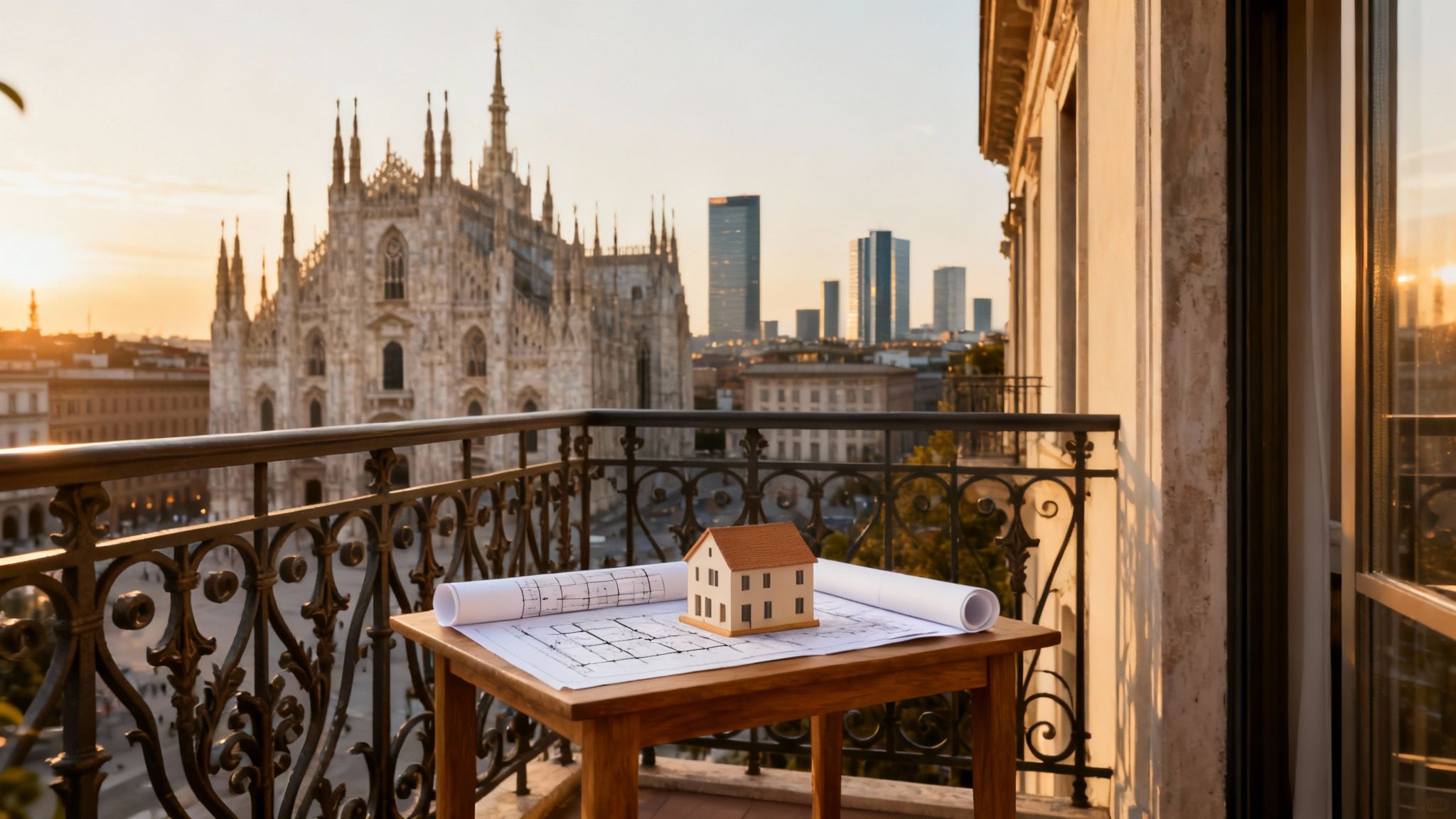
Welcome to the definitive guide on buying real estate in Milan, Italy. Milan is much more than just a global capital of fashion and finance. Beyond the glamour, you'll find a property market that's both remarkably resilient and surprisingly profitable—a perfect match for lifestyle buyers and sharp international investors alike.
Why Milan's Property Market Is a Global Magnet
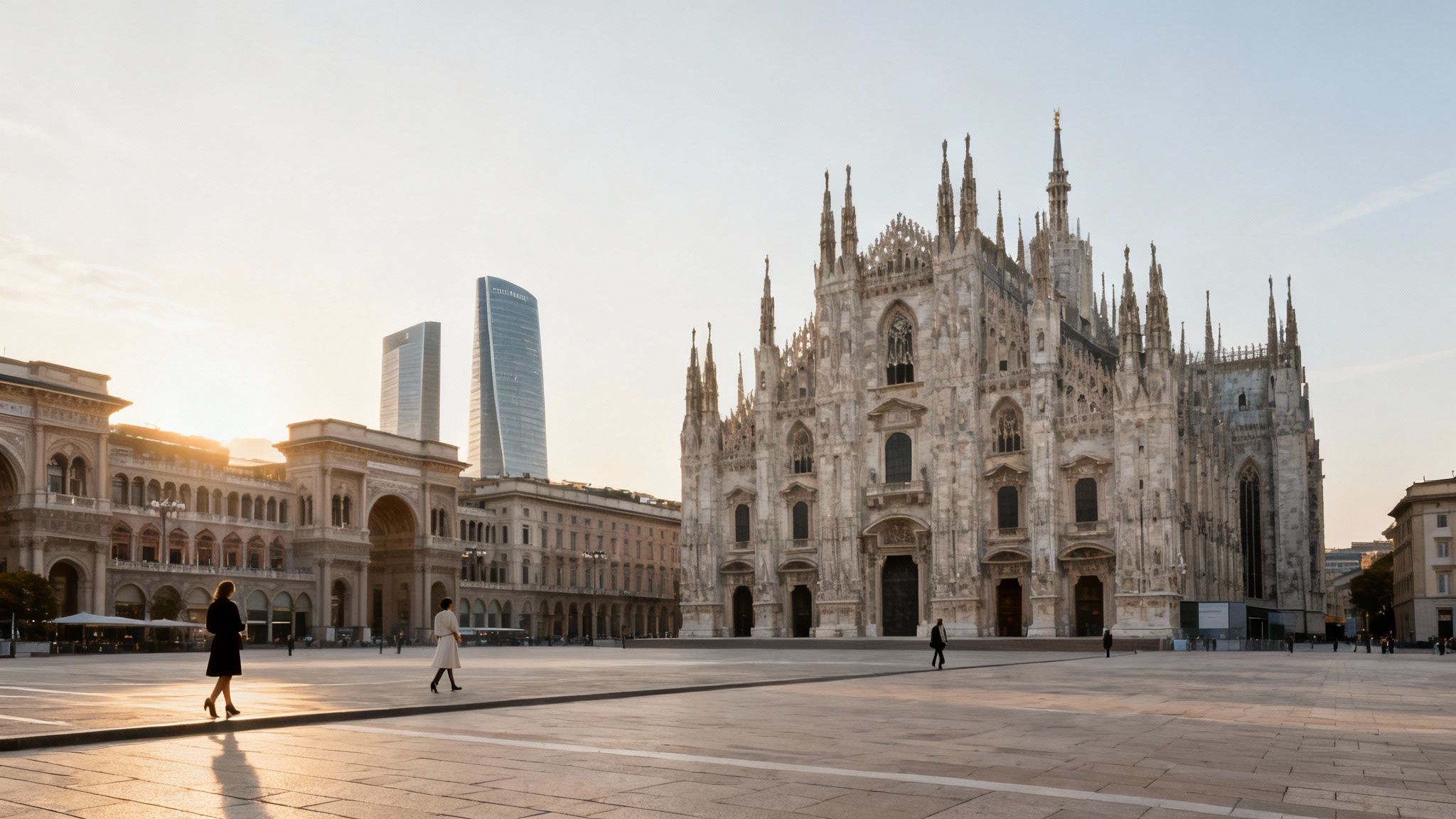
Milan isn't just another beautiful Italian city; it's the nation's economic powerhouse. This unique blend of deep cultural roots and financial muscle makes it an absolute hotspot for property investment. It's a market that consistently turns heads, promising not just a superb quality of life but also the potential for solid, reliable returns.
A Story of Resilience and Growth
The Milanese property market has a proven history of long-term strength that really sets it apart. While other markets can be a rollercoaster, real estate here has shown steady, consistent growth for decades.
Think about this: since the year 2000, residential property values in central Milan have skyrocketed, posting a stunning 105% gain. That performance blew past other assets like office and retail spaces during the same stretch. You can dig deeper into Milan's impressive long-term property performance.
We built this guide to be your personal roadmap, cutting through the complexity and giving you clear, actionable advice. We’ll cover everything from decoding local market prices to navigating the buying process as a foreigner, step by step. Our mission is simple: to give you the confidence and know-how to turn your Milan property dream into a reality.
Think of Milan's real estate market like a blue-chip stock in a high-growth industry. It gives you the stability of an established giant, mixed with the exciting energy of a city that's always evolving with massive new urban development projects.
What You'll Find Inside This Guide
This guide is designed to walk you through every critical step of your property journey. We've broken it all down to help you make the best possible decisions. Here’s a peek at what we'll cover:
- Market Analysis: Get a real feel for current prices, typical rental yields, and what the future holds.
- Neighborhood Breakdown: We'll help you find the perfect district that fits your lifestyle and investment goals.
- The Buying Process: A straightforward walkthrough of the legal steps, from putting in an offer to getting the keys.
- Financials Explained: A clear breakdown of the taxes, fees, and financing options available to you as an international buyer.
How to Read the Milan Real Estate Market
To really get a handle on real estate in Milan, Italy, you have to look past the big, flashy headlines. You need to learn how to read the market’s unique language. It’s not about one citywide average; Milan is a city of distinct tiers, and each one plays by its own rules. Getting a feel for these nuances is how you spot genuine value and make a smart move.
Think of Milan’s market as a multi-level department store. On the top floor, you’ve got the ultra-luxury segment, driven almost entirely by global wealth and international buyers. Down a level, the vibrant mid-range offers steady, reliable growth for both homeowners and investors. Each floor has its own prices, trends, and typical customer.
Decoding Prices and Yields
The most fundamental metric—the market's heartbeat, really—is the price per square meter (€/m²). As of mid-2024, the citywide average is sitting around €5,400 per square meter, which officially makes Milan Italy's most expensive major city. But that number is just a starting point.
In the most exclusive central districts like Brera or the Quadrilatero della Moda fashion district, premium properties can easily shoot past €13,000 to €15,000 per square meter. If you move out just a bit to the well-connected, semi-central neighborhoods, you'll find averages dropping to between €6,000 and €8,000. And in the more peripheral but up-and-coming areas, prices become much more accessible, often landing in the €3,000 to €4,500 range.
This incredible price variation creates a fascinating landscape for anyone looking to buy, which we can see more clearly below.
Milan Property Prices by Zone
The price you'll pay in Milan is all about location. The difference between a central historic apartment and one in a developing outer neighborhood can be staggering, but each zone offers a different kind of opportunity for buyers and investors.
| Zone | Average Price per m² (Current) | Projected Price per m² |
|---|---|---|
| Central (e.g., Brera, Porta Nuova) | €10,000 - €15,000+ | Stable growth, high demand |
| Semi-Central (e.g., Porta Romana) | €6,000 - €9,000 | Strong appreciation potential |
| Peripheral (e.g., Lambrate, Bovisa) | €3,000 - €5,000 | Highest growth potential |
As you can see, the real value hunt happens just outside the historic core, where development projects and new infrastructure are creating the next hotspots.
Of course, for an investor, rental yield is just as important as the purchase price. In Milan, you can generally expect gross rental yields to fall somewhere between 3% and 5%. Interestingly, the highest yields aren't always in the most expensive central areas. You'll often find them in neighborhoods popular with students and young professionals, where purchase prices are lower relative to what you can charge for rent.
The Two-Speed Market Phenomenon
One of the most important things to understand about Milan's property market right now is its "two-speed" nature. This means the high-end luxury sector and the general residential market are moving at completely different paces. While the overall market has seen steady, healthy growth, the luxury segment has experienced an absolutely explosive surge.
This is largely fueled by international money, especially from ultra-high-net-worth individuals relocating for business or Italy’s attractive tax programs. Since 2020, luxury properties valued over €6 million have seen their maximum prices per square meter jump by nearly 50%. This phenomenal growth is most obvious in the Quadrilatero della Moda, where top-tier property prices shot up from €25,000 per square meter in 2021 to almost €39,000 by 2024—a staggering 56% increase in just three years. For a deeper dive, you can explore the dynamics of Milan's disparate property markets.
Understanding this split is critical. It shows that while the broader market offers stability and solid returns, the luxury tier operates on a global scale, influenced more by international capital than by what's happening in the local economy.
Spotting Future Growth Areas
So, where are the next big opportunities? Prime central districts will always be a safe bet, but the most exciting growth is happening in areas undergoing serious urban regeneration. These are the neighborhoods that offer a compelling mix of lower entry prices and massive potential for appreciation.
Keep an eye out for these tell-tale signs of a neighborhood on the rise:
- Infrastructure Upgrades: New metro lines or railway connections are a game-changer. They slash commute times and dramatically boost property values.
- Urban Renewal Projects: Look for large-scale redevelopments, like old railway yards or industrial zones being transformed into new residential and commercial hubs. These are signals of future growth.
- University and Corporate Expansion: When a new university campus or a major corporate headquarters moves in, it brings a wave of students and professionals who need housing, driving up both rental demand and property prices.
By learning to read these signals, you can move beyond simply buying a property and start making a truly strategic investment in Milan's future.
Finding Your Perfect Milan Neighborhood
Choosing where to buy real estate in Milan, Italy, isn't just about picking a property; it’s about choosing a lifestyle. The city is a vibrant mosaic of distinct neighborhoods, each with its own unique rhythm, architectural feel, and community spirit. Finding the right one is like picking the perfect backdrop for your new life in Italy.
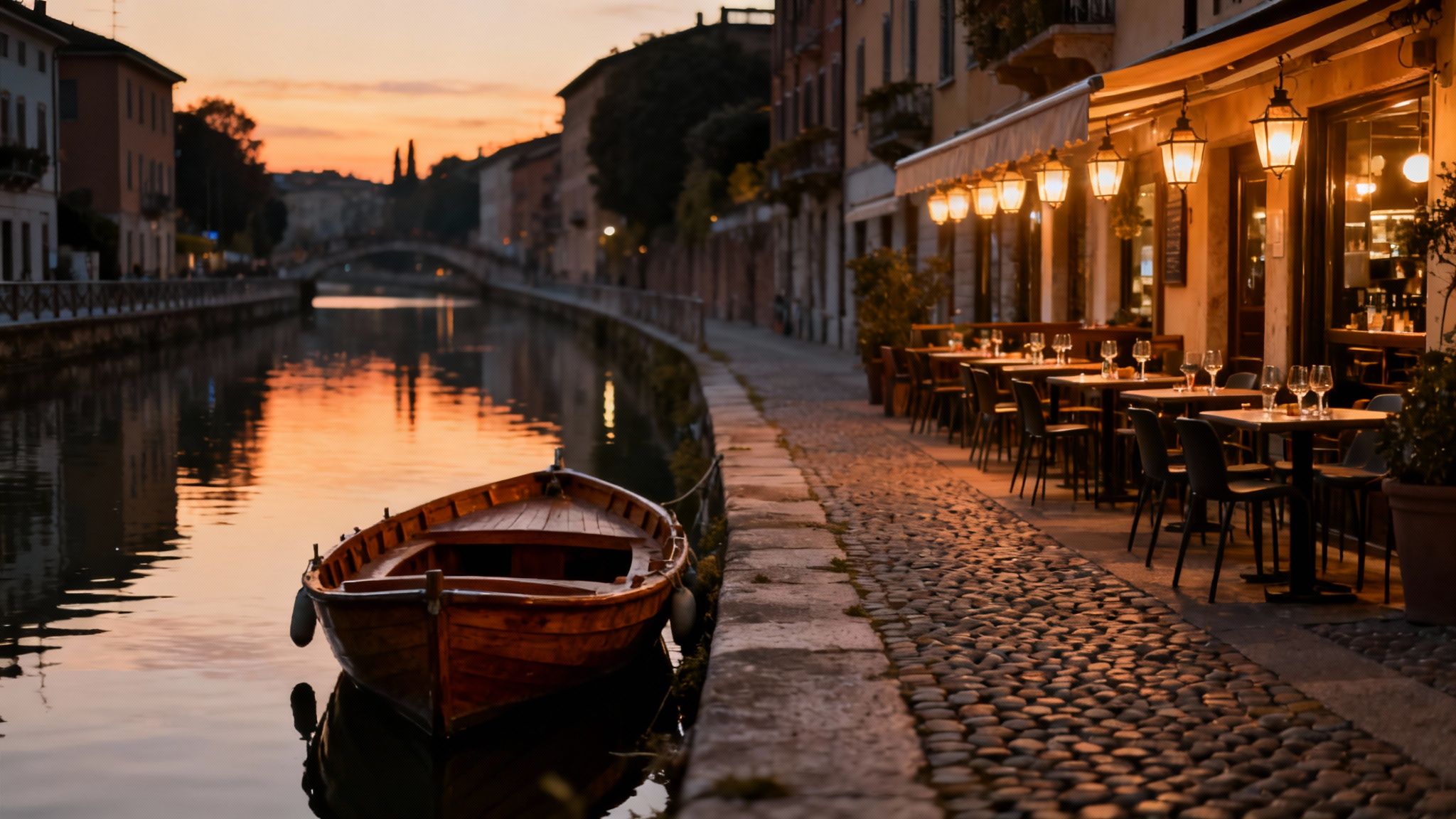
Forget a one-size-fits-all approach. Think of this as a guided tour through Milan’s most compelling areas, from the cobblestoned alleys of its historic heart to the gleaming glass towers shaping its future. This will help you match your personal vision to a specific address on the Milan map.
The Historic and Artistic Heart
For anyone who dreams of living surrounded by timeless elegance and artistic flair, the historic center is the only place to start. These neighborhoods are where Milan’s past and present perform a beautiful, lively dance.
-
Brera: Often called Milan's artistic soul, Brera is a gorgeous maze of narrow, cobblestoned streets, independent boutiques, and charming cafés. It's home to the Pinacoteca di Brera art gallery and attracts a sophisticated crowd. Properties here are often historic apartments in 18th-century buildings, full of character but carrying premium price tags.
-
Navigli: Famous for its canals—partially designed by Leonardo da Vinci—Navigli has an energetic, bohemian vibe. By day, it’s a hub for artists and antique shops; by night, it explodes with life at its countless aperitivo bars and restaurants. It's perfect for those who want a vibrant, social atmosphere right outside their door.
-
Quadrilatero della Moda: As the world's most famous fashion district, this area represents the absolute peak of luxury. It’s an exclusive enclave of high-end brands, discreet courtyards, and prestigious residential buildings. Buying here is a statement, offering unparalleled access to the best of Milanese style.
The Modern and Business-Focused Districts
If you’re drawn to sleek, modern architecture and the quick pace of international business, Milan’s newer districts offer a completely different experience. These areas are magnets for finance professionals, tech entrepreneurs, and global citizens.
You can think of these modern districts as Milan's "new city." They represent a forward-looking vision, blending cutting-edge design with sustainable urban living, and attracting a new wave of international residents and businesses leaving post-Brexit London.
Porta Nuova & Isola: This is Milan's architectural showcase, defined by the iconic Bosco Verticale (Vertical Forest) towers and the Gae Aulenti Piazza. It’s a major business hub, home to the headquarters of UniCredit and other global firms. The adjacent Isola neighborhood, once a traditional working-class area, has been transformed into a trendy spot that mixes old Milan charm with modern innovation.
CityLife: A former fairground brilliantly redeveloped into a futuristic residential and commercial district, CityLife features stunning towers designed by world-renowned architects like Zaha Hadid. It offers luxury apartments, a high-end shopping district, and one of the city's largest public parks. This area is especially popular with families and executives looking for modern comforts and green spaces.
Up-and-Coming Areas with Investment Potential
For the savvy buyer looking for growth, some of Milan's most exciting opportunities lie just outside the traditional prime zones. These neighborhoods are undergoing massive urban regeneration, making them hotspots for future value appreciation.
-
Bovisa: Fueled by the expansion of the Politecnico di Milano university campus, Bovisa is rapidly becoming a hub for students, researchers, and tech startups. With new metro connections and redevelopment projects, property values here have seen impressive growth, with some reports showing a 12% increase recently.
-
Lambrate: Once an industrial zone, Lambrate is now a burgeoning creative district, famous for its key role in Milan Design Week. It’s attracting young professionals and artists with its cool converted loft spaces and more accessible property prices, creating a dynamic and evolving community.
-
Porta Romana: This is a big one. Slated to host the Olympic Village for the 2026 Winter Olympics, the area is undergoing one of the largest urban renewal projects in Europe. The old railway yard is being transformed into a vast new park and residential district, signaling massive long-term growth potential for the entire neighborhood.
Your Step-by-Step Guide to Buying Property in Milan
At first glance, the Italian property-buying process can look a little intimidating. But once you understand the logic behind it, you'll see it’s a well-trodden path designed to protect everyone involved. Think of it as a journey with three major milestones, each one getting you closer to your new home in Milan.
Let’s walk through exactly what you can expect when you’re ready to buy.
Stage 1: The Formal Offer
So, you’ve found the perfect apartment. What now? The first official step is to make a formal written offer, or proposta d'acquisto. This isn't just a casual handshake; it's a legally significant document that kicks things off.
Your offer will lay out the key terms, including:
- The price you’re willing to pay.
- Your proposed timeline for completing the sale.
- The details of your initial deposit (caparra confirmatoria), which is usually 5% to 10% of the purchase price.
You'll submit this offer along with a check for the deposit. The seller typically has between 7 and 15 days to think it over. If they sign on the dotted line, your offer is accepted, the deposit becomes non-refundable, and you're both legally committed to seeing the deal through. This is how the system weeds out anyone who isn't serious.
For a deeper dive into these initial steps, our comprehensive guide on the process of buying a house in Italy has you covered.
Stage 2: The Preliminary Contract
With an accepted offer in hand, you'll move on to the compromesso, also known as the preliminary contract. This is a much more detailed agreement that solidifies every aspect of the sale, making it ironclad for both you and the seller. It’s usually put together by your agent or a lawyer.
This is where all the nitty-gritty details are finalized. The compromesso includes everything from the property's official registration data to its energy performance certificate, and it sets a firm date for the final closing. You'll also pay an additional deposit at this point, bringing your total down payment to somewhere between 10% and 30% of the purchase price.
The compromesso is the real point of no return. If you, the buyer, back out now, you lose your entire deposit. On the flip side, if the seller pulls out, they have to pay you back double your deposit. It’s a powerful incentive that keeps everyone committed.
A quick but crucial side note: before you get to this stage, you absolutely must have your codice fiscale. This is Italy's tax identification number, and you can't complete any major transaction—especially buying property—without one. It’s a simple piece of administrative work, but it’s non-negotiable.
Stage 3: The Final Deed of Sale
This is the grand finale: the rogito notarile, or the final deed of sale. Everything culminates in this formal meeting, which must happen in the presence of a notaio—a specialized legal professional who acts as a neutral public official, ensuring the entire transaction is above board.
The notaio's role is absolutely critical. They are tasked with:
- Legal Checks: Doing the final due diligence to make sure the property is free from any debts, mortgages, or hidden legal issues.
- Ownership Verification: Confirming the seller is, in fact, the rightful owner with the legal authority to sell.
- Witnessing the Transfer: Overseeing the signing of the deed and the transfer of the final payment.
- Official Registration: Filing the new deed with the Italian Land Registry to officially declare you the new legal owner.
On the day of the rogito, you'll transfer the remaining balance of the sale price and pay all the necessary taxes and fees. The notaio will read the entire deed aloud to everyone present. Once all the signatures are down, the seller hands over the keys. Just like that, the property is yours.
The True Cost of Buying Your Home in Milan
The asking price for a Milan apartment is just the starting point. To truly understand your budget and avoid any unwelcome surprises, you need to get familiar with the taxes and fees that come with any property purchase in Italy.
Think of it this way: these extra costs typically add another 10% to 15% on top of the property's price tag. Factoring this in from day one is the smartest way to ensure a smooth, predictable buying process.
A Breakdown of Taxes and Fees
When you buy a home here, you'll be working with a few different professionals and government bodies, and each has a specific fee tied to their role.
Here's a quick look at who you'll be paying and why:
- Real Estate Agent Fee: In Italy, the agent's commission (provvigione) is usually split between the buyer and seller. You can expect your share to be around 3% to 4% of the purchase price, plus VAT.
- Notary Fee (Notaio): This is a non-negotiable cost. The notaio is a legal professional who oversees the entire transaction, drafts the final deed, and registers the sale. Their fee varies with the property’s value but often falls between €3,000 and €6,000.
- Property Transfer Taxes: This is usually the biggest chunk of your closing costs. The amount you owe depends on the property type. For a deeper dive, check out our guide on what property transfer tax is.
The two main taxes you'll encounter are either Registration Tax or VAT.
You'll pay one or the other—never both. It all depends on who you're buying from. If it's a private seller, you pay Registration Tax. If it's a developer, you pay VAT.
If you’re buying a resale property from an individual, you'll pay Imposta di Registro (Registration Tax). This is set at 9% of the property’s cadastral value, which is a government valuation that’s often much lower than the actual market price. Better yet, if this will be your primary residence, the rate drops to just 2%.
On the other hand, if you're buying a brand-new home directly from a construction company, you'll pay IVA (VAT). The standard rate is 10% of the purchase price. But again, if it’s your main home, this is reduced to a much more manageable 4%. Just be aware that designated luxury properties are hit with a higher 22% VAT rate.
How to Get a Mortgage as a Non-Resident
Yes, foreign buyers can absolutely get a mortgage in Milan. Just know that Italian banks tend to be quite conservative. They’ll want to see a very clear and stable financial history before they approve a loan.
Typically, a bank will offer a Loan-to-Value (LTV) ratio of around 60% to 70%. This means you need to be ready to put down a significant deposit of at least 30% to 40% of the property's value from your own funds.
To get the ball rolling, you'll need to pull together some key documents. While each bank has its own specific checklist, you can get a head start by preparing these essentials:
- Proof of Identity: Your passport along with your Italian tax code (codice fiscale).
- Proof of Income: This means recent tax returns, payslips, or if you're self-employed, audited business accounts.
- Bank Statements: Most banks want to see your statements from the last six to twelve months to get a sense of your financial habits.
- Property Documents: You'll need a copy of the preliminary sales contract, known as the compromesso.
Tapping into Milan's Strong Rental Market
If you're looking at real estate in Milan, Italy as an investment, you need to understand the rental market. It’s a powerful engine for returns, and it’s constantly fueled by a steady stream of people moving to the city for its world-class opportunities. This creates a deep, reliable pool of potential tenants.
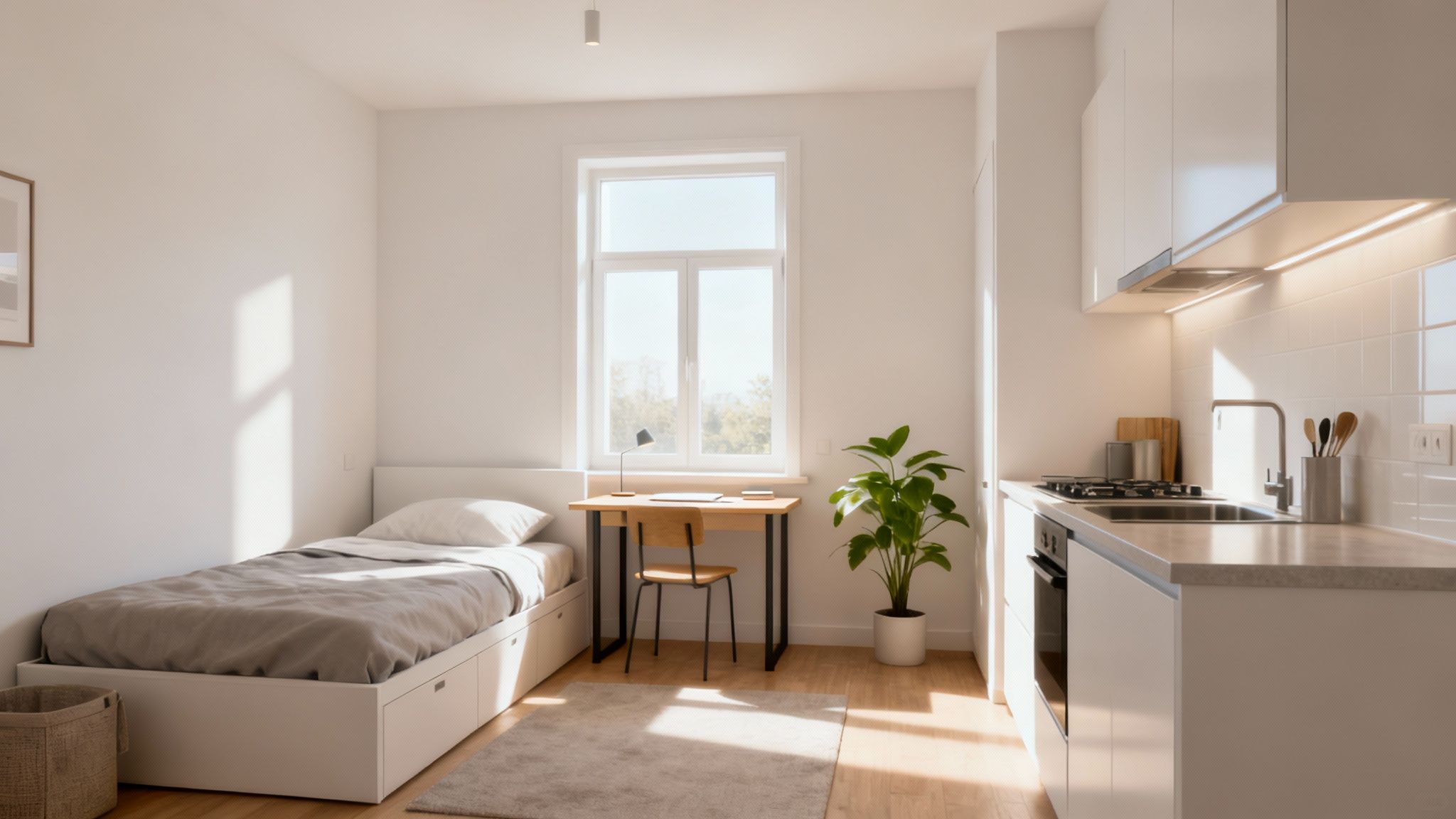
This isn't a recent fluke. The demand is driven by Milan's unshakable status as Italy's economic heart, pulling in major international companies and the ambitious professionals who follow them. Then you have the students. The city’s prestigious university network brings in thousands every year, all looking for a place to live. It's a perfect recipe for a consistently strong rental landscape.
Understanding Tenant Demand and Property Types
Different tenants want different things. That might sound obvious, but really getting a handle on who is looking for what is the key to making a smart investment.
-
Young Professionals and Students: This is a huge demographic, and they’re all about smaller, efficient living spaces. Think compact studios (monolocali) and one-bedroom apartments (bilocali). These are gold, especially if they’re near university campuses like Bovisa or business districts like Porta Nuova.
-
Expat Families and Executives: On the other end of the spectrum, you have international families and relocated execs. They’re looking for comfort and space—two or three-bedroom apartments with modern perks in well-connected residential zones like CityLife or Porta Romana are always in high demand.
This mix of needs is exactly what gives the market its stability. We've seen rental demand across Italy stay incredibly robust, climbing by 4% in 2024 alone. In Milan, that translated into rental price hikes of around 4% just in the first half of the year. Annually, you're looking at rates from €425 per square meter in the city center down to €145 on the outskirts. If you want to dive deeper, you can find more insights on Milan's accelerating rental market.
An investment property in Milan is more than just an asset; it's a service catering to a dynamic population. A well-located studio near a university campus isn't just an apartment—it's a launchpad for a student's career. A modern flat near an international school isn't just a home—it's a crucial piece of an expat family's relocation puzzle.
Navigating Landlord Responsibilities
Becoming a landlord in Italy means getting familiar with the local legal framework. It’s not overly complicated, but you need to know the rules. The most common rental agreement is the contratto di locazione a canone libero (often called a 4+4 contract). It gives you an initial four-year term with an automatic option for another four-year renewal, which offers fantastic stability for both you and your tenant.
Trying to manage a property from another country can feel daunting. That's where professional property management companies come in. They can be your boots on the ground, handling everything from finding quality tenants and collecting rent to dealing with maintenance and legal paperwork. They ensure your investment is not just safe but profitable.
For a full rundown, our guide on how to rent in Italy long term covers all the essential details. By choosing your property type wisely and understanding your responsibilities, you can build a successful and profitable real estate portfolio in Milan's thriving market.
Common Questions on Buying Real Estate in Milan
Thinking about buying property in Milan? It's a big step, and you've probably got a lot of questions running through your head. Let's tackle some of the most common ones we hear from buyers, giving you the clear, straightforward answers you need to move forward.
Can Foreigners Buy Property in Milan?
Yes, absolutely. Italy is very welcoming to international buyers. The rule is based on reciprocity: if an Italian citizen can buy property in your country, you can buy property in Italy. This covers most places, including the US, the UK, and all EU member states.
The process itself is quite well-trodden for foreign buyers. If you're from outside the EU, you'll need to get an Italian tax code—a codice fiscale—but this is just a standard part of the process for any major transaction in the country. It's a simple, necessary step.
What Are the Hidden Costs to Budget For?
This is a big one. To be safe, I always tell clients to budget an extra 10% to 15% of the property’s purchase price for all the associated costs. Thinking about this from the start saves a lot of stress and prevents any nasty surprises right before you get the keys.
So, what does that buffer cover?
- Transfer Taxes: This will be either a registration tax for a resale home or VAT if you're buying a new build.
- Notary Fees: You can't close a deal in Italy without a notary. Their fee is a required cost to legally oversee and register the sale.
- Agent Commissions: Expect this to be around 3-4% of the sale price, plus VAT.
Which Milan Neighborhoods Have the Best Growth Potential?
Everyone knows the blue-chip areas like Brera and Porta Nuova are solid, safe investments. But if you're looking for real growth, the most exciting opportunities are in neighborhoods that are being transformed by urban renewal. Keep a close eye on places like Bovisa and Lambrate.
These up-and-coming areas are drawing in students and young professionals, fueled by university expansions and new transport links. That demographic shift is a recipe for strong rental demand and sets the stage for fantastic long-term value growth.
For buyers looking for future growth, the key is to follow the infrastructure. New metro lines and large-scale regeneration projects, like the one in Porta Romana for the 2026 Olympics, are powerful indicators of where the next wave of value will be created.
Should I Buy a New Build or a Resale Property?
This really boils down to your personal taste and what you want out of the investment. A new-build property gives you modern comforts, better energy efficiency, and a place that’s ready to go from day one—all things that can attract high-quality tenants. The catch is that you'll pay a higher purchase tax (VAT).
A resale property, on the other hand, especially one in a classic historic building, is packed with character and comes with a lower tax bill upfront. The trade-off? It might need a bit of work. It’s a decision that has to line up with your budget and how much of a project you're willing to take on.
Ready to find your perfect home in Milan? Explore exclusive listings and get expert guidance with Residaro. Start your journey today by visiting https://residaro.com.