Explore Milan Italy Real Estate: Insider Tips for Buying in Milan

Welcome to the heart of Italian real estate. The market for Milan, Italy real estate is a potent mix of global finance, high fashion, and timeless culture, making it an incredibly strategic place to put your money. For international buyers, Milan offers not just stable, long-term returns but an urban lifestyle that’s hard to beat.
Why Invest in Milan Real Estate?
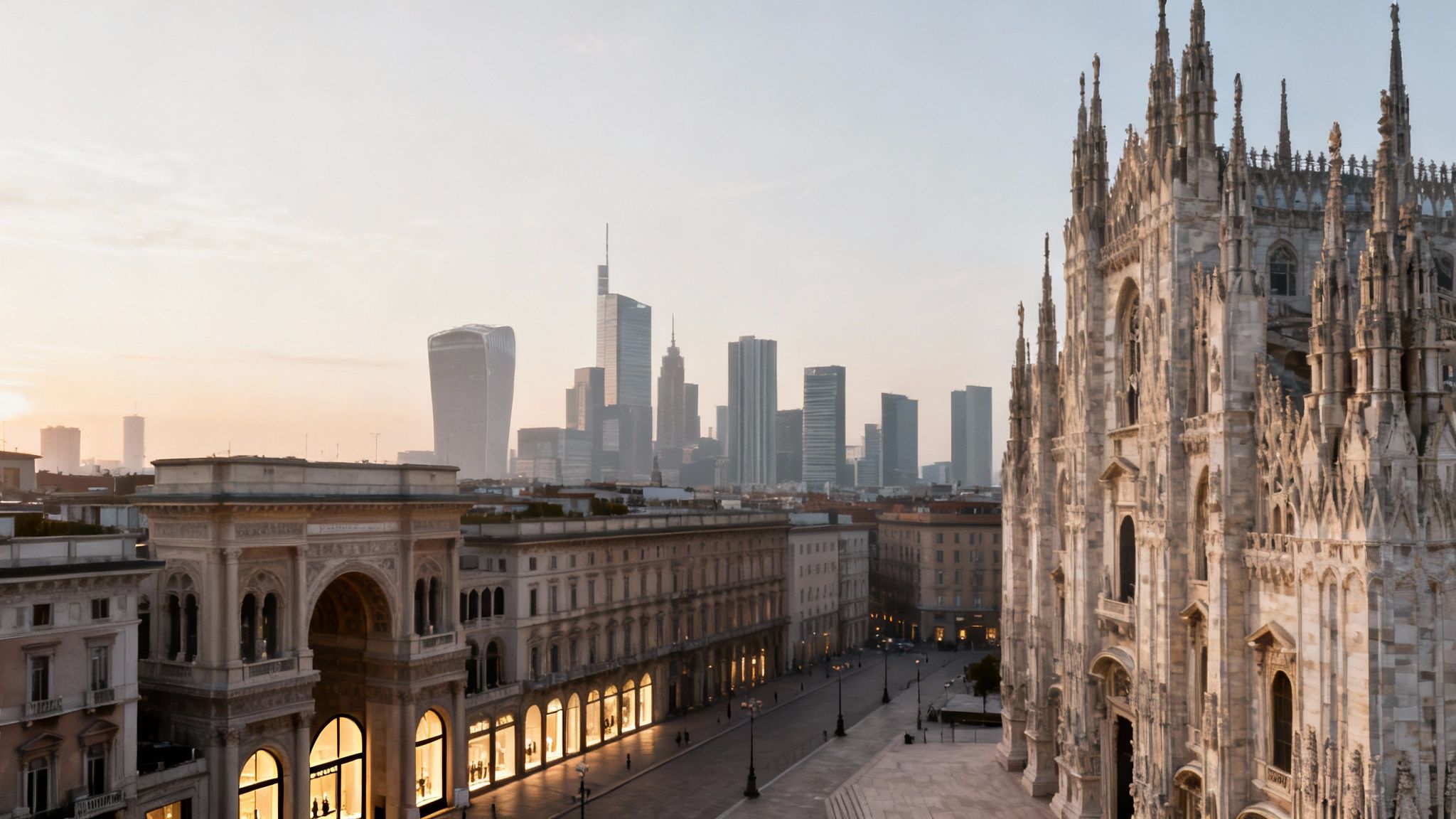
Milan isn't just a place to visit; it’s a living, breathing hub for smart investment. Unlike properties in seasonal tourist traps that boom and bust with the holidays, Milan real estate enjoys consistent demand. Why? Because it’s Italy’s undisputed capital of finance and fashion, and that creates a uniquely resilient market that pulls in buyers from all walks of life.
I often compare Milan's property market to a finely tailored Italian suit—it's a classic investment that holds its value and style year after year. The city is a magnet for professionals, students, and top-tier executives from across the globe, which translates into a rock-solid rental market and serious potential for your property's value to grow.
Key Factors Driving the Market
So, what’s the secret sauce? Several core elements make Milan a magnet for property investors and homebuyers. Getting a handle on these is the first step toward making a smart move.
- Economic Powerhouse: Milan is Italy's economic engine. It's home to the national stock exchange and the headquarters of countless multinational corporations, which means a constant influx of high-earning professionals needing a place to live.
- Cultural and Lifestyle Magnet: The quality of life here is exceptional. You get a blend of world-class art, dining, fashion, and history that few cities can match, making it an incredibly desirable place to call home.
- International Appeal: Milan's global reputation draws a steady stream of international students, expats, and tourists. This fuels both the long-term rental market and the lucrative short-term let sector.
- Stable Growth: The market has shown consistent, steady growth, sidestepping the wild price swings we’ve seen in other major European capitals. That stability makes it a reliable choice for preserving wealth over the long haul.
Investing in Milan is about more than just buying bricks and mortar; it's about securing a stake in a city with a proven track record of economic strength and cultural clout. That blend of lifestyle and financial stability is what truly sets it apart.
Think of this guide as your personal roadmap to the Milan, Italy real estate landscape. We'll walk through everything from current market trends and the distinct personalities of each neighborhood to the nitty-gritty of the legal process for buying your own piece of this vibrant city. My goal is to give you the clarity and confidence you need to invest wisely in one of Europe's most exciting markets.
A Look at Milan's Current Real Estate Market
To really get a feel for the Milan real estate market, you have to look past the stunning architecture and get into the numbers that give it value. It’s a bit like a well-aged Barolo wine—it has a track record of solid performance and just seems to get better over time. It's this resilience that catches the eye of buyers from all over the world.
The market here isn't just getting by; it's growing with a quiet, steady confidence. You won't see the wild roller-coaster rides of more volatile cities. Instead, Milan offers predictable, sustainable growth. This is all built on a classic economic recipe: high demand meets limited supply.
What's Keeping the Market So Strong?
Two big factors are at play here. First, Milan is the economic heart of Italy. It’s a magnet for professionals, students, and major companies, which means there’s a constant stream of people looking for a place to live, whether they're buying or renting. This keeps demand consistently high.
Second, in a city with as much history as Milan, you can't just throw up new buildings wherever you want, especially in the historic center. You’re not going to see a new high-rise pop up next to the Duomo. This natural limit on new property, combined with that relentless demand, keeps pushing both property prices and rental income up.
The numbers speak for themselves. Milan has cemented its place as Italy's priciest city, with an average house price hitting €5,188 per square meter as of October 2025. That's a 3.1% jump from the previous year, a clear sign of the city's steady appeal. For a deeper dive, it's worth exploring the full history of Italian property prices.
This dynamic duo of high demand and tight supply makes Milan a fundamentally sound place to put your money. It helps protect property values from major dips and lays out a clear path for growth down the road.
Key Market Numbers to Watch
Understanding the data is how you spot a real opportunity. To give you a clear picture, I've put together a snapshot of the key metrics shaping the Milan real estate scene right now.
Milan Real Estate Market at a Glance
This table breaks down the essential numbers that show the health and potential of the Milan market. For a potential buyer, these indicators offer a quick-and-easy way to gauge what you can expect from your investment.
| Metric | Figure | Significance for Buyers |
|---|---|---|
| Average Price Growth (YoY) | ~3-4% | This shows a healthy, stable market that's growing without being in a bubble. It points to a reliable long-term investment. |
| Prime Rental Yields | 2.5% - 3.5% | You can expect a solid return from rental income, particularly in sought-after central neighborhoods. |
| Average Time to Sell | ~90-120 Days | Properties sell relatively quickly, which indicates strong buyer demand and means it’s easier to sell when you’re ready. |
| Vacancy Rate (Prime Areas) | Below 5% | Low vacancy is a great sign. It means there’s huge demand for rentals, so you won't have to worry about your property sitting empty. |
These figures tell a story of a market that is not just strong, but also refreshingly predictable. For anyone buying from abroad, that predictability is gold. It means you can map out potential returns with a lot more confidence than you could in a more speculative market. Getting a handle on these trends is the first step to truly understanding the value of your future home or investment in Milan.
Exploring Milan's Most Desirable Neighborhoods
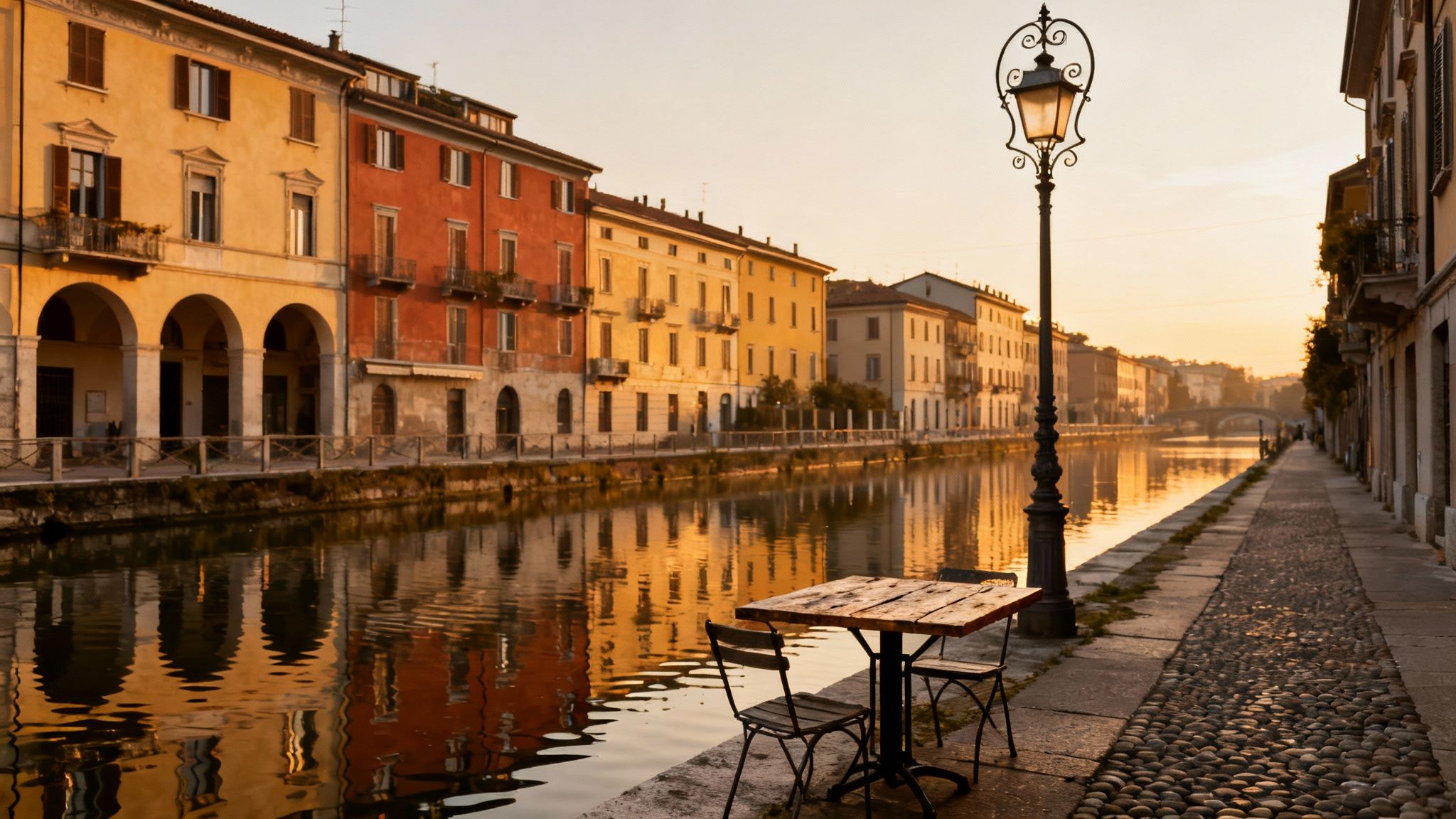
Choosing a neighborhood in Milan is a bit like picking the perfect fabric for a bespoke suit—the texture, color, and feel have to match your personal style. Every district, or quartiere, has its own distinct personality. Getting this choice right is the difference between just owning a property and truly feeling at home here.
Let's take a tour of the city's most sought-after areas. We’ll wander through the cobblestone lanes of artsy Brera and feel the buzz along the canals of Navigli. Understanding what makes each neighborhood tick is the first real step to finding your perfect corner of the Milan Italy real estate market.
Brera The Artistic Soul of Milan
People often call Brera the "Milanese Montmartre," and for good reason. It’s the city’s undeniable artistic heart. The narrow, winding streets are a treasure trove of independent boutiques, antique shops, charming cafes, and, of course, the world-renowned Pinacoteca di Brera art gallery. The vibe is pure bohemian chic, attracting a sophisticated crowd of artists, designers, and academics.
Properties in Brera are mostly historic apartments tucked away in elegant, centuries-old buildings. You’ll often find incredible original details like exposed wooden beams and terracotta floors. Because of its prime location and incredible charm, real estate here comes at a premium, making it a blue-chip investment for anyone who puts culture and history first.
Navigli Milan's Vibrant Canal District
If you thrive on energy and social life, Navigli is your spot. This neighborhood is famous for its two canals, the Naviglio Grande and Naviglio Pavese, which Leonardo da Vinci had a hand in designing. By day, it's a creative hub filled with art studios and vintage markets. By night, it explodes into the center of Milan’s aperitivo culture, with countless bars and restaurants buzzing with life.
The housing here is wonderfully eclectic. You can find quirky lofts carved out of old industrial buildings right next to traditional "case di ringhiera" (railing houses) with their iconic shared balconies. Navigli is a magnet for young professionals, creatives, and investors looking for solid rental income from both long-term residents and the very busy short-term rental market.
Navigli and Brera really show the two sides of the Milanese coin. One is all vibrant, modern energy, while the other offers quiet, historic elegance. Your choice comes down to the kind of life you see yourself living.
Demand for quality homes in these central areas isn't slowing down. In fact, prime office and residential rents in Milan are expected to keep growing into 2026, with forecasts pointing to a 1.4% annual increase. This steady climb comes after impressive recent gains, like a 10% year-on-year jump in Milan's central business district, all while vacancy rates for top-tier properties sit at a decade-low of just 2%. You can get more details from Cushman & Wakefield's Milan rental market outlook.
Porta Romana and Porta Venezia Timeless Elegance
Just to the south and east of the city center, Porta Romana and Porta Venezia offer a more residential, upscale atmosphere. These areas are defined by their grand Art Nouveau (what Italians call Liberty style) buildings, wide tree-lined avenues, and a generally refined feel. They are a big hit with established professionals and families who want a quieter home base without giving up easy access to the city’s core.
Here's a quick look at what sets them apart:
- Porta Romana: Known for its thermal baths and sophisticated restaurants, it strikes that perfect balance between residential calm and city convenience. It’s long been a favorite area for well-to-do Milanese families.
- Porta Venezia: Home to one of Milan's largest public parks, the Giardini Indro Montanelli, and the bustling shopping mile of Corso Buenos Aires. It has a wonderfully diverse, international community and absolutely stunning architecture.
Properties in these districts tend to be spacious apartments in prestigious buildings, offering a classic and elegant Milanese living experience. They represent a sound investment in neighborhoods that reliably hold their value.
Isola The Modern and Trendy Frontier
Isola—meaning "island"—was once a working-class neighborhood cut off from the rest of the city by railway tracks. Today, it has completely transformed into one of Milan's trendiest districts. It's a fascinating blend of old and new, where traditional workshops operate in the shadow of futuristic skyscrapers like the Bosco Verticale (Vertical Forest).
Isola is a hotspot for street art, innovative startups, and organic markets. It pulls in a young, dynamic crowd drawn to its forward-thinking vibe and property prices that are a bit more accessible than the historic center. The real estate here is a mix of renovated apartments in older buildings and units in sleek, new developments, giving buyers plenty of options in a neighborhood that’s clearly on the rise.
The Step-by-Step Guide to Buying Property in Milan
Buying property in another country can feel like navigating a maze in the dark. This guide is your flashlight, turning uncertainty into a clear, step-by-step roadmap designed for international buyers looking at Milan Italy real estate. We'll break down each stage so you know exactly what to expect.
Think of it as a journey with a trusted guide. By taking it one step at a time, you can move forward with confidence and avoid the common traps, making sure you end up with a piece of Milan you can truly call your own. From the first pieces of paperwork to finally getting the keys, here’s how it works.

Stage 1: Getting Your Italian Ducks in a Row
Before you even start scrolling through listings, there are a couple of foundational steps every non-resident needs to tackle. Getting these sorted out early makes the whole process smoother and shows sellers you’re a serious buyer.
First up, you absolutely must get a Codice Fiscale, which is your personal Italian tax ID number. You can’t do anything significant in Italy without it—from opening a bank account to signing the final deed. You can apply for one at an Italian consulate in your home country or pop into an Agenzia delle Entrate (tax office) once you’re in Italy.
Next, you’ll want to open an Italian bank account (conto corrente). While not technically required on day one, it's a practical necessity for transferring your deposit and the final payment. It also makes life much easier when it comes to paying future property taxes and utility bills.
Stage 2: The Offer and Preliminary Contract
So, you’ve found the perfect apartment with a view of the city. Now the real action begins. This stage involves two key legal documents that lock in the deal and set the terms for both you and the seller.
-
The Purchase Offer (Proposta d'Acquisto): This is your official, written offer. It lays out the price you’re willing to pay, how you plan to pay it, and any conditions (like getting a mortgage approved). You’ll back this up with a small deposit (caparra)—usually around 1-5% of the price—to show you mean business. Once the seller signs it, you have a legally binding agreement.
-
The Preliminary Contract (Compromesso): After the offer is accepted, both parties sign the compromesso (also called a contratto preliminare). This is a much more detailed contract that nails down every term of the sale, including the final closing date. At this point, you'll pay a much larger deposit, typically 10-30% of the purchase price. This contract legally binds both you and the seller to see the sale through; pulling out now comes with serious financial consequences.
A critical piece of advice for international buyers: always have your own independent lawyer (avvocato) review the compromesso before you sign anything. The notary is a neutral party, but your lawyer’s only job is to protect your interests.
Stage 3: Due Diligence and the Final Deed
You're on the home stretch! This is where all the final legal checks happen before the property officially becomes yours. The whole process is overseen by a public official called a notaio (notary), whose job is to make sure the entire transaction is above board and legally sound.
The notary gets to work on some thorough due diligence, which includes:
- Title Search: Confirming the seller is the legitimate owner.
- Lien Check: Making sure there are no hidden mortgages, debts, or legal claims tied to the property.
- Building Compliance: Checking that the property's layout matches the official floor plans filed at the land registry (catasto) and that all building permits are in order.
Once the notary gives the green light, it’s time for the final act: the rogito.
The rogito, or final deed of sale, is the document that makes the transfer of ownership official. Everyone—you (or a legal representative), the seller, and the notary—gathers at the notary's office to sign it. This is when you'll pay the remaining balance and all the closing costs. The notary then registers the deed, and just like that, the keys are yours.
For a deeper dive into the legal fine print, our guide on buying a house in Italy has even more detail.
Navigating Taxes, Legalities, and Financing
Once you've zeroed in on the perfect Milan neighborhood, the next step is diving into the financial and legal details. Think of this as the backstage work—it's not as glamorous as house hunting, but it’s absolutely essential for a smooth, surprise-free purchase. Getting a firm grip on the taxes, closing costs, and financing landscape from the get-go will empower you to budget smartly and move forward with confidence.
The price you see on the listing is just the starting point. In Italy, you need to account for additional closing costs, which typically add another 7% to 12% on top of the property's purchase price. This buffer covers all the necessary taxes and fees to legally seal the deal and get your name on the deed.
Breaking Down the Purchase Taxes
When you buy real estate in Milan, a few key taxes come into play. The exact amounts will hinge on whether you're buying from a private individual or a construction company, and if the home will be your primary residence (prima casa).
- Registration Tax (Imposta di Registro): This is the big one for most resale properties. As a non-resident, you can expect to pay a flat 9% of the property’s cadastral value—that's the official value registered with the land office, which is usually quite a bit lower than the market price.
- VAT (IVA): If you're buying a brand-new home directly from a developer, you'll pay VAT instead of the registration tax. The rate is typically 10% of the sale price, but it jumps to 22% for properties officially classified as luxury.
- Stamp Duty & Cadastral Tax: These are minor fixed fees, generally €50 each, for the administrative work of updating the property records.
After the purchase, you'll also have an annual property tax called IMU (Imposta Municipale Unica). The good news is that primary residences are usually exempt, unless it's a designated luxury home. For a complete breakdown, check out our dedicated guide to property taxes in Italy.
Securing Financing as a Foreign Buyer
So, what about a mortgage? It’s a common question, and the answer is yes—Italian banks are definitely open to lending to non-residents. That said, the process is a bit more involved than what you might be used to back home.
"While paying in cash is common for international buyers, securing an Italian mortgage is entirely possible. Banks will carefully assess your income and credit history, so having your financial documents organized and translated is a key first step to a successful application."
Lenders will want to see solid proof of a stable income, a clean credit history, and your Italian tax ID (Codice Fiscale). Get ready for a deep dive into your finances. For foreign buyers, banks will typically finance between 50% and 60% of the property's appraised value, known as the loan-to-value (LTV) ratio. This means a substantial down payment is a must.
The entire mortgage application process can easily take a couple of months, so starting these conversations with lenders early is a smart move. In fact, getting pre-qualified for a loan can make your offer much more compelling to sellers, as it shows you’re a serious buyer with the funds ready to go.
Milan as an Investment and Rental Market Outlook
Owning a property in Milan is more than just having a place to stay; it's holding a powerful financial asset. The city's investment appeal isn't just hype—it's built on a rock-solid foundation of intense rental demand and fantastic potential for long-term growth. For landlords, it's a dream scenario.
Milan is Italy's economic engine and a global fashion capital, a combination that creates a constant, unyielding need for quality housing. Think about it: a steady flow of corporate executives, international students flocking to its top universities, and young professionals launching their careers all need a place to live. This means well-located properties rarely stay vacant for long, ensuring a reliable income stream for investors.
Understanding Rental Yields and Growth Potential
For anyone looking at property as an investment, the magic number is rental yield—the annual return you can expect on your purchase. In Milan's most sought-after neighborhoods, you can realistically expect gross rental yields between 2.5% and 3.5%. For a major European city, that's a very healthy return. This kind of consistent income makes owning Milan Italy real estate a smart move for building and preserving wealth.
If you're new to this, we have a helpful guide on how to calculate rental yield that breaks it all down.
The good news doesn't stop there. The entire Italian real estate market is heating up, with forecasts pointing to a major boom around 2026. Projections show total sales jumping by 8.4% to hit nearly 800,000 transactions. Milan is expected to lead this charge, with property prices predicted to climb by a substantial 7.3%. This momentum has actually placed Milan 7th in all of Europe for real estate prospects, signaling a very bright future for investors.
Key Drivers for Milan's Investment Strength
So, what makes Milan's property market so resilient and appealing for buy-to-let investors? It really comes down to a few key factors that work together.
- Strong Corporate Presence: Milan is home to the Italian stock exchange and countless multinational headquarters. This attracts a steady stream of high-earning professionals who often prefer to rent, at least initially.
- Top-Tier Universities: World-renowned institutions like Bocconi and Politecnico di Milano pull in thousands of international students every year, creating a massive and reliable tenant base for smaller apartments and studios.
- Tourism and Short-Term Lets: As a global hub for fashion, design, and business, Milan's short-term rental market is incredibly lucrative, especially in the central districts where tourists and business travelers want to be.
Owning property in Milan is about more than just collecting rent. It's about investing in a market with sustained demand, clear growth drivers, and a resilient economic backbone that protects and enhances your asset's value over the long haul.
Your Milan Real Estate Questions Answered
Diving into Milan’s property market, especially from abroad, naturally brings up a lot of questions. It's easy to feel overwhelmed by a new country's laws and processes, but getting the right information upfront makes all the difference. Think of this section as your practical Q&A, where we tackle the common hurdles we see international buyers face.
We’ll cut straight to the chase on the big topics: getting a mortgage, understanding the real costs, and why having legal backup is non-negotiable. These are the details that matter, the ones that turn a dream of owning a Milanese apartment into a smart, successful reality.
Can a Foreigner Get a Mortgage in Italy?
Absolutely. Securing a mortgage from an Italian bank as a non-resident is quite common, but you need to come prepared. Lenders will put your finances under a microscope, so expect to provide detailed proof of income and a solid credit history to show you're a reliable borrower.
For international buyers, Italian banks typically finance somewhere between 50% and 60% of the property’s appraised value. You’ll also need to get an Italian tax code, the Codice Fiscale, which is essential for almost any major transaction in Italy. My advice? Start the application for both the mortgage and the tax code as early as you possibly can.
What Are the Main Closing Costs?
The price you agree on for the property is just the starting point. It’s critical to budget for closing costs, which usually add another 7% to 12% on top of the purchase price. These are the various professional and government fees you’ll pay when you sign the final deed, so they can't be an afterthought.
Here’s a quick breakdown of what those costs cover:
- Notary Fees: The notaio is a public official who legally validates the sale.
- Agent Commissions: This is typically 3-4% of the purchase price, plus VAT.
- Property Registration Taxes: These can change based on the property’s official value and whether it will be your primary home.
The biggest mistake I see buyers make is underestimating these extra costs. A good rule of thumb is to set aside a buffer of at least 10% of the sale price. That way, you're covered and there are no unpleasant surprises at the finish line.
Do I Need a Lawyer to Buy Property in Milan?
While you're not legally required to hire your own lawyer (avvocato), I can't recommend it highly enough, especially for international buyers. The notary (notaio) is a neutral party, there to make sure the deal follows Italian law for everyone involved. A lawyer, on the other hand, is there to protect you and only you.
Your lawyer will dig deep into the property's history, check for any hidden problems, and scrutinize every line of the contracts, like the preliminary agreement (compromesso). It’s an extra layer of protection that gives you complete peace of mind, and frankly, it's one of the best investments you can make when buying real estate in Milan.
Ready to find your perfect property in Milan? Residaro offers an extensive collection of listings to help you discover your dream home. Start your search on Residaro and make your Italian property goals a reality.