Land Sale Spain: A Practical Guide to Buying Land in Spain
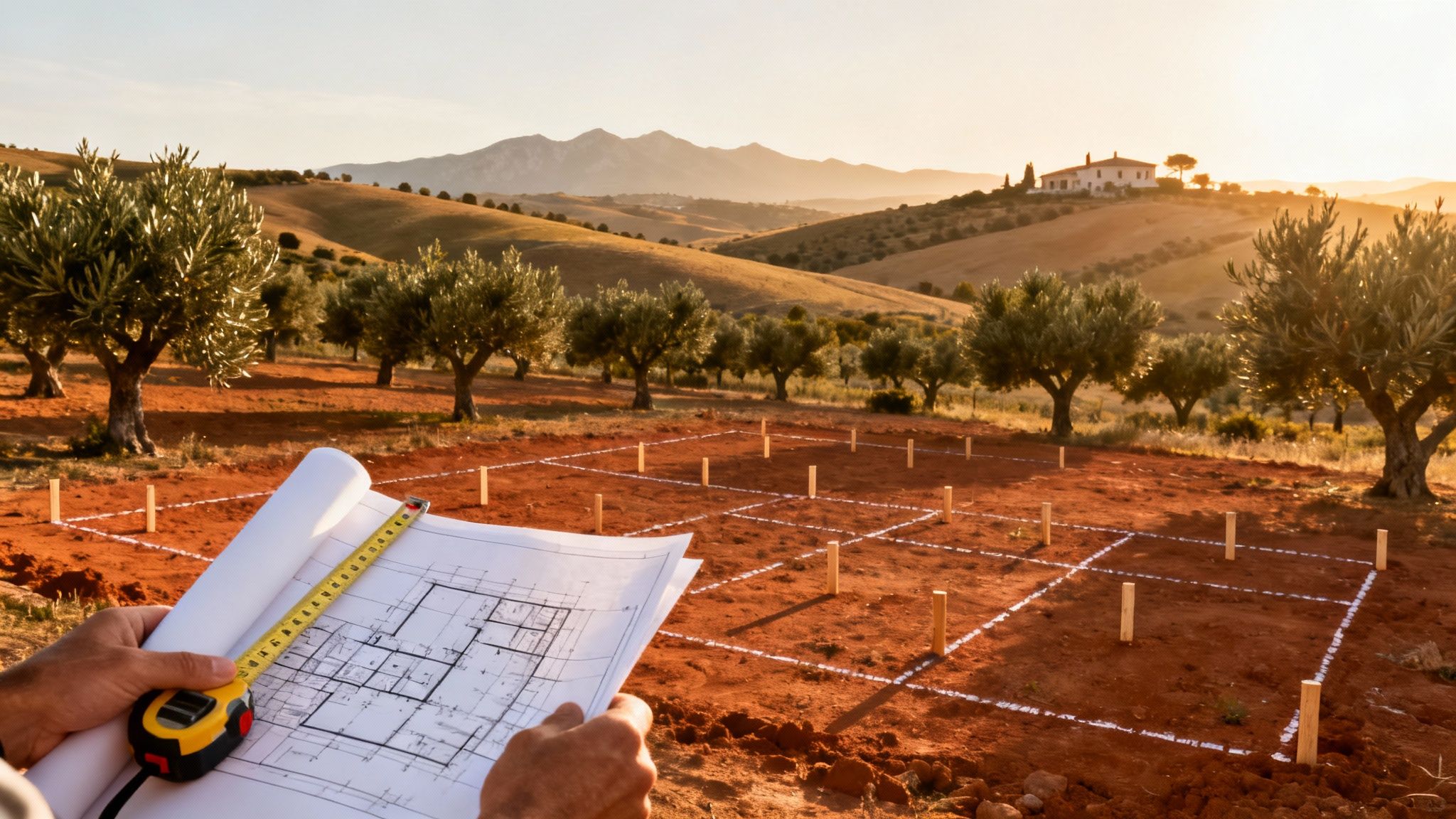
Picture this: you've found the perfect spot in Spain. It's the canvas for your dream villa on the Costa del Sol or a quiet, rustic getaway deep in the Andalusian hills. A land sale in Spain can be a surprisingly smooth journey, but getting it right means knowing the local rules and navigating the purchase with a bit of expert guidance. This guide is your complete blueprint for turning that vision into a reality.
Your Dream of Owning Land in Spain Starts Here
Think of this as your step-by-step plan for a successful land purchase. We're going to pull back the curtain on the whole process, from making sense of legal jargon like Suelo Rústico to scouting out the perfect location for your project. Our aim is simple: to give you the practical, real-world knowledge you need to turn a dream into a solid, valuable asset.
This isn't just another checklist; it's a strategic guide. We’ll show you how to lay a strong foundation by picking the right kind of plot, confidently handling the legal hurdles, and getting a true handle on all the costs involved. No more guesswork—we're here to help you build your future on solid ground.
What You Will Learn
Whether you’re looking to invest, plan for retirement, or build a holiday home for the family, this guide walks you through every crucial stage. By the end, you'll have a firm grasp of:
- The Critical Land Types: We'll clearly explain the huge difference between urban and rustic land so you can be certain your plot legally permits construction.
- Essential Legal Checks: Learn to do your homework like a pro, from confirming ownership with a Nota Simple to making sure there are no hidden debts attached to the land.
- The True Purchase Cost: We'll uncover all the taxes and fees that go beyond the asking price, helping you build a budget that’s realistic and won't have any nasty surprises.
- Prime Regional Opportunities: Find out which parts of Spain are best for what you have in mind, whether that’s farming, long-term investment growth, or the perfect plot for a sea-view villa.
A successful land sale in Spain isn't just about finding a plot; it's about finding the right plot. Understanding its legal status and all the hidden costs from day one is the single most important investment you can make.
The Two Critical Categories of Spanish Land
When you start looking at land for sale in Spain, you'll quickly discover that not all plots are created equal. In fact, everything boils down to one crucial detail: the land's legal classification. This single factor determines whether you can build, what the land is worth, and ultimately, the success of your entire project.
Getting this wrong is the most expensive mistake you can make. The two key categories you must understand are Suelo Urbano (Urban Land) and Suelo Rústico (Rustic or Rural Land).
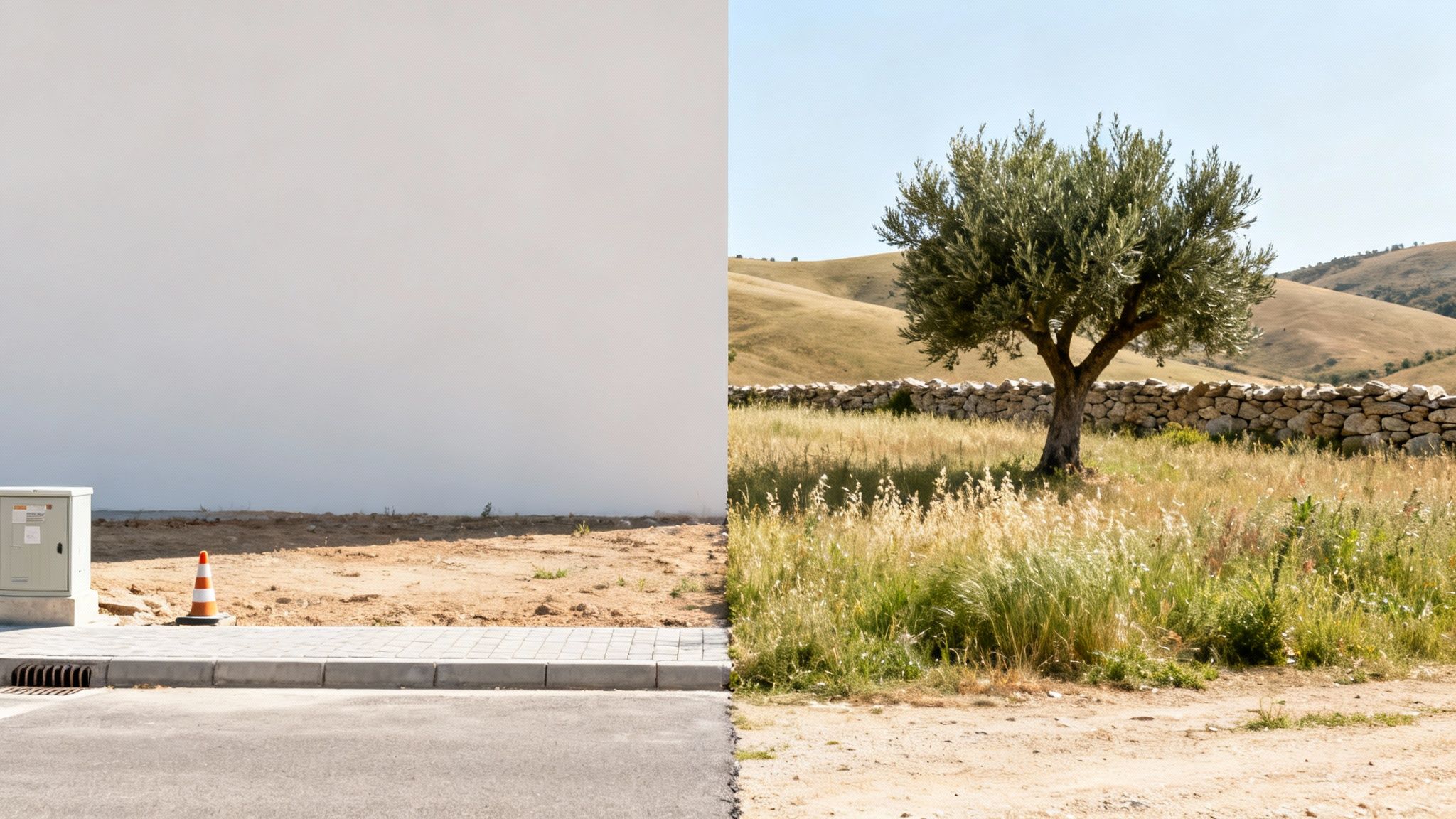
Think of it like this: Suelo Urbano is a serviced plot in a housing development. The roads are in, the utilities are right there at the curb, and the local council has already given the green light for construction. You still need to follow the rules, but the fundamental permission to build is already in place.
On the other hand, Suelo Rústico is like a beautiful, wild field out in the countryside. It’s full of potential and charm, but there’s no guarantee you can do anything with it beyond farming or enjoying the view. This land is protected for agricultural or environmental reasons, and trying to build a house on it is, in most cases, a non-starter.
Suelo Urbano: The Builder's Choice
If your dream is to build a home, Suelo Urbano is what you’re looking for. This is land that the local town hall (the Ayuntamiento) has officially included in its development plan. It's zoned, serviced, and ready for construction.
Because this land comes with the all-clear for development, getting a building license is more of a procedural step than a high-stakes gamble. This certainty, however, comes at a price. Urban land is far more valuable and in high demand, with average prices recently hitting €180.2 per square meter after an 8.1% annual increase.
In hot markets like the Valencian Community, that figure jumps to €220.3 per sqm—a staggering 26.7% year-over-year climb. This tells you just how scarce and desirable buildable plots have become. You can dig deeper into Spanish property market trends for more context.
Choosing Suelo Urbano means you are buying certainty. The local government has already confirmed that this plot is part of its development plan, significantly reducing the risk of your building project being rejected.
The Realities of Suelo Rústico: A Cautious Approach
Suelo Rústico makes up the vast majority of Spain's stunning landscape. It's often beautiful, spacious, and temptingly cheap compared to its urban counterpart. But that low price tag comes with some very heavy strings attached.
In most parts of Spain, building a new house on rustic land is nearly impossible. While there are a few narrow exceptions—like for farm buildings or renovating a legally registered ruin—the process is a bureaucratic nightmare with absolutely no guarantee of success. Many people buy rustic plots hoping they'll one day be rezoned, a gamble that almost never pays off.
Urban Land vs Rustic Land A Head-to-Head Comparison
To make the right choice when looking at a land sale in Spain, you need to see the differences laid out clearly. This table cuts through the noise and compares the two land types directly, so you can match the plot to your goals.
| Feature | Suelo Urbano (Urban Land) | Suelo Rústico (Rustic Land) |
|---|---|---|
| Building Permission | Generally permitted, subject to local building codes. | Severely restricted or prohibited for new residential construction. |
| Primary Use | Residential homes, commercial buildings, and infrastructure. | Agriculture, forestry, livestock, or conservation. |
| Utilities | Usually available at the plot boundary (water, electricity, sewage). | Typically not available; requires expensive private solutions. |
| Investment Risk | Lower risk; value is tied to development potential. | High risk; value is low unless reclassified, which is rare. |
| Purchase Price | Significantly higher due to scarcity and building rights. | Much lower, reflecting its limited use and development restrictions. |
In the end, it’s simple. If you want to build a house, Suelo Urbano is the only safe and reliable path. If you want to start a farm, preserve a piece of nature, or simply own a slice of the Spanish countryside, then Suelo Rústico is the right fit. Understanding this fundamental divide is the first and most important step toward buying land in Spain without regret.
Navigating the Legal Labyrinth, Step-by-Step
Buying land in Spain is about more than just finding the perfect view; it's about making sure the plot is legally bulletproof. Think of the legal process as a thorough health check for your property investment. Each step is a vital test to confirm your purchase is secure, free from nasty surprises, and ready for whatever you're planning.
Skipping these checks is like buying a car without even glancing under the hood—a gamble that could lead to some very expensive headaches down the road. But don't worry. With the right approach, this legal labyrinth becomes a clear, manageable path to ownership.

Verifying Ownership with the Nota Simple
Your first move should always be to get a copy of the Nota Simple Informativa. This is a short, official report from the Spanish Land Registry (Registro de la Propiedad), and it’s essentially the property's ID card. It's an absolutely indispensable document that gives you a snapshot of the land's legal standing.
Getting a Nota Simple is simple and answers three critical questions:
- Who actually owns it? This confirms the person selling the land is the true, registered owner.
- What are its official boundaries? It describes the property's registered size and limits.
- Are there any hidden debts? Most importantly, it reveals any charges or encumbrances (cargas) attached to the land.
This document is your frontline defense against fraud or any misrepresentation from the seller.
Uncovering Hidden Debts and Claims
The most important section of the Nota Simple is the one on cargas. These are financial or legal claims tied directly to the land, not the owner. That means if you buy the plot, you inherit the problems. It’s like buying a house only to discover you're now on the hook for the previous owner's unpaid mortgage.
Common cargas to watch out for include:
- Mortgages (Hipotecas): An outstanding loan secured against the property.
- Easements (Servidumbres): Things like a right-of-way that lets a neighbor cross your land to get to theirs.
- Embargos: A legal seizure of the property because of unpaid taxes or other debts.
Finding a carga doesn't have to be a deal-breaker, but it does mean the seller has to sort it out before the sale goes through. Your lawyer's job is to make sure any debts are wiped clean before you sign anything.
Confirming Permissions at the Town Hall
Once you’ve confirmed who owns the land and that it's debt-free, your next stop is the local town hall, or Ayuntamiento. The Land Registry tells you who owns it, but the town hall tells you what you can do with it. This is where you verify the plot's planning status and building permissions.
You'll need to get a Certificado Urbanístico, a certificate that confirms:
- The land's official classification (urbano or rústico).
- The specific local building rules (normas urbanísticas).
- Any planned public works, like a new road, that might affect the plot.
This check ensures your grand design actually aligns with what the local council will allow, saving you from the nightmare of buying land you can't build on. Despite falling transaction volumes, rising prices in Spain hint at a limited supply of properly zoned land. With residential sales hitting 642,208 homes (a 10% increase) and new builds surging 23.2% to 134,926 units, verified building permission is more critical than ever. You can discover more insights about the dynamics of the Spanish property market on globalpropertyguide.com.
Non-Negotiable Advice: Hire an independent Spanish property lawyer (abogado). They are your single most important asset in any land sale in Spain. They work only for you, making sure every document is checked, every debt is found, and your interests are protected at every turn.
A good abogado who specializes in property law will handle all these checks for you. They’ll cut through the legal jargon, deal with the Land Registry and town hall, and make sure your purchase contract is airtight. Never, ever rely on the seller's lawyer or the real estate agent for legal advice—their primary loyalty isn't to you.
For a deeper dive into this whole process, take a look at our guide on the complete real estate due diligence checklist. Think of hiring your own lawyer as the best insurance policy you can buy.
Calculating the True Cost of Buying Land in Spain
The price you see on a listing is just the starting point. To really understand what it costs to buy land in Spain, you need to look past that initial number and factor in the various taxes and fees that come with the territory.
Think of the advertised price as the base ingredient. To get the final, all-in cost, you need to add several other crucial components. Getting this wrong can wreck your budget, so let's break down exactly what you need to plan for.
The Two Big Taxes: ITP vs. IVA
When you buy a piece of land, your biggest extra cost is almost always going to be tax. The specific tax you'll pay hinges on one simple question: who are you buying it from? This is a critical detail that completely changes the numbers.
-
Property Transfer Tax (ITP): This is the tax you pay when buying from a private individual—what’s known as a resale. The rate varies quite a bit depending on which of Spain’s autonomous communities you're in, but it generally falls between 6% and 11% of the purchase price.
-
Value Added Tax (IVA or VAT): This one applies when you buy land from a business, like a developer or a company. The standard rate for building land is a hefty 21%.
On top of IVA, you also have to pay Stamp Duty, or Actos Jurídicos Documentados (AJD). This is another regional tax that usually adds 1% to 1.5% more to the total. This combo makes buying a brand-new plot from a developer a significant upfront investment.
Other Essential Professional Fees and Costs
Beyond the big taxes, there's a lineup of smaller but absolutely necessary fees to make the sale official and secure your ownership. First-time buyers often forget to budget for these, but they are essential for a smooth process.
Here’s a practical checklist of the other fees you’ll need to cover:
-
Notary Fees (Notaría): The notary is a public official who officiates the signing of the final deed, the Escritura de Compraventa. Their fees are fixed by law and usually run between 0.5% to 1% of the property’s value.
-
Land Registry Fees (Registro de la Propiedad): Once the deed is signed, it has to be officially registered in your name. This fee is also set on a national scale and typically costs between 0.4% and 0.8%.
-
Lawyer’s Fees (Abogado): Hiring a good, independent lawyer isn't optional—it's essential. For handling all the legal checks and paperwork, expect to pay between 1% and 1.5% of the purchase price, plus IVA.
-
Architect & Surveyor Fees: If you’re planning to build, you'll need an architect for the design and a surveyor (topógrafo) to verify the plot’s boundaries. These costs can vary dramatically depending on how ambitious your project is.
This cost structure positions Spain's land market as a notable option for investors looking at Europe, where land scarcity often drives value. You can learn more about these European property market dynamics on globalpropertyguide.com. For a deeper dive into all these expenses, be sure to read our detailed guide to understanding property taxes in Spain.
Finding Your Perfect Plot: The Best Regions for Every Goal
So, you've got a handle on the nuts and bolts of a land sale in Spain. Now for the fun part: deciding where to plant your flag. Spain’s landscape is a patchwork of incredible diversity, with a perfect spot for just about any dream, whether it’s a sun-drenched holiday villa or a sprawling agricultural business.
Choosing the right region isn't just about chasing a pretty view; it's a strategic move. The right location can supercharge your investment, streamline the building process, and ultimately shape the life you'll live there. Let’s dive into some of Spain's hotspots and see what they offer different kinds of buyers.
For Luxury Holiday Homes and Coastal Living
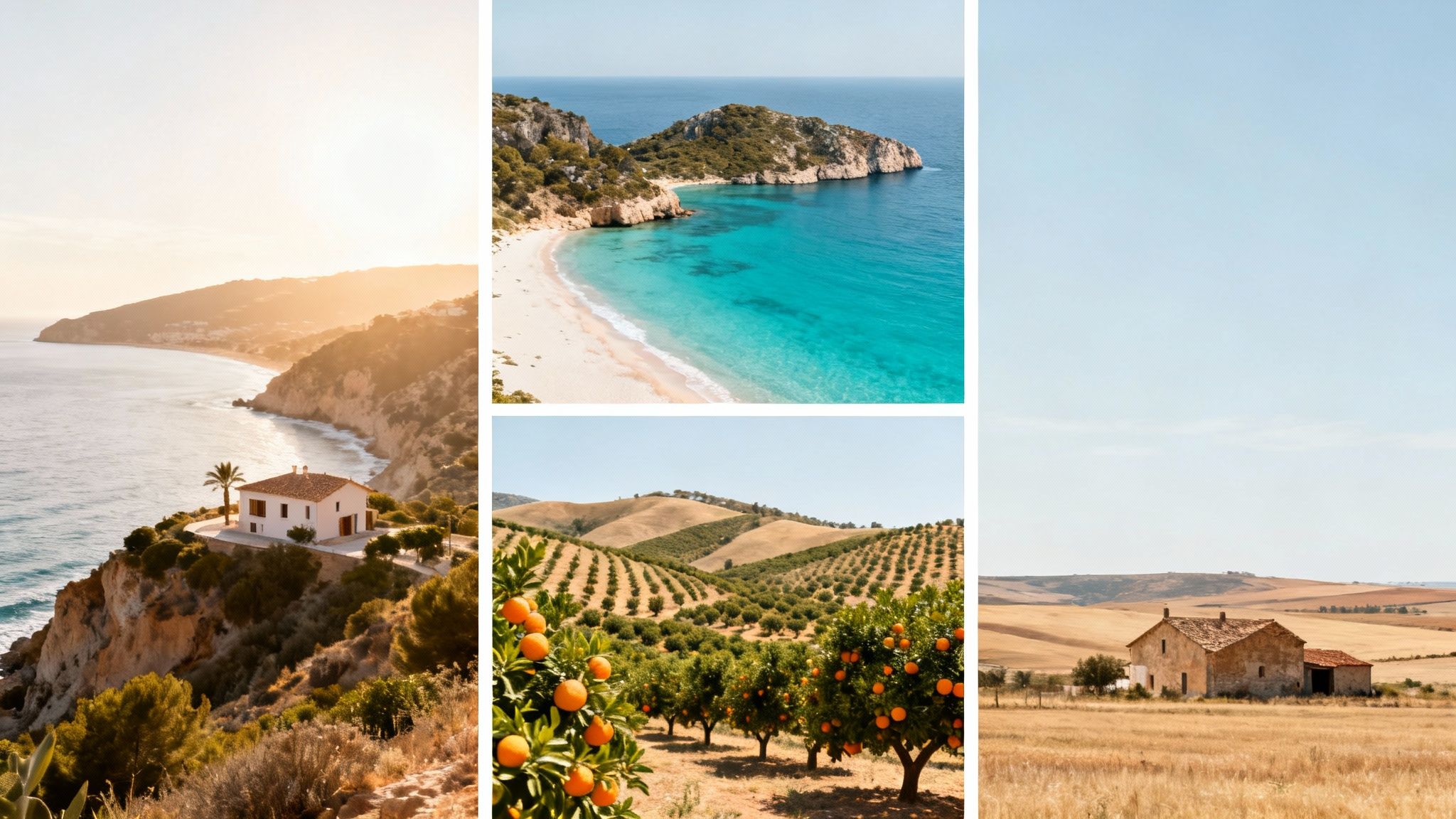
If your Spanish dream involves waking up to the sound of waves and spending your days by the pool, two places immediately spring to mind: the Costa del Sol and the Balearic Islands. These areas are the heart of luxury living in Spain, offering world-class amenities, breathtaking coastlines, and a seasoned market for high-end properties.
Costa del Sol (Andalucía): Stretching along the southern coast in Málaga province, this is the Spain many of us picture.
- Why here? It’s hard to argue with over 320 days of sunshine a year, championship golf courses, and iconic marinas like Puerto Banús.
- What to expect: You'll find a mature market with plenty of Suelo Urbano plots ready for development, but they don’t come cheap. The good news is that the process is well-established, and finding English-speaking lawyers, architects, and agents is a breeze.
The Balearic Islands (Ibiza, Mallorca, Menorca): These Mediterranean jewels have an exclusive, chic vibe that pulls in a sophisticated international crowd.
- Why here? Unbeatable turquoise waters, secluded coves (calas), and a buzzing cultural scene make the islands a premier destination.
- What to expect: Land is both rare and expensive, especially in prime coastal spots. Building rules are notoriously strict to protect the islands' natural beauty. For a deeper look, our guide on how to buy land in Ibiza gives you the inside track on this unique market.
For High-Growth Investment Potential
If you’re hunting for capital appreciation, you need to follow the growth. Regions with booming economies, rising demand, and new development projects are where you’ll want to focus. The Valencian Community and Cataluña are buzzing with opportunity, offering a compelling mix of urban expansion and coastal allure.
The numbers tell the story. Andalucía commands the market, accounting for nearly 21% of all land transactions in Spain. But Cataluña isn't far behind at 17.7%, followed by the Valencian Community at 9.3%. These three regions are the ones to watch.
As an investor, keep an eye out for areas with planned infrastructure upgrades, like new train lines or commercial hubs. These are flashing green lights for future growth and can send your plot's value soaring.
For Agricultural Projects and Off-Grid Dreams
Maybe your vision is less about glamour and more about getting back to the land. If so, Spain's vast interior offers incredible space and value. Regions like Castile-La Mancha and Extremadura are perfect for farming projects, equestrian estates, or building a self-sufficient life far from the hustle.
- Castile-La Mancha: Known as Don Quixote country, this region is home to huge, affordable expanses of Suelo Rústico. It's ideal for planting vineyards, olive groves, or even setting up a solar farm.
- Extremadura: Tucked away on the Portuguese border, this is one of Spain's most sparsely populated regions. Here you can find massive plots of rustic land at some of the lowest prices in the country—perfect for anyone seeking true tranquility and room to breathe.
By matching your goal to the right region, you make your search for the perfect land sale in Spain smarter and more focused. You'll stop searching everywhere and start looking in the right place—the place that will bring your vision to life.
Common Pitfalls When Buying Land in Spain (And How to Dodge Them)
Buying land in Spain can be an incredible adventure, but it's also a path dotted with potential traps for the unwary. Knowing where others have gone wrong is your best defense against making the same costly mistakes.
Let’s be honest, it’s easy to get swept up by a bargain price or a breathtaking view and miss the red flags. So, let's pull back the curtain on the most common pitfalls and give you a clear roadmap to navigate around them.
The "I Can Build on Rustic Land" Myth
This is, without a doubt, the biggest and most heartbreaking mistake we see. A buyer finds a gorgeous, sprawling plot of Suelo Rústico (rustic land) for a steal and dreams of building a villa. The reality? In most parts of Spain, you simply can't build a new house on rustic land. Period.
The planning laws are incredibly strict, and they're there to protect Spain's countryside. Don't let verbal promises from a seller or agent convince you otherwise. The only way to know for sure is to get a Certificado Urbanístico—an official planning certificate—from the local town hall (Ayuntamiento).
Here's the golden rule: If you want to build a home, stick to land officially classified as Suelo Urbano. Anything else is a massive gamble, and you could end up with a beautiful field you can do nothing with.
Forgetting About the "Hidden" Costs
Another major trap is looking only at the asking price for the land. That figure is just the starting line, not the finish. The true cost of a land sale in Spain will be significantly higher, often adding 30% or more to the initial price tag.
It's easy to forget all the extras that add up. Be sure to budget for:
- Taxes: You'll pay either ITP (Property Transfer Tax, at 6%-11%) or IVA (VAT, at 21%), plus Stamp Duty (1%-1.5%).
- Professional Fees: Your bill for the notary, Land Registry, and your lawyer will likely add another 2%-4%.
- Utility Connections: If water, electricity, and sewage aren't already at the edge of your plot, connecting them can cost tens of thousands of euros.
- The Build Itself: The actual construction is a whole separate budget, and it's a big one.
Trusting the Seller's Team
This one is crucial: never, ever rely on the seller's lawyer or real estate agent for your legal advice. Their job is to get the deal done for their client—the seller. It’s a fundamental conflict of interest.
Your shield and your best advocate is your own independent Spanish property lawyer (abogado). They work for you and only you. They'll dig into the property records to uncover hidden debts (cargas), confirm the boundaries are correct, and make sure every clause in the contract is there to protect you. Hiring your own lawyer isn't an expense; it's the single best investment you can make in the entire process.
Common Questions When Buying Land in Spain
Even after you've done your homework, a few questions always seem to pop up when you're close to buying a piece of land in Spain. Let's tackle some of the most common ones head-on so you can move forward with total confidence.
What Exactly Does the Notary Do?
Think of the Spanish notary (notario) as the official, impartial referee of the property deal. They aren't on your side or the seller's side; their sole job is to make sure the entire transaction is above board and follows Spanish law to the letter.
The notary confirms everyone's identity, carefully reviews the final purchase deed (the Escritura de Compraventa), and watches as both parties sign. Crucially, they immediately notify the Land Registry of the ownership change, which is a key step that protects you from any last-minute funny business.
How Long Does It Realistically Take to Buy Land?
While every deal is different, a relatively straightforward land purchase in Spain usually takes somewhere between 4 to 8 weeks. This clock starts ticking from the moment you sign a reservation agreement and stops when you sign the final deeds in front of the notary.
But what can slow things down?
- Due Diligence: Your lawyer needs time to dig into the Land Registry and town hall records. You can't rush this part.
- Getting a Mortgage: If you're borrowing from a Spanish bank, their approval process can easily add a few weeks.
- The Seller's End: Sometimes the seller has to clear old debts (cargas) tied to the land before they can legally sell it, which can cause delays.
Can I Get a Spanish Mortgage If I'm Not a Resident?
Absolutely. Spanish banks are quite used to lending to non-residents, but you should expect stricter terms. Typically, they'll offer a loan-to-value (LTV) of around 60-70%, which means you’ll need to have a larger cash down payment ready compared to a resident.
To get approved, you'll need to provide a mountain of paperwork, like proof of income, tax returns from your home country, and a detailed credit report. My best advice? Start talking to banks early in your search to find out what they need and to get a pre-approval in hand.
The Spanish real estate market is hotter than ever. Investment hit an impressive €7.3 billion in just the first six months of a recent year—a 22% jump from the year before. This shows just how much confidence international buyers have in Spain. You can get a better sense of Spanish real estate investment trends to understand the bigger picture.
Ready to find that perfect plot? Residaro has a massive collection of listings all over Spain, from sun-drenched coastal plots to quiet rustic retreats. Start your search today and turn your dream into a reality at https://residaro.com.