Your Guide to Finding Land for Sale in Spain
Picture this: you're standing on your own piece of land, the Spanish sun warming your face, with the freedom to build the exact home you've always dreamed of. Finding land for sale in Spain is the first step towards making that vision a reality, and for smart international buyers, the market is brimming with potential right now. There's a real energy in the air, fueled by a growing desire for custom homes and unique investment properties.
Why Buying Land in Spain Is a Great Investment
For decades, Spain has been a magnet for international buyers, and it’s easy to see why. The allure of its vibrant culture, incredible climate, and unmatched quality of life is undeniable. Owning a piece of this country is more than just an asset; it’s an investment in a lifestyle built around well-being, fantastic food, and centuries of history.
But what makes today different? The real story is in the market's momentum. Spain's economy is on a solid upswing, and the property sector is riding that wave. This creates a fantastic opportunity for investors looking to get in on an asset with strong potential for appreciation.
A Market on the Rise
The conversation around Spanish real estate has moved past "recovery" and is now all about solid, confident growth. After years of stabilisation, investor confidence has returned in a big way, making this a prime moment to look at buying land. The demand isn't just for turnkey villas anymore; it's for the raw potential a plot of land holds—the chance to create something from scratch that’s perfectly yours.
The numbers tell the story. In the first half of 2025, Spain’s land transaction market exploded, with the number of deals rocketing up by 28.7% compared to the previous year, reaching 13,863 sales. This isn't just a small uptick; it's a boom that shows serious confidence and a huge appetite for developable plots, especially from international buyers planning residential or holiday homes. You can dig deeper into these trends and get more insights on the Spanish property market at Global Property Guide.
To give you a quick overview, here are some of the key indicators shaping the market today.
Key Spanish Land Market Indicators at a Glance
This table summarizes the essential statistics driving the Spanish land market, offering a quick snapshot of growth, pricing, and key regional activity for prospective buyers.
| Metric | Recent Data | Market Implication |
|---|---|---|
| Transaction Volume Growth | +28.7% year-on-year (H1 2025) | High demand and strong investor confidence. |
| Average Land Price | Varies widely by region (€50/m² to over €1,000/m²) | Opportunities exist at various price points. |
| Foreign Buyer Share | Approximately 15% of all property transactions | Shows significant and sustained international interest. |
| Top Regions for Land Sales | Andalucía, Cataluña, Valencia, Balearic Islands | These areas are hotspots for development and investment. |
As you can see, the data points to a dynamic and growing market where international buyers are playing a major role.
Key Benefits for International Buyers
Beyond the strong market trends, there are some fundamental advantages that make buying land in Spain so appealing for non-residents:
- Straightforward Ownership Laws: Spain is very welcoming to foreign buyers. Unlike some countries, there are very few restrictions on property ownership, and the legal framework is clear and secure.
- Cost-Effective Opportunities: When you compare land prices to many other Western European countries, Spain often offers incredible value. This means your investment can go much further, potentially yielding a better return.
- Total Lifestyle Customisation: This is the big one. Buying a plot gives you a blank canvas. You have complete control to design and build a home that fits your life perfectly, whether that’s a sleek, modern villa or a traditional, rustic finca.
- Incredible Regional Diversity: Do you dream of waking up to sea views in Andalucía? Or perhaps you prefer the cosmopolitan vibe of Cataluña or the idyllic island life in the Balearics? Spain’s regions are so diverse that you’re sure to find a landscape and community that feels like home.
Investing in Spanish land is about more than just securing an asset. It's about buying a blank canvas in one of the world's most desirable locations, giving you the freedom to build your vision from the ground up.
Understanding Spanish Land Classifications
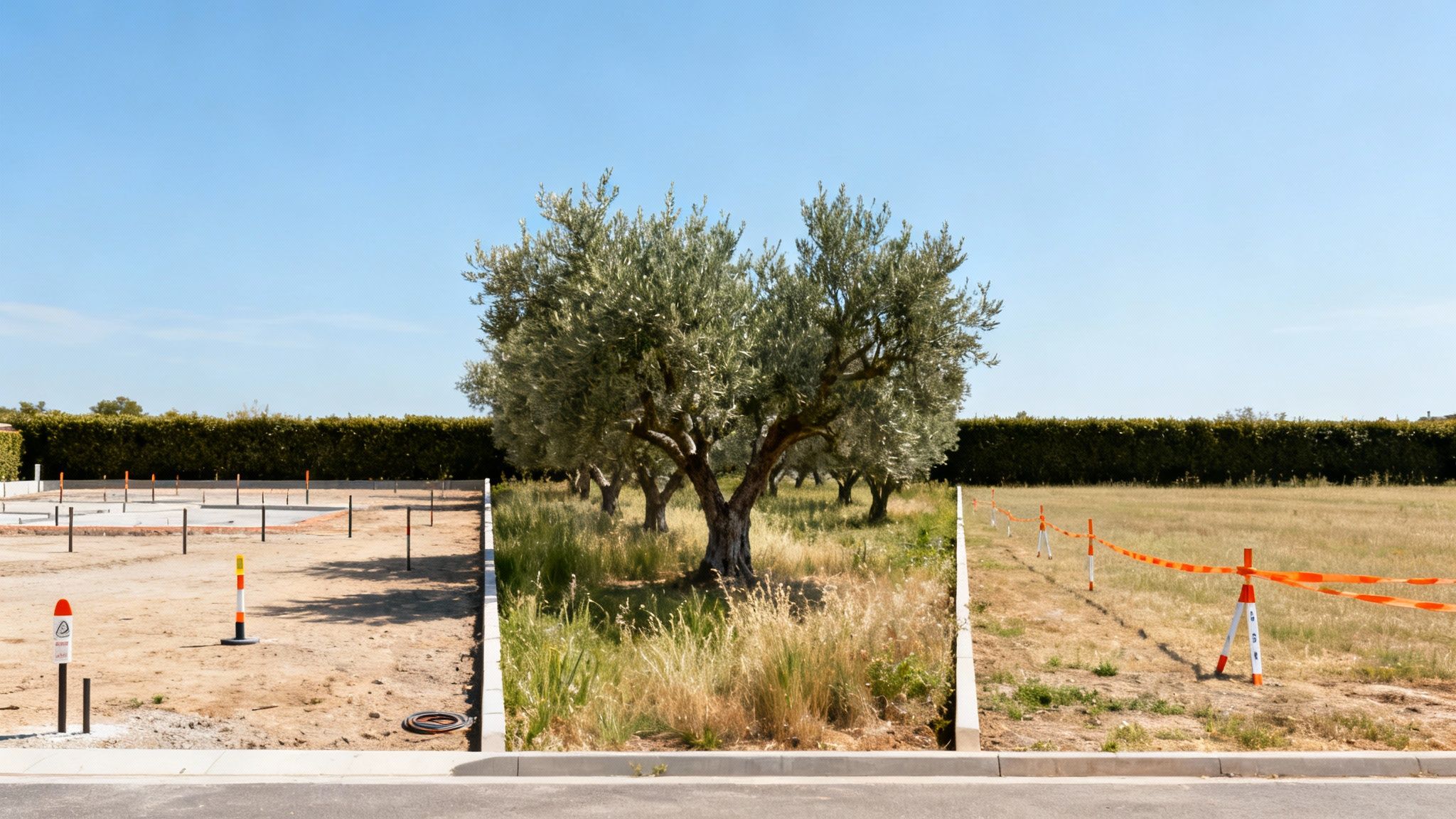
Before you even start browsing listings for land for sale in Spain, there's one crucial detail you absolutely must grasp: not all land is created equal. Spanish law divides land into three very distinct categories, and each comes with its own set of rules, possibilities, and headaches.
Picking the wrong type can turn your dream project into a bureaucratic nightmare. Getting this right from the very beginning is the most important step you'll take.
Think of it this way. You could buy a plot that’s like a brand-new smartphone—unlocked, fully serviced, and ready to use right out of the box. Or, you could buy one that’s earmarked for future use but needs years of work. And finally, you could buy a beautiful vintage model that's meant for display only, not for making calls. Spanish land works a lot like that.
Suelo Urbano: The "Ready to Build" Plot
First up is Suelo Urbano, or urban land. This is your "plug-and-play" option, the easiest and most straightforward choice for anyone wanting to build. These plots are already within a town or city's development plan and come fully equipped with the essential services needed for a home.
Basically, the groundwork has been done for you. The roads are paved, the streetlights are in, and the connections for water, electricity, and sewage are right there at the edge of your plot.
Because it's already designated for development, getting a building license (Licencia de Obras) is generally a clear-cut process, as long as your plans meet the local building codes. For anyone looking to start construction without getting tangled in red tape, this is the gold standard.
Suelo Rústico: The Protected Green Space
On the complete opposite end of the spectrum is Suelo Rústico, also known as rustic or rural land. This is Spain's protected countryside—think rolling olive groves, vineyards, or pristine forests. Its main purpose is for agriculture, forestry, or conservation, not for building a new house.
Let me be clear: building a new home on rustic land is incredibly difficult, and in most cases, completely impossible. While a few very niche exceptions exist (like restoring a legally registered ruin), you should never buy Suelo Rústico assuming you can build on it. The rules are iron-clad, and trying to bend them will lead to massive fines and demolition orders.
Suelo Rústico offers incredible peace and beauty, making it ideal for farming projects or simply owning a private slice of the Spanish countryside. It is not, however, a backdoor to building a cheap villa.
These plots are often temptingly cheap, but that low price directly reflects the severe building restrictions. If a new home is your goal, Suelo Rústico is almost certainly the wrong path.
Suelo Urbanizable: The Future Investment
Finally, we have the middle ground: Suelo Urbanizable, or developable land. This is land that the local town hall has earmarked for future urban growth, but it isn't ready yet. It’s like a neighbourhood that's been zoned for development, but the streets, power lines, and water pipes haven't been laid.
Buying Suelo Urbanizable is a long-term play. The journey to convert it into fully serviced Suelo Urbano requires a comprehensive development plan (Plan Parcial), a process that can take years and involves significant investment from all the landowners in the area.
Key Differences at a Glance
| Land Type | The Analogy | Building Potential | Best For |
|---|---|---|---|
| Suelo Urbano | Plug-and-Play | High (Immediate) | Buyers who want to build their dream home without delays. |
| Suelo Rústico | Protected Park | Extremely Low | Agricultural use, conservation, or enjoying nature. |
| Suelo Urbanizable | Up-and-Coming | Medium to High (Future) | Long-term investors and developers with patience. |
Getting your head around these three classifications is the most critical piece of due diligence you can do. It allows you to filter your search on platforms like Residaro with confidence, ensuring you only look at plots that actually fit your vision. This knowledge will save you time, money, and from making a very expensive mistake.
Exploring the Best Regions to Buy Land
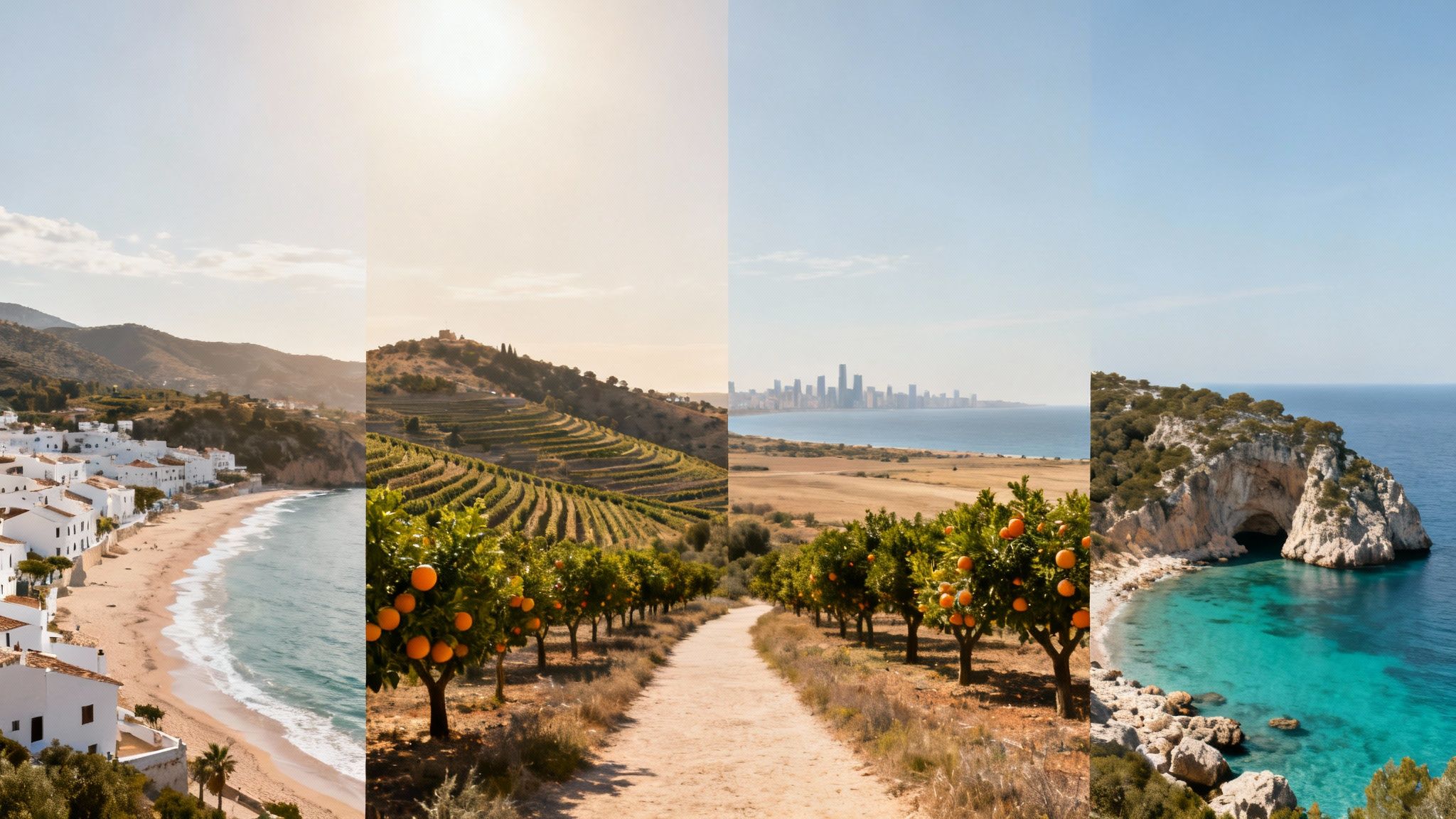
Trying to pick a region in Spain is a lot like choosing from a menu at a world-class restaurant. Every option is fantastic, but each offers a completely different flavour. The country’s incredible geographic diversity means a plot of land for sale in Spain could be anything from a sun-drenched coastal perch to a quiet escape in a rolling green valley. Ultimately, your perfect spot comes down to your goals, your budget, and the lifestyle you’re chasing.
This regional variety is a huge part of what's drawing international buyers. Foreign investment is fuelling a major market revival, with non-residents involved in 14.7% of property deals in early 2024. With over 578,000 total sales recorded in just eight months—a figure that blows pre-2020 averages out of the water—it's clear the demand is spilling over into the land sector. For anyone scouting for a Spanish plot, this is a golden era. You can dig deeper into Spain's booming real estate market at Quadratia.
So, where should you start your search? Let’s break down some of the most popular regions.
Andalucía: The Sunshine Coast
For many, Andalucía is the Spain they've always imagined: flamenco, brilliant whitewashed villages, and a coastline stretching over 800 kilometres. Home to the legendary Costa del Sol, this southern region is a magnet for lifestyle buyers and savvy investors alike. It attracts everyone from retirees seeking year-round sun to developers eyeing prime locations for luxury villas.
Land prices here can vary wildly. A coastal plot near a hotspot like Marbella might set you back over €500 per square meter for prime urban land. But just a short drive inland, the picture changes completely. You can find sprawling rustic plots perfect for a private country estate or finca for a fraction of that cost.
- Lifestyle: Sun-soaked and social, with a huge expat community and some of the world's best golf courses.
- Investment Potential: Strong and steady rental demand, especially in established coastal towns, leading to solid capital appreciation.
Cataluña: Culture and Cosmopolitan Flair
Stretching from the Pyrenees mountains down to the Mediterranean, Cataluña offers a unique combination of high-energy city life and rugged natural beauty. At its heart is Barcelona, a global capital for art, business, and tech. Buying land here gives you access to every modern amenity imaginable, while the stunning beaches of the Costa Brava or the quiet countryside are just a short trip away.
The property market in Cataluña is strong, and land prices reflect that. Plots with sea views along the Costa Brava are highly sought-after, but heading inland reveals more spacious and peaceful options. This region is a perfect match for anyone who wants it all—cultural depth, economic opportunity, and an incredible quality of life.
Cataluña is a fantastic choice for buyers who want to build a home that connects them to both a dynamic, international city and some of Europe’s most beautiful coastline.
Valencian Community: Affordable Coastal Living
The Valencian Community, which includes the ever-popular Costa Blanca, is famous for offering some of the best value for money on the Spanish coast. Areas around Alicante and Valencia serve as a more affordable gateway to the Mediterranean lifestyle than Andalucía or the Balearics, and you won't have to sacrifice beautiful beaches or modern infrastructure.
This region is a real sweet spot for families and budget-conscious buyers. It's much easier to find well-priced urban plots in established communities, making the dream of building a custom home by the sea a tangible reality.
- Typical Land Prices: Urban plots often fall between €150 and €300 per square meter in many areas.
- Best For: Buyers looking for a great balance of affordability, sunshine, and a relaxed, family-friendly vibe.
The Balearic Islands: Exclusive Island Paradise
For those with a bigger budget chasing exclusivity and jaw-dropping natural beauty, the Balearic Islands—Mallorca, Ibiza, Menorca, and Formentera—are in a class of their own. Land here is scarce and highly desirable, making it one of the most prestigious and stable real estate investments in Europe.
Building regulations are incredibly strict to protect the islands' unique charm, which only increases the value of legally buildable plots. A plot of land for sale in Spain here isn't just a piece of property; it's a ticket to an exclusive lifestyle surrounded by pristine coves, upscale marinas, and a sophisticated international crowd. Finding the right plot requires patience and a significant investment, but the rewards are truly unmatched.
Navigating Spanish Legal and Zoning Requirements
Let's be honest, tackling the legal side of buying land in Spain can feel a little intimidating at first. The paperwork and processes are likely different from what you're used to back home, but every step is there for a reason: to protect you and your investment. With a good team and a clear roadmap, you'll navigate it with confidence.
The whole system is designed to make sure you know exactly what you’re buying before any money changes hands. It's all about digging into the official records to confirm the plot you’ve fallen for is free of debts, has a clean title, and can legally be used for your dream project. This isn’t just red tape; it’s your best line of defense.
The Rulebook for Everything: The PGOU
Every town and city in Spain has its own master plan, a document called the Plan General de Ordenación (PGOU). Think of it as the ultimate rulebook for every square meter of land in that municipality. It spells out precisely what can and can't be done, everywhere.
The PGOU dictates which zones are residential, which are commercial, and which are protected green spaces. It will tell you exactly what you can build on a specific plot, right down to the maximum height, the building footprint (the percentage of land you can build on), and even architectural style. Looking at the PGOU isn't just a suggestion; it's the absolute first step. It’s what separates a dream villa from a beautiful but unbuildable field.
Your Legal X-Ray: Essential Property Reports
Once you know the zoning works for your plans, it’s time to put the specific plot under the microscope. Your lawyer will pull a couple of key reports to get a complete snapshot of the property's legal health. You don't need to be an expert, but you should know what they're looking for.
-
The Nota Simple: This is a crucial summary from the Land Registry (Registro de la Propiedad). It confirms who the legal owner is, describes the official size and boundaries, and—most importantly—flags any debts or claims against the property. This is where you’ll see if there’s an unpaid mortgage, a tax lien, or any other financial skeleton in the closet.
-
The Referencia Catastral: This is the plot's unique ID number with the Cadastre, Spain's official real estate census. This report verifies the physical details of the land, its exact size, and its taxable value. A key check is making sure the details on the Cadastral record match the Nota Simple. If they don't, that's a red flag that needs investigating.
Verifying that the seller is the true, undisputed owner is the cornerstone of the entire process. For a deeper dive into this specific check, take a look at our guide on how to verify property ownership in Spain.
Building Your A-Team
You might be tempted to save a few euros by going it alone, but navigating the Spanish legal system without a local expert is asking for trouble. Hiring two key professionals isn't a luxury; it’s a non-negotiable part of a secure purchase.
Hiring a local, independent lawyer and architect is the single best decision you can make. They work for you, protecting your interests and ensuring every legal and technical box is ticked.
Your essential team should include:
-
An Abogado (Lawyer): Find a lawyer who specializes in Spanish property law and is completely independent of the seller or estate agent. They are your champion. They'll run all the legal checks, scrutinize the contracts, and ensure the title is transferred to you cleanly, without any nasty surprises down the line.
-
An Arquitecto (Architect): An architect does far more than just design your home. They'll be the one to interpret the PGOU, conduct a topographical survey of the land, and confirm that the plot is technically suitable for building. They can spot problems a lawyer would never see, like issues with soil stability, site access, or connecting to utilities.
Think of your abogado and arquitecto as a shield. Together, they ensure the land you’re about to buy is legally sound, technically viable, and truly ready for you to start building your Spanish dream.
Calculating the True Cost of Buying Land
When you find the perfect plot of land for sale in Spain, the asking price is just the opening act. The final figure—what you’ll actually spend to make that land yours—is a mix of the purchase price plus a string of unavoidable taxes and fees. Budgeting for these extras from the get-go is the key to avoiding any nasty financial surprises down the line.
Think of it like buying a plane ticket. The base fare gets you on the plane, but you still have to factor in baggage fees, airport taxes, and other charges. It’s the same with Spanish land; your total investment will almost always be 10% to 15% higher than the number on the price tag. Factoring this in from day one keeps your budget realistic and the buying process smooth.
This financial reality is especially important to grasp in a hot market. As a reference point, Spain's residential property prices hit new all-time highs in 2025, with urban plots averaging €180.2 per square meter in the second quarter. This growth shows strong demand and really highlights the need for precise budgeting. You can dig deeper into these trends and learn more about Spanish property prices on howtobuyinspain.com.
The Main Taxes on Your Purchase
The biggest chunk of your extra costs will be taxes, and the specific tax you pay hinges entirely on who you’re buying from. This is a critical distinction that directly impacts your bottom line.
There are two main taxes to get your head around:
- Property Transfer Tax (ITP): This is the one you’ll pay when buying land from a private individual. The rate isn't the same everywhere; it varies by region but typically falls between 6% and 11% of the purchase price.
- Value Added Tax (IVA or VAT): This applies when you purchase land from a business, like a developer. The rate for land is a hefty 21%, so it's absolutely crucial to know who the seller is.
The seller’s status—a private person or a company—is what determines which tax you pay. It’s the single biggest factor affecting your total costs, so get your lawyer to confirm this right away.
For a complete breakdown of these and other levies, check out our detailed guide on property taxes in Spain.
Professional Fees and Administrative Costs
Taxes aside, you'll need a team of professionals to guide you through the maze of paperwork, along with several administrative fees to make the sale official. These aren't optional extras; they are essential for a secure and legally sound transaction.
Here’s a quick look at the other costs you need to budget for:
- Legal Fees (Abogado): Your lawyer is your most important ally in this process. Their fees for handling due diligence, contracts, and closing usually come in at 1% to 1.5% of the purchase price.
- Notary Fees: The public notary is the official who witnesses the signing of the final deed (escritura). Their fees are set by a standard scale and generally land between 0.5% and 1%.
- Property Registry Fees: This is the cost to officially register the land in your name, making you the undisputed owner. It's usually a bit less than the notary fees, around 0.5%.
- Architect Fees (Initial Stages): Before you commit, it’s a smart move to have an architect do a technical survey. This initial check-up might cost a few hundred to a couple of thousand euros, but it can save you from a catastrophic mistake.
Estimated Costs When Buying Land in Spain
The table below breaks down the typical extra costs you can expect. Remember, these are percentages of the final sale price, so they scale with the value of the land.
| Cost/Tax Item | Estimated Percentage | Description |
|---|---|---|
| Property Transfer Tax (ITP) | 6% - 11% | Paid when buying from a private seller. Varies by region. |
| Value Added Tax (IVA/VAT) | 21% | Paid when buying from a company or developer (instead of ITP). |
| Legal Fees | 1% - 1.5% | For your lawyer's services (due diligence, contracts, etc.). |
| Notary Fees | 0.5% - 1% | For the notary who formalizes the deed of sale. |
| Property Registry Fees | ~0.5% | To register the land under your name. |
As you can see, these numbers add up quickly. A plot of land advertised for €100,000 could easily end up costing you €110,000 to €115,000 or more once everything is settled. Understanding this from the start empowers you to search for land for sale in Spain with a clear and accurate budget.
Your Step-by-Step Guide to the Buying Process
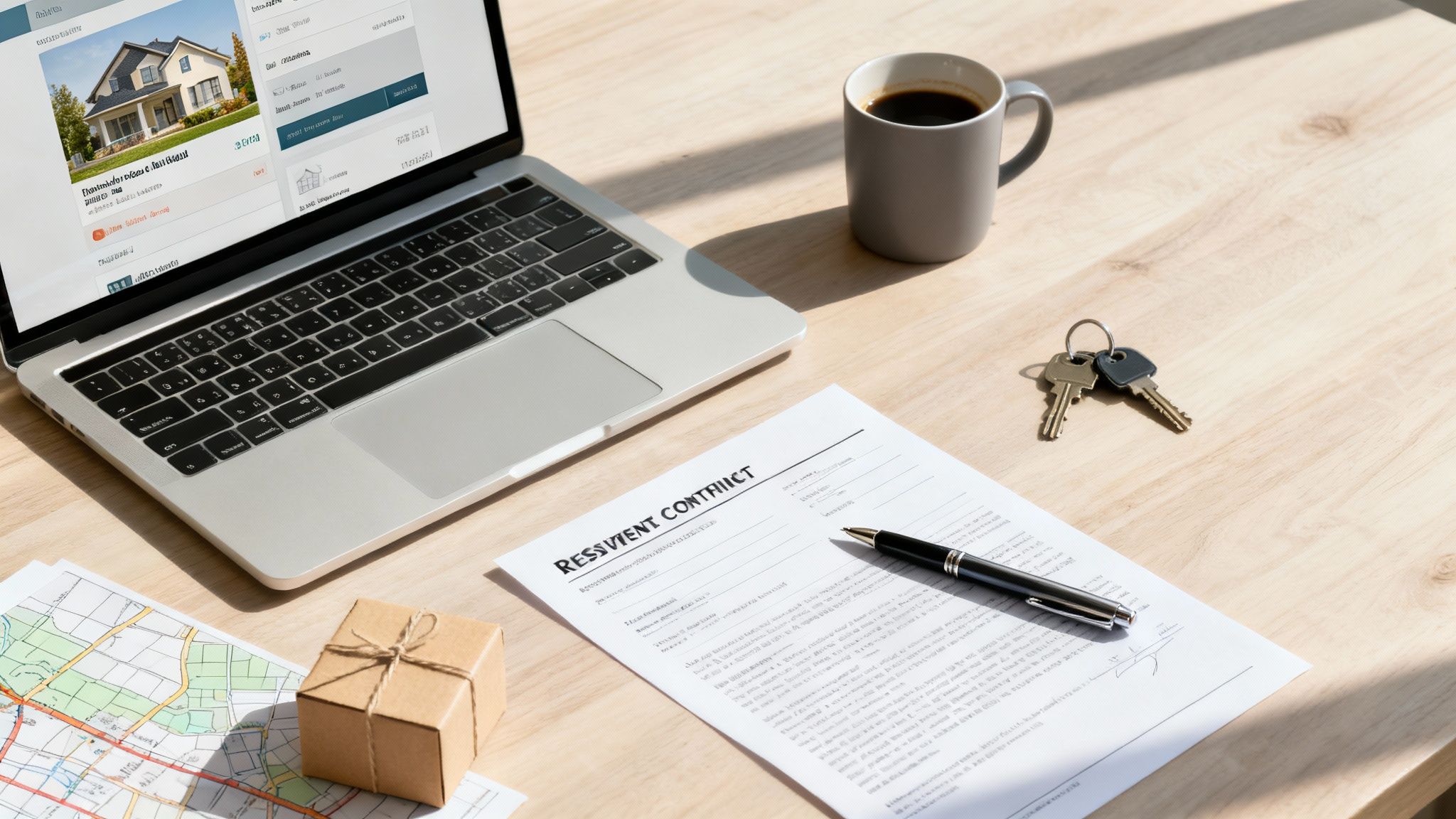
Alright, you've got a handle on the types of land, the regional hot spots, and the costs involved. Now for the exciting part: actually buying the plot. The Spanish system is quite structured, following a logical sequence of steps designed to protect both you and the seller.
Think of it less as a single transaction and more as a journey. Each contract signed and document reviewed brings you one step closer to owning your slice of Spain, turning a complex process into a series of clear, manageable actions.
From Discovery to Formal Offer
It all starts with the search. Finding land for sale in Spain is easier than ever, thanks to online platforms that let you filter by region, land type, and price from halfway across the world. This is your chance to really explore what’s out there. To get a feel for the market, you can browse a curated selection of plots and land for sale in Spain and see what catches your eye.
Once you’ve found the one, your first move is to make an offer and lock it down with a reservation agreement, or Contrato de Reserva. This is a straightforward document backed by a small deposit—usually €3,000 to €6,000—that takes the property off the market for about 30 days. It’s a crucial pause that gives your lawyer time to get to work without you worrying about another buyer swooping in.
The Due Diligence and Contract Phase
This is where a good lawyer earns their fee. During that 30-day reservation period, they'll dig into everything. They’ll pull the land registry report (Nota Simple), confirm zoning permissions, and check for any outstanding debts or legal claims against the property. This is non-negotiable; it ensures there are no nasty surprises waiting for you down the line.
If your lawyer gives the green light, you’ll move on to the private purchase contract, known as the Contrato de Arras. This is the serious one. It’s a detailed agreement laying out all the terms and conditions of the sale. When you sign it, you’ll pay a substantial deposit, typically 10% of the purchase price, minus the reservation fee you already paid.
Heads up: The Contrato de Arras is legally binding. If you decide to walk away after signing, you’ll forfeit your deposit. On the flip side, if the seller backs out, they are legally obligated to pay you back double what you put down.
Finalizing the Purchase at the Notary
The grand finale takes place in a notary's office. This is the official completion meeting where you, the seller, and your respective legal teams come together to sign the final deed of sale, the Escritura Pública de Compraventa.
Here, you'll pay the remaining balance of the purchase price. In return, the seller hands over the keys—it's a great moment! The notary's job is to witness the signing, verify everyone’s identity, and ensure the entire transaction is above board.
Once the Escritura is signed, the land is officially yours. The last step is for your lawyer to take this new deed to the Land Registry to formally record your ownership, making you the undisputed owner.
Got Questions About Buying Land in Spain? We’ve Got Answers.
Even with the best-laid plans, a few nagging questions always seem to surface when you start seriously looking at land for sale in Spain. That’s perfectly normal. Getting your head around building permits, utility connections, and residency rules can feel like a maze, so let’s clear up some of the most common queries we hear from buyers.
My goal here is to give you straightforward, practical answers you can actually use. Let's get those last few doubts out of the way so you can move forward with confidence.
Can a Foreigner Really Buy Land in Spain?
Yes, absolutely. Spain is one of the most welcoming property markets in Europe for international buyers. There are no special hoops for non-residents to jump through, whether you’re from the US, the UK, or anywhere outside the EU.
The process is identical for a foreigner as it is for a Spanish citizen. The only extra piece of admin you’ll need is a Foreigner's Identification Number, or NIE (Número de Identificación de Extranjero). It’s a must-have for any big financial move in the country.
Do I Need a Spanish Bank Account?
While you're not legally required to have one, I can’t recommend it enough. Opening a Spanish bank account will make your life so much easier.
Think about it—having a local account just streamlines everything:
- Paying the deposit and the final purchase price without a hitch.
- Handling taxes and fees without worrying about international transfer delays or hefty charges.
- Setting up utility bills once you're ready to build.
How Do I Get Utilities Hooked Up to My Plot?
This is a big one, and the answer hinges entirely on the land’s official classification. If you're buying Suelo Urbano (Urban Land), the connection points for water, electricity, and sewage are usually right at the edge of your property. Your architect and builder will handle it, and it's typically a straightforward job.
But if you’re looking at Suelo Rústico or Suelo Urbanizable, you're in a completely different ballgame. The nearest connection points could be kilometers away, and getting them to your plot can be eye-wateringly expensive—if it's even possible. This is something you absolutely must confirm with an architect before you even think about making an offer.
My best advice? Never, ever assume utility connections will be easy or cheap. A technical report from a qualified architect confirming the cost and feasibility is one of the most crucial parts of your due diligence.
Will Buying Land Get Me Spanish Residency?
Simply buying a plot of land won't automatically get you a residency permit. However, it can definitely be a key part of your strategy. For a while, Spain’s "Golden Visa" program was a popular route, offering residency for real estate investments of €500,000 or more, but the government is currently overhauling this program.
For other types of visas, owning property shows you have strong ties to Spain and can bolster your application. The best move is to talk to an experienced immigration lawyer who can map out the best path for your specific circumstances.
Ready to put these answers into action? At Residaro, we take the guesswork out of finding the right plot. Start exploring our handpicked listings and lay the groundwork for your dream home in Spain. Visit us at https://residaro.com to begin your search today.