Explore Italian Country Houses: Your Guide to Buying in Italy
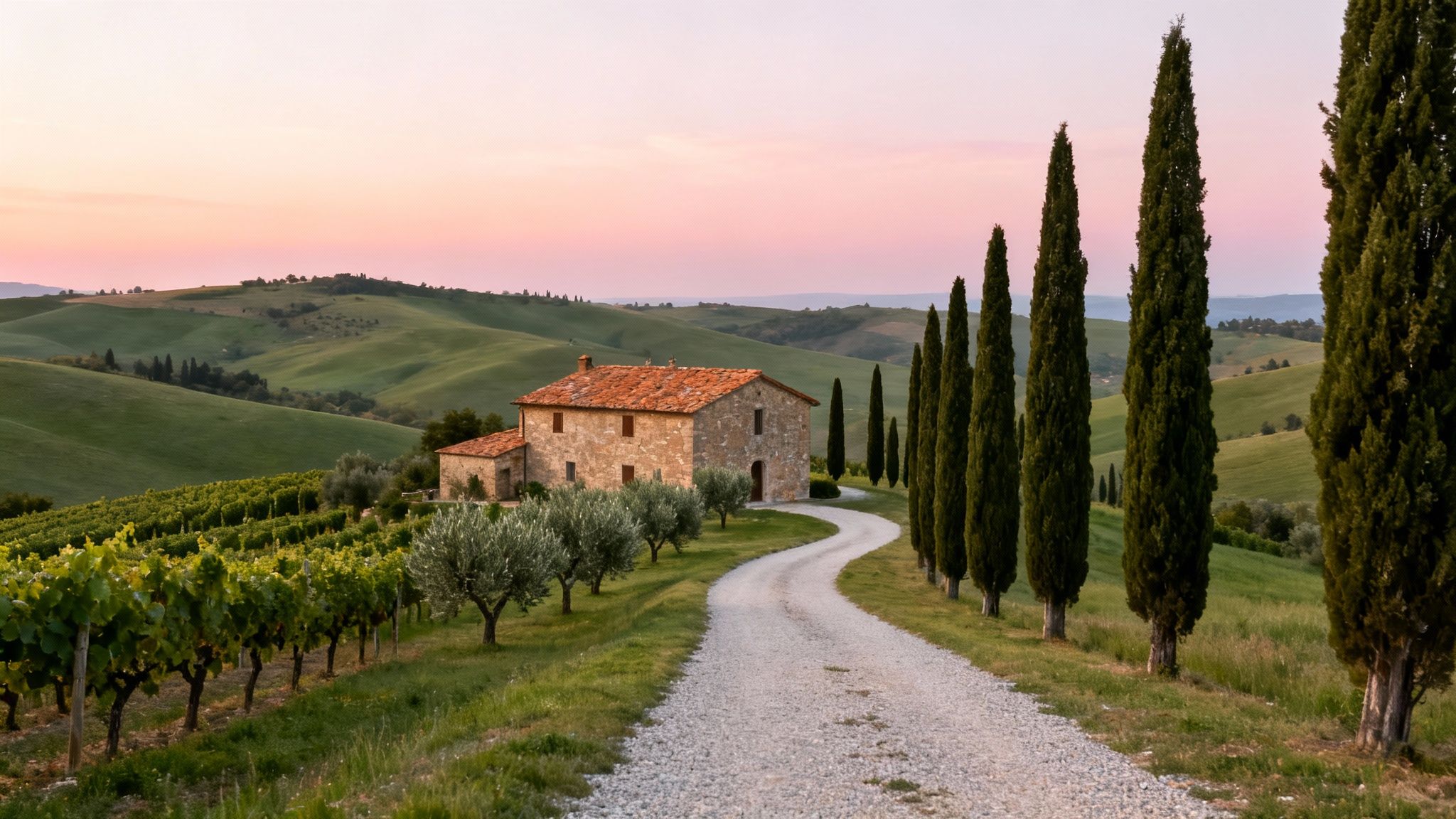
Picture this: you wake up, open the shutters, and the morning sun spills across rolling Tuscan hills. Or maybe you're enjoying a long, rustic dinner under the stars at your masseria in Puglia. This is the magnetic pull of an Italian country house—it’s more than just a building; it’s your personal gateway to la dolce vita, a life steeped in culture, history, and breathtaking natural beauty.
The Timeless Dream of an Italian Country House
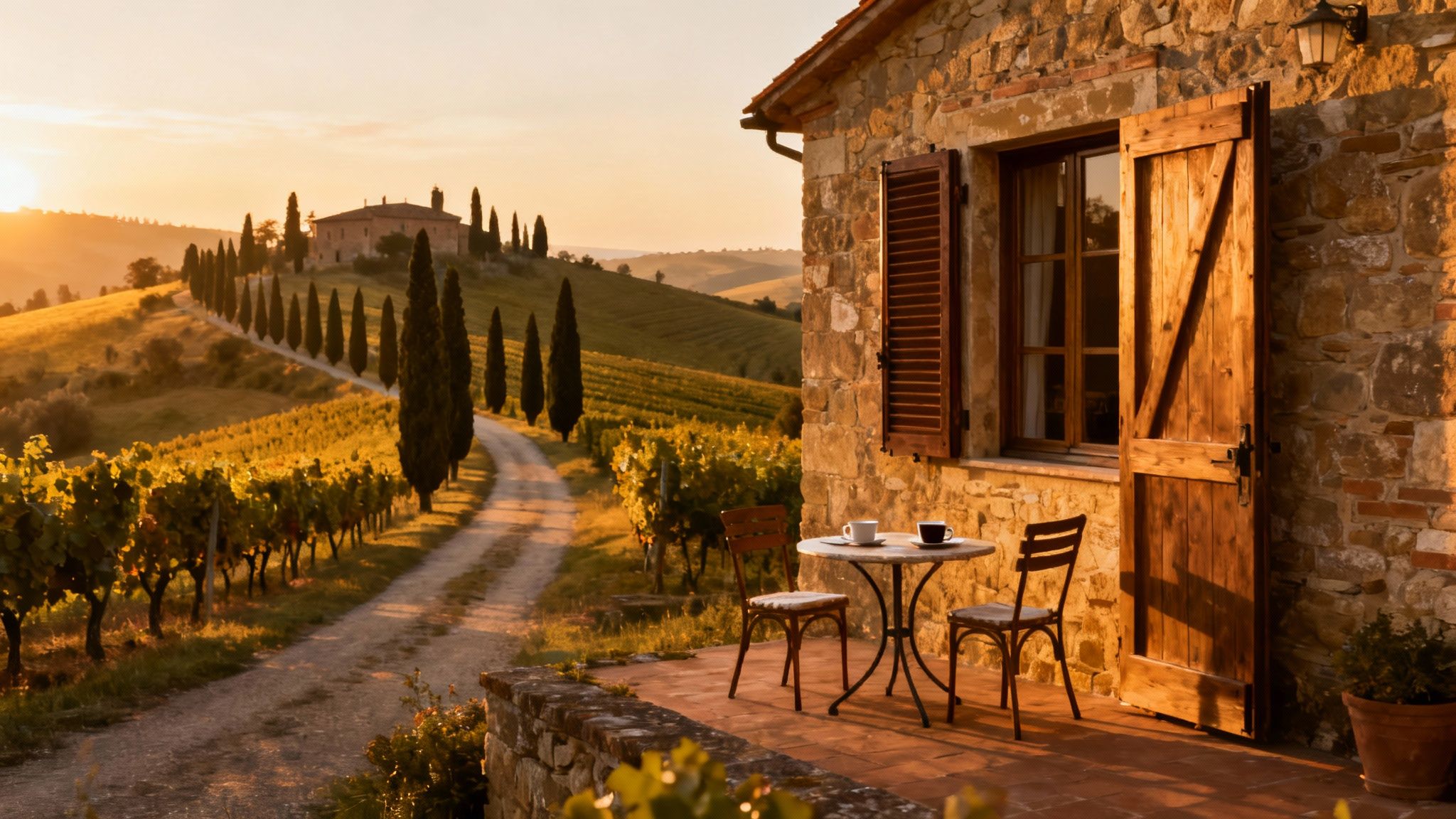
The dream of a home in the Italian countryside is a powerful one. It’s woven from images of sun-drenched landscapes, ancient olive groves, and leisurely meals shared with friends and family. For many, it's about slowing down, connecting with a more authentic way of life, and owning a genuine piece of history. These properties are far more than vacation homes; they are the living legacies of agricultural tradition and regional soul.
This deep-rooted appeal has made these homes a cornerstone of both local culture and tourism. In fact, Italy has around 46,000 historic country houses, including villas and palazzos. They draw over 35 million visitors each year, breathing new life into small rural communities. You can read more about how these historic homes bolster Italian tourism and local economies.
What Makes These Homes So Special?
The true magic of Italian country houses is their incredible diversity and deep connection to the land. Every region has its own architectural dialect, shaped by centuries of local climate, history, and available materials. This means your dream home could be a rustic stone casale in Tuscany, a whitewashed masseria in Puglia, or a majestic baglio in Sicily.
"Owning an Italian country house is less about acquiring real estate and more about becoming a custodian of a story—a story of the land, its people, and its timeless traditions."
Think of this guide as your compass for exploring these regional gems. Getting to know their unique characteristics is the very first step in turning your Italian dream into a real address.
Your Journey to Ownership Starts Here
Buying an Italian country house is a grand adventure, but like any great journey, it helps to have a map. From understanding the subtleties of regional styles to navigating the legal and financial paperwork, being well-informed makes all the difference.
This comprehensive guide will help you:
- Find the right region and property style that truly fits your lifestyle.
- Understand the market, including current prices, trends, and investment potential.
- Navigate the buying process as a non-resident, step by step.
- Plan for the long term, from renovations and maintenance to legal obligations.
Let’s begin exploring the rich tapestry of Italian country houses and find the one that’s waiting just for you.
Finding Your Perfect Style Across Italian Regions

Choosing an Italian country house is a bit like picking a fine wine. Each region has its own character and history, a unique flavor shaped by the local landscape, or terroir. The architecture tells the story of the land, the climate, and the people who’ve worked it for centuries. The real key is finding the region whose story resonates with you.
From the iconic cypress-dotted hills of Tuscany to the sun-drenched coast of Sicily, the style of a country home changes dramatically. This isn’t just about looks; it’s a reflection of a deeply ingrained way of life. Your journey starts here, by getting to know these architectural dialects and seeing which one speaks your language.
To get a clearer picture, it helps to see how these styles stack up against each other. Each region's homes were built with a purpose, using local materials to solve local challenges, which is what gives them such distinct personalities.
Regional Italian Country House Styles at a Glance
| Region | Primary House Type(s) | Key Architectural Features | Typical Landscape | Price Indicator |
|---|---|---|---|---|
| Tuscany | Casale (farmhouse) | Exposed stone, terracotta tile roofs, large wooden beams, simple, rustic forms. | Rolling hills, vineyards, olive groves, cypress-lined roads. | High |
| Umbria | Fortified farmhouse | Thick stone walls, hilltop locations, central courtyards, often more rugged. | Dense forests, mountains, green valleys, less manicured than Tuscany. | Medium |
| Puglia | Masseria, Trullo | Whitewashed walls, fortified courtyards (Masserie); conical stone roofs (Trulli). | Ancient olive groves, flat plains, dramatic Adriatic coastline. | Medium-High |
| Le Marche | Brick farmhouse | Elegant brickwork, panoramic positions between mountains and sea. | Rolling hills meeting the Adriatic coast, mountains, vineyards. | Medium |
| Sicily | Baglio | Large, fortified courtyard manors, blending Arab-Norman and Spanish influences. | Vineyards, citrus groves, rugged mountains, ancient ruins. | Low-Medium |
This table gives you a starting point, but the real magic is in the details. Let's dig a little deeper into what makes each of these regional homes so special.
Tuscany: The Quintessential Casale
When you close your eyes and picture an Italian country house, you’re probably thinking of a Tuscan casale. These classic farmhouses are the absolute heart and soul of the region, celebrated for a simple, rustic elegance that feels like it grew right out of the landscape.
Originally the hub of a working farm, a casale is all about robust, practical construction. Think thick, exposed stone walls that keep the home refreshingly cool in the summer and cozy in the winter. You’ll see low-pitched terracotta tile roofs (coppi), small windows, and massive wooden beams crisscrossing the ceilings. Many come with plenty of land—perfect for starting your own olive grove or vineyard. To learn more, take a look at our guide on the process of buying a Tuscan villa and what makes these properties so sought-after.
Umbria: Fortified Farmhouses and Rustic Charm
Often called "the green heart of Italy," Umbria has a similar rustic vibe to Tuscany but with a wilder, more rugged personality. Its country houses reflect this; they often feel more fortified and imposing, a throwback to the region's medieval history of warring city-states.
Here, you’ll find stone farmhouses that feel ancient and deeply rooted in the earth. They are often perched on hilltops, giving them commanding views over the dense forests and sweeping valleys below. Compared to their Tuscan neighbors, Umbrian homes can feel more private and self-contained, frequently built around a central courtyard that once offered protection for families and their livestock.
Puglia: The Unique Masseria and Trulli
Head south to the heel of Italy's boot, and the architecture becomes something else entirely. Puglia is a land of whitewashed walls, gnarled olive trees, and the brilliant blue of the Adriatic, giving rise to two of Italy's most distinctive country homes.
- Masseria: These are large, fortified agricultural estates. Originally built to protect inhabitants from coastal raiders, they feature high walls, expansive courtyards, and sometimes even their own watchtowers. Today, many have been beautifully converted into luxurious private homes or boutique hotels, offering vast living spaces and a palpable sense of history.
- Trulli: Found mainly in the Itria Valley, trulli are whimsical, cone-roofed stone huts built with a prehistoric dry-stone method. A single trullo is quite small, but they are often clustered together to create a larger, sprawling complex. Owning a trullo is like living inside a piece of architectural folklore.
A region's architecture is its autobiography. In Puglia, the whitewashed walls of a masseria speak of defense and self-sufficiency, while the conical roof of a trullo whispers tales of ancient ingenuity.
Le Marche and Sicily: Undiscovered Gems
For those looking to venture off the beaten path, Le Marche and Sicily offer incredible architectural variety and often better value. Le Marche, tucked between the Apennine Mountains and the Adriatic coast, is filled with beautifully restored brick and stone farmhouses that deliver panoramic views of both sea and mountains.
Sicily, a cultural crossroads for thousands of years, has its own grand style in the baglio. This is a large courtyard manor, often with fortified walls and a distinctly aristocratic feel. These estates were the heart of huge agricultural holdings and reflect the island’s rich, complex history—blending Norman, Arab, and Spanish influences into a completely unique architectural statement.
Decoding the Italian Property Market
Stepping into the world of Italian country houses is like learning a new language. You have to understand its unique financial rhythm. The market isn't one single thing; it’s a vibrant patchwork of regional economies, property conditions, and deep-rooted history. Think of it less like a stock market, where prices are uniform, and more like an art market. The value of each piece is tied to its story, its condition, and just how rare it is.
For example, a beautifully restored Tuscan casale in the heart of Chianti will always fetch a premium, often starting around €800,000 and easily climbing into the multi-millions. But head over to Le Marche or rural Sicily, and you might find a similar-sized property needing a complete overhaul for as little as €100,000. That huge gap really hammers home the three most important factors: Region, Restoration, and Remoteness.
Key Factors That Shape Property Value
Looking past the asking price is where you'll find the real story. Several key ingredients determine what an Italian country house is truly worth, and knowing them will help you spot genuine opportunities.
- Accessibility: How far is the property from a town with a supermarket, a main road, or an airport? A secluded home an hour from the nearest shop is going to be priced very differently from one just ten minutes from a bustling local community.
- Land Size and Quality: The amount of land is one thing, but what you can do with it is far more important. Is it workable farmland with olive groves or vineyards? Or is it a steep, rocky hillside? Productive land doesn't just add charm; it adds real, tangible value.
- Historical Significance: Does the property have protected historical features, known as vincoli? Original frescoes? A documented past? These details add incredible character, but they can also come with strict renovation rules that will affect your budget and timeline.
- Condition: This is the big one. A "project" house is so much more than a lower sale price—it's a serious commitment of time, energy, and money. Getting a structural survey from a qualified geometra isn't just a good idea; it's essential to uncover hidden costs for things like foundations, roofs, and utilities.
The Impact of Growing International Interest
The secret is out. The allure of the Italian lifestyle has captured the world's imagination, and the market for historic country houses has seen a massive surge in interest from foreign buyers, especially since 2020. This influx of international money is definitely changing the game, particularly in the most famous hotspots.
In a striking illustration of this trend, a recent report revealed that demand for luxury rural homes—including historic villas and farmhouses—skyrocketed by an incredible 107.38% in just one year. This wave of interest from German, American, British, and other international buyers shows just how powerful the appeal of Italy's heritage is. You can read more about foreign investment in Italian real estate.
What does this mean for you? It means that while true bargains are still out there, you'll often find them in the lesser-known regions or attached to properties needing a lot of work. This makes it more important than ever to set a realistic budget that covers not just the purchase price, but the total investment needed to bring your vision to life. If you understand these market dynamics, you’ll be in a much better position to make a smart, informed decision.
Your Step-by-Step Path to Ownership

The journey to owning a country house in Italy follows a very clear, well-trodden path. It might seem complicated from the outside, but think of it like assembling a beautiful piece of Italian furniture—follow the instructions in the right order, use the right tools, and the end result is sturdy, reliable, and deeply satisfying.
Let's break down that bureaucratic maze into a series of simple, manageable milestones. Interestingly, your adventure doesn’t begin with house viewings or grand plans, but with a small, essential piece of paperwork that unlocks every other step.
Step 1: Get Your Codice Fiscale
Before you can do anything official in Italy—make an offer, open a bank account, even sign up for electricity—you need a Codice Fiscale. This is a unique alphanumeric code that works like a Social Security Number in the US or a National Insurance number in the UK. It's your official identifier in the Italian system.
The good news is that getting one is surprisingly easy. You can apply at an Italian consulate or embassy in your home country before you even leave. Or, if you're already in Italy, just pop into any local Agenzia delle Entrate (the Italian tax office).
The official Italian revenue agency website has clear instructions for foreign citizens, showing the simple application form and ID you'll need. Once you have this code, you're officially on the board and ready to engage with the property market.
Step 2: Make a Formal Offer
So, you’ve found the one. That perfect rustic farmhouse with the olive grove. The next step is making a formal written offer, known as a proposta d'acquisto. This isn't just a casual handshake; it's a legally binding document. It clearly lays out your proposed price, a timeline for the sale, and any important conditions, like the purchase depending on a clean structural survey.
Once the seller signs your offer, the deal is set in motion and is binding on you both. At this point, you'll put down a small deposit (caparra) to show you're serious. This money is usually held safely by the estate agent or a notary until the sale progresses.
Step 3: Assemble Your Professional Team
You can't—and shouldn't—navigate the Italian property system alone. You absolutely need two key professionals on your side. They are your guides and your guardians, making sure the whole process is secure and legally sound.
- Geometra: This role is uniquely Italian. A geometra is a surveyor, architect, and project manager all rolled into one. Before you commit, your geometra will perform critical due diligence. They’ll check that the property’s physical state perfectly matches the plans on record at the land registry and that all building permits are in order. This is a lifesaver, especially for older Italian country houses that have often seen undocumented changes over the decades.
- Notaio: The notaio (notary) is a public official appointed by the state who acts as a neutral third party to oversee the transaction. Their job is to verify the legal status of the property, confirm there are no hidden debts or claims against it, and ensure all taxes are calculated and paid correctly. The buyer always gets to choose the notaio.
Think of it this way: The geometra is your property’s doctor, giving it a complete health check-up. The notaio is the judge who verifies the entire proceeding is lawful and finalizes the union between you and your new home.
Step 4: The Preliminary and Final Contracts
With all the checks done and your team in place, you move to the final legal stages. This involves two key contracts that lock in the sale for good.
-
The Compromesso (Preliminary Contract): This is a much more detailed agreement that cements all the terms—the final price, the closing date, and a full legal description of the property. When you sign the compromesso, you’ll pay a significant deposit, usually 10% to 30% of the purchase price. This contract is ironclad; backing out now comes with serious financial penalties for either party.
-
The Rogito (Final Deed of Sale): This is the grand finale. The rogito is the final deed, signed by you and the seller in the physical presence of the notaio. After the notary reads the entire deed aloud to ensure everyone understands and agrees, it's signed. At this exact moment, you pay the remaining balance, and the keys are handed over. You are now the official owner of an Italian country house. The notaio handles the final step of registering the sale with the Land Registry, officially writing your name into the property's history.
Keeping Your Legal and Financial House in Order
Once you have the keys to your Italian country house, the journey isn't over—it’s just beginning. Now comes the practical side of living the dream: managing the legal and financial responsibilities that keep your investment safe and your ownership experience stress-free for years to come.
Think of it like this: the buying process is the exciting courtship, but owning the home is the long-term relationship. It requires attention, planning, and a clear understanding of your commitments. Let's break down what you need to know.
Navigating Purchase Taxes and Fees
The first thing to get your head around is that the final price you pay isn't just the number on the sales contract. You'll have one-time acquisition costs, and the biggest chunk of these will be the purchase taxes. Who you buy from—a private individual or a developer—makes all the difference.
- Buying from a private seller: In this case, you'll pay Imposta di Registro (Registration Tax). The good news is that it’s calculated on the property’s cadastral value—a government assessment that's almost always lower than the actual market price. For non-residents, this tax is typically 9%.
- Buying from a company: If you’re buying a brand-new or fully restored home from a developer, you'll pay IVA (Italy's version of VAT) instead. This is calculated on the full sale price, usually at a rate of 10% for a standard home.
On top of these, you’ll also need to budget for the notary’s fee (onorario notarile) and the real estate agent's commission (provvigione). Together, these can add a few more percentage points to your total bill.
Understanding Ongoing Ownership Taxes
Once the house is yours, you'll need to pay annual property taxes to the local municipality. The main one to know is IMU (Imposta Municipale Unica).
IMU is the municipal property tax levied on properties that are not the owner's primary residence. The rate varies from town to town because it's set by the local comune and depends on the property's cadastral value.
It's essentially the Italian equivalent of council tax in the UK or property taxes in the US, and it pays for local services like road maintenance and rubbish collection. Your accountant (commercialista) can handle the calculation and payment for you each year, so it's quite straightforward.
Planning for Renovations and Permissions
Part of the magic of owning a country house in Italy is often the chance to restore it. But you can't just start knocking down walls. Italy has very strict planning laws, especially for historic buildings or homes in protected landscapes.
This is where your geometra (a surveyor/project manager) becomes your most important ally. Before you lift a single hammer, they will work with the local planning office to secure the right permits. This step is crucial; it ensures your beautiful renovation is completely legal and protects you from hefty fines down the road.
Financing Your Italian Dream Home
While plenty of people buy with cash, financing is a perfectly viable option. It's possible for non-residents to get a mortgage from an Italian bank, but be prepared for a slightly different process. You’ll likely need a larger down payment, often around 30-40%, and the bank will want to see thorough proof of your income and a strong credit history.
Another popular route is to arrange financing back home, perhaps by releasing equity from your primary residence. To get a better sense of all the possibilities, it’s worth taking a closer look at the different second home financing options available. Getting your finances sorted from the outset is the key to making sure your Italian retreat is a source of joy, not a headache.
Bringing Your Rustic Italian Dream to Life
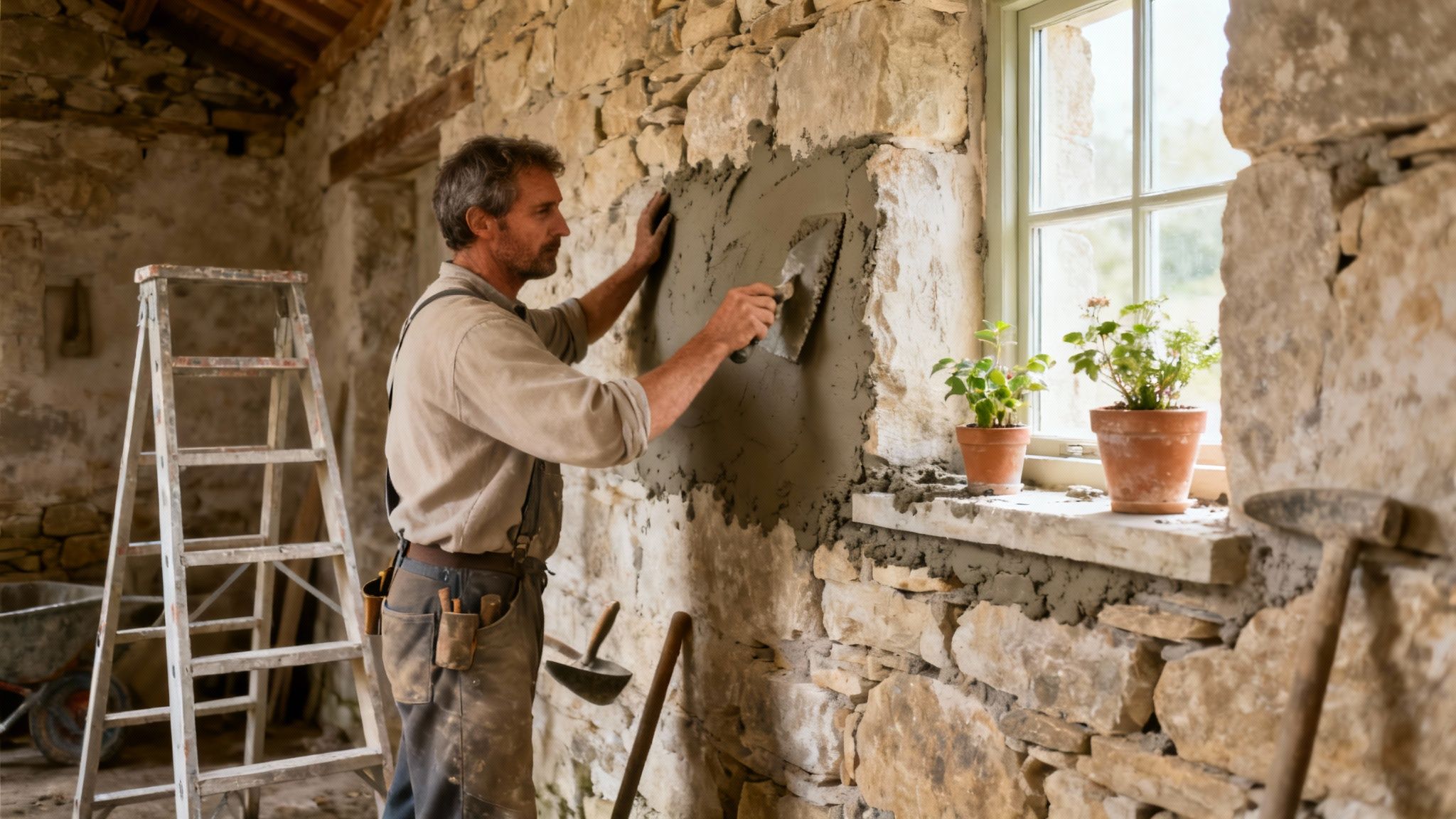
The moment the keys are finally in your hand is just the beginning. It's an incredible feeling, but it’s also when the real work starts. You’re no longer just a buyer; you're the custodian of a small piece of Italian history, and it's up to you to breathe new life into it.
Whether you're planning a few cosmetic touch-ups or a complete, down-to-the-studs renovation, having a realistic budget is everything. For Italian country houses, you can expect restoration costs to fall anywhere between €800 to €1,500 per square meter for a quality job. This isn't just about the big-ticket items; you have to account for everything from structural repairs and roofing down to the very last light fixture.
Assembling Your Renovation Dream Team
This is not a solo project. The success of your renovation rests entirely on finding the right local professionals—people who genuinely understand the quirks of traditional Italian construction. Think of this team as your lifeline.
Your key players will be:
- A Geometra or Architect: This person is your project manager, your guide through the maze of building permits (permessi di costruire), and the one who ensures every plan is technically sound and legally compliant.
- Reputable Builders (Impresa Edile): You need a building crew with a portfolio of restored historic homes in your specific region. Always ask for references and, if possible, go see their past projects with your own eyes.
- Specialist Artisans (Artigiani): For jobs like restoring original terracotta floors, repointing ancient stone walls, or bringing wooden beams back to life, you’ll need true craftspeople who have dedicated their lives to these skills.
"A great restoration doesn't impose a new identity on an old house. It listens to the stories the walls have to tell and helps them speak clearly for a new generation."
So, where do you find these experts? Your real estate agent or geometra is the best place to start, as they’ll have a network of trusted local contacts. Don’t just hire the first person you meet—interview several candidates to find a team that truly gets your vision and respects your budget.
The Ongoing Joy of Maintenance
Once all the renovation dust has settled, your role shifts again. Now, it's about the ongoing care that keeps your property looking and feeling its best. The real cost of owning a country home isn't just in the bricks and mortar.
Make sure your annual budget includes line items for:
- Land and Garden Care: This is especially true if your property includes olive groves or a small vineyard.
- Systems Checks: Regular maintenance on your plumbing, electrical, and heating systems is non-negotiable.
- Exterior Work: Think repointing stonework, painting wooden shutters, and having the roof inspected.
Preserving these incredible properties is a commitment, one that’s even recognized at a national level. The Italian Registry of Historic Houses of Excellence catalogs over 8,500 properties, but only a tiny fraction—about 0.5%—earn top certifications after passing intense quality controls. This gives you an idea of the dedication involved.
It’s a labor of love, for sure, but the reward is a lifestyle that’s deeply connected to Italy's timeless soul. To make sure you’re starting this journey on solid ground, take a look at our guide on how to inspect a house before buying.
Common Questions About Buying a House in Italy
So, you’re dreaming of your own place in the Italian countryside. It's a fantastic dream, but it's natural for practical questions to pop up. The process might seem a bit daunting from the outside, but once you understand the key steps, you’ll find it’s more straightforward than you think. Let's walk through some of the most common things international buyers ask.
A big one is residency. Do you need to be a resident to buy? The short answer is no. For citizens from the EU, UK, and US, the rules for buying property are pretty much the same whether you live here or not. The one thing everyone needs, no exceptions, is a Codice Fiscale—your personal Italian tax code. It's easy to get and is your official entry ticket into the system.
Can Foreigners Easily Buy Property?
Yes, absolutely. Italy has always been open to foreign buyers, and there are no special hoops to jump through just because you aren't Italian. Whether you're planning to move full-time or just want a holiday home, the path is open.
The whole thing is less about getting permission and more about following the correct procedure. Italy’s legal process is well-established and designed to protect everyone involved. If you line up a solid team—a trustworthy agent, a competent geometra (a surveyor), and an experienced notaio (notary)—you'll find the journey to owning one of those incredible Italian country houses is clear and secure.
What Are the Biggest Unexpected Costs?
If there's one thing that catches people by surprise, it's the total closing costs. You should plan on adding another 10% to 15% on top of the property's purchase price. These aren't sneaky hidden fees; they're just the standard costs of doing business, and you absolutely need to factor them into your budget from day one.
The main expenses you’ll see are the purchase taxes (Imposta di Registro or VAT, depending on the seller), the notary’s fee (onorario notarile), and the real estate agent's commission (provvigione). Knowing these numbers upfront saves a lot of headaches later on.
And if you're looking at a property that needs some love, the renovation is the other major "hidden" cost. Before you even think about making an offer, get a geometra to do a thorough structural survey. This will give you a real, hard-nosed estimate of what it will take to turn that rustic ruin into your dream home.
How Long Does the Buying Process Take?
From the moment your offer is accepted to the day you get the keys in your hand, you're typically looking at about two to four months. The initial back-and-forth can be quick, but the real work happens during the due diligence phase.
This is when your notaio earns their fee, meticulously checking every document, confirming property lines, and making sure the ownership history is clean. It’s a crucial step to ensure there are no legal surprises down the road. The whole process culminates in signing the rogito, the final deed of sale, at the notary’s office. That's the moment it's officially yours.
Ready to stop dreaming and start searching? At Residaro, we connect you with a curated selection of beautiful country houses across Italy. Begin your search for the perfect property today at https://residaro.com.