Your Guide to Finding and Buying Italian Country Homes
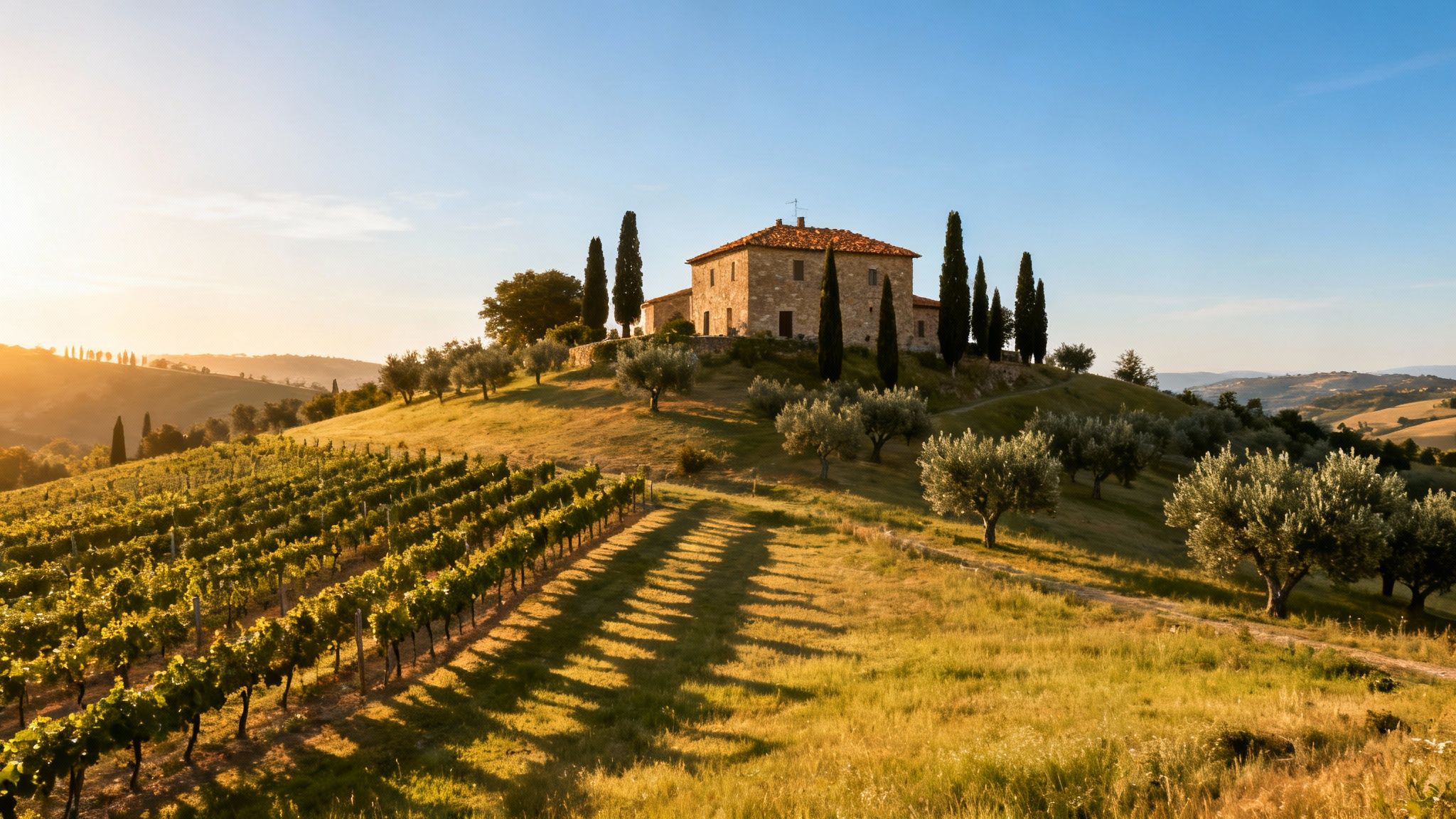
Picture this: you wake up, step onto a sun-drenched terrace, and sip your morning espresso while gazing out over rolling hills and ancient olive groves. This isn't just a daydream; it's a vision that draws countless people to the idea of owning one of the many Italian country homes. This guide is designed to be your practical roadmap, turning that beautiful image into your reality.
The Enduring Allure of Italian Country Homes

There’s an undeniable magnetic pull to the rustic Italian lifestyle. It’s born from a deep-seated desire for something more authentic, for space to breathe, and for a pace of life that’s a little bit slower. This is about so much more than just a property investment; it’s about buying into a way of life that celebrates simple pleasures and a profound connection to history and nature.
And what was once a distant dream is now more achievable than ever. The market for country homes in Italy has been gaining real momentum, bouncing back strongly after the pandemic. In the first half of 2025 alone, Italy saw 373,395 property transactions—a remarkable 9.5% increase from the same period in 2024. This growth isn't just happening in the big cities, which signals a healthy, widespread demand across Italy's diverse regions. You can find more insights on Italy's property market growth on sites like idealista.it.
Your Roadmap to La Dolce Vita
While the romance of it all is wonderful, this guide is here to give you a clear, step-by-step plan for the exciting journey ahead. Think of it as your trusted companion for finding, buying, and ultimately bringing your perfect rural Italian retreat to life.
Owning an Italian country home is an immersive experience. It's not just a purchase but an adoption of a new way of life—one that is deeply intertwined with the land, culture, and community around you.
We'll walk through all the essential topics, giving you the clarity you need to make informed decisions and feel prepared for every stage.
Here’s a taste of what we’ll cover:
- Regional Architectural Styles: You'll learn the difference between a Tuscan casale and a Puglian masseria.
- Market Realities: We’ll look at real price trends and uncover value opportunities far from the usual tourist traps.
- The Buying Process: We'll demystify the legal and administrative hurdles for foreign buyers, making it all feel much less intimidating.
- Renovation and Restoration: You'll get practical advice on how to budget for and manage a restoration project.
- Financials and Ownership Costs: We’ll break down the taxes, fees, and financing options you need to know about.
By the time you finish this guide, you won't just be dreaming. You'll have the knowledge and confidence to make owning one of the many beautiful Italian country homes your reality.
Exploring the Styles of Rural Italian Properties

Every region in Italy tells its own story through its architecture, a narrative shaped by centuries of local history, the specific climate, and whatever building materials were pulled from the surrounding land. Learning to spot these differences is like learning a new language—it lets you read the landscape and see the deep cultural roots built right into the walls of each home.
Let's be clear: Italian country homes are not one-size-fits-all. Their styles are as diverse and fiercely local as the country's cuisine.
From the sun-scorched south to the rolling hills of the central regions, a rural property's design was always driven by its purpose. A home wasn’t just a place to sleep; it was the engine of a farm, a defensive stronghold, or a nobleman's escape from the summer heat. This history is what gives each style its authentic, unshakeable character.
Tuscany and Umbria: The Classic Casale
When people daydream about an Italian country home, the Tuscan casale is usually what they’re picturing. These iconic stone farmhouses are the heart and soul of Central Italy. Originally the command centre for a working farm, a casale was built to endure, with thick stone walls that keep the inside cool in the summer and hold the warmth in winter.
You can almost always spot a classic casale by a few key features:
- Exposed Stone Walls: Built from local pietra, these walls have a warm, earthy look that feels like it grew right out of the landscape.
- Terracotta Roof Tiles: Known as coppi and tegole, these classic clay tiles create that quintessential rustic Italian roofline.
- Small Windows: These weren't an aesthetic choice originally—they were for defence and insulation. Today, they give the home a cosy, protected feeling.
- Wooden Beams: Massive chestnut or oak beams, called travi, support the ceilings and lend immense character to the rooms.
These homes often have a wonderfully irregular layout, the result of being added onto over generations as families and farm operations grew. If this is the style that captures your imagination, our detailed guide on what to consider when buying a Tuscan villa is a great place to dive deeper.
Puglia: The Fortified Masseria
Head south to the heel of Italy's boot, and the architecture changes completely. Down in Puglia, the defining property is the masseria, a grand, fortified farmhouse complex. Born from a history of pirate raids along the coast, these estates were built as self-sufficient, defensible compounds, usually organized around a central courtyard.
A masseria isn’t just a house; it’s a small, private village. Its high walls and central courtyard were designed to protect residents, livestock, and harvests, creating a secure world within its boundaries.
The design of a masseria is both imposing and brilliant in its practicality. Its features are a direct response to the southern sun and the region's turbulent history. Whitewashed walls reflect the intense heat, while star-vaulted ceilings create airy, high-ceilinged rooms. Many historic masserie still have their ancient olive groves, citrus orchards, and sometimes even a private chapel.
Sicily: The Inward-Facing Baglio
Over in Sicily, the traditional rural estate is the baglio. Much like a masseria, a baglio is a large agricultural property built around a courtyard. The name itself comes from the Latin ballium ("outer wall of a castle"), which tells you everything you need to know about its defensive past.
The layout of a baglio is distinctly inward-facing. All the doors and windows of the living quarters, stables, and storage rooms open onto the central courtyard, leaving a formidable, nearly windowless wall facing the outside world. This ingenious design provided security while creating a private, sheltered space for work and family life, protected from both intruders and the punishing Sicilian sun.
To help you visualize these differences, here’s a quick breakdown of what makes each of these regional styles unique.
Regional Italian Country Home Styles at a Glance
| Region | Primary Property Type | Key Architectural Features | Common Materials |
|---|---|---|---|
| Tuscany & Umbria | Casale (Farmhouse) | Irregular layouts, small windows, large hearths, external staircases | Local stone (pietra), terracotta tiles, chestnut wood beams |
| Puglia | Masseria (Fortified Estate) | High boundary walls, central courtyard, star-vaulted ceilings | White lime plaster (calce), local tuff stone, limestone |
| Sicily | Baglio (Courtyard Estate) | Inward-facing design, formidable outer walls, central courtyard | Sandstone, volcanic rock, terracotta, wood |
Of course, the casale, masseria, and baglio are just the beginning. They represent three of the most iconic styles, but the architectural diversity across rural Italy is immense. Each one tells a vivid story of its region's past, offering a powerful connection to the land and its history.
Finding Your Place in the Modern Italian Property Market
So, you're ready to start the search for your dream home in the Italian countryside. Fantastic. The first step is to get a real feel for the market—to move past the glossy photos and understand what's really happening on the ground. The Italian property market isn't one single thing; it's a wonderfully complex and varied landscape, and knowing how to navigate it is what separates a casual dreamer from a savvy buyer.
Think of it like a sprawling, beautiful mosaic. From a distance, it seems like one cohesive picture, but when you get up close, you see that every little tile—every region, province, and even village—has its own unique character, color, and price. While the big cities and famous tourist hotspots can be predictably expensive, there are countless rural pockets where you can find incredible, character-filled homes for a fraction of the cost. This regional variation is your biggest advantage.
Understanding Price Trends and Regional Differences
In recent years, the market has seen some pretty uneven price movements across the country, which is great news for international buyers. If you only look at the nationwide averages, you might see slow, modest growth. But the real story, the one that matters to you, is found when you zoom in on specific areas. This is where you find the hidden gems.
For example, asking prices can vary dramatically. You might see an average of around €1,341 per square meter in Palermo, while in Rome, it’s closer to €3,237 per square meter. For someone looking for a country home in Tuscany, Umbria, or Puglia, this wide gap is a huge opportunity. The price for a beautiful old farmhouse in a quiet rural province can be a world away from the rates you'd pay in a prime urban location. You can dig into these trends yourself by checking out Italy's property market analysis and forecast.
What this really means is that your budget will go a lot further in up-and-coming regions like Le Marche, Abruzzo, or parts of Sicily than it will on the well-trodden paths of Chianti. These places offer the same idyllic lifestyle and breathtaking scenery, just without the premium price tag.
What Really Determines a Property's Value?
Beyond the region, a few key factors will always shape the price of an Italian country home. Learning to see a property through the eyes of a local expert will help you spot both potential pitfalls and incredible deals.
The State of Repair (Stato di Manutenzione)
This is probably the single biggest factor affecting the price. Generally, a property will fall into one of three buckets:
- Fully Restored (Ristrutturato): These are the turn-key homes. They’re ready to live in, often blending modern comforts with beautiful historic details. You’ll pay a premium for the convenience, but you get peace of mind in return.
- Structurally Sound but Dated (Abitabile): This is often the sweet spot. The house is livable—the roof is solid, the walls are standing—but the kitchen, bathrooms, and electrical systems need a complete overhaul. It’s a fantastic way to get a solid property and add your own touch (and value) over time.
- A Complete Ruin (Da Ristrutturare): The ultimate romantic project. The initial price tag is incredibly low, but don't be fooled—the renovation will be a serious investment. Still, it’s a blank canvas, giving you the chance to build your absolute dream home from the ground up.
Accessibility and Proximity to Town
How easy is it to actually get to your rustic paradise? A stunning home tucked away at the end of a long, bumpy "strada bianca" (a classic Italian white gravel road) will naturally be priced lower than one with smooth, paved access. How close you are to the nearest town with a market, a couple of cafes, and a pharmacy also plays a huge role in a property’s day-to-day appeal and long-term value.
Always think about the "last mile." That charming isolation is wonderful, but make sure the access works for your lifestyle, especially in winter when some rural roads can become a real challenge.
Land and Outdoor Space
The land is just as important as the house itself. A property that comes with a few acres of productive olive groves or a small vineyard is going to be valued much higher than one with just a little garden. You also need to look at how usable the land is. Is it steep and terraced, or is it flat and easy to manage? Is there a well or other reliable water source for a pool or vegetable garden? These details aren't just line items; they contribute massively to both the financial value and the quality of life you'll enjoy there.
A Foreign Buyer's Guide to the Purchase Process

The thought of navigating Italian bureaucracy can be intimidating, bringing up images of endless paperwork and confusing regulations. But while the system has its quirks, the process of buying a country home here is surprisingly structured and secure. The real secret is simply understanding the steps and knowing who to have on your side.
Think of it as a well-choreographed dance. You have a few key partners, and each one has a specific, legally defined role designed to protect everyone involved—buyer and seller alike. With the right team in place, the journey from finding your dream farmhouse to finally holding the keys can be perfectly manageable.
Assembling Your Professional Team
Before you get swept away and make an offer, the smartest thing you can do is line up your professional team. These people aren't just helpful guides; they are absolutely essential for making sure your purchase is legally sound.
Your core team will be made up of three key players:
- Agente Immobiliare (Real Estate Agent): This is your scout on the ground, the person who helps you find properties and negotiates the price. Just make sure they're licensed and properly registered with the local Chamber of Commerce.
- Geometra (Surveyor): This technical expert is arguably your most important ally. A geometra handles the critical due diligence, verifying property lines, checking for building permits, and ensuring the house is compliant with all local regulations.
- Notaio (Notary): The notaio isn't your lawyer; they are a public official appointed by the state who acts as a neutral third party. Their job is to verify everyone's identity, confirm the property's legal history is clean, and ensure the final deed is executed and registered correctly.
The Key Steps in the Purchase Journey
The Italian property-buying process follows a very clear, logical path. It's designed to build commitment and security at each stage as you move from an initial offer to the final transfer of ownership.
The very first official step, before anything else, is getting your Codice Fiscale. This is an Italian tax identification number, and you can't do anything without it—buy property, open a bank account, or even set up utilities. It’s a straightforward process that you can do at an Italian consulate in your home country or at the local Agenzia delle Entrate (tax office) in Italy.
Once you have your Codice Fiscale and you’ve found the perfect place, the real legal process kicks off. It generally unfolds in three main contractual stages.
The Italian purchase process is deliberately methodical. Each step, from the preliminary contract to the final deed, is a legal checkpoint that locks in the terms and protects your investment, preventing last-minute changes or surprises.
From Preliminary Contract to Final Deed
Getting your head around these milestones is the key to navigating the purchase with confidence. Each contract serves a distinct purpose, building on the one before it.
-
Proposta d'Acquisto (Purchase Offer): This is your formal, written offer. Once the seller signs it and you pay a small initial deposit (caparra), it becomes a legally binding agreement.
-
Compromesso (Preliminary Contract): Also called the Contratto Preliminare di Vendita, this is the most significant step before closing. It’s a detailed contract spelling out every term of the sale—the price, payment schedule, and completion date. When you sign the compromesso, you’ll typically pay a substantial deposit, often 10% to 30% of the purchase price.
-
Rogito (Final Deed of Sale): This is the grand finale. The rogito is the final contract signed in front of the notaio. At this meeting, you pay the remaining balance, the seller hands over the keys, and the notaio officially registers the property transfer in your name at the Land Registry (Catasto).
Now, here’s a crucial piece of advice: your geometra must complete all their checks and surveys before you sign the compromesso. This is non-negotiable. They need to confirm that every structure on the property is legally registered and that there are no hidden debts or claims against it. For a deeper dive into this entire process, you can explore our complete guide on what to expect when buying a house in Italy. Taking this step ensures you’re committing your deposit to a property with a clean bill of health.
Bringing Your Italian Dream Home to Life
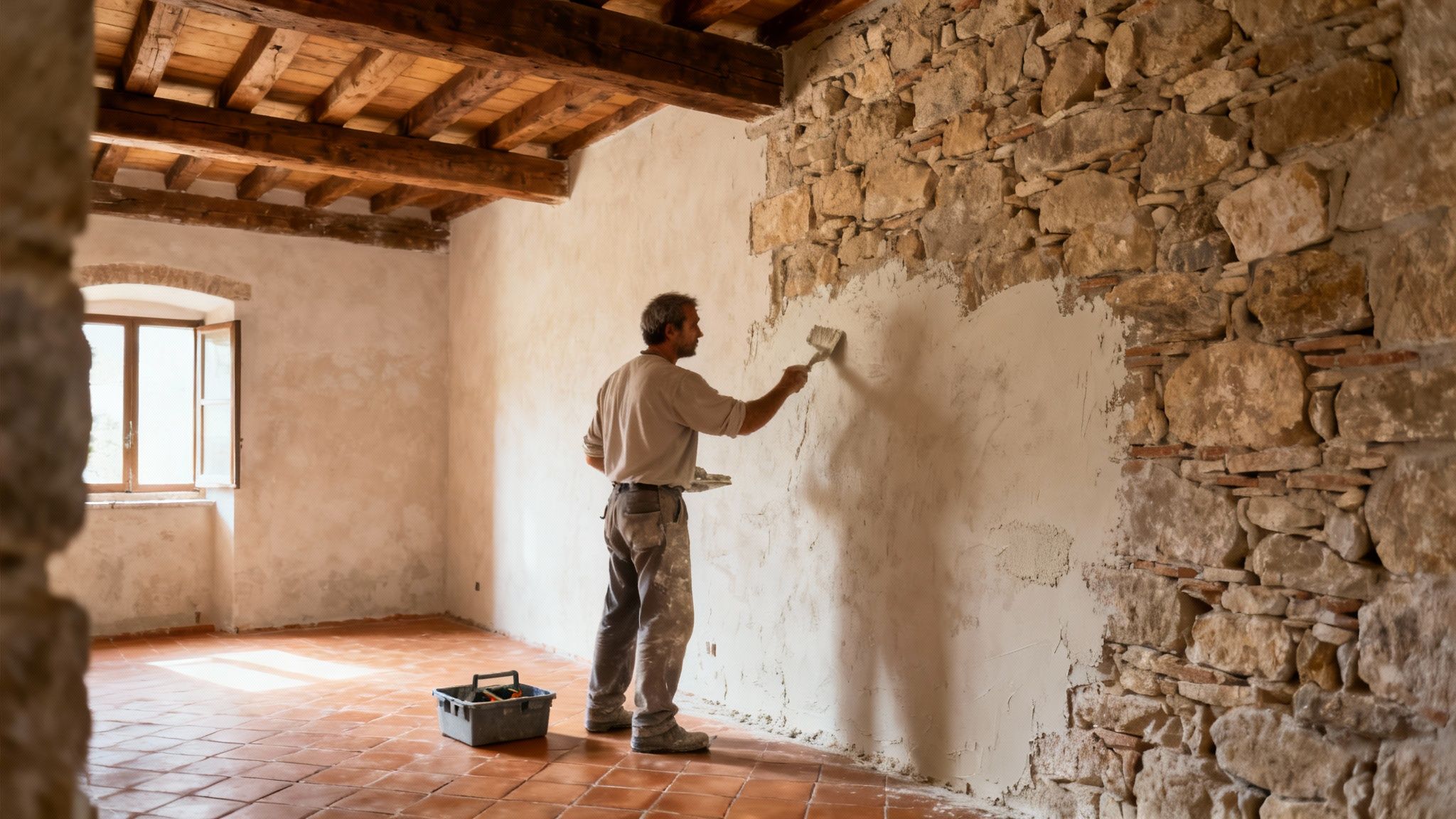
Getting the keys to your rustic Italian retreat is a huge moment, but in many ways, it’s just the start of the real adventure. If you’ve bought a property that needs some love, the renovation is where the magic truly begins. This is your chance to breathe new life into an old soul, carefully peeling back the layers of time to reveal the home’s original character while weaving in the comforts of today.
Bringing an old stone farmhouse back to life isn’t like building from scratch. It's more of a delicate dance between preserving its history and making it livable for the 21st century. The goal is to honor the stories held within its walls—the uneven terracotta floors, the massive chestnut beams, the hand-carved stone sinks—while making the space work for you. It takes patience, a clear vision, and most importantly, the right local experts who just get it.
Assembling Your Restoration Dream Team
Your first job, and the most important one, is finding the right people. Working on these old country homes is a specialized skill. You need craftspeople who understand traditional materials and respect the building’s past, not a crew that just wants to cover everything in plasterboard.
A local, independent geometra (a type of surveyor and project manager unique to Italy) or an architetto (architect) will be your most valuable ally. Think of them as more than just designers; they're your project manager, your guide through the maze of local building codes, and your direct line to the municipal planning office (comune). They are essential for securing the permits, a process that can be famously slow and complicated in Italy.
Once you have a good geometra on your side, finding the right builders and artisans gets a whole lot easier. They'll have a network of trusted professionals, from stonemasons (muratori) who can expertly repoint old walls to carpenters (falegnami) who can bring an ancient wooden door back from the brink.
When you're talking to builders, always ask to see their previous work on similar historic homes. A portfolio full of modern apartment renos just doesn't cut it when you're dealing with a 500-year-old stone casale. You're looking for someone with a genuine passion for preservation.
Budgeting for Beauty and Surprises
Nailing down a realistic budget is everything. The purchase price of an unrestored property might look like a steal, but the renovation costs will be a huge part of your total investment. It’s a classic mistake for foreign buyers to underestimate just how much this part will cost.
As a general rule, you should plan on spending at least €1,000 to €1,500 per square meter for a full, high-quality restoration. Of course, this can swing wildly depending on the home's condition and the finishes you choose, but it’s a solid number to start with.
Break your budget down into a few key areas:
- Structural Work: This is the big stuff—roof, walls, foundations, and any seismic upgrades required by law. Never, ever cut corners here.
- Systems (Impianti): This means all new electrical, plumbing, and heating. It's also the perfect time to install energy-efficient solutions like underfloor heating or solar panels.
- Finishes (Finiture): Think flooring, plastering, painting, windows, and doors. The goal should always be to restore original materials when you can.
- Kitchen and Bathrooms: These rooms often have the highest cost per square meter.
- Contingency Fund: This is non-negotiable. Always, always set aside an extra 15-20% of your total budget for the unexpected. The moment you open up an old wall, you have no idea what you might find.
Preserving the Soul of the Home
Ultimately, a great restoration creates a home that feels both timeless and perfectly comfortable. The real charm of an Italian country house is in its quirks and historic details. The trick is to keep that soul intact while making sure the house is safe and warm.
Focus on celebrating the original features that make your property one-of-a-kind. This could mean:
- Repairing, not replacing, the original terracotta floors.
- Sandblasting and treating old wooden beams to show off their beautiful grain.
- Leaving sections of interior stone walls exposed for texture and a powerful sense of history.
When you blend these authentic elements with modern must-haves like a well-designed kitchen, reliable Wi-Fi, and efficient heating, you create a space that honors its past while being perfectly ready for your future. It's this thoughtful approach that turns your Italian dream home from just a building into a living piece of history.
Understanding the True Costs of Ownership
Buying a country home in Italy is a dream, but a well-funded dream is one that actually comes true. It's easy to get swept up in the romance of it all, but the first step is always to build a clear, honest financial picture. This isn't just about the asking price on the listing; it's about mapping out every cost so you can move forward with confidence, without any nasty surprises down the road.
Think of the listing price as your starting point. All the other expenses are what make the purchase real, ensuring everything is legally sound and the property is truly yours. The good news is these costs are predictable, so you can factor them into your budget from day one.
Beyond the Purchase Price: The Key Expenses
When you buy a home in Italy, several mandatory fees pop up, most of which are handled by the notaio (a highly-regarded public official and lawyer) and paid when you sign the final deed.
- Registration Tax (Imposta di Registro): This is a big one. As a non-resident, you'll typically pay a transfer tax of 9% of the property’s cadastral value. This is a value recorded in the land registry, which is often, thankfully, much lower than the actual market price.
- Notary Fees (Atto Notarile): The notaio’s fee is regulated by the state and scales with the property's price. This isn't just a rubber stamp; it covers all the crucial legal work of drafting the final deed and officially registering your ownership.
- Agent Commission (Provvigione): In Italy, it’s common for both the buyer and the seller to pay the real estate agent's commission. Expect this to be between 3% to 5% of the sale price for each party.
Securing Financing as a Foreign Buyer
For many buyers, a mortgage is a key part of the puzzle. The great news is that Italian banks are quite accustomed to lending to foreign buyers, but they do expect you to come prepared. You’ll need to pull together detailed proof of your income and demonstrate a solid credit history.
As a general rule, non-residents can typically secure a loan for about 50-60% of the property's value, which means you’ll need a significant down payment ready to go.
The market itself is sending some encouraging signals. Recent data shows that stronger demand and more accessible credit are propping up property values and encouraging renovation projects. This influx of cross-border capital is injecting fresh life into the market, a trend that's particularly beneficial for rural Italian properties. If you want to dive deeper, you can explore more about the Italian real estate market overview to get a feel for these dynamics.
Before you even start looking at listings, get a firm grip on your financial capacity. Know exactly what you can comfortably afford—not just for the purchase, but with a healthy buffer for renovations and the ongoing costs of ownership.
For a much closer look at getting a mortgage in Italy, be sure to read our guide on navigating second home financing options.
Ongoing Costs of Owning an Italian Country Home
Once those historic keys are finally in your hand, your financial focus shifts from the one-time purchase costs to the recurring expenses of ownership. These annual costs are just part of life in Italy, and they're essential to budget for properly.
The main annual tax is the IMU (Imposta Municipale Unica). It's calculated based on that same cadastral value and the local rates set by your municipality. If you make the home your primary residence, you're exempt, but it's mandatory for all second homes.
Beyond the IMU, you'll need to account for utilities, property insurance, and of course, routine maintenance—the little things that will keep your piece of Italian history beautiful for years to come.
Common Questions About Buying Italian Country Homes
Alright, let's talk about the practical questions that pop up when you start getting serious about buying a home in the Italian countryside. It's completely normal to have a few lingering concerns, even after doing your research. Think of this as the part of the conversation where we clear the air on the most common sticking points for foreign buyers.
We’ve heard these questions time and again from people in your exact position. From language barriers to costly mistakes, we'll cover what you really need to know to move forward with confidence.
Do I Need to Speak Italian to Buy a Property?
For the purchase itself, no, you don't need to be fluent. But for everything that comes after—managing a renovation, getting to know your neighbors, or just dealing with daily life—a basic handle on Italian will make your life infinitely easier and richer.
When it comes to the legal side of things, having bilingual professionals is non-negotiable. Your real estate agent, lawyer, and especially your surveyor (geometra) must be able to communicate clearly with you in your own language. The final deed of sale, the rogito, is always in Italian, but you have the right to an official, certified translation. This ensures you know exactly what you're signing.
What Are the Most Common Pitfalls to Avoid?
It's easy to get swept up in the romance of it all, but a few common mistakes can turn a dream into a headache. Here’s what to watch out for:
- Underestimating Renovation Costs: That beautiful stone ruin might look like a bargain, but restoration costs can balloon unexpectedly. Always get detailed quotes from builders and then add a contingency fund of at least 15-20% for the inevitable surprises hiding behind the walls.
- Not Verifying Permissions and Boundaries: Illegal or unpermitted building work (abuso edilizio) is a surprisingly common issue. Before you even think about signing a preliminary contract, you need an independent geometra to confirm that every structure on the property is legally registered and that the property lines (confini) are accurately recorded.
- Forgetting About Ongoing Costs: The purchase price is just the beginning. Make sure you fully understand and budget for annual property taxes (like the IMU), utilities, and routine maintenance.
If there's one piece of advice to take away, it's this: hire your own independent geometra to conduct a full technical survey (relazione tecnica). Their only job is to protect you by uncovering any hidden problems before you’re financially committed.
Can I Get a Mortgage in Italy as a Non-EU Citizen?
Yes, it’s absolutely possible for non-EU citizens to get a mortgage from an Italian bank, but you should prepare for a more thorough process. Lenders will want to see extensive proof of your income, a strong credit history from your home country, and a more significant down payment.
You should generally be ready to put down a deposit of 40-50% of the property's value. The best way to navigate this is by working with a specialized mortgage broker who knows the ins and outs of helping foreign buyers. They can make the whole application process much smoother and greatly increase your odds of approval.
Ready to turn your dream of owning a country home in Italy into a reality? The perfect property is waiting. Let Residaro help you discover it. Explore our curated listings of beautiful Italian country homes on residaro.com and start your journey today.