France Retirement Visa Requirements: Your Complete Guide to Retiring in France
So, what are the core France retirement visa requirements? It really boils down to four key pillars: securing a Long-Stay Visitor Visa, proving you have enough income or savings to support yourself (think a figure close to the French minimum wage), locking in comprehensive private health insurance, and having a place to live.
You also have to make a formal promise that you won't look for a job in France. This visa is built for people who are already financially independent.
Your Roadmap to a French Retirement

Picture it: waking up to the smell of fresh croissants, wandering through villages that are centuries old, and sipping a glass of local wine as the sun dips below the horizon. That dream? It's much closer than you might think. Retiring in France is a journey, and it all starts with understanding the specific path laid out for people just like you.
This guide is here to pull back the curtain on the entire process and show you the exact route to getting your visa. For most non-EU citizens looking to retire here, the key that unlocks this new chapter is the Long-Stay Visitor Visa, or as it's officially known, the visa de long séjour valant titre de séjour – visiteur (VLS-TS).
What This Guide Covers
Consider this article your personal roadmap. We're going to break down every requirement into simple, straightforward steps to make sure you feel confident and ready. The goal is to turn what looks like a mountain of bureaucracy into a clear, actionable plan. We'll cover:
- The VLS-TS Visitor Visa: We’ll explain why this specific visa is the standard choice for retirees and what it means for your life in France.
- Financial Thresholds: I'll show you exactly how much money you need to have and the various ways you can prove your financial stability to the consulate.
- Healthcare Essentials: You'll learn about the specific type of health insurance you absolutely must have before you even submit your application.
- Your Application Dossier: We’ll go through a checklist of all the documents you’ll need to gather, from your passport to proof of your French address.
At its heart, the French retirement route is based on a simple principle: you must prove you can live comfortably in France without working or relying on the French social security system. Your success hinges on how well you prepare this proof.
Planning Your Move
Getting the visa is one thing, but planning your new life is another. While you aren't required to buy a property to get the visa, you absolutely must have a solid plan for your accommodation. This could be a long-term rental agreement or, for those ready to plant deeper roots, a home you own. Thinking through your lifestyle and location ahead of time makes the entire application process run so much more smoothly.
Before you get lost in the visa details, it’s a good idea to step back and look at the bigger picture. Understanding both the incredible benefits and the potential hurdles of life in France helps set the right expectations. For a balanced view, our guide on the pros and cons of retiring in France is a great place to start. From the amazing healthcare to the slower, more deliberate pace of life, the rewards are well worth the effort for those who come prepared.
Understanding the Long-Stay Visitor Visa
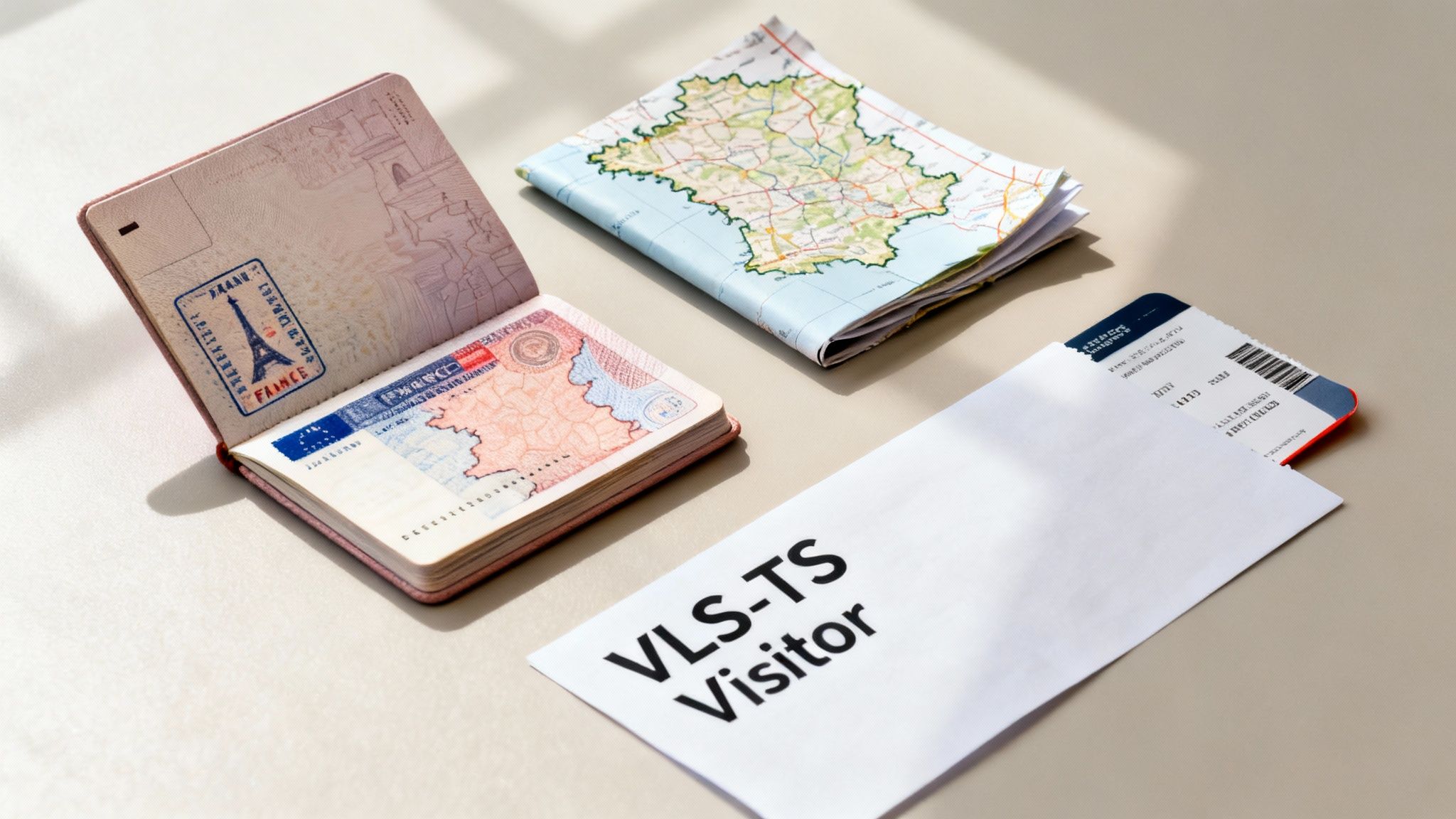
For most people dreaming of a French retirement, the path almost always starts with one specific document: the Long-Stay Visitor Visa. You'll see it officially called the visa de long séjour valant titre de séjour – visiteur (or VLS-TS Visitor for short), and it's the standard, go-to option for non-EU citizens who want to live in France without working.
Think of the VLS-TS as your all-in-one entry ticket and first-year residence permit. It’s not just about getting past the border; once you arrive and validate it, it allows you to legally reside in France for up to 12 months. This first year is your time to settle in, find your local market, and get a real feel for French life before you even have to think about renewals.
The whole philosophy behind this visa is refreshingly simple. You just need to show the French government that you can support yourself financially without needing a job or becoming a drain on their social systems.
The Three Pillars of Eligibility
If you want your visa application to be successful, you need to build it on three solid pillars. Getting these right is the single most important part of meeting the France retirement visa requirements.
- Sufficient Financial Resources: This is the big one. You have to prove, with bank statements and income records, that you have the money to live comfortably. It’s all about reassuring the consulate of your financial self-sufficiency.
- Comprehensive Health Insurance: You must have a private health insurance policy that covers you for your entire first year in France. This shows you won't immediately lean on the public healthcare system.
- Commitment Not to Work: You will have to sign a formal statement promising not to take on any paid work in France. This visa is strictly for living, not for earning.
Nearly every rejection or delay comes down to a weakness in one of these three areas. That’s why it’s so crucial to get your paperwork for each one absolutely perfect.
The French consulate isn’t just ticking boxes. They're trying to build a picture of a responsible person who is genuinely prepared for a new life abroad. Your application needs to tell that story, clearly and convincingly.
The Lifecycle of Your VLS-TS Visa
Knowing how the visa works, from the first application to the final validation, makes the whole process feel much less intimidating. It’s really a two-part journey: one part happens before you leave home, and the other happens after you've arrived in France.
Stage 1: The Application Process
You'll start the process in your home country. Applications are typically submitted to a French consulate or a third-party visa center like VFS Global within three months of your planned travel date. These days, much of it is handled online, where you’ll fill out the forms and book an appointment to give your fingerprints and hand over your documents. Once you get the green light, a visa sticker will be placed in your passport, which is your permission to travel to France.
Stage 2: Post-Arrival Validation
This step is just as critical as the application itself, and many people forget about it. Within three months of landing in France, you must go online and validate your VLS-TS through an official government portal. It’s a straightforward digital process that officially turns your visa into your residence permit. Once that’s done, you are a legal resident of France for the rest of the year. This final click of a button is what solidifies your status and gets the clock ticking on your residency.
Meeting the Financial Requirements for Your Visa
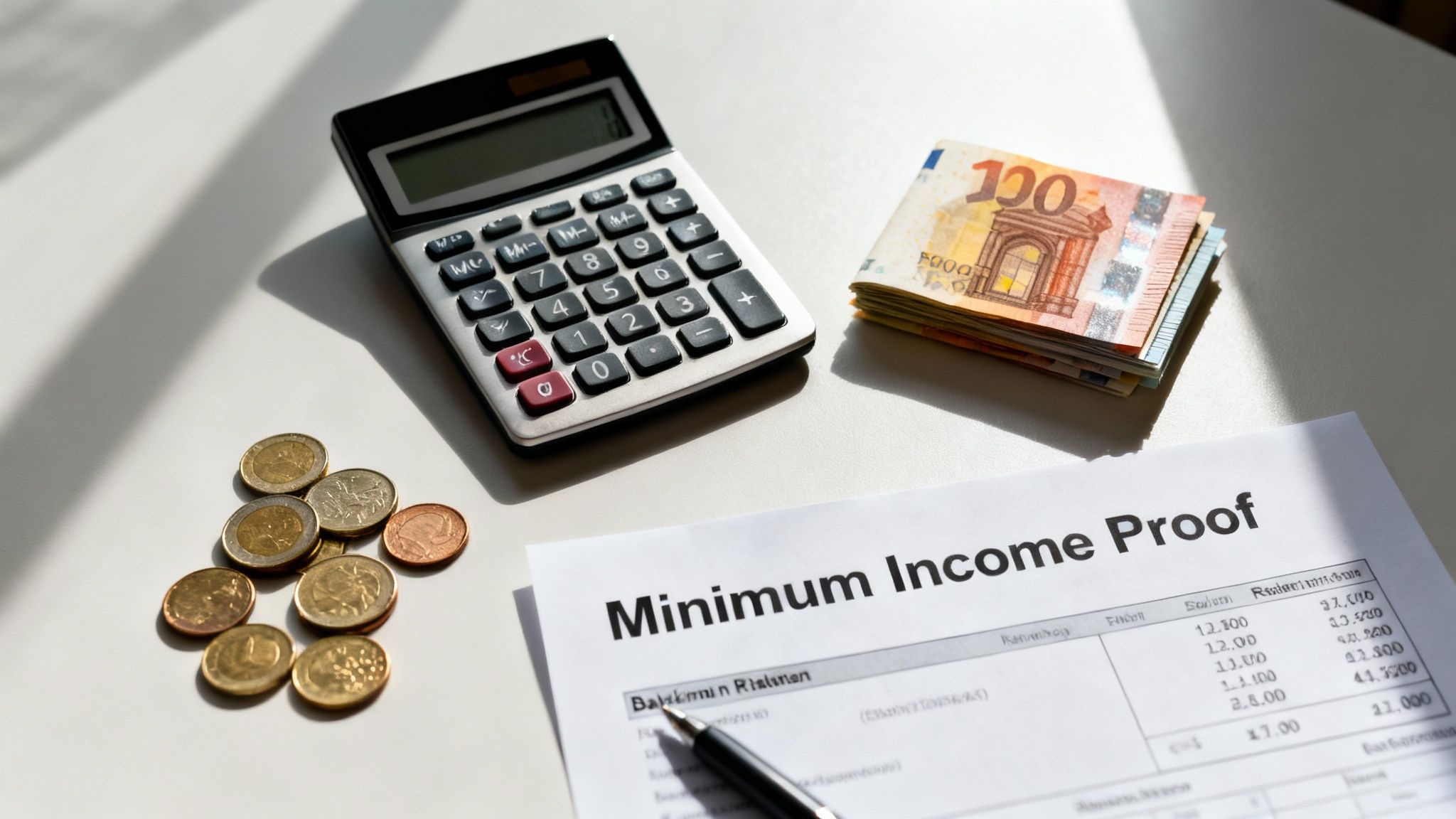
Of all the hurdles on the path to retiring in France, the financial proof is often the one that causes the most anxiety. It makes sense—the French government wants to be sure you can support yourself comfortably without needing to work or rely on public assistance.
The magic number here is tied to France's national minimum wage, known as the SMIC (Salaire Minimum Interprofessionnel de Croissance). Think of it as the official baseline for a decent standard of living. To get your visa approved, you have to prove your net monthly income clears this bar. It's not a guideline; it’s a non-negotiable part of your application.
The Current Income Threshold
For most retirees, the go-to option is the France Long-Stay Visitor Visa (VLS-TS). As of 2026, the financial requirement for this visa is a minimum monthly income of €1,554.60 per person. This works out to an annual income of about €18,665.20.
These figures are directly pegged to the French minimum wage to ensure you can live at a standard comparable to local residents. You can find a great analysis of the Long-Stay Visa in France that goes into more detail on how these numbers are applied.
For a couple, you’ll need to double that amount. While some consulates might show a little flexibility if one partner’s income is particularly high, the safest bet is to plan on showing the full amount for each person. When it comes to families, the requirements scale up; a family of four, for instance, would need to show a combined minimum monthly income of €6,218.40 (or annual savings of €74,620.80).
To make these figures easier to digest, here's a quick summary.
France Retirement Visa Financial Thresholds at a Glance
This table breaks down the minimum income and savings you'll need to demonstrate for the Long-Stay Visitor Visa, depending on who is applying.
| Applicant Type | Required Monthly Income (Approx.) | Equivalent Annual Income (Approx.) | Equivalent Annual Savings in Bank |
|---|---|---|---|
| Single Applicant | €1,554.60 | €18,665.20 | €18,665.20 |
| Couple | €3,091.20 | €37,330.40 | €37,330.40 |
| Family of Four | €6,218.40 | €74,620.80 | €74,620.80 |
These are the official minimums, but as you'll see, aiming a bit higher is always a smart strategy to strengthen your application.
Building Your Financial Case
The good news is that French authorities take a holistic view of your finances. You don't need to have a single paycheck that meets the threshold; you can (and should) combine multiple income streams to build your case. This is perfect for retirees, who often draw from a varied portfolio.
Here are the most common and well-regarded sources of funds:
- Pensions: Government pensions, like US Social Security or the UK State Pension, are the gold standard. They represent a stable, guaranteed income—exactly what the consulate wants to see.
- Private Pensions and Annuities: Consistent payments from a company pension or a private annuity are also excellent forms of recurring income.
- Investment Income: Dividends from stocks, interest payments, and distributions from mutual funds all contribute to your total.
- Rental Property Income: If you own properties that generate steady rental income, this can be a huge part of your financial proof.
- Passive Business Income: Do you own a business you don't actively manage? As long as the income is clearly passive, it can be included.
Your goal is to paint a clear picture of financial independence. The more stable and diversified your income sources appear, the more confidence the visa officer will have in your application.
Using Savings as Proof of Financial Means
What if your passive income falls just short of the SMIC threshold? Don't panic. This is where your savings come into play.
The general rule is that you can use a lump sum in the bank to cover the annual income requirement. So, if the target is roughly €18,665 for the year, you need to show at least that amount sitting in an accessible bank account.
Let's walk through an example.
Example Scenario
Imagine a single applicant has a monthly pension of €1,000. That's below the required €1,554.60. Their total annual pension income is €12,000.
- Annual Requirement: €18,665
- Annual Pension: €12,000
- The Shortfall: €6,665
To bridge this gap, they can show at least €6,665 in savings. However, my advice is to always show more than the bare minimum. Presenting a balance of €10,000 or more demonstrates a comfortable financial cushion and makes your application much stronger. You'll typically need to provide the last three to six months of bank statements to prove the funds are stable and readily available.
Assembling Your Application Dossier
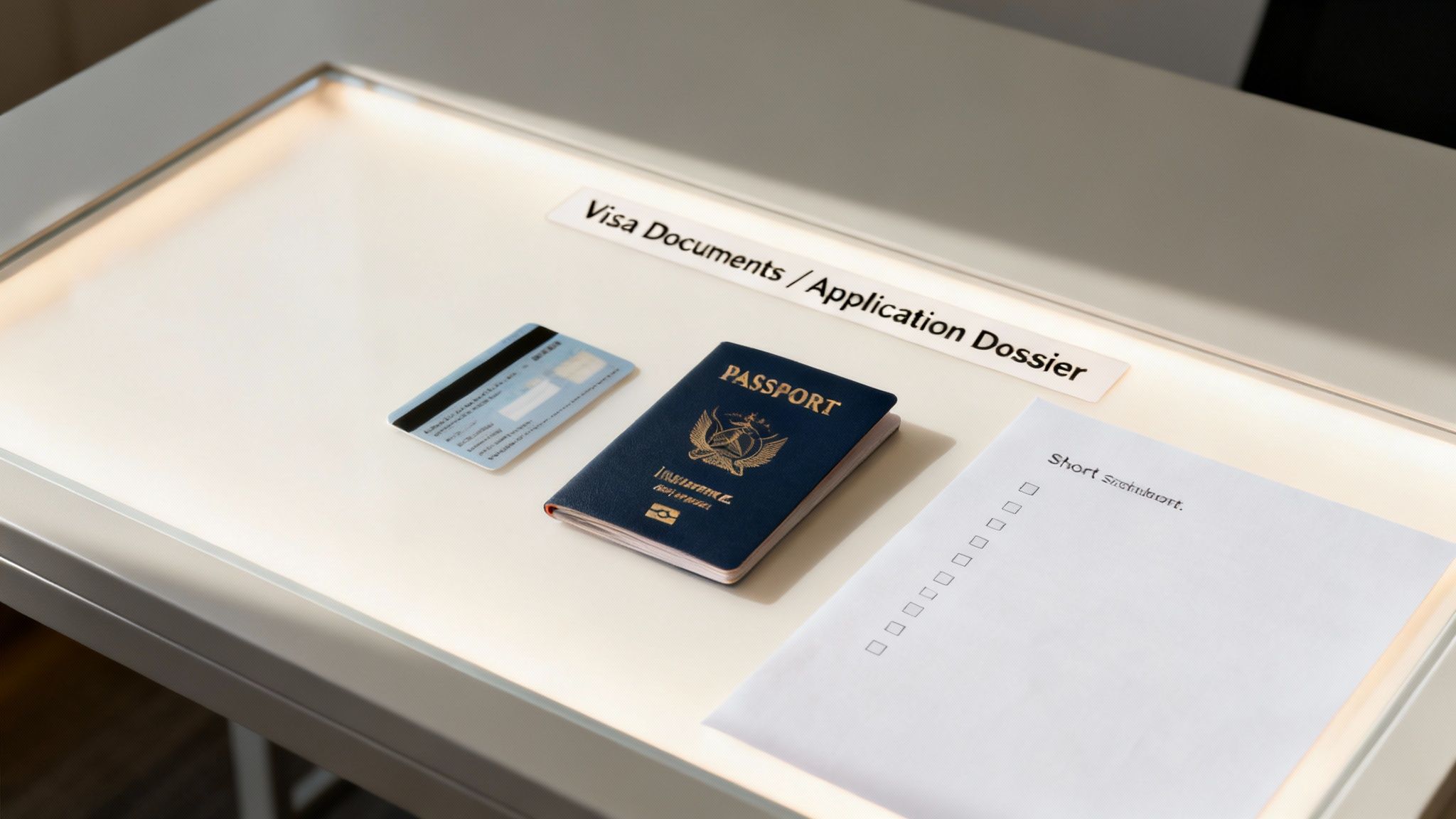
Think of your visa application as a meticulously built house—it needs a solid foundation of perfectly organized documents. Get this part right, and you're well on your way. Get it wrong, and you're looking at frustrating delays that could put your entire retirement dream on hold.
Let's walk through the master checklist. This isn't just about what to get, but why each piece of paper is so critical to the French authorities.
Securing Compliant Health Insurance
Here's one of the biggest hurdles I see people trip over. That standard travel insurance you buy for a two-week holiday? It won't cut it. Not even close. For a long-stay visa, French officials need to see something much more comprehensive.
You’ll need a private health insurance policy that meets a few non-negotiable criteria. It must:
- Be valid for the entire 12 months of your initial visa.
- Cover you across the whole Schengen Area, not just in France.
- Offer at least €30,000 in coverage for medical emergencies, hospitalization, and repatriation.
Why so strict? The French government needs a guarantee that you won't be a financial burden on their public healthcare system. This makes perfect sense when you consider that the World Health Organization has long praised France's system as one of the world's best—it’s a major draw for retirees, and they want to protect it. You can read more about what makes the French system so appealing on Relocate.world.
Pro Tip: Don't just submit the policy booklet. Ask your insurer for a specific letter or certificate for the consulate. It needs to clearly state the policy's start and end dates, the exact coverage amount, and the geographical scope. This is the single page the officials are looking for.
The Master Document Checklist
With your insurance sorted, it's time to gather everything else. While you should always check the website of the specific French consulate handling your application for their final list, the items below are the universal requirements for a VLS-TS Visitor visa.
1. Passport and Identification:
- Your original passport. Make sure it's valid for at least three months after your one-year visa will expire and has at least two blank pages.
- Photocopies of the main pages of your passport (the ones with your photo, signature, and info).
- Passport-sized photos that meet the very specific French visa standards (check the dimensions and background color).
2. Application Forms:
- The long-stay visa application form, which you'll complete online and then print.
- The OFII residency form. You won't need this until you arrive in France, but it's part of the initial submission package.
3. Proof of Accommodation: This is a big one. You have to prove you have a place to live for at least the first few months. The authorities want to see stability. Your options include:
- A formal rental agreement, known as a bail de location.
- A reservation for a long-term hotel or aparthotel stay.
- An official letter from a host, called an attestation d'accueil.
- The deed of sale (acte de vente) if you've already bought a property.
For many people planning to retire in France, buying a home is the most solid way to meet this requirement and anchor their application. If that's your plan, our guide on buying a home in France is a great place to start.
4. Financial and Legal Documents:
- Proof of financial means: This is where you bring out the bank statements, pension letters, and investment portfolio summaries we talked about earlier.
- A signed letter of commitment (often called a lettre d'engagement) where you formally promise not to seek employment in France.
- A police clearance certificate from your home country, usually one that's been issued within the last three to six months.
And a final, crucial point: any official document that isn't already in French will need a certified translation from a sworn translator (traducteur assermenté). Don't skip this step or try to do it yourself—it's a firm requirement. Be sure to budget both time and money for it.
The Path to Permanent Residency and Citizenship
Your initial one-year visa isn't the finish line; it’s the starting block. Think of it as the key that gets you through the door, but the real process of building a life in France begins as that first year wraps up. This is where you shift from being a visitor to a long-term resident, following a clear path toward permanent status.
The system is designed to be gradual. For the first 12 months, your long-stay visa (VLS-TS) doubles as your residence permit. Just before it expires, you'll apply for your first official residence card, known as a carte de séjour. This is a big step, and you’ll handle it locally at your prefecture in France, officially moving you from newcomer to a recognized resident.
From Annual Renewals to Long-Term Stability
For the next several years, you'll find yourself renewing this carte de séjour annually. Each time, you'll need to show that you still meet the original requirements—mainly, that you have enough money to support yourself and have solid health insurance. It might sound a bit repetitive, but this period is your chance to really settle in, maybe work on your French, and become part of your local community.
The first major milestone comes after five years of continuous, legal residence. This is a huge turning point. Once you hit that five-year mark, you can apply for a 10-year permanent residency card (the carte de résident de longue durée-UE).
This 10-year card is the gold standard for anyone planning to stay for the long haul. It breaks the cycle of yearly renewals and gives you the freedom to live in France and travel throughout the EU with your status locked in for a decade at a time.
The Ultimate Goal: French Citizenship
That same five-year mark opens another, even more significant, door: applying for French citizenship. This is the final step in truly making France your permanent home, transforming you from an expat into a dual citizen. And here’s where France really stands out.
France allows dual citizenship. This means you can become French without having to give up your original passport—a massive advantage that many other countries don't offer. This forward-thinking policy is a key reason France remains such a popular retirement destination. In fact, a recent analysis found that about 93% of the 44 countries in the Global Retirement Report 2025 now provide a clear path to permanent residency or citizenship, a trend France has championed for years. You can read more on these global retirement trends at Live and Invest Overseas.
To become a citizen, you’ll need to prove you’ve truly integrated. This typically involves:
- Language Proficiency: Showing you can speak French to an intermediate level (usually B1 on the European framework).
- Cultural Integration: Having a good grasp of French history, culture, and civic values.
- Clean Record: Demonstrating you’ve been a law-abiding resident.
The journey from your first visa to potentially holding a French passport is a marathon, not a sprint, but the reward is a profound sense of belonging. For a wider look at what this kind of move entails, our guide on how to retire abroad covers many of the universal steps you'll encounter.
Common Questions About Retiring in France
Even with the best-laid plans, the road to retiring in France can have a few bumps. It’s a detailed process, and it’s completely normal to have questions pop up along the way.
Think of this section as a chat with someone who's seen it all before. We'll tackle the most common queries we hear from people just like you, aiming to clear up those nagging doubts so you can move forward with confidence.
Can I Use a Property Purchase as My Proof of Accommodation?
Yes, you absolutely can. In fact, showing you own a home in France is probably the strongest proof of accommodation you can provide. From the consulate's perspective, it signals a serious, long-term commitment to living in the country.
When you're putting your application together, you can submit either the preliminary sales agreement, known as the compromis de vente, or the final deed of sale, the acte de vente. Getting your property sorted early on doesn't just give you a place to call home—it ticks a major box on your visa checklist right from the start.
Do I Need to Speak French to Get the Visa?
For the initial one-year Long-Stay Visitor Visa (VLS-TS), the answer is no. There's no formal language test you have to pass. At this first stage, the French authorities are almost entirely focused on your financial resources and your promise not to work.
But—and this is a big but—language becomes crucial down the line. As you start renewing your permit and eventually look towards permanent residency or even citizenship after five years, you'll need to prove you can speak French (usually to an A2 or B1 level). So, while you don't need it to get in the door, starting your French lessons before you move is one of the best things you can do for your future self.
Think of the initial visa as your entry ticket, where money gets you in. Your long-term stay, however, is all about integration, and language is the key that unlocks everything.
What Are the Most Common Mistakes People Make on Their Applications?
It's frustrating, but most visa rejections or delays come down to a handful of small, avoidable errors. Knowing what these are ahead of time can save you a world of headaches.
Here are the top four slip-ups we see time and again:
- The Wrong Kind of Health Insurance: Submitting a standard travel insurance policy is a classic mistake. You need a comprehensive private plan that's valid for your entire first year in France and covers at least €30,000.
- Messy Financial Documents: Simply handing over a stack of bank statements isn't enough. Your proof of funds needs to tell a clear story, showing either consistent income or a healthy lump sum. Make it easy for the visa officer to understand.
- Out-of-Date Official Records: Documents like police background checks have a shelf life. Many consulates require them to be issued within the last three to six months. Always double-check the dates.
- Forgetting Certified Translations: Any official document that isn't in French—like your birth certificate or a letter from your pension provider—must be translated by a sworn translator (traducteur assermenté).
The single best piece of advice? Go through the consulate's checklist one item at a time. Then do it again. A perfect dossier is your best friend in this process.
Does My Social Security or State Pension Count as Income?
It sure does. For the French authorities, government pensions like US Social Security or the UK State Pension are the gold standard for proving you can support yourself. It's exactly the kind of stable, reliable income they want to see.
To use it, you’ll need to provide an official, recent statement from the government agency that pays you, clearly showing your name and the benefit amount. Because this income is guaranteed for life, it’s powerful evidence that you can live comfortably in France without ever needing to work. It’s a true cornerstone of a strong retirement visa application.
Finding the right property is a huge step in making your French retirement dream a reality. At Residaro, we make it simple to discover beautiful homes across France, from charming country houses to elegant city apartments. Start your search and find the perfect foundation for your new life today. Explore properties in France on residaro.com