Finding Cheap Homes to Buy in France That Aren't a Mistake
Yes, you can absolutely find cheap homes in France. But you have to know where to look. Forget Paris or the sun-drenched Riviera for a moment. The real magic happens in rural France, where charming village houses and properties ripe for renovation can be snapped up for well under €100,000.
This isn't just a daydream; it's a completely achievable reality for those who understand the regional price differences and are drawn to a slower, more authentic pace of life.
Your French Home Dream Is Closer Than You Think
The idea of a French home might conjure images of multi-million euro villas, but that's a narrow slice of a huge and incredibly diverse property market. The price gap between bustling cities and the quiet countryside is vast, and that’s where the opportunity lies.
This guide is here to cut through the romanticism and give you a practical, no-nonsense starting point. We'll show you that affordability and authentic French living aren't mutually exclusive—in fact, they often go hand-in-hand in the beautiful regions where property is plentiful and life is a little simpler.
What Does "Cheap" Really Mean in France?
Let's get real about what "cheap" means in the French property market. It’s not about finding a flawless, move-in-ready château for the price of a studio apartment. It’s about understanding the incredible value you can get if you're flexible.
- Renovation Projects: This is where the true bargains are. Many of the most affordable properties, some listed for as low as €50,000 to €80,000, will need a lot of love. We're talking anything from cosmetic touch-ups to a complete overhaul of the electrics and plumbing.
- Ready-to-Go Apartments: In smaller regional towns, you can find modest but perfectly livable apartments for €90,000 to €150,000. They're a fantastic, low-maintenance entry point into French life.
- Village and Townhouses: These often hit the sweet spot, balancing character, space, and price. Finding a solid house that just needs some modernizing is a common scenario in less-populated areas.
My biggest piece of advice? Remember that "cheap" in France often means trading modern, turnkey convenience for character, space, and a more authentic local experience. Your budget will go so much further if you’re willing to put in a bit of elbow grease after you get the keys.
Getting your finances sorted from day one is also critical, as securing a mortgage as a non-resident has its own set of rules. For a clear-eyed look at what's involved, you'll want to read our guide on getting a mortgage for a foreign property. It will help you build the right financial foundation for this life-changing adventure.
Discovering France's Most Affordable Regions
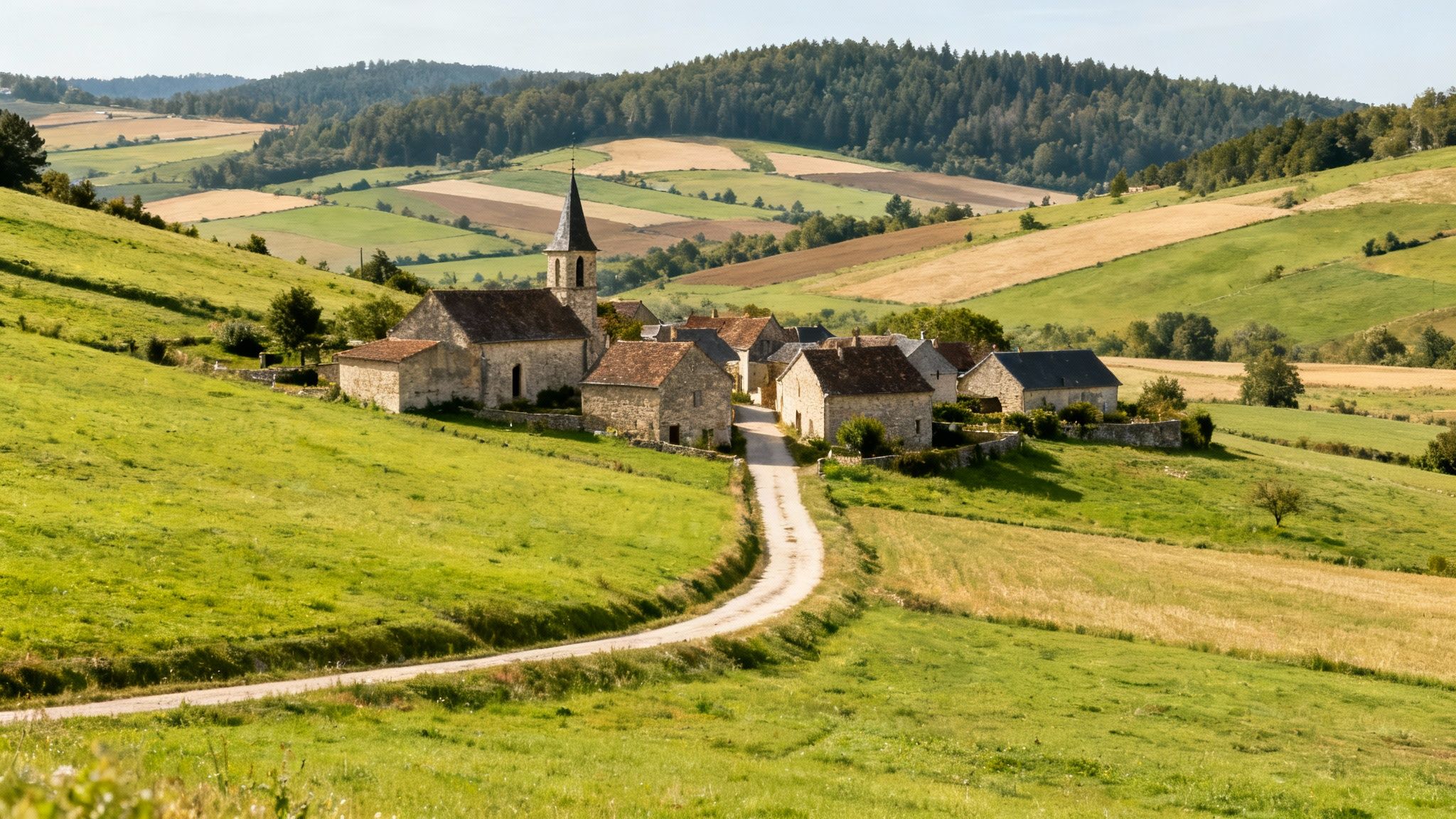
When it comes to finding a truly affordable home in France, geography is your greatest asset. There's a world of difference between the eye-watering prices of Paris or the Côte d'Azur and the quiet, rural heartlands. This is where the real opportunity lies.
Forget the glamour and the tourist hotspots. The best value is tucked away in the rolling hills and historic villages of what the French lovingly call la France profonde—deep France.
Focusing your search on these specific pockets will radically improve your chances of landing a bargain. In these areas, the pace of life is slower, the market is driven by locals, not international investors, and the price tags reflect that reality. A charming stone house suddenly becomes a very achievable dream.
Nouvelle-Aquitaine: A Land of Contrasts and Value
Nouvelle-Aquitaine is a massive region, and a perfect example of France's split-personality property market. While coastal hubs like Bordeaux and Biarritz will drain your bank account, a short drive inland reveals some of the country's most affordable real estate.
The real treasure trove for bargain hunters is the area formerly known as Limousin. Its departments, like Creuse and Haute-Vienne, are legendary among property seekers for their lush landscapes, tranquil lakes, and shockingly low prices.
- Creuse: This is often called the cheapest department in all of France. It’s not an exaggeration. Here, you can find stone farmhouses and village homes needing work for well under €70,000.
- Haute-Vienne: A bit more populated but still an incredible bargain, this area offers a great mix of rural peace with the convenience of nearby market towns and amenities.
The properties here are brimming with rustic character. Think traditional stone longères (long farmhouses), village houses with attached barns, and detached country homes on surprisingly large plots of land.
Bourgogne-Franche-Comté: Historic Charm on a Budget
Head east, and you'll find another fantastic hunting ground in Bourgogne-Franche-Comté. Famous for its world-class wines, historic canals, and dense forests, it's a region that feels steeped in culture and natural beauty.
Naturally, the prestigious vineyard areas of Burgundy are out of reach for most. But departments like Nièvre and Saône-et-Loire are a different story entirely. They offer a much more accessible entry point, with classic village townhouses and sturdy farmhouses priced far below the national average.
The real trick is to look for properties in villages just off the beaten path. I've seen homes a mere 15-minute drive from a popular tourist town sell for half the price. You get the same regional lifestyle without the hefty price tag.
Pockets of Affordability in Occitanie
Occitanie, a sprawling region in the sunny south, is loved for its warm climate and proximity to both the Mediterranean coast and the Pyrenees mountains. While the popular spots are predictably expensive, venturing into the rural interior reveals some real gems.
Departments like Aveyron, Lozère, and parts of the Gard are filled with dramatic landscapes and ancient medieval villages. This is where you'll find stone houses built right into the hillsides and country properties that offer a true sense of escape.
If this sun-drenched region calls to you, our guide on finding property for sale in the former Languedoc-Roussillon area is a great place to start.
To put it all in perspective, here's a quick look at what you can expect in some of France's most budget-friendly regions.
Affordable French Regions At a Glance
| Region | Average Price for Renovation Project | Property Style | Best For |
|---|---|---|---|
| Nouvelle-Aquitaine (Inland) | €50,000 - €90,000 | Stone farmhouses, barns, village houses | Nature lovers, total peace and quiet, maximum space for your money. |
| Bourgogne-Franche-Comté | €60,000 - €100,000 | Characterful village homes, classic farmhouses | History buffs, food and wine enthusiasts, canal-side living. |
| Occitanie (Inland) | €70,000 - €120,000 | Medieval stone houses, rustic country homes | Sun-seekers, hikers, those wanting a Mediterranean feel on a budget. |
| Grand Est (Rural) | €50,000 - €90,000 | Half-timbered houses, sturdy farm properties | Proximity to Germany/Switzerland, forest landscapes, historical sites. |
This table just scratches the surface, but it shows the kind of value you can unlock by looking beyond the obvious destinations.
The French property market offers incredible opportunities, especially when compared to other Western European countries. For context, as of early 2026, you can find small apartments in regional cities like Saint-Etienne for €80,000 to €120,000. With the median home price across France hovering around €240,000, the savings in these less-traveled regions are enormous.
Ultimately, finding a cheap home in France is about looking where others aren't. It means trading the hustle for authenticity, the high prices for more space, and getting the chance to own a piece of the French countryside that is truly your own.
How to Actually Find These Property Bargains
Finding a real bargain in France means looking where most people don't. The big, popular property websites are great for getting a feel for the market, but the truly cheap homes—the ones that are genuine steals—are rarely found there. They're often hidden in plain sight, accessible through local networks and less conventional channels.
To find them, you need to shift from being a passive online browser to an active, on-the-ground hunter. It's about talking to the right people and knowing where the deals surface before they hit the mainstream. Here’s how you do it.
Befriend a Local Estate Agent or Immobilier
Your best asset in the French property hunt is a local immobilier (estate agent). Forget the transactional relationships you might be used to. In rural France, agents often become long-term allies for serious buyers. They'll give you a heads-up about new listings, sometimes even before a "For Sale" sign goes up.
But you have to prove you're not just another daydreamer.
- Be hyper-specific. Don't just say, "I want a cheap country house." Instead, try: "I'm looking for a two-bedroom stone house under €90,000 that needs work, specifically in the Creuse department. My financing is already pre-approved." That’s a brief they can actually work with.
- Show you’re ready. Casually mention you have your financing sorted and understand the notaire's role. This signals you're a serious buyer who won’t waste their time.
- Stay in touch. A polite email every few weeks is all it takes to stay on their radar.
Building this kind of rapport can open doors to off-market properties, especially inherited homes that a family needs to sell quickly and quietly.
The Notaire Is More Than Just a Lawyer
In France, the notaire is a public official who handles all the legal paperwork for a property sale. What most foreign buyers don't know is that notaires often manage private property sales (ventes particulières) themselves. They're the first to know about properties coming onto the market from an inheritance, a divorce, or financial hardship.
Walk into a notaire's office in your target town and simply ask if they handle any direct sales. It’s an old-school approach, but it works. Because they aren't acting like traditional agents, their listings often completely bypass the open market, meaning you face far less competition. This is a classic insider move that can lead you straight to some of the best-value cheap homes to buy in France.
Don't Overlook Property Auctions
If you've got a bit of nerve, ventes aux enchères (property auctions) are where you can find jaw-dropping deals. This isn't just for fancy châteaux; it's a common way to sell repossessed homes, old government buildings, and inherited properties that need to be sold fast.
You'll typically find two kinds of auctions:
- Ventes aux enchères judiciaires (Judicial Auctions): These are court-ordered sales, usually from a foreclosure. The starting prices can be incredibly low, sometimes 30% below the actual market value. The catch? You need to be ready to move very, very quickly.
- Ventes aux enchères notariales (Notarial Auctions): These are voluntary auctions run by a notaire. They're a bit more straightforward and often feature interesting or historic properties that an owner wants to sell transparently and efficiently.
Auctions demand preparation. Your financing must be 100% locked in before you even think about bidding, because a winning bid is a binding legal contract. It's a high-stakes game, for sure, but the payoff for a well-prepared buyer can be enormous.
Auctions might seem intimidating, but they are one of the most direct routes to buying a property for a fraction of its worth. Just make sure you do your homework and view the property before auction day. And if you want to see how France stacks up against other countries, take a look at our guide to affordable homes across Europe for more ideas.
Making Sense of the French Buying Process
The French property buying process can seem intimidating at first glance, but it's far more logical than you might think. Forget the frantic, often chaotic markets you might be used to back home. France takes a much more deliberate, step-by-step approach that’s designed to protect everyone involved.
Once you get a handle on the key stages and who does what, you’ll find the whole system is built on a foundation of legal security. Every move, from your first offer to getting the keys, is overseen by a legal professional, making the transaction feel solid and official.
Making an Offer and Signing the First Contract
So, you’ve found the perfect little stone cottage or village house. What now? The first real step is making an offer, or offre d'achat. While you can do this verbally, it’s always smarter to put it in writing. This shows you’re a serious buyer and gets the process moving, even though it isn't legally binding on you just yet.
Once the seller accepts, you’ll move on to the most critical document of the initial phase: the compromis de vente. This is the preliminary sales contract that lays out everything in black and white:
- The final, agreed-upon price.
- A full description of the property.
- Any conditional clauses, known as clauses suspensives (for instance, making the sale dependent on you securing a mortgage).
- A target date for completion.
When you sign the compromis, you'll need to pay a deposit, usually 5-10% of the purchase price. This money doesn’t go to the seller; it's held safely in an escrow account by a legal professional called a notaire.
And here's a key protection for you: after signing, you get a 10-day cooling-off period. During these ten days, you can walk away for any reason whatsoever without losing your deposit.
The Notaire: The Heart of the Transaction
In France, there’s one figure who orchestrates the entire legal side of a property sale: the notaire. This is a huge difference from systems in the UK or US where buyers and sellers each have their own lawyers.
A notaire is a state-appointed public official who acts as a neutral party, representing the interests of both you and the seller. Their job is to make sure the sale is 100% legal, from checking property deeds and land boundaries to ensuring all the right taxes are paid. They are the ultimate gatekeepers of a secure deal.
It's crucial to understand this: the notaire works for the French state, not for you personally. Their main duty is to certify the legality of the transaction. This impartiality is precisely what makes the system so incredibly secure for foreign buyers.
From Financing to Finalising the Deal
While the notaire is busy with their due diligence, you’ll be sorting out your finances. If you included a mortgage clause in the compromis, now is the time to get that formal approval from your bank.
Don't forget to budget for the closing costs. The price you see on the listing isn’t the final figure. You'll need to account for the frais de notaire, which are often incorrectly called "notary fees." This chunk of money, typically 7-8% of the property price for an older home, is mostly made up of government taxes (like stamp duty). Only a small fraction is the notaire's actual fee.
The grand finale is signing the acte de vente, the final deed of sale. This usually happens at the notaire's office around three months after the compromis. Once the ink is dry and the final funds have been transferred, the keys are yours. You’re officially a homeowner in France!
This robust process is part of a wider national effort. France faces a significant housing shortage, with estimates suggesting the country needs to build around 518,000 new homes every year until 2040 to keep up. This underlying demand helps stabilize the market. You can learn more about the factors shaping the European housing supply and what it means for anyone looking to buy.
Budgeting for the True Cost of Your French Home
It’s an amazing feeling when you find a property listed for a price that seems too good to be true. But hold on—that figure is just the starting point of your financial journey in France.
The final bill for owning that dream home will always be higher. Getting a firm grip on these extra costs right from the beginning is the secret to a smooth, stress-free purchase. It’s easy to get fixated on the asking price and completely overlook the essential fees that come with every single transaction.
Unpacking the Frais de Notaire
The biggest one-time cost you’ll encounter after agreeing on a price is the frais de notaire. This is a classic stumbling block for foreign buyers. It's often mistaken for just the notary's fee, but that’s only a tiny fraction of the total. Think of it as the complete closing costs, all bundled into one payment.
For older properties—which covers most bargain homes—this amount usually lands between 7% and 8% of the purchase price. So, if you’re looking at an €80,000 house, you need to have another €5,600 to €6,400 set aside.
This single payment is broken down into three main parts:
- Government Taxes: This is the lion's share, covering stamp duty and land registration taxes.
- Administrative Fees: These are the costs for all the official searches and paperwork processing.
- The Notaire's Fee: The smallest piece of the pie is the actual regulated payment for the notaire's professional services.
Forgetting to budget for the frais de notaire is the most common and costly mistake I see buyers make. A safe rule of thumb is to add 8% to your target purchase price to get a much more realistic idea of your true upfront cost.
The Reality of Renovation Costs
Many of the most affordable properties in France need some TLC, ranging from a fresh coat of paint to a full-blown renovation. Underestimating what this will cost can quickly turn your bargain buy into a money pit. The smartest move is always to get a devis (a quote) from a local artisan before you commit.
To give you an idea, here’s a look at what you might be facing.
The table below outlines some of the most common—and often necessary—renovation projects for older French homes, along with a rough guide to their costs.
Estimated Costs Beyond the Property Price
| Cost Item | Typical Percentage/Range | Key Considerations |
|---|---|---|
| New Roof (Toiture) | €10,000 - €30,000+ | The final price depends heavily on the house size and materials (slate is pricier than tile). |
| Septic Tank (Fosse Septique) | €8,000 - €15,000 | A very common need in rural areas. The diagnostic reports will tell you if it's non-compliant. |
| Electrical System (Électricité) | €6,000 - €12,000 | Old wiring is a major safety hazard and a frequent red flag in property surveys. |
| Window Replacement | €500 - €1,500 per window | Upgrading from single-glazing is a game-changer for heating bills and overall comfort. |
It's always a good idea to keep a contingency fund of at least 15-20% on top of your quoted renovation budget. Old French homes are notorious for hiding surprises, like a patch of damp behind a wall that you only discover once work begins.
Planning for Annual Ownership Costs
Once the keys are in your hand, your expenses shift to the ongoing costs of ownership. The good news? Annual property taxes in rural France are often refreshingly low compared to places like the UK or the US.
You’ll need to budget for two main annual taxes:
- Taxe Foncière: This is the land tax paid by the property owner. For a modest rural home, you could be looking at anywhere from €400 to €900 a year.
- Taxe d'Habitation: This residency tax is being phased out for primary residences. But—and this is important—it still applies to second homes. If this is your holiday getaway, you must factor it in.
Beyond taxes, you have the usual bills. One thing to be mindful of with old stone houses is heating. They are beautiful and full of character, but they can be expensive to keep warm in winter. Heating costs can easily hit €200-€400 per month in the colder seasons. Don't forget to budget for home insurance, too; it's a legal requirement in France.
Got Questions About Buying a Bargain French Property?
Diving into the French property market, especially at the more affordable end, is bound to bring up a few questions. That’s perfectly normal. It's a huge decision, and you want to be sure you know what you’re getting into before you start dreaming of croissants on your new terrace.
Let's walk through some of the most common queries I hear from buyers. The great thing is, the French system is incredibly well-regulated—it’s actually set up to protect the buyer. Once you get your head around a few key points, you'll find the whole process is a lot less intimidating than it seems.
Can a Foreigner Really Get a Mortgage in France?
Yes, absolutely. This is one of the biggest myths out there. You don’t need to be a French citizen to get a mortgage, and French banks are quite happy to lend to foreign buyers—provided you look like a safe bet.
Of course, they’ll want to see all your financial ducks in a row. They’re naturally cautious, so they will put your application under a microscope.
To give yourself the best shot at getting approved, you'll need to have your paperwork ready. Be prepared to show them:
- A Solid Income Stream: They'll want to see recent pay slips, your last few years of tax returns, and proof of employment.
- A Substantial Deposit: For non-residents, the bar is a bit higher. Plan on having a deposit of at least 20%, but closer to 30% is even better.
- A Good Debt-to-Income Ratio: In France, there's a hard rule. All your monthly debt payments (including the new French mortgage) can't be more than about 35% of your gross monthly income.
Getting organized upfront is the secret. A clean, well-presented application makes all the difference.
What Are the Real Risks With a Renovation Project?
That picture-perfect stone barn for €40,000 is undeniably tempting, but that price tag is a huge clue. The single biggest risk when buying a cheap French property is dramatically underestimating what the renovation will actually cost. Old buildings are notorious for hiding expensive problems.
Before you sign anything binding, you absolutely must get a proper building survey (an expertise technique). This isn’t as common in France as it is in the UK or US, but for an old property, I’d say it’s non-negotiable. A good surveyor will look for the big-ticket items:
- Structural Health: Are the walls, roof, and foundations solid?
- Damp (Humidité): A classic problem in old stone houses and can be a real nightmare to fix properly.
- Pest Problems: Woodworm (capricornes) and other timber-loving insects can cause serious damage that isn't always obvious.
- Septic Tank Compliance: Is the fosse septique up to code? If it isn't, a replacement can easily set you back €10,000 or more.
A survey might feel like an extra expense at a few hundred euros, but it could honestly save you tens of thousands down the line. Think of it as the best insurance policy you can buy against a catastrophic mistake.
How Long Does It All Actually Take?
When it comes to the French buying process, patience is key. It’s a methodical, step-by-step affair, not a race. From the moment your offer is accepted to the day you’re popping champagne with the keys in hand, you should realistically set aside about three months.
Here’s a rough breakdown of how that time is spent:
- Offer & Initial Contract (Compromis de Vente): This part is usually quite fast, happening within a week or two.
- The Cooling-Off Period: As soon as you sign the compromis, a 10-day countdown begins. During this time, you can walk away for any reason, no questions asked.
- The Legal Work (2-3 months): This is where most of the time goes. Your notaire (the state-appointed solicitor) does all the legal searches, and you'll be finalizing your mortgage.
- Final Signing (Acte de Vente): This is the final meeting at the notaire's office. You sign the final deed, hand over the rest of the money, and the property is officially yours.
Things can sometimes get delayed, but three months is a solid benchmark to use for your planning.
At Residaro, we take the guesswork out of finding your place in Europe. Our platform is packed with listings and local market knowledge to help you find and buy affordable homes in France and beyond. Ready to start looking? Explore your options with Residaro today.