Explore Buying Property in Italy: A Clear, Concise Guide
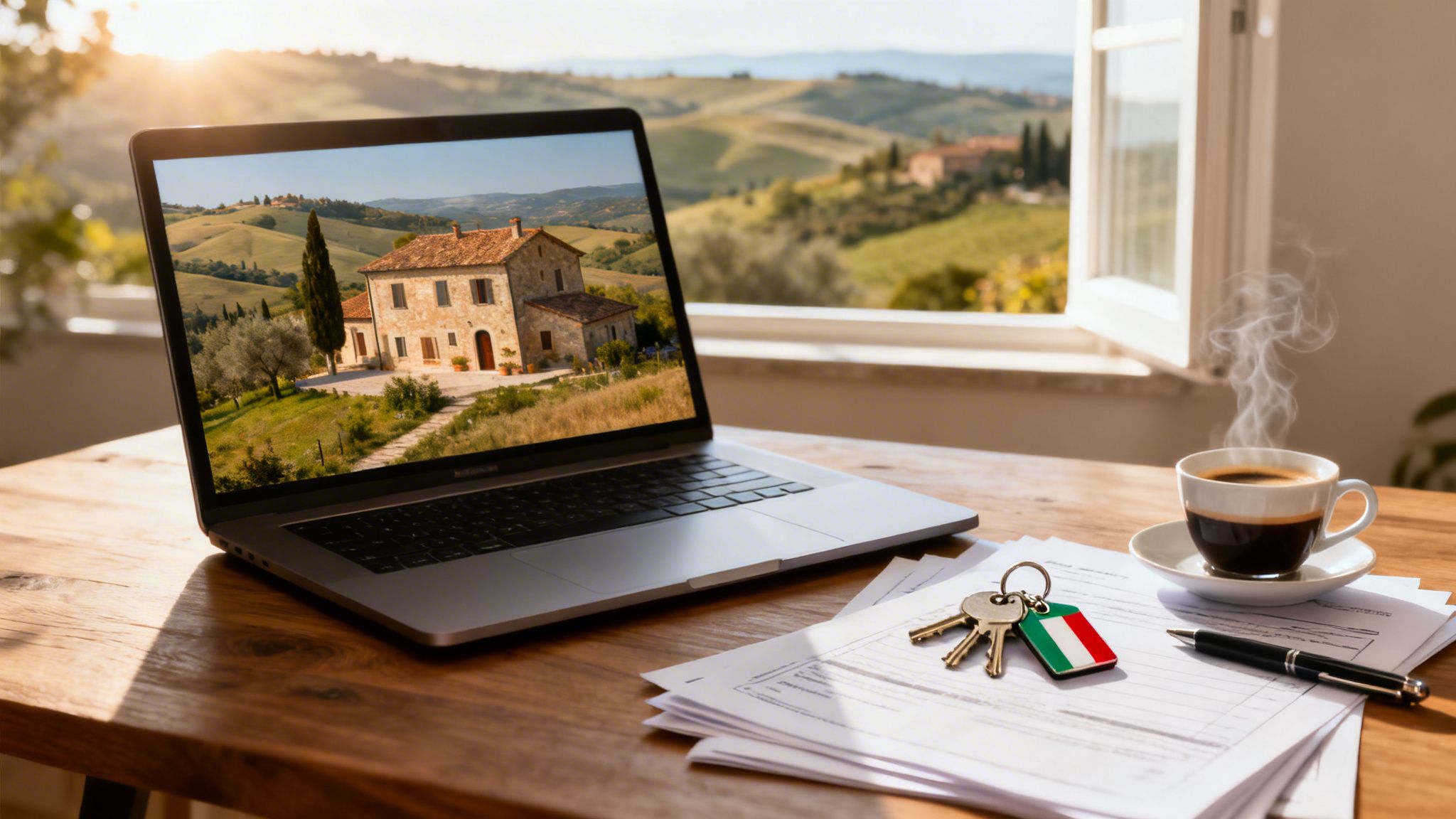
Buying property in Italy is a dream for so many, and the good news is, it's more achievable than you might think. The key is knowing what you're getting into—from navigating the vast differences in regional prices to understanding the legal steps like the compromesso (preliminary contract) and budgeting for all the extra taxes and fees.
Understanding The Italian Property Market

Before you get swept away by visions of a Tuscan farmhouse or a chic Milanese apartment, it's smart to get a feel for the reality of the Italian property market. It’s a place of incredible diversity, a true mosaic of regional markets, each with its own rhythm, price points, and distinct opportunities.
Your money will go a lot further in some places than in others. A rustic trullo in Puglia or a countryside home in Abruzzo, for instance, can offer incredible value. Compare that to a waterfront villa on Lake Como or a historic apartment in Florence, and you're in a completely different world. This regional disparity is one of the biggest things for international buyers to wrap their heads around.
Current Market Trends And Regional Hotspots
So, is now a good time to buy? The latest numbers paint a pretty optimistic picture. Italy's residential property market is showing steady price growth. The national average asking price for homes recently hit €2,150 per square meter, which is a 3.61% increase from the year before.
This upward trend is even more pronounced in major hubs like Rome and Milan. To see just how much it varies, you'll find regions like Trentino Alto Adige at the top end, with prices hovering around €3,701 per square meter, while a region like Calabria offers entry points as low as €958 per square meter. For anyone starting their search, this signals a great window to get in before prices climb higher. You can dig deeper into these trends on platforms like Immobiliare.it.
Understanding these dynamics helps you spot where the real value is. While the classic hotspots will always be popular, some emerging areas are really starting to shine.
- Northern Italy: Think higher prices but also strong rental demand, especially in business centers like Milan and Turin or tourist magnets like the Dolomites.
- Central Italy: This is the heartland of iconic regions like Tuscany and Umbria. It offers a real mix, from stunning luxury estates to affordable farmhouses ripe for renovation.
- Southern Italy: Places like Puglia, Sicily, and Calabria are booming in popularity. They offer an incredible lifestyle with significantly lower property prices, making them a huge draw.
The real secret is to look past the postcard-perfect views. Dig into the local economy, check out the infrastructure, and see what the tourism trends are. A town with new transport links or a growing international community could be a very smart move for the long haul.
Italian Property Prices A Regional Snapshot
To give you a clearer picture of the market's diversity, here's a quick look at how property prices can differ across the country.
| Metric | National Average | High-End Example (Region/City) | Affordable Example (Region) |
|---|---|---|---|
| Price per m² | €2,150 | €3,701 (Trentino Alto Adige) | €958 (Calabria) |
| Annual Growth | +3.61% | Higher in major cities (e.g., Milan) | Stable or modest growth |
| Property Type | Apartments, villas, farmhouses | Luxury villas, city penthouses | Country homes, village apartments |
This table really highlights the importance of zeroing in on a specific region that matches your budget and goals before you get too far down the road.
What To Expect When You Start Your Search
As you begin browsing listings, you’ll come across all sorts of property types, and each comes with its own quirks. City apartments, for example, nearly always have condominium fees (spese condominiali), while rural properties might need you to verify land boundaries and access rights.
The most important first step is to be clear about what you want. Is this a holiday home? A rental investment? Or are you planning a permanent move? Your answer will completely shape your search.
To get a better feel for different locations, you might find it helpful to check out our guide on the best cities to live in Italy. It's a great resource for narrowing down your options and focusing on areas that truly fit your vision.
Working Through the Italian Legal Process

The path to owning a home in Italy might seem complex at first glance, but it’s actually a well-defined and secure process. It's less of a maze and more of a structured journey designed to protect everyone involved. Getting a handle on these steps from the get-go will demystify the experience and give you the confidence to move forward.
Before you get too deep into the process, there's a crucial piece of admin to tick off: getting your Codice Fiscale. This is Italy’s tax identification number, and you literally can't do anything without it—from opening a bank account to signing the final deed. You can get one from an Italian consulate in your home country or at an Agenzia delle Entrate (tax office) in Italy. Trust me, sorting this out early saves a lot of headaches down the line.
Who's Who on Your Property Buying Team
You won’t be navigating this alone. Buying property in Italy means assembling a small team of professionals, and it’s vital to understand who does what.
-
Real Estate Agent (Agente Immobiliare): This is your person on the ground. They’ll be your guide for finding properties, setting up viewings, and handling the initial back-and-forth on price and terms. Think of them as the bridge between you and the seller.
-
Notary (Notaio): The notaio is a state-appointed public official who is legally required to be impartial. Their job is to verify the entire transaction is above board, check the property’s legal title for any issues, draft the final deed, and officially register the sale. They represent the Italian state, not you or the seller, which adds a powerful layer of security to the whole deal.
-
Surveyor (Geometra) or Architect (Architetto): This is your technical expert, the one who looks beyond the legal paperwork. You hire a geometra to perform due diligence, making sure the physical property matches the official floor plans, all building permits are in order, and there are no hidden structural problems. Their report is your peace of mind.
A classic rookie mistake is assuming the notaio will catch every little detail. While their legal checks are indispensable, they don't involve a tape measure or a review of building permits. The geometra's technical survey is a completely different, but equally critical, safety net. Don't skip it.
From Your Offer to the Preliminary Contract
So, you’ve found the one. What happens next? The first formal step is to submit a written offer, the proposta d'acquisto. This is a binding document where you state your offer price, any conditions (like needing to secure a mortgage), and a proposed closing date. You'll typically include a small deposit cheque (caparra) to show you're serious.
Once the seller accepts, you move on to the most significant milestone before the final closing: the preliminary contract, or compromesso. This is a far more detailed agreement that officially locks both parties into the sale.
The compromesso clearly lays out:
- A complete legal description of the property
- The final, agreed-upon price
- The payment schedule and closing date
When you sign this, you’ll pay a much larger deposit—usually between 10% and 30% of the purchase price. This is called the caparra confirmatoria, and it has real teeth. If you, the buyer, back out for a non-legitimate reason, you lose your deposit. But if the seller backs out, they are legally obligated to pay you back double your deposit. It’s a powerful incentive for everyone to see the deal through.
The Final Handshake: Signing the Rogito
The final act is the signing of the deed of sale, known as the rogito. This is the formal event that happens in the notaio's office, where you, the seller, and the notaio (or your legal representatives) all come together. The notaio will read the entire deed aloud to ensure everyone is clear on the terms.
This is when you pay the remaining balance of the sale price, plus all the taxes and fees. Once the rogito is signed by everyone, the notaio registers it with the authorities.
And just like that, it's official. The keys are in your hand, and you are the legal owner of a property in Italy. Congratulations
How to Budget and Finance Your Italian Home
When you start dreaming of buying a home in Italy, it's easy to get swept up by the listing price. But from my experience, the real key to a smooth purchase is understanding that the final number is always bigger. You have to account for a whole host of taxes and fees that can catch people by surprise if they aren't prepared.
Think of it this way: whatever the property's price tag is, you should realistically budget an extra 10% to 15% on top for all the associated transaction costs. So, for a home listed at €250,000, you'll need to have an additional €25,000 to €37,500 set aside. Planning for this from day one is the smartest move you can make.
Breaking Down the Purchase Costs
The moment you sit down at the notary's office for the final signing—the rogito—is when these costs become very real. It’s not just about handing over the remaining balance for the house; you’ll need to cover several other significant expenses right then and there.
Here’s a practical look at what you’ll be paying for:
- Registration Tax (Imposta di Registro): This is the big one. It's calculated on the property’s official land registry value (the valore catastale), which is almost always lower than the market price. The rate is just 2% if it's your main home (prima casa) and you become a resident. For a second home or if you remain a non-resident, it jumps to 9%.
- Land Registry Tax (Imposta Ipotecaria): A fixed fee of €50 for a main home, or 1% of the cadastral value for a second home.
- Cadastral Tax (Imposta Catastale): Same deal here—a fixed €50 for a main home, or 1% for a second home.
- Notary Fees (Parcella Notarile): These aren't set in stone and can vary from 1% to 2.5% of the property price. It’s always a good idea to shop around and get a few quotes before settling on a notary.
- Agent Commission (Provvigione): In Italy, both the buyer and the seller typically pay a commission. Expect this to be between 3% and 5% of the purchase price, plus a 22% VAT (IVA) on top of the commission fee itself.
A very common pitfall is underestimating the tax difference between a primary and a second home. That jump from 2% to 9% is a game-changer for your budget. Deciding on the property's use early on is absolutely crucial for accurate financial planning.
Securing a Mortgage as a Non-Resident
For many international buyers, a mortgage is a necessary piece of the puzzle. It’s absolutely possible for a non-resident to get financing from an Italian bank, but you need to go in with your eyes open and all your paperwork in order.
Italian banks tend to be more cautious than what you might be used to back home. They will generally only lend up to 60-70% of the property’s appraised value, which means you’ll need to come up with a substantial down payment of at least 30-40%. The bank will also send their own surveyor, and the loan offer will be based on their valuation, not necessarily the price you agreed to pay.
To even begin the application, you'll need a file of documents ready to go:
- Codice Fiscale: This is your Italian tax identification number. It's non-negotiable; you can't do anything without it.
- Proof of Income: Recent payslips, tax returns from your home country, and a letter from your employer will be required.
- Bank Statements: You'll need to provide at least six months of statements to demonstrate financial stability.
- Credit Report: A clean credit history from your country of residence is a must.
- Preliminary Contract (Compromesso): The signed preliminary contract proves to the bank that you are seriously committed to the purchase.
Before getting too deep into the weeds of Italian finance, it's wise to review the essential financial steps before buying a home to ensure you're starting on solid ground. For a more detailed look at borrowing abroad, our guide on getting a mortgage for a foreign property is a great resource. Being well-prepared really does make all the difference in making the process smoother and getting that approval.
Why Due Diligence and Inspections Are Non-Negotiable
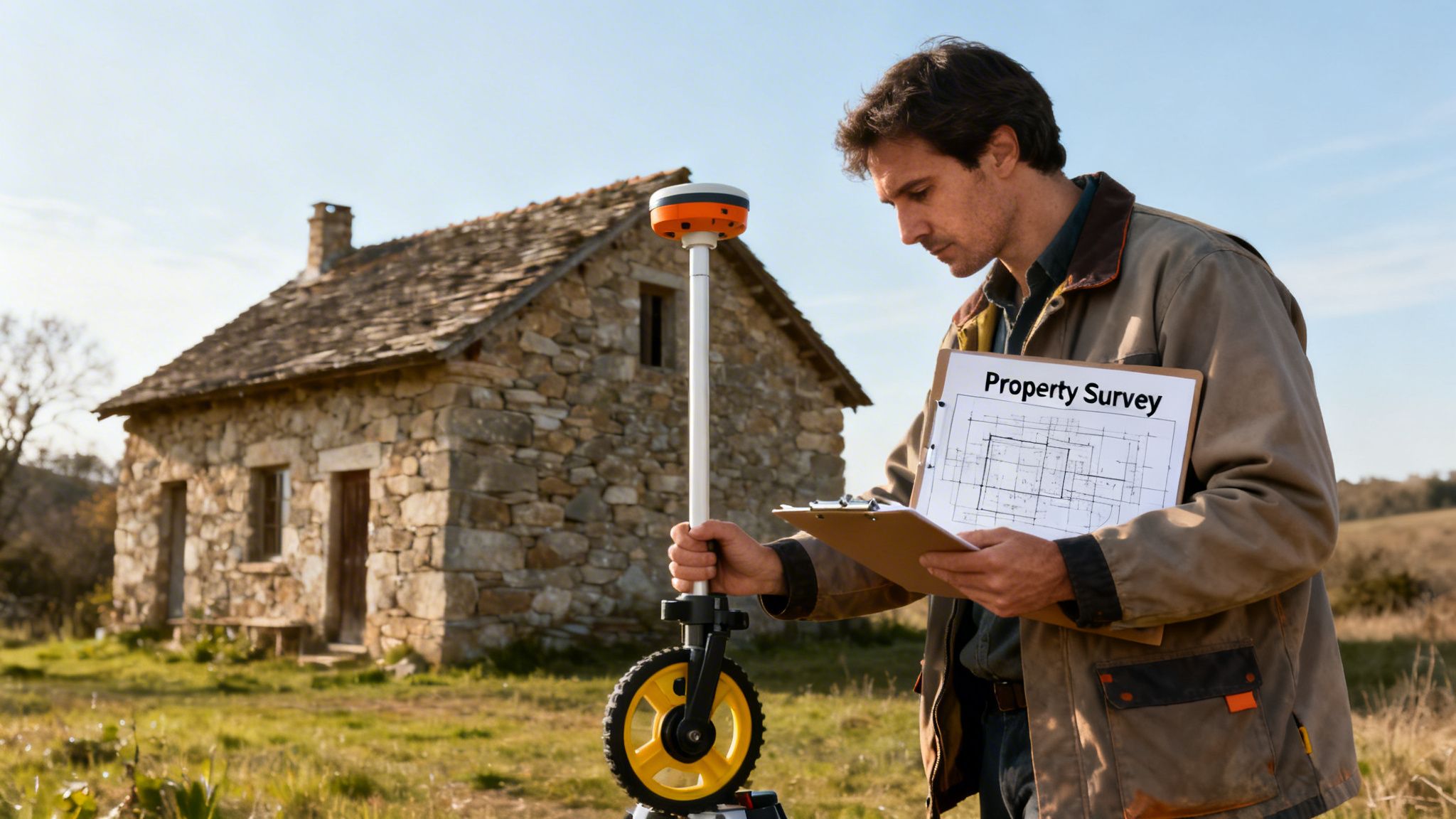 When you're caught up in the excitement of finding your perfect Italian home, it's easy to want to speed through the technical stuff. But let me be clear: skipping a thorough due diligence process is a risk you simply cannot afford to take.
Think of this phase as your investment's insurance policy. It's what stands between your dream home and a potential financial nightmare, and it relies on two key experts: the geometra (a technical surveyor) and the notaio (the notary). While the notaio handles the legal side, the geometra gets their hands dirty, checking the physical property. Trust me, this is not a corner you want to cut.
The Geometra’s On-the-Ground Investigation
Hiring an independent geometra might be the single most important decision you make. Their job is to perform a detailed technical survey, or relazione tecnica, to make absolutely sure that what you're seeing is what you're legally getting. This goes way beyond just looking for a few cracks in the walls.
A huge part of their work is confirming urbanistic conformity (conformità urbanistica). This is a fancy term for a simple concept: does the property's registered floor plan at the land registry (catasto) perfectly match the house as it stands today? It’s incredibly common in Italy for past owners to have made changes—knocking down a wall, adding a window, or building a small bathroom—without ever updating the official paperwork.
If there's a mismatch, the property can't be legally sold until the seller fixes it. That process can be a long and expensive headache, and a good geometra will spot these red flags from a mile away, saving you from a deal that could fall apart weeks or even months down the line.
Here’s what they’ll be looking at:
- Structural Health: A deep dive into the condition of the foundation, roof, walls, and any supporting beams.
- Permit History: Making sure all past construction and renovations had the proper permits (permesso di costruire).
- System Checks: Reviewing the plumbing, electrical, and heating systems to ensure they’re up to modern code.
- Energy Certificate: Verifying the Attestato di Prestazione Energetica (APE), a legally required energy performance certificate.
Key Takeaway: The notaio ensures the legal title is clean, but they won't set foot on the property. The geometra is your expert on the ground, making sure the physical building matches its legal identity.
Uncovering Hidden Legal Surprises
While the geometra inspects the bricks and mortar, your legal team or notaio digs through piles of paperwork to find any potential legal issues. This isn't just about making sure the seller actually owns the property; it's about uncovering the little details that could seriously impact how you live there.
They're looking for things like:
- Rights of Way (Servitù di Passaggio): Does a neighbor have a legal right to drive across your driveway to reach their own property?
- Liens and Mortgages: Are there old debts tied to the property that could suddenly become your responsibility?
- Condo Rules (Regolamento di Condominio): If you're buying an apartment, these rules can hold surprising restrictions on everything from pets and renovations to whether you're allowed to rent your unit out.
Before you even think about signing a preliminary contract, you need to have all these boxes checked. Using an ultimate real estate due diligence checklist is a great way to make sure nothing gets missed. For an even more focused look, we've put together our own real estate due diligence checklist based on years of experience.
This level of preparation is more important than ever. Italy's property market is heating up, with a recent Banca d'Italia survey showing homes are now selling in an average of just 5.4 months. That pace is nearing historic lows, which means strong demand is creating a seller's market. Now is the time to move decisively, but more importantly, to move carefully.
Closing the Deal and Life After Purchase

After all the searching, paperwork, and anticipation, the big day finally arrives. The entire process of buying your Italian home comes down to one key meeting at the notary’s office for the final signing of the deed, or rogito. This is far more than a simple formality—it’s the moment the property officially and legally becomes yours.
This final signing is a formal gathering with you, the seller, and the notaio. The notary will read the entire deed aloud to everyone present, making sure every detail is crystal clear. This is when you’ll pay the final balance on the property, along with all the outstanding taxes and fees. Once everyone signs, the keys are handed over. It’s a fantastic feeling.
Settling into Your New Italian Life
With the keys in your hand, a new chapter begins, and so does a new to-do list. Transitioning from buyer to homeowner means ticking off a few essential administrative boxes to get properly set up in your new community. Tackling these tasks early will save you a lot of headaches down the road.
Here are your first practical steps:
- Transfer Utilities (Voltura): You’ll need to get the electricity, gas, and water accounts switched to your name. This is called a voltura, and it's usually quite simple. A phone call or online form is often all it takes, as long as you have the previous owner’s details and a copy of your signed rogito.
- Register for Waste Tax (TARI): Pop down to the local municipality’s tax office to register for the TARI, the waste collection tax. The amount you pay is based on your property's size and how many people live there.
- Register Your Residency (Iscrizione Anagrafica): If this new property is your main home, you must register as a resident at the local comune (town hall). This is a crucial step for accessing local services and is a requirement for almost everything else you'll do officially in Italy.
A word of advice: One of the most common post-purchase hurdles is underestimating Italian bureaucracy. Things can move at their own pace. Don't let it frustrate you—a bit of patience and a friendly attitude at the local comune can make all the difference.
Understanding Your Ongoing Obligations
Owning a home in Italy comes with a few annual financial responsibilities. The main one to know about is the IMU (Imposta Municipale Unica), which is the annual property tax.
There's some great news here, though. If the property is your primary residence (prima casa), you are exempt from paying IMU.
For second homes, holiday properties, or rentals, the IMU is calculated using the property's official cadastral value and the local tax rates. You'll typically pay it in two installments, one in June and the other in December. It's important to keep these dates in your calendar to avoid any late fees.
Residency and Visas for Non-EU Citizens
For buyers coming from outside the European Union, purchasing a property is often the first step toward a long-term plan to live in Italy. It’s critical to remember that simply buying a home doesn't automatically give you the right to stay in the country year-round.
You’ll need to apply for a long-stay visa. A very popular route for those who don't plan on working is the Elective Residency Visa (Visto per Residenza Elettiva). This visa is designed for people who can support themselves with a stable, passive income, such as a pension, investments, or rental income.
The application process involves showing proof of property ownership (or a long-term rental contract) and providing detailed financial records. It’s a separate journey in itself, so be sure to start the visa process well before you plan to move.
Interest from abroad in Italian real estate is booming. Major events like Rome's Jubilee have drawn international buyers, pushing prices in the capital to €3,306 per square meter. Milan's market is also heating up ahead of the Olympics, which you can read more about on Idealista.it. This new wave of expats and investors is exactly who we at Residaro help find everything from a modern villa to a rustic country home.
Common Questions About Buying Property in Italy
Even with the best plan, buying a home in Italy will throw a few curveballs your way. It’s completely normal to have a long list of questions. Let's walk through some of the most common ones we get from international buyers, so you can move forward with a bit more confidence.
Do I Actually Need to Fly to Italy to Close the Deal?
This is a huge logistical hurdle for many people, but the good news is you don't have to. While being there for the final signing—the rogito—is an incredible moment, it’s not always realistic.
You can handle the entire closing remotely by granting a Power of Attorney (known as a procura speciale) to someone you trust. This is typically your lawyer, but it could also be a family member or a friend in Italy. This legal document gives them the authority to sign the final deed and manage the payments for you. Just know it has to be done right: the document is usually drafted in both English and Italian and must be legally notarized in your home country, complete with an Apostille stamp to make it official in Italy.
How Long Does This Whole Process Usually Take?
Every purchase has its own quirks, but you can generally bank on a timeline of about two to four months from the day your offer is accepted to the moment you’re holding the keys.
Here’s what that looks like in practice:
- Offer to Compromesso: The first phase, which covers the initial back-and-forth and basic due diligence, tends to take around 3-6 weeks.
- Compromesso to Rogito: This is usually the longest stretch, often lasting 6-10 weeks. It gives you breathing room to get your financing in order and lets the notary do their deep dive into the property’s legal history.
A word of caution: this is just an average. A simple, all-cash deal with no legal tangles could wrap up quicker. On the other hand, if you’re dealing with complex surveys, slow-moving banks, or other surprises, don’t be shocked if it takes longer than four months.
Are the Rules Different for EU vs. Non-EU Citizens?
Yes, there are differences, but they're not as complicated as you might fear. If you’re an EU citizen, it's simple: you have the exact same property-buying rights as an Italian. No extra hoops to jump through.
For non-EU citizens, it usually comes down to a legal principle called the condition of reciprocity. In plain English, this just means an Italian citizen must be allowed to buy property in your home country. For buyers from places like the USA, Canada, and the UK, this is already in place, so there’s nothing stopping you.
The real difference for non-EU buyers isn't about buying the property—it's about living in it. Owning a home doesn’t automatically give you the right to stay long-term. If you plan to live in Italy for more than 90 days at a stretch, you'll need to apply for the right kind of visa, like the Elective Residency Visa.
Can I Get a 100% Mortgage in Italy?
To put it bluntly, no. This is a crucial reality check for anyone budgeting for a purchase. Italian banks are known for being quite cautious, especially when lending to non-residents.
You should realistically expect to get a mortgage covering 60-70% of the property's value. That means you’ll need to come up with a cash down payment of at least 30-40%, plus enough to cover all the closing costs and taxes. And remember, the bank will base its loan on its own surveyor’s valuation, which might come in lower than the price you agreed to pay.
Embarking on this journey is one of the most exciting things you can do. At Residaro, we take the guesswork out of the search by bringing you a handpicked collection of properties all over Italy, from rustic farmhouses to stunning modern villas. Start exploring and find your dream home in Europe today.