Buying a House in Sweden - Your Complete Expat Guide
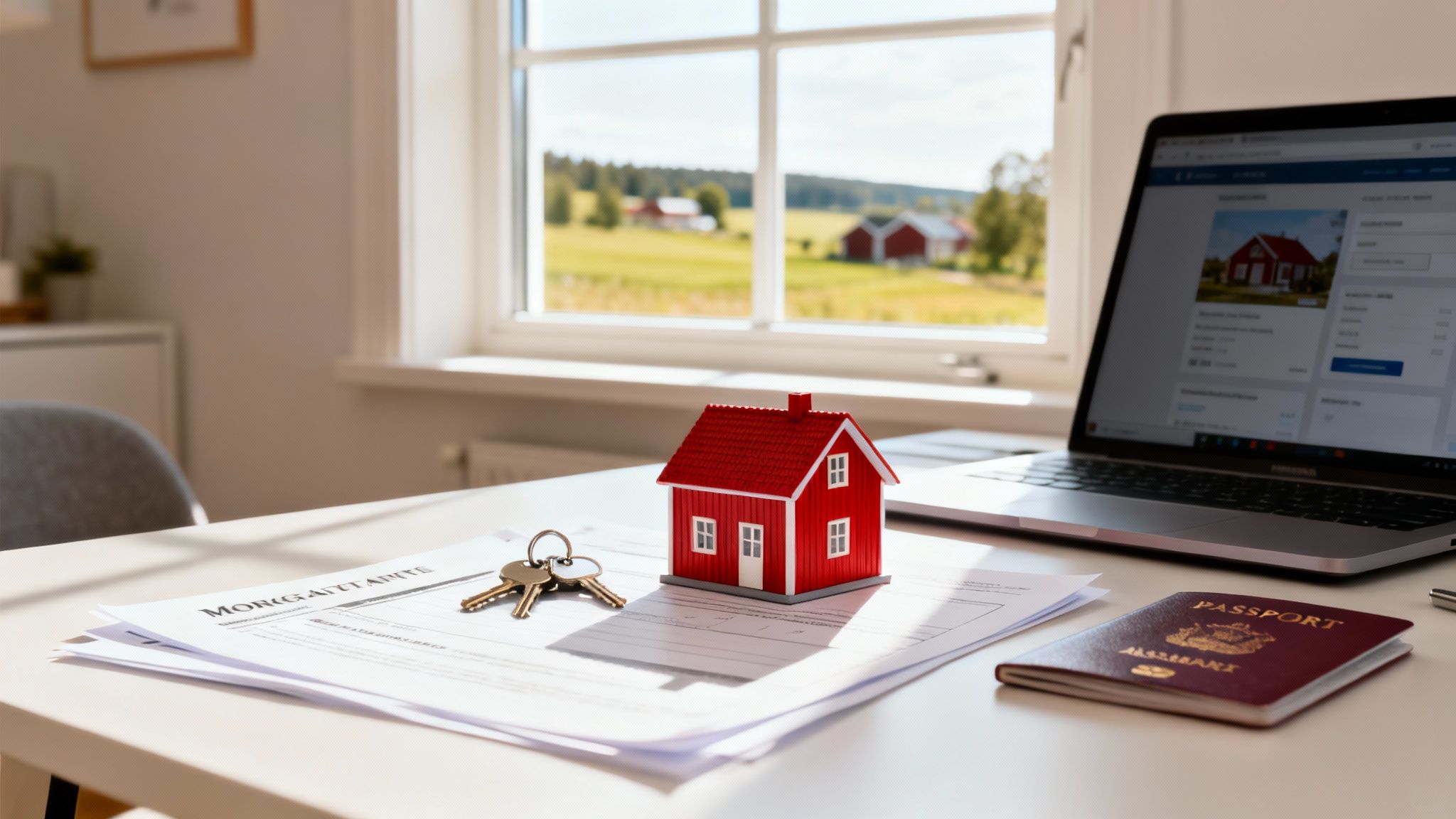
Ever dreamed of owning a chic Stockholm apartment or a classic red stuga tucked away in the countryside? Buying property in Sweden is an exciting prospect, but it's a world away from how things are done in many other countries. The market is remarkably transparent, but it moves at lightning speed.
Here, being prepared isn’t just a good idea—it’s absolutely essential.
Your Guide to the Swedish Property Market

This guide is built to be your roadmap, helping you navigate every twist and turn of buying a home in Sweden. The good news? The system is refreshingly open. International buyers, even from outside the EU, face almost no restrictions and have the same property rights as Swedish citizens.
The catch, however, is the pace. The market can be intense, with bidding wars often happening over text message in a matter of hours. This can push the final sale price far beyond what was initially listed. It’s a reality that means you must have your financing sorted out before you even think about attending a viewing.
What This Guide Covers
We’ve designed this guide to be your go-to advisor, breaking down a potentially stressful process into simple, actionable steps. We’ll cover everything from the crucial first conversations with a bank to the day you finally hold the keys in your hand. Our aim is to give you the confidence that comes from real, practical knowledge.
By the time you're done, you'll have a solid grasp on:
- Financial Foundations: How to get a "lånelöfte" (a loan promise) and why the 15% down payment is non-negotiable.
- The Property Search: Understanding the key difference between a freehold house ("äganderätt") and a tenant-owner's apartment ("bostadsrätt").
- Bidding and Negotiation: Smart strategies for the fast and open bidding process known as "budgivning."
- Closing the Deal: What happens between signing the contract and the official handover day, or "tillträdesdag."
The Swedish property market runs on two things: speed and transparency. To succeed, you need more than just the highest bid. You need a solid understanding of the local rules and your finances in perfect order from day one.
With these insights, you’ll be in a strong position to turn your dream of owning a home in Sweden into a reality. Let’s start with the most critical first step: getting your financing locked down.
Getting Your Finances in Order: The Swedish Way
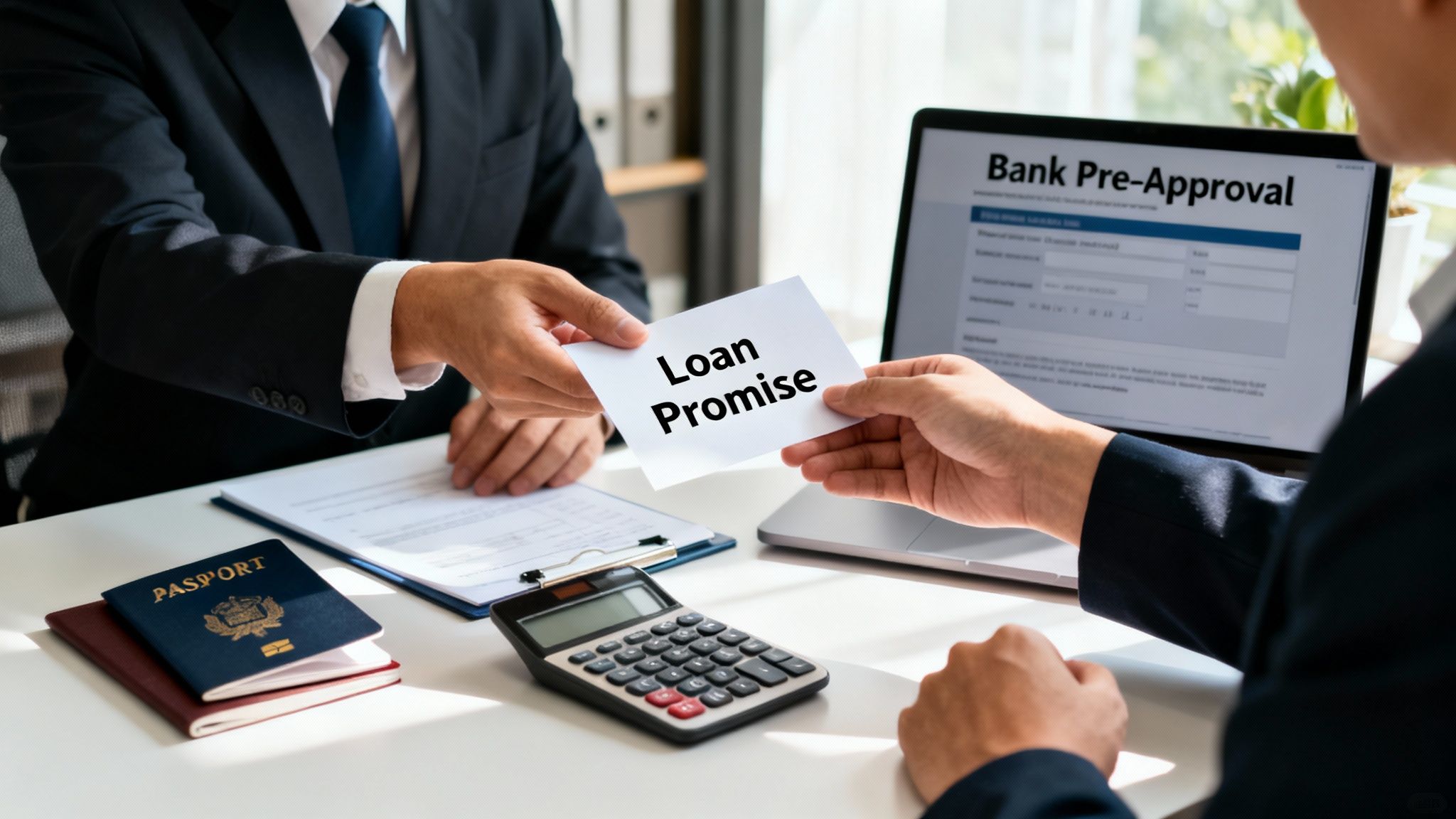
If you're used to house hunting in other countries, you might be tempted to find your dream home first and then worry about the financing. In Sweden, you need to flip that script entirely. Here, your journey begins not with a property viewing, but with a visit to the bank.
The absolute first thing you need is a 'lånelöfte'—a loan promise. This little document is your golden ticket into the Swedish property market.
What Exactly Is a Lånelöfte?
Think of a lånelöfte as an official pre-approval from a bank, stating the maximum amount they’re willing to lend you for a home purchase. It’s not just a nice-to-have; it's a non-negotiable prerequisite for getting involved in the fast-paced bidding wars that are common here.
This document, which is usually valid for three to six months and free to obtain, signals to real estate agents and sellers that you're a serious contender. Without one, you simply won't be allowed to place a bid.
Getting your lånelöfte is the starting gun for buying a house in Sweden. It defines your budget, proves your seriousness, and gives you the confidence to act quickly when you find the right property.
To get one, Swedish banks will need to take a close look at your financial health. For expats, this means having all your ducks in a row.
What Banks Look For in International Buyers
The process is generally straightforward, but as an international buyer, you'll need to present a solid financial profile.
- A Swedish Personnummer: This personal identity number is the key that unlocks most financial services in Sweden. While a few banks might consider a coordination number ('samordningsnummer'), having a proper personnummer makes everything infinitely easier.
- Stable Employment: Banks want to see a permanent employment contract, or 'tillsvidareanställning'. If you're self-employed, get ready to show a few years of consistent, documented income.
- A Clean Credit History: Your financial background will be vetted through a credit agency like UC, so a good record is a must.
- Sufficient Income: Your earnings have to comfortably cover not just the mortgage, but also the monthly fees ('avgift') and general living costs, based on the bank’s stress-test calculations.
The Mandatory 15% Down Payment
One of the biggest financial hurdles for anyone buying in Sweden is the 'kontantinsats', or down payment. The law is crystal clear: banks can only finance up to 85% of a property's final sale price.
This means you must come up with the remaining 15% in cash. This rule is strict and there are no workarounds. For a home that sells for SEK 4,000,000, you'll need to have SEK 600,000 ready for the down payment, plus extra funds for other small fees. It's a perfect example of why preparing your finances well in advance is so crucial.
Despite market shifts, the mortgage market in Sweden has remained active. Total lending for housing reached over SEK 5,413 billion by mid-2025, an increase of 5.5% from three years prior. This shows continued lending confidence, and recent interest rate cuts have started to ease the monthly financing burden for new buyers compared to the 2022-2023 peak. You can dig into the specifics in the Finance Sweden mortgage market report from September 2025.
Fixed vs. Variable Rates: What’s the Right Move?
Once your mortgage is approved, you’ll have a choice to make: fixed ('fast ränta') or variable ('rörlig ränta') interest rates. A variable rate moves up and down with the market, while a fixed rate locks in your interest for a set term—usually 1, 3, 5, or 10 years.
Many buyers actually hedge their bets by splitting their mortgage, putting a portion on a fixed rate for stability and leaving the rest variable to potentially benefit from rate drops. The best choice really comes down to your personal risk tolerance.
For more in-depth strategies, you might find our guide on securing a mortgage for a foreign property particularly helpful.
Finding Your Dream Home in Sweden
With your lånelöfte in hand, the real fun begins: the hunt for your new Swedish home. Thankfully, the search process is surprisingly straightforward. Unlike in many countries where listings are scattered across dozens of websites, the Swedish market is highly centralized.
You'll quickly find that pretty much every property for sale ends up on one dominant platform: Hemnet. It’s so ingrained in the culture that "checking Hemnet" is practically a national pastime. A smaller alternative, Booli, is also worth a look, but Hemnet is the undisputed king.
Here’s what you’ll see when you land on the Hemnet homepage—a clean, simple starting point for your search.
The search filters are incredibly powerful, letting you drill down by price, square meters, property type, and even specific features, making it easy to zero in on places that fit your criteria.
Understanding Swedish Property Types
As you start browsing, you'll immediately run into two core ownership concepts. Getting this right from the start is absolutely essential, as it affects everything from your monthly bills to your legal rights.
-
Äganderätt (Freehold): This is the classic ownership model you're likely familiar with. You buy the building and the land it stands on. This is standard for freestanding houses (villor) and most townhouses (radhus). You have total freedom, but you're also on the hook for all maintenance, property taxes, and general upkeep.
-
Bostadsrätt (Right of Residence): This is how nearly all apartments are owned in Sweden, and it’s a bit different. You aren't technically buying the physical apartment. Instead, you're buying a share in a housing cooperative (bostadsrättsförening, or BRF) that owns the entire building. That share grants you the exclusive and permanent right to live in your specific unit.
Think of buying a bostadsrätt as becoming a part-owner of the building itself. You pay a monthly fee (the avgift) to the cooperative, which covers shared expenses like heating, water, trash collection, and maintenance of common areas. A well-managed, financially stable BRF is one of the most important signs of a sound property investment.
Preparing for the Visning
The property viewing, known as a visning, is your chance to see if a place feels right and to kick the tires, so to speak. Viewings are almost always open-house style and are scheduled for very specific times, usually on a Sunday afternoon.
When you arrive, the real estate agent (mäklare) will hand you a prospectus filled with official details. Your job is to look past the perfectly arranged pillows and fresh flowers and really assess the home’s condition.
Your Viewing Checklist
Don't just wander through for 15 minutes. This is a massive financial decision, so go in with a plan and a critical eye.
- Check for Obvious Issues: Look for any signs of damp, check the condition and age of the windows, and turn on the taps and shower to test the water pressure. These small checks can reveal bigger problems.
- Ask the Mäklare Smart Questions: Don't be shy. Ask about recent renovations, why the owner is selling, and what the typical utility costs are. If it’s a bostadsrätt, dig into the BRF’s finances. Are any major repairs (like a new roof or plumbing) planned for the building?
- Review the Inspection Report: For houses, the seller often provides a pre-sale inspection report (besiktningsprotokoll). This document is gold. It can uncover hidden issues with the foundation, roof, or electrical systems that could save you a fortune—and a massive headache—later on.
A visning is more than a simple tour; it's a fact-finding mission. The more you learn at this stage, the more power and confidence you'll have when it's time to make a bid.
Getting to Grips with the Swedish Bidding Process
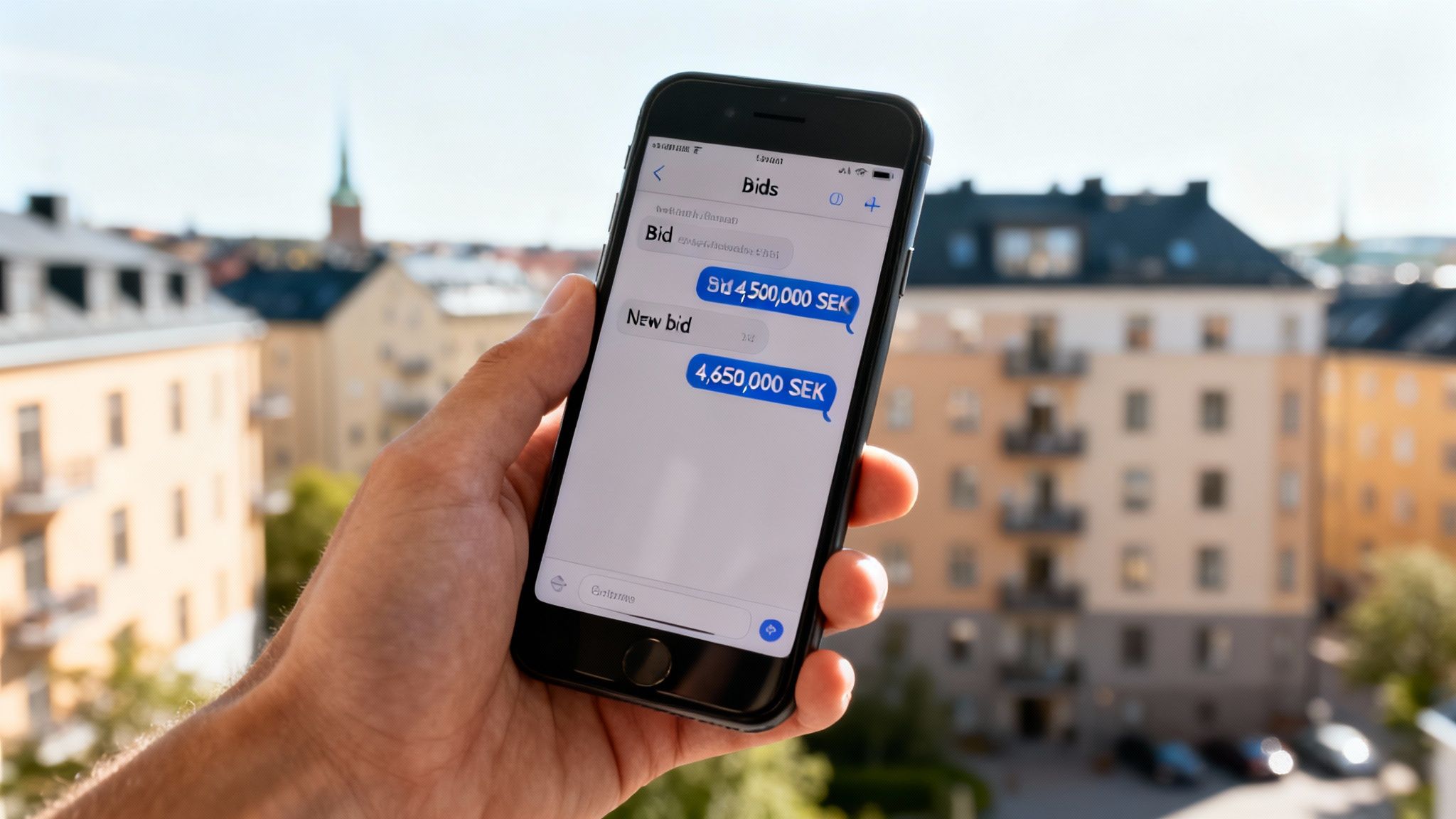
This is where things get interesting—and uniquely Swedish. Welcome to the 'budgivning', the bidding process. If you’re used to sealed bids or quiet back-and-forth negotiations, you’re in for a surprise. Here, it’s a fast, open, and often nerve-wracking auction, usually handled entirely by text message and phone calls.
Think of the real estate agent as an auctioneer. They broadcast every new bid to all the other hopeful buyers, creating a transparent but intense environment. To come out on top, you need a cool head, a firm budget, and a clear strategy before you even think about making an offer.
First, you need to understand the 'utgångspris' (starting price). It's not a valuation or what the seller necessarily expects to get. Treat it as the opening bell for the auction. In hot markets like Stockholm or Gothenburg, it’s completely normal for the final price to shoot up 15-20% or even more.
How the Bidding Actually Works
Once the property viewings are done, the agent will invite everyone who registered their interest to the bidding party. The mechanics are simple, but they’re incredibly effective at building momentum.
- The Opening Bid: Someone kicks things off with the first offer, which the agent verifies.
- The Domino Effect: The agent immediately texts all other potential buyers to let them know the new highest bid.
- Round and Round: The cycle repeats. Bidders increase the price, often in small increments, and everyone is kept in the loop in near real-time.
- The Last One Standing: The auction runs until everyone else has dropped out, leaving a single winning bidder.
This open format means you’re never in the dark about where you stand. But it also dials up the pressure and creates a powerful sense of competition. It’s a psychological game just as much as a financial one.
Common Tactics and Strategies
Winning a budgivning isn’t just about having the most money; it’s often about smart timing and playing your cards right. Experienced bidders use a few classic moves to gain an advantage.
- The Slow Burn: Making small, frequent bids is a strategy to wear down your competition. The hope is that they'll get frustrated or hit their limit through sheer fatigue.
- The Knockout Punch: On the other hand, making a single, large jump in price can be a power move. It’s designed to scare off other bidders and show you mean business.
- The Pre-emptive Strike: Some buyers try to sidestep the bidding war entirely. They’ll put in a strong, time-sensitive offer before the main viewing even happens, hoping the seller will be tempted to accept it and cancel the auction.
Heads Up: Here's the most important rule for anyone new to the Swedish system: bids are not legally binding. Not for you, and not for the seller. A binding agreement only exists once the final purchase contract, the 'köpekontrakt', is signed by everyone.
This means a buyer can technically pull out at any moment before signing, and a seller can change their mind even after verbally accepting an offer. While backing out is bad form and very rare, the lack of a legal commitment until the ink is dry is a fundamental part of the process.
The Seller Always Has the Final Say
Perhaps the biggest surprise for international buyers is the seller’s 'fri prövningsrätt'—their absolute right to choose who they sell to. The highest bid doesn't automatically win.
So, why would a seller ever accept a lower offer?
- A quick and easy closing. A buyer who can move fast might be more appealing than one who needs more time.
- A no-strings-attached offer. Someone with no contingencies, like needing to sell their own apartment first, is a much safer bet.
- A gut feeling. The seller might just feel more confident that one buyer’s financing is more secure than another’s.
This is actually another tool in your strategic toolkit. Through the agent, you can communicate things like your flexibility on the move-in date ('tillträdesdag'). Sometimes, being the most convenient buyer is what gives you the winning edge, not just being the richest.
From Winning Bid to Getting the Keys
So, you've won the bidding war—congratulations! While the most nerve-wracking part is behind you, the Swedish property system kicks into high gear from this point. You need to be ready to move fast to go from the winning bidder to the legal homeowner.
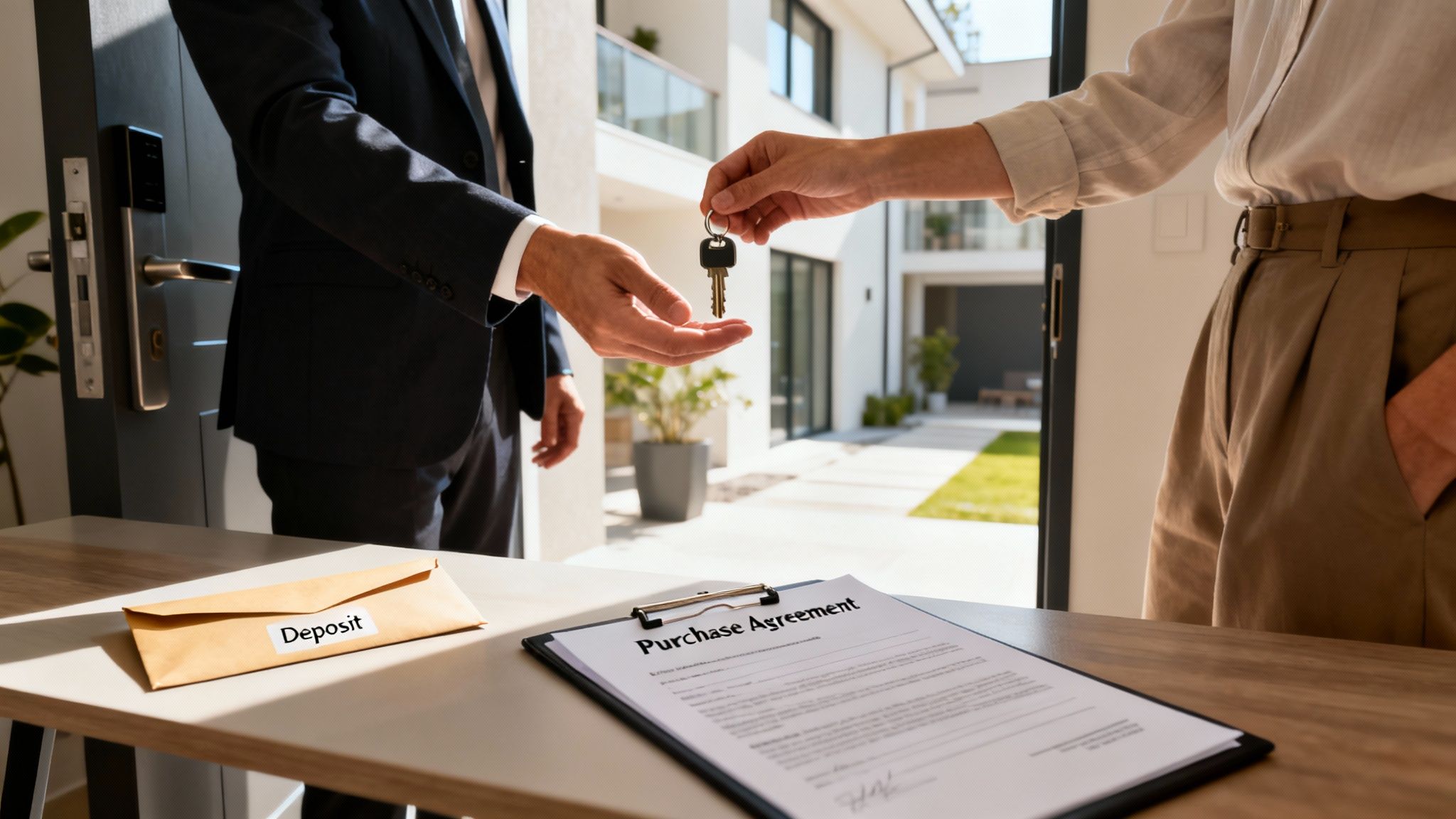
The first major milestone is the 'kontraktsskrivning', or contract signing. This isn't something that happens next week; it's usually scheduled within just a few days of your bid being accepted. This is the moment it all becomes official and legally binding.
At this meeting, you’ll sit down with the seller and the real estate agent to sign the 'köpekontrakt'—the formal purchase agreement. This document is the rulebook for the sale, spelling out everything from the price and closing date to any special conditions you've both agreed on.
The Deposit and Your Duty to Inspect
Right after you sign that contract, you'll need to pay the 'handpenning', which is the deposit. This is almost always 10% of the final purchase price. The money is transferred to the real estate agent's secure client account, where it stays safe until the final closing day.
This is also where the buyer’s 'undersökningsplikt' (duty to inspect) comes into sharp focus. Swedish law is very clear on this: the responsibility to thoroughly check the property's condition falls squarely on your shoulders before you sign.
'Undersökningsplikt' means you can't come back later and seek compensation for faults you could have reasonably found during a proper inspection. The bar for what counts as a "hidden defect" is very high, making your pre-signing diligence your single best form of protection.
If the seller hasn't already provided a recent inspection report, it's a very good idea to hire your own certified inspector (besiktningsman). This is a non-negotiable step, especially for a house, as it gives you a clear-eyed view of what you’re buying. For a systematic way to tackle this, our real estate due diligence checklist can help you cover all the important bases.
Understanding Your Closing Costs
The price you agreed on isn't the final number you'll pay. When buying a property in Sweden, you need to budget for a few specific closing costs to avoid any nasty surprises on the big day. These fees mostly come into play when you're buying a freehold property (äganderätt), like a house.
To give you a clearer picture, here’s a breakdown of the typical one-time costs you'll face.
Estimated Closing Costs When Buying a Swedish Property
| Cost or Fee | What It Covers | Estimated Amount |
|---|---|---|
| Lagfart (Stamp Duty) | The tax for legally registering your ownership of the property. | 1.5% of the purchase price for private individuals. |
| Pantbrev (Mortgage Deeds) | A fee to register new mortgage deeds against the property if you're taking out a loan. | 2% of the new mortgage amount being registered. |
| Administrative Fee | A small fee paid to the Land Registry for processing the stamp duty. | A fixed fee, typically around 825 SEK. |
These one-time fees are paid at closing and are separate from your deposit and the final payment. It's worth noting that if you're buying an apartment (bostadsrätt), you won't have to pay for stamp duty or mortgage deeds, though the housing cooperative (BRF) might charge a small administrative fee for the ownership transfer.
The Final Step: Tillträdesdag
The 'tillträdesdag' is the closing day—the day you finally get possession of the property. You'll typically meet with the agent, and sometimes the seller, at your bank. This is when your bank transfers the remaining 90% of the purchase price to the seller, and the deal is officially done.
Once the money transfer is confirmed, the agent hands over the keys to your new home. With all the legal documents signed and filed with the Swedish Land Registration Authority (Lantmäteriet), the property is officially yours. Welcome home
Understanding Regional Market Differences
Thinking of the Swedish property market as one big, uniform thing is a mistake many international buyers make. The truth is, Sweden is a patchwork of distinct regional markets, and each one plays by its own set of rules, especially when it comes to price. Where a property is located can often matter more than almost any other factor.
Think of the national average house price like a blended smoothie. It gives you a general idea of the taste, but it completely masks the sharp, individual flavors of the ingredients. The property markets in Stockholm, Gothenburg, and Malmö are a world away from what you'll find in smaller towns or the countryside.
The Big City Premium
The price gap between Sweden's major cities and everywhere else is massive. This is especially true in Stockholm, where a chronic shortage of housing means demand always seems to outpace supply, leading to fierce competition and ever-rising prices. Understanding this from the start is absolutely critical for setting a realistic budget.
The numbers really tell the story here. The national average might sound manageable, but it's a completely different ballgame in the metropolitan areas.
In Q3 2025, the average price for a house across Sweden was about SEK 3.9 million. But in Greater Stockholm, that same average skyrocketed to SEK 7.0 million. In Greater Malmö, it was SEK 5.3 million. That means you could be paying nearly double the national average for a place in the capital—a sobering reality for anyone looking to buy a house in Sweden.
These figures show just how much your budget's buying power depends on a pin on a map. A sum that could get you a spacious family home in one region might only stretch to a small city apartment in Stockholm. For a deeper dive into market trends, the Investropa blog has a great piece on the Swedish property market crash and recovery.
Different Property Types, Different Paces
It’s not just about geography; the type of property you're after also makes a big difference. The markets for freestanding houses (villor) and cooperative apartments (bostadsrätter) often move at completely different speeds.
- Apartment Market: This market is often fueled by first-time buyers and young professionals, making it very sensitive to things like interest rate hikes or shifts in the job market. In recent years, city-center apartments have sometimes seen stronger price growth than houses.
- House Market: The market for single-family homes is typically driven by families needing more room. It tends to be more stable but can also be slower to react to big economic changes.
Knowing which segment is hot right now can give you a real edge. It helps you anticipate how much competition you'll face and how intense the bidding might get. For example, even when the total number of homes for sale hit nearly 82,000 in mid-2025, this did little to cool the red-hot market in prime city locations.
This knowledge helps you spot real value. If you're dreaming of a quiet escape rather than city life, looking for a cabin for sale in Sweden could open up a totally different market with fantastic opportunities. At the end of the day, matching your search to the realities on the ground is the key to making a smart, successful purchase.
Your Top Questions Answered: Buying a Home in Sweden
As you get closer to making an offer, a few practical questions always pop up. Let's tackle the most common ones we hear from international buyers to clear up any lingering confusion and help you move forward confidently.
Can I Really Buy a House in Sweden if I'm Not from the EU?
Yes, you absolutely can. Sweden is one of the most welcoming countries in Europe when it comes to property ownership. There are no special rules holding back foreign buyers—whether you're from the EU or not, you have the same rights as a Swedish citizen to purchase a home.
You won't need to apply for any special permits or even have a residency visa to buy. This makes the legal side of things refreshingly simple and straightforward for everyone.
Is My Bid Final Once I Make It?
This is a crucial point to understand about the Swedish system: no, your bid is not legally binding. Think of it more as a strong statement of intent.
Even if your bid is accepted verbally or in writing, the deal isn't sealed until both you and the seller have signed the official purchase contract, the 'köpekontrakt'. Until that happens, either party can legally back out. It's considered bad form, of course, but it's not illegal.
How Critical Is a 'Personnummer' for Getting a Mortgage?
It's pretty close to essential. Having a Swedish personal identity number, or 'personnummer', is the key that unlocks the door to most mortgage lenders. A few banks might entertain an application with a temporary coordination number ('samordningsnummer'), but the vast majority see a personnummer as a non-negotiable requirement.
Why? It’s how you build a credit history in Sweden, which is what banks scrutinize to gauge your financial reliability. Without one, you'll find it incredibly difficult to get a loan approved unless you have an exceptionally strong financial background.
A Word of Advice: Remember, the real estate agent ('mäklare') is hired by the seller. Their job is to get the best price and terms for their client, not for you. While they are bound by law to be fair, they aren't your representative. If you want someone in your corner, it's a smart move to talk to a property lawyer.
Will Buying a House Help Me Get a Swedish Residence Permit?
Simply put, no. Owning property in Sweden has no bearing on your residency status. Buying a home and applying for residency are two completely separate legal tracks.
You can own a home here without ever living in the country. If you do plan to stay for more than 90 days (and you're a non-EU citizen), you'll need to apply for a residence permit through the Swedish Migration Agency based on your reason for moving, such as work or family connections.
Ready to find your perfect Swedish home? At Residaro, we specialize in connecting international buyers with their dream properties across Europe. Explore our curated listings and start your journey today. Visit us at https://residaro.com.