What Is Property Conveyancing - A Guide for Global Buyers

At its core, property conveyancing is the legal process that officially transfers a home from one person to another. Think of it as the formal, legally-binding handover for real estate. It's the series of steps that ensures the entire transaction is valid, recognized by law, and that you end up as the true, undisputed owner.
Your Guide to Property Ownership Transfer

Imagine you're buying a large, valuable ship. You wouldn't just hand over the cash and sail away. You’d want to inspect the vessel from top to bottom and, crucially, check its official logbook to make sure everything is in perfect working order. Property conveyancing is that meticulous legal inspection and handover process, designed to protect your investment.
This isn't just about shuffling papers from one desk to another. It’s a critical legal framework that makes sure the property you're buying is exactly what it seems. It’s the engine that verifies the seller has the legal right to sell, confirms the property is free from hidden debts or disputes, and finally, records your name as the new owner.
Why Conveyancing Is Non-Negotiable
Conveyancing is all the legal legwork handled by a professional—like a solicitor or a licensed conveyancer—to ensure a property's title is legitimately transferred. It's the crucial difference between a handshake deal and a legally sound purchase. It's the "how" of moving ownership from the seller to you.
The process has a few main jobs:
- Verifying Ownership: Making absolutely sure the person selling the property actually owns it and has the right to do so.
- Conducting Searches: Digging into local authority records and other databases for any issues that could affect the property’s value or how you use it. Think planned motorways at the end of the garden or environmental risks.
- Managing Contracts: Drafting, reviewing, and exchanging the legally binding contracts that lock in the terms of the sale.
- Handling Finances: Overseeing the secure transfer of money between you, the seller, and any mortgage lenders involved.
Conveyancing provides the legal certainty that turns a property purchase into a secure asset. It is the structured procedure that safeguards the buyer's rights, confirms the seller's claims, and makes the transfer of ownership official in the eyes of the law.
More Than Just a Formality
At the end of the day, the goal is to protect everyone involved. For you as the buyer, it provides peace of mind that there are no nasty surprises waiting down the road, like a boundary dispute with a neighbor or a hidden rule preventing you from building an extension. For the seller, it ensures the transaction is wrapped up correctly, protecting them from future claims.
Skipping this vital legal step would be like navigating treacherous waters without a map or compass. It’s a risk no smart buyer should ever take.
Your Step-By-Step Conveyancing Roadmap

At first glance, the property conveyancing journey can feel like a daunting legal maze. But once you break it down, it’s actually a clear, manageable sequence of events. While the finer details might shift from one country to the next, the core milestones are remarkably consistent.
Think of this as your roadmap. We'll walk through each phase, explaining what’s happening and, more importantly, why it matters for you.
The whole thing kicks off the moment your offer on a property is accepted. This is when you’ll formally instruct a solicitor or conveyancer, giving them the green light to start the legal work and protect your interests. They’ll then open a file for your purchase, run some initial identity checks, and get in touch with the seller’s solicitor to get the ball rolling.
The Investigation Phase: Property Searches
Once you're set up, your legal expert moves into a critical investigation stage known as property searches. You can think of this as a comprehensive background check on the property and its surroundings. The goal here is to unearth any hidden issues that could affect the home's value, your ability to enjoy it, or even your chances of reselling it down the line.
These aren't just casual queries; they're formal enquiries sent to various authorities. The standard checks usually include:
- Local Authority Searches: This digs into the local council's records, revealing crucial details like nearby planning permissions, who maintains the roads, or any enforcement notices against the property itself.
- Environmental Searches: A vital check that flags potential risks like contaminated land from previous industrial use, floodplains, or ground stability issues.
- Water and Drainage Searches: This confirms the property is hooked up to the mains water and sewer systems and, crucially, shows where public pipes are located, which could scupper any future extension plans.
The results from these searches are a huge deal. A nasty surprise—like a notice for a new motorway planned at the end of the garden—could give you solid grounds to renegotiate the price or even walk away entirely.
Reviewing the Contract and Raising Enquiries
While the searches are chugging along, your solicitor gets the draft contract pack from the seller's team. This bundle contains the draft contract, the property's title deeds (the ultimate proof of ownership), and a stack of property information forms filled out by the seller.
Your solicitor will go through every single document with a fine-tooth comb, hunting for inconsistencies or red flags. Based on their findings and the search results, they’ll then raise pre-contract enquiries with the seller’s solicitor. These are just targeted questions designed to clear up anything murky, from a fuzzy boundary line to the last time the boiler was serviced.
This back-and-forth is your legal team’s chance to iron out every single wrinkle before you’re legally on the hook. A meticulous enquiry process is the hallmark of a great conveyancer and is absolutely essential for protecting your investment.
The Point of No Return: Exchange of Contracts
Once all the questions have been answered to your satisfaction, the search results are in the clear, and your mortgage offer is locked in, you’re ready for the exchange of contracts. This is, without a doubt, the most significant moment in the whole process.
During the exchange, you and the seller sign identical contracts, and your solicitors officially swap them. The second this happens, the deal is legally binding. Neither side can pull out without facing serious financial penalties. A completion date is set in stone, and just before the exchange, you’ll transfer your deposit to your solicitor’s client account.
Completion Day: Getting the Keys
Completion is the grand finale—the day it all comes together and the property officially becomes yours. On the morning of completion day, your solicitor will send the remaining purchase funds (your money plus the mortgage lender's) over to the seller’s solicitor.
As soon as the seller’s team confirms the money has landed, they’ll give the estate agent the go-ahead to release the keys to you. The property is now legally yours.
But it doesn't quite end there. Your solicitor has a few final but vital jobs to do. They’ll handle paying any property taxes due (like Stamp Duty in the UK) and then, most importantly, they will register you as the new owner with the national property register (e.g., the Land Registry). This final step officially records your ownership and secures your title, bringing the conveyancing journey to a successful close.
Who's On Your Team? Key Players in a Property Transaction

Buying a property isn't a one-person job. It's more like a well-coordinated film production, where a whole crew of specialists comes together to make the magic happen. Each person has a specific role, and a smooth, successful purchase depends entirely on how well they work in sync.
Getting to know the cast of characters from the start will save you a world of headaches. When you understand who does what, you know exactly who to call with a specific question, which keeps the whole process chugging along without any unnecessary delays.
Your Legal Expert: The Quarterback of the Deal
Front and center in this process is your legal representative. This is your quarterback, the person you trust to navigate the maze of property law, protect your interests, and make sure the title you get at the end is clean, clear, and legally yours.
Depending on where you're buying, this role might be filled by a few different professionals:
- Solicitor: This is a fully qualified lawyer who can handle every legal angle of a property deal, including any tricky or unexpected issues that might pop up.
- Licensed Conveyancer: Think of them as a specialist. They are lawyers who focus only on property transactions and can handle all the standard steps just like a solicitor.
- Notary: In many European countries, the Notary is a government-appointed official who plays a central, impartial role. They are legally required to draft and witness the final deed of sale, making it official.
Choosing the right legal guide is absolutely critical, especially if you're buying internationally where the rules of the game can be completely different. For a closer look at what to look for, our guide on finding an international real estate lawyer is a great resource.
The Supporting Cast: Essential Roles for a Smooth Closing
While your legal pro handles the core transfer, several other people are essential to getting the deal across the finish line. They don’t manage the legal paperwork, but without them, the transaction would grind to a halt.
A property transaction is a collaborative effort where legal, financial, and logistical experts converge. Each professional manages a distinct piece of the puzzle, and their synchronized work is what ultimately allows you to receive the keys to your new home.
The sheer volume of work these professionals handle is massive. In the United States alone, industries tied to conveyancing were projected to generate $22.1 billion in revenue in 2025. That figure actually shows a dip, largely because higher mortgage rates slowed home sales and reduced the demand for these very services.
Here are the other vital members of your team:
-
The Estate Agent: They're the matchmaker, connecting you with the seller and acting as the main line of communication. They'll negotiate the price and arrange viewings and surveys, but remember, they can't give you legal advice.
-
The Mortgage Lender: If you're getting a loan, your bank or lender is a huge part of the process. They'll have their own legal team to protect their investment, and that team will work closely with your solicitor to ensure everything is in order.
-
The Surveyor: Before you sign on the dotted line, you'll want a surveyor to give the property a thorough health check. Their report can uncover hidden problems, from a leaky roof to structural issues, and can be a powerful tool for renegotiating the price.
How Conveyancing Varies Across Europe
Buying property is rarely a one-size-fits-all deal, and that’s especially true when you start looking across international borders. While the end goal is always the same—to securely and legally transfer ownership—the path to get there can look completely different from one European country to another.
Assuming the process you know from home will apply in Spain or Sweden is one of the most common (and costly) mistakes international buyers make.
Understanding these national quirks isn’t just an academic exercise; it’s a practical necessity. Each country’s legal system, shaped by centuries of unique history, dictates who’s in charge of the transaction, what paperwork you’ll need, and how long the whole thing will take. This is why having local expertise isn't just helpful—it's absolutely critical.
The Central Role of the Notary in Civil Law Countries
One of the biggest differences you'll run into is the powerful role of the Notary. In common law systems, like the UK or US, you typically have solicitors for the buyer and seller managing the back-and-forth. But in most of continental Europe, which operates under a civil law tradition, the Notary is a highly qualified, state-appointed legal professional who acts as an impartial public officer.
This person isn't just stamping documents. The Notary is legally required to ensure the entire transaction is fair, valid, and follows all state laws. They often draft the final deed, run the official checks, and register the property, essentially representing the interests of the state to guarantee a legitimate transfer.
Let's take a look at how this—and other local rules—plays out across a few popular European destinations.
A Tour of European Conveyancing Systems
Buying property in a new country means learning a new set of rules. Here’s a quick tour of the conveyancing process in six key nations to give you a feel for the unique steps and key players you'll meet.
France In France, the process is built around the Notaire. Once your offer is accepted, both parties sign a preliminary contract called the compromis de vente. This is a serious, legally binding agreement that kicks off a mandatory 10-day cooling-off period just for the buyer. The Notaire then gets to work on extensive due diligence before everyone meets to sign the final deed, the Acte de Vente, in their office.
Spain Spain also puts the Notario at the heart of the deal. Things usually start with a private preliminary contract, or contrato privado de compraventa. But the truly critical step is the signing of the public deed of sale—the escritura pública—in front of the Notario. Only then is the sale legally complete and ready to be logged at the Property Registry (Registro de la Propiedad).
Italy The Italian system is similarly Notary-centric. The journey to ownership typically has three stages: a formal offer (proposta d'acquisto), a detailed preliminary contract (compromesso), and the final deed (rogito). The Notaio is that impartial figure who oversees the final signing, verifies every legal detail, and makes sure all taxes are paid before registering the new ownership.
In many European civil law countries, the Notary acts as a trusted, impartial guarantor of the transaction's legality. Their involvement isn't optional; it's a fundamental requirement of the state, designed to protect both parties and the integrity of the property register.
Portugal In Portugal, you’ll likely have a lawyer representing you for due diligence, but the Notary's role is non-negotiable for the final act. After a promissory contract (Contrato de Promessa de Compra e Venda) is signed, the final deed (Escritura Pública de Compra e Venda) must be executed before a Notary to make the transfer of ownership official.
Sweden Sweden offers a different model. Here, a real estate agent handles a lot of the process, including drafting the purchase agreement (köpekontrakt). There's no Notary in the same way as in Southern Europe. Instead, the buyer's bank and the official Land Registration Authority (Lantmäteriet) are the key players in securing the transfer and registering the new title deed (lagfart).
Austria In Austria, the process is typically managed by a lawyer (Rechtsanwalt) or a Notary (Notar). A binding offer (Kaufanbot) is usually made first, which leads to the drafting of the main purchase contract (Kaufvertrag). This contract has to be officially notarized, and the deal is only truly done once the new owner is registered in the Land Register (Grundbuch).
European Conveyancing at a Glance
As you can see, the path to getting the keys varies quite a bit. The differences in legal frameworks and key personnel directly impact how long a purchase takes and who you'll be working with.
This table offers a snapshot of what to expect in our focus countries, highlighting the main legal professional you'll encounter and a typical timeline.
| Country | Primary Legal Professional | Key Preliminary Agreement | Average Timeline |
|---|---|---|---|
| France | Notaire (Notary) | Compromis de Vente | 2-3 Months |
| Spain | Notario (Notary) | Contrato Privado de Compraventa | 2-3 Months |
| Italy | Notaio (Notary) | Compromesso | 2-4 Months |
| Portugal | Notary & Lawyer | Contrato de Promessa de Compra e Venda | 1-3 Months |
| Sweden | Real Estate Agent & Bank | Köpekontrakt | 4-6 Weeks |
| Austria | Rechtsanwalt (Lawyer) or Notar | Kaufvertrag | 1-2 Months |
It’s clear that a process taking a few weeks in Sweden could stretch on for months in Italy, with entirely different professionals leading the way. Approaching an international purchase with this awareness is the first step toward a smart, secure, and successful investment.
Common Conveyancing Problems and How to Avoid Them
Even the most straightforward property purchase can hit unexpected turbulence. While conveyancing is a methodical process, a few common problems can pop up, causing frustrating delays or, in the worst cases, scuppering the whole deal. Knowing what these potential roadblocks look like is the best way to steer clear of them.
Many issues are uncovered during the property searches. Your solicitor might discover a planned motorway at the end of the garden or an environmental report could flag a risk of flooding. These aren't just minor hiccups; they can fundamentally change whether the property is a sound investment for you.
Another classic hurdle is a delay with the mortgage offer. Lenders are meticulous, and if they need extra documents or their valuation survey throws up an issue, it can easily push your timeline back by weeks. The key is to be organized with your paperwork from day one and respond to their requests immediately.
Navigating Title Deed and Chain Complications
One of the trickier areas where problems can surface is with the property's legal title. Think of the title deeds as the property's official passport—any ambiguity or error can halt a sale dead in its tracks.
A few common title problems include:
- Unclear Boundaries: The lines on the legal plan don't quite match the fences and walls you saw on your viewing.
- Restrictive Covenants: You might find old, forgotten rules tied to the property, like a ban on building an extension or running a business from home.
- Missing Information: For older properties, it’s not uncommon for a key document—like one proving a right of way over a neighbour's path—to have gone missing over the years.
Fixing these issues requires careful legal work and really highlights why thorough checks are so important. For a deeper dive, you can work through our real estate due diligence checklist, which breaks down all the critical checks for a secure purchase.
Anticipating potential issues is half the battle. A proactive approach, combined with an experienced legal team, transforms potential deal-breakers into manageable challenges, keeping your purchase firmly on track.
Proactive Strategies to Mitigate Risks
The secret to a smooth process really comes down to preparation and communication. A great first step is to ask your solicitor about common delays they see in the specific area you're buying in—they’ll have invaluable local knowledge.
Also, keep an eye on the bigger picture. Wider economic trends can have a real impact on how quickly things move. For example, major housing shortages often put a huge strain on conveyancers, which can lead to slower service all around. This is a dynamic you can see in many markets with big supply gaps, as discussed in a report on global housing from Hines.
Finally, the biggest threat to any transaction is often a break in the property chain, where someone else in the linked series of sales pulls out. While you can't control what other people do, having your finances sorted and being ready to move quickly makes your position much stronger and helps hold the entire chain together.
How We Can Help You Buy Property in Europe
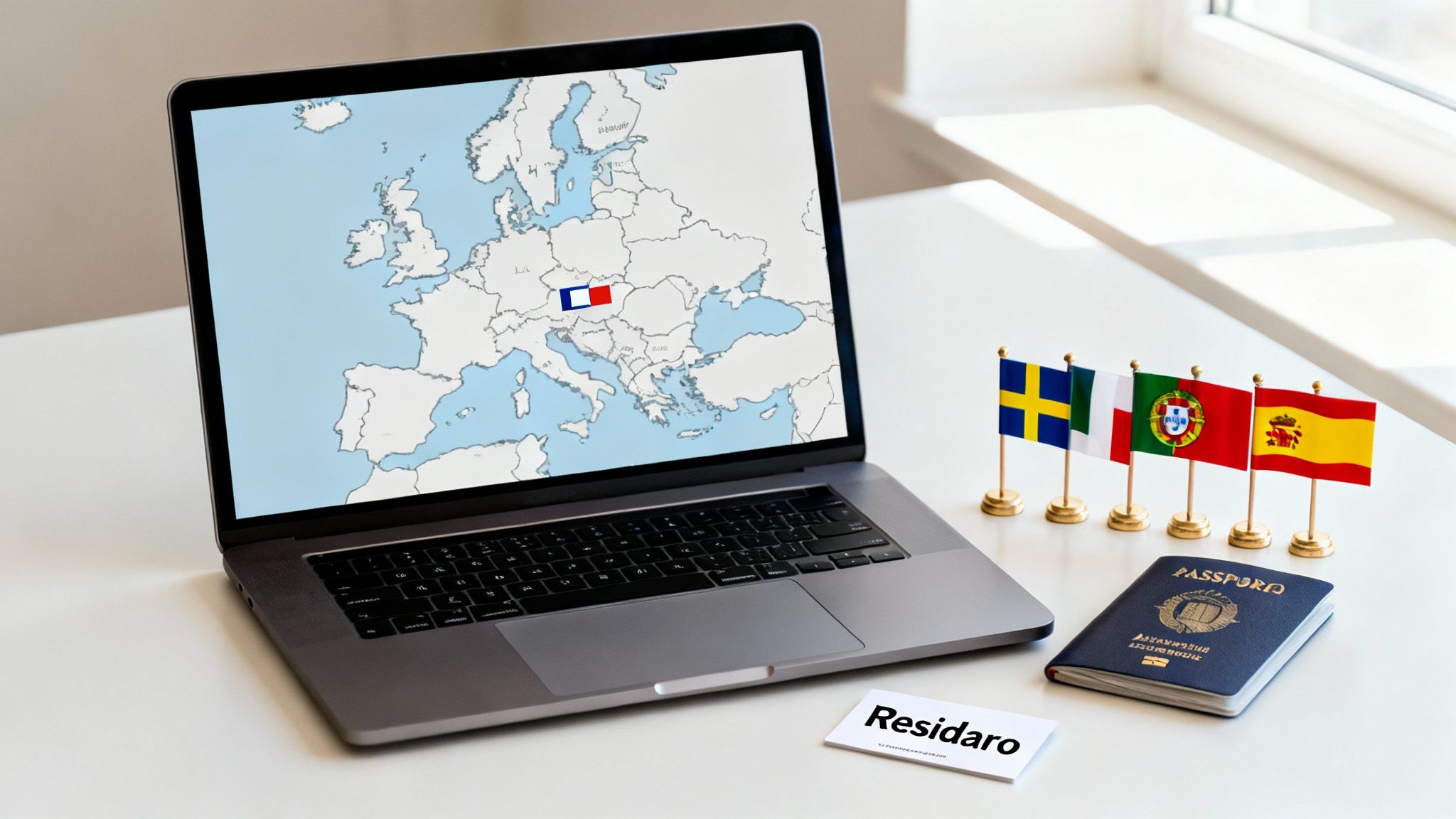
Buying a property in your own country is complicated enough. But when you venture abroad, you're suddenly juggling language barriers, unfamiliar legal systems, and different ways of doing business. It can turn an exciting dream into a major headache.
This is where a trusted partner makes all the difference. Knowing the local system isn't just helpful—it's essential. The process hinges on a Notaire in France, but it’s often led by an agent in Sweden. Without someone in your corner who speaks the language and understands the law, you're risking expensive mistakes and long delays.
A Clearer Path to Owning Your European Home
We built Residaro to solve this exact challenge. We've created a network of hand-picked, multilingual legal experts across Europe, ready to help international buyers like you. These aren't just any lawyers; they are specialists in their local property markets who can guide you through every step with total clarity.
Our whole approach is designed to take the guesswork out of buying overseas. We connect you with a professional who can:
- Break Down Language Barriers: No more getting lost in translation. They'll explain complex legal documents in plain English.
- Navigate Local Laws: You'll understand your rights and responsibilities from the very beginning.
- Give You Transparent Advice: You'll get a clear, honest picture of the timeline, costs, and what to expect next.
The real goal of any property purchase is peace of mind. When you work with a vetted local expert, you’re not just buying a house—you're making a secure, legally-sound investment for the future.
Our mission is simple: to make your dream of owning property abroad a reality by connecting you with the right expertise. From the first contract to the final deed, your Residaro-affiliated expert will be your dedicated guide.
If you’re just getting started, our comprehensive guide on how to buy property overseas is packed with practical tips and insights.
Ready to move forward with confidence? Let us connect you with our network of legal professionals and help you find a seamless path to owning your dream home in Europe.
Your Top Property Conveyancing Questions Answered
Even with a good map, the journey of buying a property can still have some confusing turns. This is especially true when you're buying abroad. Let's clear up some of the most common questions we hear from international buyers.
How Long Does Property Conveyancing Usually Take?
Honestly, there's no magic number. The timeline really depends on the country and the specific details of your purchase. As a general rule of thumb, a smooth, straightforward transaction often takes somewhere between 8 to 12 weeks.
But what can slow things down? A long chain of buyers and sellers, hold-ups with your mortgage provider, or unexpected legal issues popping up during property searches can easily add weeks to the process. In countries that rely on a central notary, things can move a bit faster once you get to the final signing stage.
Can I Do My Own Conveyancing to Save Money?
It’s a tempting thought, isn't it? Cutting out the legal fees seems like a great way to save a bit of cash. However, we'd have to say this is a really bad idea, especially if you're buying in a country you're not familiar with.
The legal risks are huge. One tiny mistake could cost you a fortune, leave you with a faulty title to your property, or land you in a legal battle down the road. Plus, if you're getting a mortgage, your lender will almost certainly require you to use a qualified legal professional. They want to protect their investment, and you should too.
"Trying to save money by doing your own conveyancing is a classic false economy. The potential cost of fixing a mistake can be crippling, far exceeding what you would have paid for an expert to get it right the first time."
What Is the Difference Between Exchange and Completion?
This is a big one, particularly in countries with a legal system based on common law (like the UK). Getting these two stages clear is essential.
-
Exchange of Contracts: Think of this as the point of no return. You and the seller sign identical contracts, your solicitors swap them, and the deal becomes legally locked in. Once contracts are exchanged, pulling out comes with serious financial penalties. This is also when you'll typically pay your deposit.
-
Completion: This is the finish line! It usually happens a couple of weeks after the exchange. On completion day, the rest of the money is sent to the seller's solicitor. As soon as they confirm it's arrived, the property is officially yours, and you can finally pick up the keys.
What Are Disbursements in Conveyancing Costs?
When you get a quote from your solicitor, you'll see their legal fee and a separate list of costs called "disbursements." These are simply costs that your solicitor pays to third parties on your behalf to get the deal done.
Think of your solicitor as paying these bills for you and then passing the cost directly on to you—there’s no markup.
Common disbursements include things like:
- Fees for official property searches (checking for planning issues, for example).
- The Land Registry fee to update the records and officially name you as the new owner.
- Bank charges for wiring the large sums of money needed for the purchase.
Buying a property in another country can feel complicated, but having the right local expert on your side makes all the difference. At Residaro, we connect you with trusted, multilingual legal professionals across Europe to make sure your purchase is as smooth and secure as possible. Find your dream home and the perfect expert to guide you at https://residaro.com.