What Is Dual Citizenship and How Does It Work
So, what exactly is dual citizenship? At its simplest, it’s the legal status of being a citizen of two countries at once, giving you all the rights and responsibilities that come with each.
Think of it like having a set of keys to two different homes. Each one opens up a different world of benefits, access, and opportunities. For anyone looking to build a more global life, it's an incredibly powerful tool.
Your Guide to Holding Two Passports

When you're a dual citizen, you are legally recognized as a national by two separate governments. This is far more than a symbolic title—it comes with very real, tangible perks for your lifestyle, your finances, and especially your freedom to move around the world.
Imagine being able to live, work, and own property in either country without ever having to worry about applying for a long-term visa. It's a game-changer.
But holding two passports is about more than just collecting travel documents. It represents a genuine connection to two distinct cultures and legal systems. For many of our clients, it's a way to honor their family heritage while seizing new life experiences abroad.
What Dual Nationality Really Means
To truly grasp what dual citizenship is, you have to look at both sides of the coin: the privileges you gain and the obligations you take on. It's a delicate balance of benefits and duties, and the specifics can change dramatically from one country to another.
A second passport fundamentally changes your relationship with the world. It provides a safety net, expands your personal and professional horizons, and offers a level of freedom that a single citizenship often cannot match.
Let's take a real-world example. A dual U.S. and Italian citizen can use their Italian passport to breeze through EU immigration, completely bypassing the long queues for non-EU nationals. But, they also remain responsible for filing U.S. taxes on their worldwide income, no matter where they live. That's the duality in a nutshell.
To give you a clearer picture, we've broken down the core concepts in this table.
Dual Citizenship at a Glance
| Concept | What It Means for You |
|---|---|
| Legal Recognition | You are a full citizen of two countries, not just a resident. Both governments acknowledge your nationality. |
| Rights & Privileges | You can live, work, vote, and access social services (like healthcare and education) in both countries. |
| Travel Freedom | You hold two passports and can use whichever one offers better visa-free access for your destination. |
| Obligations & Duties | You must follow the laws of both countries. This can include obligations like taxes, and in some rare cases, mandatory military service. |
| Property & Finance | It often becomes much easier to open bank accounts, buy property, and invest in both of your home countries. |
This summary shows just how comprehensive this status is, touching nearly every aspect of your life.
Here are a few of the biggest advantages people talk about:
- Enhanced Mobility: You get to choose which passport to travel on, strategically picking the one that gives you easier, visa-free entry.
- Broader Rights: This isn't just about travel. It's about the right to participate fully in society—voting in elections, accessing public healthcare, and working without needing a special permit.
- Economic Opportunities: For property buyers, this is huge. Dual nationality can make it far simpler to open local bank accounts, secure a mortgage, and invest in different markets.
When it comes right down to it, dual citizenship is a strategic asset. Whether you're dreaming of a European vacation home, expanding your business, or planning a retirement abroad, it provides a rock-solid foundation for a truly international life.
The Global Shift Towards Multiple Passports
It might be hard to imagine now, but holding two passports wasn't always so common. For a long time, most countries viewed dual citizenship with suspicion, worried about where a person’s true allegiance would lie, especially during wartime. You were often forced to choose just one national identity.
But the world has changed. We're more connected than ever—through travel, business, and the internet—and those old, rigid lines on the map have started to blur. As a result, the very idea of exclusive national loyalty has softened, paving the way for a more global mindset. This cultural shift is the real engine behind the growing acceptance of having more than one passport.
From Exception to Norm
We’re not just talking about a minor tweak in policy here; it's a massive transformation in how nations think about citizenship. The numbers tell the story loud and clear. Back in 1960, fewer than 33% of countries would let you become a citizen of another nation without forcing you to renounce your original one.
Fast forward to today, and that figure has more than doubled. Over three-quarters of the world's countries now fully accept dual nationality. This trend offers incredible security and peace of mind for anyone thinking about a second passport.
Of course, understanding this global movement also means getting into the nitty-gritty of how to get a second passport, from investment programs to ancestral claims. For anyone looking to buy property, this widespread acceptance is a huge green light. It confirms that investing in a European home can be a secure and viable part of a long-term citizenship plan. And since residency is often the first step, our guide on how to get permanent residency is a great place to start.
Why This Matters for European Property Buyers
So, what does all this mean for you? It means the dream of owning a home in Europe and one day becoming a citizen is built on a solid, globally recognized foundation. This growing tolerance for multiple citizenships has directly shaped more welcoming immigration policies across the continent.
The widespread acceptance of dual citizenship has transformed it from a legal gray area into a strategic asset. For international investors, this means countries are not just selling properties; they are offering a gateway to a more flexible, secure, and mobile future.
Countries like Portugal, Spain, Italy, and France have laid out clear paths to citizenship that, crucially, allow you to keep your original passport. You don't have to make that impossible choice between your home country and your new one. Instead, you can enjoy the rights and benefits of both, building a truly global life backed by legal and political stability.
Navigating Your Rights and Responsibilities

Getting a second passport is like being handed a key to another life. It opens doors you might not have even known existed. But it’s not just about the new freedoms; it comes with a new set of rules and responsibilities. The key is understanding this balance to truly make the most of what dual citizenship has to offer.
The upsides can be genuinely life-changing. You suddenly have the right to live, work, and study in a whole new country—or even an entire region like the EU—without constantly worrying about visas or residency permits. It creates a level of flexibility for your career, education, and lifestyle that a single passport just can't match.
Maximizing Your Freedoms
One of the most immediate and powerful benefits is sheer mobility. With two passports, you can think strategically about travel. Say your new EU passport gets you into a country visa-free, but your original one doesn't. Problem solved. That’s less paperwork and more freedom.
But it goes much deeper than just travel. You're gaining fundamental rights as a citizen. This means you can:
- Vote in Elections: You get a say in the democratic process of your second country.
- Access Social Services: You're often entitled to public healthcare, education, and other social safety nets.
- Own Property Freely: You can buy real estate without the limitations and extra hurdles frequently placed on foreigners.
Being a dual national means you are not just a visitor; you are a full member of two societies. This deepens your connection to your new country and provides a powerful sense of security and belonging.
Understanding Your Obligations
Of course, with rights come responsibilities. The big one for many people is taxation. U.S. citizens, for instance, have to file taxes on their worldwide income regardless of where they live. Tax treaties are in place to prevent double taxation—paying tax twice on the same income—but it’s a layer of complexity that you absolutely need to manage properly.
Another thing to be aware of is compulsory military service. While it’s becoming less common, some countries still require their citizens (usually men) to serve in the armed forces. It's crucial to check the specific laws of your second country to see if this applies to you.
Ultimately, navigating dual citizenship is about embracing both sides of the coin. It’s about using your new rights to build a richer, more global life while responsibly fulfilling the duties that come with being a citizen of two nations.
Common Pathways to a Second European Passport
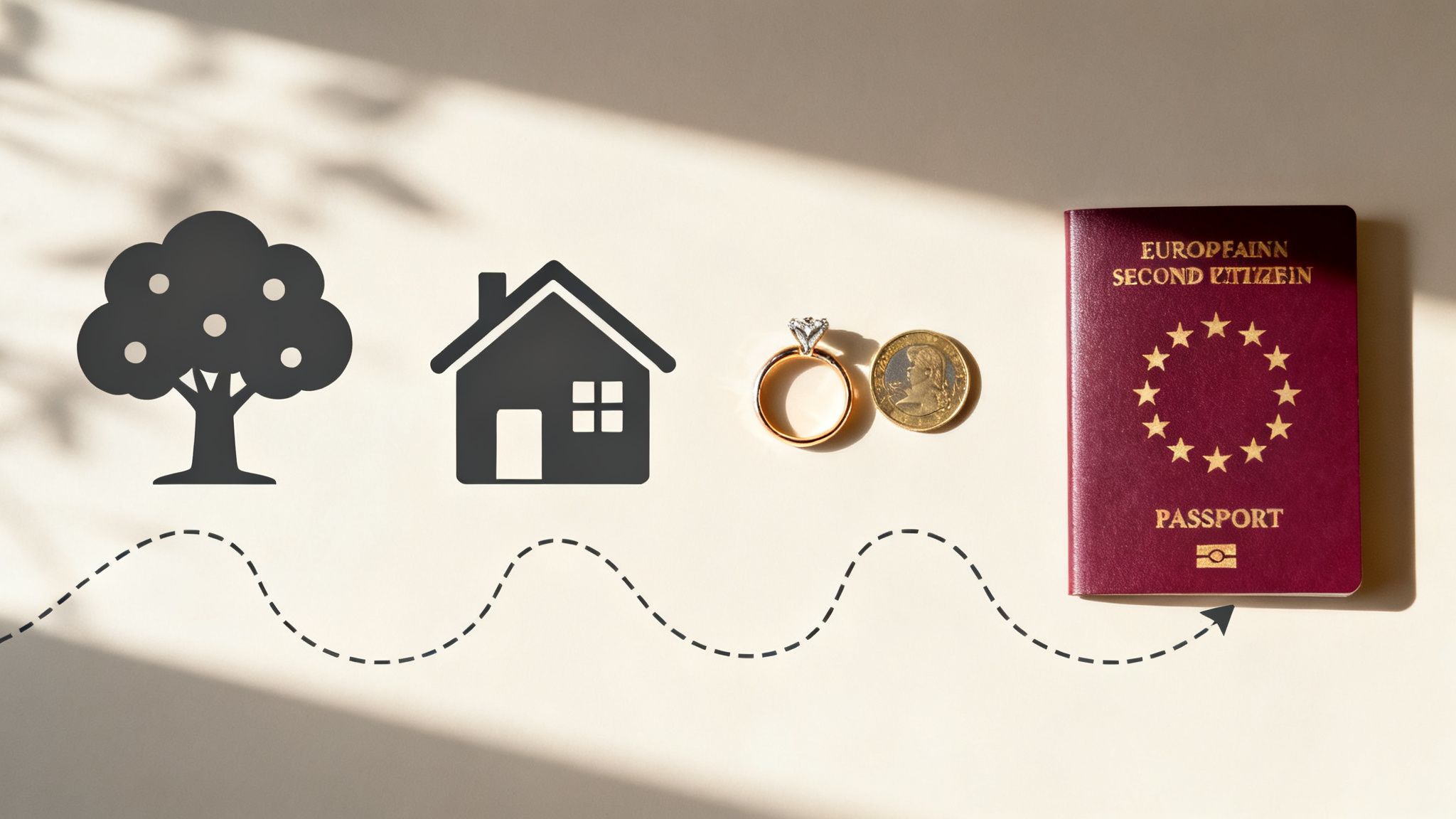
Gaining a second European passport might sound like a huge undertaking, but it usually boils down to a handful of well-trodden paths. Figuring out which one fits you is the first real step in turning that dream of a European life into a solid plan.
Each route has its own timeline and demands, so the key is to find the one that clicks with your personal story. For some, the connection is through family history. For others, it's about putting down roots and committing to a new home. Ultimately, the best path for you is the one that aligns with where you see your life going.
Citizenship By Descent (Jus Sanguinis)
This is probably the most direct route, and its formal name, Jus Sanguinis, literally means "right of blood." If you have a parent, grandparent, or sometimes even a great-grandparent who was a citizen of a European country, you might be able to claim that nationality for yourself. It’s all about your ancestry.
Countries like Italy, Ireland, and Poland are well-known for their generous citizenship-by-descent laws. The real work here is in the details—tracking down official records like birth certificates and marriage licenses to build a clear paper trail. It can feel like a marathon of paperwork, but for those with the right heritage, it’s a powerful way to reconnect with their roots and unlock the benefits of an EU passport.
Citizenship By Naturalization
Naturalization is for those who make a country their home over the long haul. It's the process of becoming a citizen after living there legally for a set number of years, and it's the go-to path for most expats and property investors who don't have family ties to Europe. The journey almost always starts with getting a long-term residency permit.
Think of naturalization as proof of your commitment. It’s not just about buying a house; it’s about becoming part of the local fabric, learning the language, and truly embracing the culture as your own.
So, what does it usually take?
- Continuous Residency: You'll need to live in the country for a specific amount of time, often somewhere between five and ten years.
- Language Skills: Most countries will want to see that you can hold a conversation and understand the local language.
- A Clean Slate: A background check to confirm you have a clean criminal record is standard procedure.
- Cultural Fit: Some countries even have a test on their history, laws, and social values to make sure you're ready to be a fully integrated citizen.
If you’re serious about making Europe your permanent base, it’s worth exploring how to apply for Portuguese citizenship or similar options. This is where a real estate investment can become a direct stepping stone to your ultimate goal of a second passport.
Citizenship By Marriage
Marrying a European citizen can also open a clear, and often faster, route to citizenship. While it’s certainly not an overnight pass, tying the knot can shorten the time you need to live in the country before applying for naturalization. For instance, you might only need to wait three years instead of the standard five or more.
Just be aware that governments are incredibly strict here. They will want to see solid proof that your marriage is the real deal and not just a convenient arrangement for a passport.
Citizenship By Investment
A handful of European nations roll out the welcome mat for investors through programs often called "Golden Visas." These residency-by-investment schemes allow you to secure a residency permit by making a significant financial contribution to the country.
This usually involves buying property, investing in a local business, or making a capital transfer. This residency permit is your first step; after holding it for the required number of years, you can then apply for full citizenship.
To help you see how these options stack up, here’s a quick comparison:
Comparing Routes To European Citizenship
| Pathway | Typical Requirements | Best Suited For |
|---|---|---|
| Descent | Proof of lineage (birth/marriage certificates), clean criminal record. | Individuals with recent European ancestry (parents, grandparents). |
| Naturalization | 5-10 years of legal residency, language proficiency, cultural integration. | Expats and property owners planning to live in Europe long-term. |
| Marriage | Legally married to a citizen, 2-5 years of residency, proof of genuine relationship. | Spouses of European citizens who intend to live in the country together. |
| Investment | Significant investment (real estate, business), clean criminal record, residency. | High-net-worth individuals seeking a strategic path to residency and future citizenship. |
As you can see, the "best" path really depends on your background, your resources, and how you envision your future in Europe.
A Look at Dual Citizenship Rules Across Key European Nations
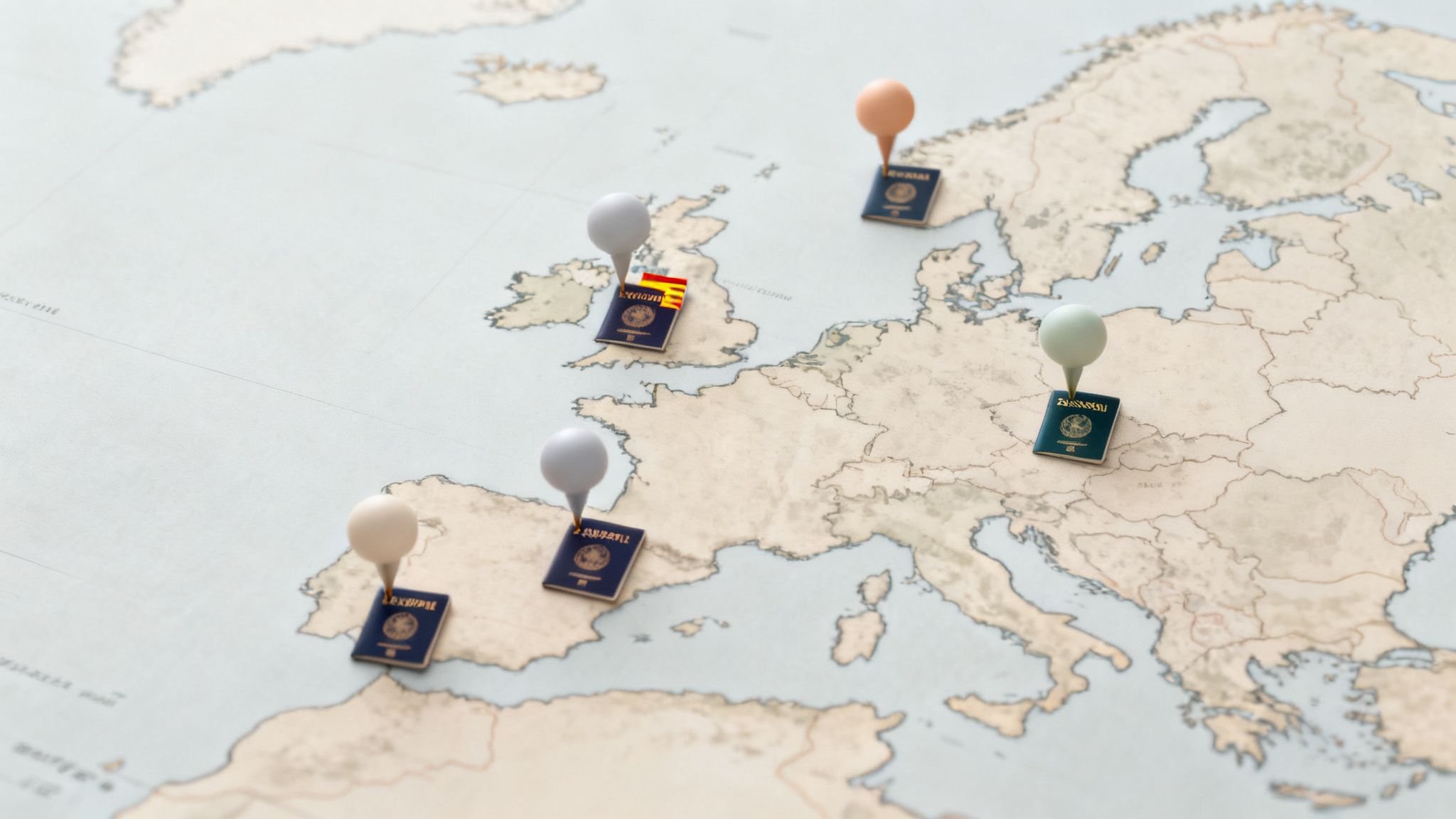
Europe is a patchwork of cultures and legal traditions, and that diversity is perfectly reflected in its citizenship laws. While the EU fosters a sense of unity, the actual rules for getting a passport—and whether you can keep your original one—are strictly a national affair. For anyone looking at property as a gateway to a second citizenship, getting a handle on these specific regulations is the first critical step.
Every country has its own unique mix of requirements and opportunities. Italy, for example, has some of the most expansive laws in the world for citizenship by descent. Meanwhile, Portugal has built a reputation for its residency programs that offer a clear path to naturalization. This country-by-country reality means your investment strategy has to be tailored to a specific set of laws.
Portugal: A Welcoming Path Through Residency
Portugal is widely seen as one of Europe's most dual citizenship-friendly countries. The government generally allows its citizens to hold other nationalities without any issues, a policy that has made it a top destination for investors and expats.
The most popular route by far is naturalization, which only requires five years of legal residency. This relatively short timeline makes Portugal's various residency visas, like the D7 Visa, incredibly appealing. Our guide explains how to get residency in Portugal and take that crucial first step.
Spain: Navigating the Nuances
Spain’s stance on dual citizenship is a bit more complicated. The general rule is that if you naturalize as a Spanish citizen, you're expected to renounce your original nationality. But—and this is a big but—there are major exceptions.
Nationals of Ibero-American countries, Andorra, the Philippines, Equatorial Guinea, and Portugal can all become Spanish citizens without giving up their first passport. For most others, the road is longer, typically requiring ten years of residency before you can even apply.
A crucial takeaway for property buyers is that the legal framework of your target country dictates the entire strategy. What works in Lisbon may not be the best approach for a property purchase in Barcelona.
This is exactly why deep-diving into national laws is so vital. To see how another country handles this, a quick guide on dual citizenship in the Philippines can offer a useful perspective on just how different these legal frameworks can be.
Italy: The Power of Ancestry
Italy is famous for its generous jus sanguinis (right of blood) principle. If you can prove you have an Italian ancestor, you may be able to claim citizenship yourself, often without ever needing to live in Italy. The country fully accepts dual nationality, so you’ll never be asked to give up your current citizenship.
France and Sweden: Open and Straightforward
Both France and Sweden are also very open when it comes to dual citizenship. France has allowed it for decades, with the standard pathway being naturalization after five years of living there.
Sweden is much the same. It requires five years of residency for naturalization and has permitted dual citizenship since 2001, making both countries solid choices for anyone planning to put down long-term roots.
The demand for European citizenship is undeniably on the rise. In the last recorded year, EU countries granted over a million new citizenships, with Spain (240,200) and Italy (213,600) leading the pack. These figures aren't just statistics; they represent real, achievable opportunities for people across the continent.
Here's the rewritten section, designed to sound completely human-written and natural:
Why So Many Americans Are Getting a Second Passport
It seems like more and more Americans are looking for a second passport these days, and it’s about a lot more than just making travel easier. For many, it's a strategic move—a way to gain more freedom, diversify their lifestyle, and create a solid backup plan in an increasingly unpredictable world. Think of it as building a personal "Plan B."
A big part of this shift comes down to a simple reality: the power of the U.S. passport isn't what it used to be. Back in 2014, it was considered the best in the world for travel freedom. Fast forward to today, and its ranking has slipped, prompting a lot of people to look for a second citizenship that opens up doors, especially across the European Union.
Redefining the American Dream
This isn't just a niche interest anymore; it's a full-blown movement. Americans are now the top nationality worldwide seeking dual citizenship, trying to reclaim that edge in global mobility. Firms that handle this kind of thing, like Henley & Partners, have seen a massive spike in inquiries from U.S. citizens over the last few years.
Some experts are even calling this trend "the new American dream." Families are essentially using what they call 'geopolitical arbitrage' to secure better opportunities for themselves, both personally and financially. It’s a proactive way to build a more resilient, international life. For a deeper dive into this, you can explore the full analysis on American dual citizenship demand.
Dual citizenship used to be seen as a luxury for the super-rich. Now, it's becoming a practical tool for professionals, families, and retirees who want to secure a foothold in Europe and improve their quality of life.
By getting a passport from a country like Portugal, Spain, or Italy, Americans are unlocking a whole new set of possibilities. It means the freedom to live, work, and invest across the entire EU—building a stable and enriching foundation for themselves and their kids.
Your Dual Citizenship Questions Answered
The idea of holding two passports is exciting, but it naturally brings up a lot of practical questions. Let's walk through some of the most common ones we hear from people planning their move, so you can get a clearer picture of what daily life as a dual citizen looks like.
Getting these details straight from the start is key to a smooth journey.
Do I Have to Pay Taxes in Both Countries?
This is probably the most frequent—and most important—question we get. The answer isn't a simple yes or no; it really hinges on the specific countries you're dealing with and their relationship with each other.
For example, U.S. citizens have a unique obligation to file taxes on their worldwide income, regardless of where they call home. The good news is that most countries have tax treaties designed to prevent double taxation, meaning you won't get hit with the same tax bill twice. These agreements typically let you credit taxes paid in one country against what you owe in the other.
Still, this is one area where you absolutely shouldn't guess. The only way to be certain about your obligations is to speak with a tax professional who specializes in expat finance.
Could I Lose My Original Citizenship?
This is another major concern, and it all comes down to the laws of your home country. While holding two nationalities is more common than ever, some countries still have rules that might require you to give up your original citizenship if you voluntarily take on another.
Countries like China, India, and Japan, for instance, generally don't permit it. Before you even start down this path, you must verify the laws of your current country.
Pro Tip: Understanding the rules of both your current and your future home countries is non-negotiable. It's the only way to ensure your path to a second passport is secure and free of any unwelcome surprises down the road.
Which Passport Should I Use When I Travel?
The rule of thumb here is refreshingly simple: use the passport of the country you are entering or leaving.
So, if you're flying from the U.S. to Italy, you'll show your American passport to officials when you leave the States. Upon landing in Rome, you'll present your Italian (or other EU) passport to immigration there. It just makes the whole process smoother.
When you're heading to a third country—say, from Europe to Thailand—you have a choice. You can use whichever passport gives you better visa-free access or an easier entry process for that specific destination.
Ready to turn the dream of European property ownership into a reality? Residaro offers an extensive selection of homes across Europe's most desirable locations. Find your perfect property and start your journey today.