How to Get Permanent Residency Across Europe
Making the move to Europe permanent is a goal for many, but it's rarely a quick process. Typically, you're looking at a journey that spans several years, starting with temporary permits and leading to permanent status once you've proven your commitment and met the country's specific rules.
The most well-trodden paths involve landing a skilled job, making a significant financial investment (like a Golden Visa), or demonstrating you have the funds to support yourself without taking a local job. The trick is to find the route that best fits your life and finances, then stick to the script and follow the legal requirements to the letter.
Your Guide to European Permanent Residency
It's one thing to dream of living in Europe, but turning that dream into a legal reality is a whole different ball game. This guide is here to help you cut through the red tape and understand the most practical pathways to permanent residency. We'll focus on the strategies that have worked for countless expats, investors, and professionals before you.
For a general overview of the nuts and bolts, a resource on applying for permanent residence can offer a solid foundation, even though it's not Europe-specific.

Understanding Your Options
Before you pack a single box, you need to get a handle on the main routes available. Every country has its own flavor of rules, but most residency programs boil down to a handful of core categories. Figuring out which one you slot into is the first step, whether your plan is to work, invest, retire, or join family already there.
Here’s a quick look at the most common options we’ll dive into:
- Investment Routes: Think Golden Visas in places like Portugal and Spain, where buying a property can put you on the fast track.
- Employment-Based Paths: This is the classic route—getting a skilled worker permit in a country like Sweden or Austria because a company wants to hire you.
- Self-Sufficiency Visas: For those with passive income, this is a popular choice. You prove you have enough from pensions, investments, or rentals to live comfortably in Italy or France without needing to work.
To give you a bird's-eye view, here's how the primary routes stack up across our featured countries.
Primary Routes to European Permanent Residency
| Country | Work and Skilled Worker Path | Investment and Golden Visa Path | Family and Ancestry Path | Average Time to PR Eligibility |
|---|---|---|---|---|
| Sweden | Strong focus on employer-sponsored work permits. | No direct property-for-residency visa. | Clear path for joining a partner or close family member. | 5 years |
| France | Talent Passport for highly skilled workers. | Real estate can support long-stay visa applications. | Well-defined process for spouses and family members. | 5 years |
| Italy | Quota-based system (Decreto Flussi) for work permits. | Investor Visa for Italy (requires €250k-€2M investment). | Strong emphasis on family reunification. | 5 years |
| Portugal | D7 Visa (passive income) and Skilled Worker permits. | Famous Golden Visa program, often tied to real estate. | Common route for joining resident family. | 5 years |
| Spain | Highly-Qualified Professional Visa. | Popular Golden Visa program (€500,000 property investment). | Straightforward family regrouping visas. | 5 years |
| Austria | Red-White-Red Card for skilled workers in shortage occupations. | No direct Golden Visa; significant investment can be a factor. | Strong legal basis for family reunification. | 5 years |
This table simplifies the main avenues, but remember that the devil is always in the details of each country's specific immigration laws.
Why Property Ownership Matters
As you explore these options, you'll see one requirement pop up again and again: stable housing. For almost any visa that isn't a short-term tourist stay, you must prove you have a legitimate place to live. This is non-negotiable for family visas and self-sufficiency applications.
Owning a property isn't just for Golden Visa applicants. It sends a clear message to immigration officials that you’re serious about putting down roots and have the financial stability to support yourself. From my experience, it can be the factor that tips a borderline application into the approval pile.
In this guide, we're zeroing in on expat hotspots like Sweden, France, Italy, Portugal, Spain, and Austria. We'll break down what it really takes to get residency in these places and show you how a smart move—like buying a home—can lay the foundation for your new life abroad.
The Investment Route: A Shortcut with Golden Visas
For those with the financial resources, the fastest way to get your foot in the European door is often through a strategic investment. This path, widely known as the "Golden Visa," allows you to secure a residency permit by making a significant contribution to a country's economy—most often by purchasing real estate.

These programs are specifically designed to be less of a bureaucratic headache than traditional visa routes. When you meet a clear financial threshold, you’re sending a strong signal of your commitment and stability, which is exactly what immigration authorities want to see.
How Golden Visa Programs Actually Work
At their heart, Golden Visas are straightforward residency-by-investment deals. While some programs offer options like creating jobs or making a capital transfer, buying property remains the most popular and tangible choice for people learning how to get permanent residency.
Portugal and Spain have been the heavy hitters in this space for years. Their programs provide a clear path from temporary residency to permanent status and, eventually, citizenship. One of the biggest perks? A residency permit from one of these countries unlocks visa-free travel across the entire Schengen Area, a massive advantage for international families and business owners.
Make no mistake, these are some of the most dependable routes to living in Europe. Portugal's Golden Visa, for example, has green-lit over 12,000 applications since it started back in 2012. The program has a stunning 99% approval rate for properly filed applications, granting residency to investors who put down as little as €280,000 on property in less populated areas. You can dig into migration stats and see how these programs stack up on sites like global-relocate.com.
Real-World Scenarios: A Retiree and An Entrepreneur
To get a better sense of how this plays out, let's look at two different people with different goals.
First, picture a retired couple from the U.S. who want to spend their golden years in Portugal's sunny Algarve region. They find a beautifully renovated farmhouse for €350,000 in a designated low-density area, which qualifies them for the visa.
Their journey would look something like this:
- They’d hire a local lawyer who lives and breathes Golden Visa applications.
- Next, they’d finalize the property purchase, getting all the official deeds and registration paperwork in order.
- Finally, their lawyer would bundle everything up—proof of funds, clean criminal records, property title—and submit it to AIMA, the Portuguese immigration agency.
In a matter of months, they'd have their residency cards in hand. This lets them live in Portugal full-time and travel anywhere in the Schengen zone without a second thought. And the best part? They only need to be in the country for an average of seven days a year to keep their residency active. If this sounds like your plan, our detailed guide on how to get residency in Portugal breaks it all down.
Now, let’s switch gears to a young tech entrepreneur from Asia looking for a European base. She sets her sights on Barcelona for its buzzing startup scene. She buys a modern apartment for €550,000, easily clearing Spain’s €500,000 minimum for its real estate Golden Visa.
Her process is similar, but her motivations are different. The property is both a home and a smart business asset. With her residency permit, she can run her European operations without constantly worrying about visa renewals, giving her a huge leg up on the competition.
Key Takeaway: A Golden Visa isn't just about buying a house. It's an investment in a lifestyle and a powerful key to global mobility. It erases travel barriers, opens doors to new business ventures, and offers a clear, structured path to making Europe your permanent home.
Investment Thresholds and Core Requirements
The financial commitment is, of course, the central piece of any Golden Visa application. The exact numbers can shift with new legislation, but the general real estate investment thresholds are fairly consistent.
| Country | Minimum Real Estate Investment | Key Features |
|---|---|---|
| Spain | €500,000 | No minimum stay required to maintain residency. You can include your family on the application. |
| Portugal | €280,000 – €500,000 | Investment level depends on the property's age and location. Very low physical presence needed (7 days/year). |
| Greece | €250,000 – €500,000 | One of the lowest entry points in Europe. The minimum amount varies by region. |
Beyond the money, every applicant must show a clean criminal record, have valid health insurance, and prove they can support themselves. The paperwork is meticulous, and there's no room for error. But for those who come prepared, the high success rates of these programs make them one of the most attractive options for building a future in Europe.
Working Your Way to Residency (Or Proving You Don't Need To)
Not everyone has a spare half-million euros for a Golden Visa, and that's perfectly fine. For most people, the most realistic path to living in Europe long-term is through their professional skills or by proving they can support themselves without taking a local job.
This is where your career or your savings become your ticket in. It’s less about a massive upfront investment and more about demonstrating your value to the local economy or, conversely, proving you won’t be a drain on it.

Countries like Sweden and Austria have built clear, structured programs around this idea. They're actively looking for skilled talent and financially independent individuals to join their communities.
Landing a Skilled Worker Permit
The classic route is getting a job offer before you pack your bags. But it can’t be just any job. Governments are careful to ensure foreign workers are filling genuine skills gaps, not just taking jobs that a local could do.
Sweden, for example, is a fantastic destination for professionals. It’s not just my opinion; it ranks 4th in the 2025 Immigration Index, with an incredible 94.9/100 score for quality of life. The numbers back it up: in 2024, Sweden welcomed 430,000 immigrants, and a remarkable 115,000 of them became permanent residents after only two years on a work permit. With a 92% approval rate for those who meet the criteria, the opportunity is very real, especially if you're in tech or healthcare. You can dive deeper into these trends at remitly.com.
So, what does it take to get a Swedish work permit? First, you need a formal job offer. The contract must align with Swedish collective agreements or the industry standard for that role. That means a fair salary you can live on, proper insurance, and employment conditions that match local laws. Your future employer actually kicks off the process by advertising the job in the EU/EEA, proving they couldn't find a suitable candidate closer to home.
Austria takes a slightly different, more methodical approach with its points-based Red-White-Red Card. This isn't a general work visa; it's a highly targeted system designed to attract specific talent pools, like "very highly qualified workers" and "skilled workers in shortage occupations."
Your application is scored based on a few key factors:
- Qualifications & Skills: Your level of education and specialized training.
- Work Experience: Relevant years in your profession.
- Age: There's often a sweet spot for younger applicants.
- Language Skills: Proving you speak German or English gives you a major boost.
If your score is high enough, you might get a visa to come to Austria and then look for a job. If you already have an offer, you can get a Red-White-Red Card tied to that specific company. After working for two years, you can often upgrade to the Red-White-Red Card Plus, which is a game-changer because it gives you unrestricted access to the job market.
The Self-Sufficiency Route: Proving Financial Independence
What if you're a retiree, a digital nomad, or someone with enough passive income to live comfortably? The self-sufficiency route is designed for you. The entire premise is simple: prove you can pay your own way without needing to work or rely on social welfare.
Often called a "residence permit for persons of independent means" or something similar, this visa hinges on one thing: money. You have to show a steady, reliable stream of passive income from sources like pensions, investments, rental properties, or royalties. For anyone running an online business or working remotely, our guide on remote work visas in Europe offers some great parallel options to explore.
A Word of Advice: When you're applying based on self-sufficiency, immigration officials want to see stability and a real commitment to their country. Nothing demonstrates this better than owning property. It’s more than just a roof over your head; it’s a powerful statement that you’re financially secure and serious about putting down roots.
Take Austria, for instance. A retiree applying there needs to show a recurring income that meets a specific annual threshold. On top of that, they need comprehensive health insurance that’s valid in Austria and, critically, proof of a place to live. While you can rent, showing a deed to a property you own makes your application infinitely stronger. It removes any doubt about your financial stability and long-term intentions.
The Passive Income Path to European Residency
You don't always need a high-powered job offer or a seven-figure investment to build a new life in Europe. In fact, one of the most popular routes is designed for people who can simply support themselves without taking a local job.
For retirees, remote professionals, and anyone with a stable financial footing, a steady stream of passive income can be the golden key. This path is all about proving you won't be a burden on the state, and countries like Portugal, Spain, and France have created specific visas for exactly this purpose. The idea is straightforward: show you have enough recurring income from pensions, rental properties, dividends, or investments to live comfortably, and the door to long-term residency swings open.
Portugal's Highly Popular D7 Visa
When people talk about moving to Europe on passive income, Portugal's D7 Visa is almost always part of the conversation. It's become a cornerstone of the country's immigration strategy, attracting thousands who dream of a life in the sunny Algarve or vibrant Lisbon without the need to find work locally.
The program's success is no secret. Portugal's welcoming reputation has put it at the top of many expat lists, and the D7 has been a huge driver. In 2025, the country is on track to welcome 140,000 net immigrants, a figure fueled in part by the D7's clear-cut path to permanent residency after five years. The numbers from 2024 speak for themselves: 18,000 applications were approved with a 95% success rate, and an impressive 85% of those visa holders are expected to gain permanent residency. You can dig deeper into these migration trends in this official report.
The financial requirements are surprisingly accessible. A single applicant just needs to show a minimum annual passive income of €8,460. For a couple, you simply add 50% for the spouse, bringing the total to a very manageable €12,690 a year.
Here's how it plays out in the real world: A retired couple from Canada, Mark and Susan, decide Portugal is for them. Their combined annual pension is €35,000. They're well over the income threshold, so they secure a 12-month apartment lease in Porto to prove they have a place to live and get a private health insurance policy. Their D7 application is approved, and they receive a temporary residence permit they can keep renewing until they hit the five-year mark for permanent residency.
Spain's Non-Lucrative Visa
Spain offers a very similar and equally popular alternative: the Non-Lucrative Visa (NLV). Just as the name suggests, this visa is for people who want to live in Spain without working or engaging in any professional activities. It’s a perfect fit for retirees or anyone with enough savings or passive income to fund their Spanish lifestyle.
The financial bar here is a bit higher than in Portugal. The main applicant has to prove they have funds equivalent to at least 400% of Spain's Public Multiple Effects Income Indicator (IPREM). In real terms, that’s about €28,800 per year. For each family member you bring along, you'll need to show an additional 100% of the IPREM (around €7,200).
Getting your documents in order is the key to a smooth application. You'll need:
- Proof of Funds: This is non-negotiable. Gather your bank statements, investment portfolio summaries, or official pension letters.
- Private Health Insurance: You must have a comprehensive policy from a company that’s authorized to operate in Spain.
- A Clean Criminal Record: A background check from your country of residence is mandatory.
The NLV initially grants you residency for one year. From there, you can renew it for two-year periods. After five years of living in Spain legally and continuously, you become eligible to apply for permanent residency.
France's Long-Stay Visitor Visa
Not to be outdone, France also has a pathway for the financially independent. It's called the visa de long séjour valant titre de séjour – visiteur (or VLS-TS Visitor for short). This visa is designed for anyone who wants to stay in France for more than three months without working, making it a fantastic option for a sabbatical, retirement, or simply a long-term change of scenery.
Interestingly, French law doesn't set a hard-and-fast income number. Instead, the general rule is that you must prove you have resources equal to the French minimum wage (SMIC), which comes out to roughly €21,203 net per year.
That said, immigration officials look at your whole financial situation, so showing a healthy savings balance in addition to your income will only strengthen your case. A critical part of the application is signing a formal declaration promising you won’t engage in any professional work while in France.
Family Ties and Unique Italian Residency Paths
Beyond the typical work and investment visas, some of the most solid routes to European residency are built on personal connections. Family ties create a powerful foundation for a new life abroad, and countries like France and Spain have well-established processes for bringing your loved ones to join you.
This path, often called family reunification, lets legal residents or citizens sponsor close relatives. We're usually talking about a spouse, dependent children, and sometimes even elderly parents. The entire process boils down to proving two key things: the legitimacy of your relationship and your financial ability to support them.
Making Your Case for Family Reunification
When you're applying for family reunification, your documentation has to be airtight. Immigration officials want to see undeniable proof that your relationship is real and that you can provide for your family without needing public assistance.
Your application file will need to be thorough. Expect to gather:
- Proof of Relationship: This is non-negotiable. Marriage and birth certificates are the starting point. For spousal applications, you’ll likely need more to show an ongoing partnership—think photos together over the years, joint bank account statements, or shared utility bills.
- Financial Stability: You have to prove you earn enough to support your family. Pay stubs, an employment contract, and recent tax returns are the standard documents to demonstrate you meet the minimum income threshold.
- Adequate Housing: This is a big one, and it trips a lot of people up. You must have a home that's big enough for your family, meeting specific space-per-person requirements. A property deed or a long-term rental contract is essential here.
Imagine a software developer on a Talent Passport visa in Paris who wants to bring her husband over. She’d need to submit her French employment contract, bank statements showing her salary, and the lease for their two-bedroom apartment to prove it meets the housing standards.
The housing requirement is where many applications hit a snag. A short-term Airbnb or temporary living situation is a huge red flag for immigration officials. Securing a stable, long-term home is one of the best ways to show you're serious about building a life and supporting your family in your new country.
Italy’s Unique Residency Opportunities
Italy has the standard family reunification options, but it also offers two other fascinating routes that cater to very different circumstances. These pathways really highlight Italy’s unique approach to welcoming foreigners who can contribute to the country, whether through financial independence or by honoring their Italian heritage.
One of the most popular options for those with stable finances is the Elective Residency Visa, or residenza elettiva. This is Italy's self-sufficiency visa, perfect for people who can live in Italy without needing to work. To qualify, you must show proof of a substantial and consistent passive income—think pensions, investments, or rental income. The unofficial but widely accepted minimum is around €31,000 per year for a single applicant. A stable home is also a must for this visa. For anyone considering this path, getting a feel for the housing market is a crucial first step; you can learn more about securing long term rentals in Italy in our detailed guide.
The Ancestry Route: Jure Sanguinis
Then there's the remarkable pathway through ancestry, known as jure sanguinis—literally "by right of blood." If you can prove you have an Italian ancestor who didn't renounce their citizenship before their child was born, you might be eligible to claim Italian citizenship yourself.
It’s a complex journey that involves a deep dive into your family history, collecting a chain of official records like birth, marriage, and death certificates from both your home country and Italy. But if you succeed, the reward is immense. Once your citizenship is recognized, you gain the permanent right to live and work not just in Italy, but across the entire EU.
Key Documents and Common Pitfalls to Avoid
Knowing the pathways to residency is just the start. Your application’s success really comes down to flawless preparation and steering clear of the common mistakes that trip people up. It’s a process where every single detail matters. One missing document or a small misunderstanding of a rule can cause major delays or even get your application rejected outright.
The sheer amount of paperwork can seem daunting at first, but thankfully, most countries ask for a similar core set of documents. Your job is to pull this file together with painstaking care, leaving no room for immigration officials to second-guess anything.
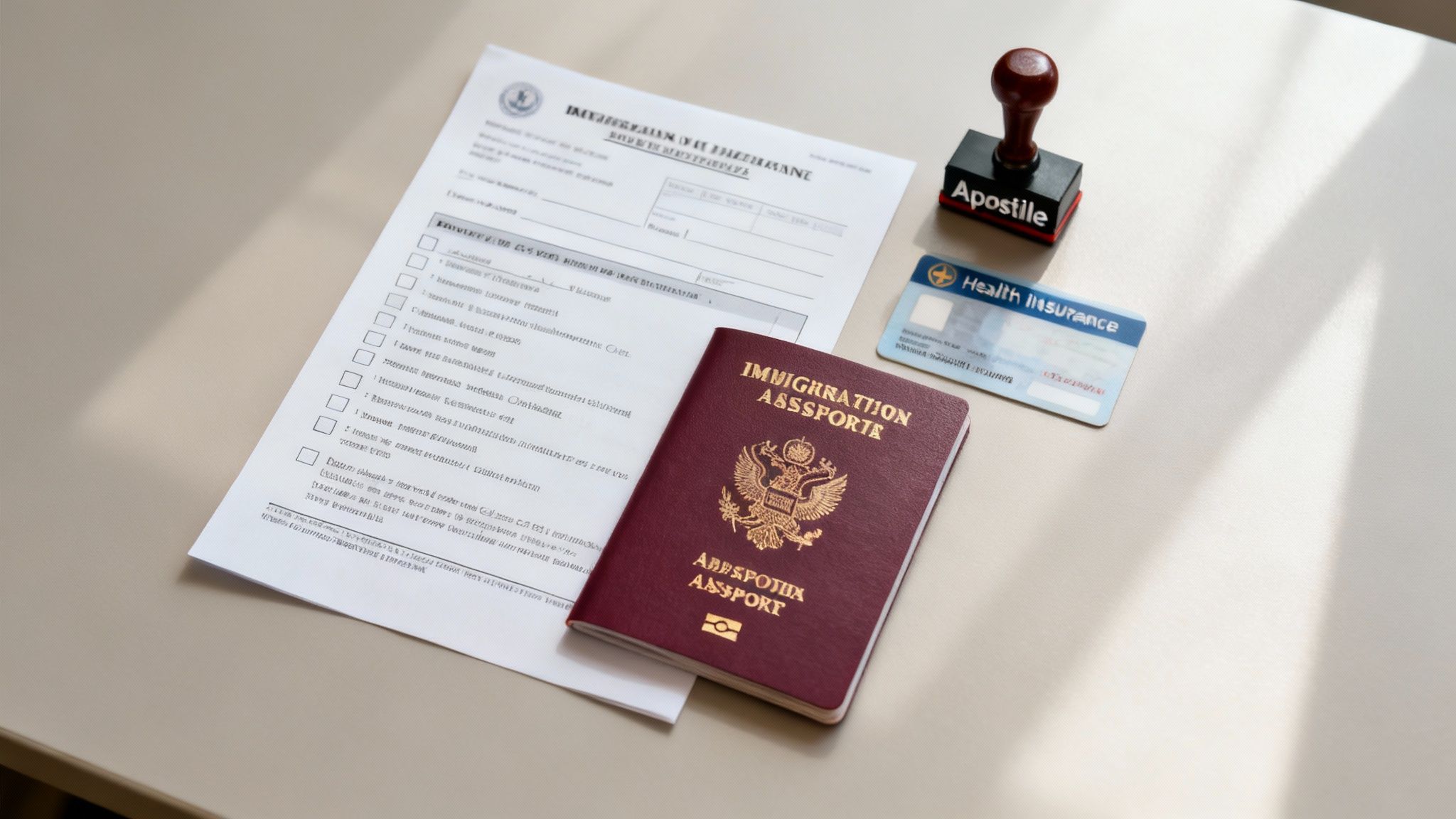
Your Essential Document Checklist
While the specifics will definitely change depending on the country and the exact visa you're applying for, almost every application will require these fundamentals. Think of this as your starting point.
- Valid Passport: This is a no-brainer, but check the details. It needs to be valid for at least a year after your planned entry date and have plenty of blank pages for stamps.
- Proof of Financial Stability: How you show this depends on your visa. It could be bank statements proving you have enough savings, recent pay stubs for a work permit, or official letters confirming your pension income for a visa like Portugal's D7 or Spain's Non-Lucrative Visa.
- Comprehensive Health Insurance: You’ll need a policy that gives you full coverage in your new country for the entire length of your initial visa. Don't skimp here.
- Police Clearance Certificate: Every country wants to see a certified criminal background check from your current country of residence. Sometimes, you'll also need one from any other country where you’ve lived for more than six months.
When you're gathering documents from your home country, remember they often need to be presented in the local language. This is where professional certified translation services for immigration become essential to meet the strict legal standards.
Pro Tip: Don't forget about the apostille. This is a special stamp that authenticates public documents for international use. Things like birth certificates and police records often need one to be considered valid abroad. Always double-check if it's required.
Common Pitfalls That Derail Applications
I’ve seen it time and again: people with strong cases get denied because of simple, preventable mistakes. One of the biggest is miscalculating the financial requirements. If a visa specifies you need €28,800 in annual passive income, showing them €28,500 is an automatic "no." There’s absolutely no wiggle room for being "close enough."
Another classic error is missing a renewal deadline for a temporary permit. For instance, if you let your one-year Spanish Non-Lucrative Visa expire before you apply to renew it, you've just broken your continuous residency. That can mean the five-year clock to permanent residency resets, and you have to start all over again. In this game, being organized and staying ahead of deadlines is everything.
Answering Your Top Questions About European Permanent Residency
As you get closer to making the move, the details can start to feel a bit overwhelming. The path to permanent residency has its share of quirks and non-obvious rules. Let's clear up some of the most common questions that pop up for aspiring European residents.
I Have Permanent Residency in One EU Country. Can I Work in Another?
This is a big one, and it trips a lot of people up. The short answer is no. Your permanent residency is tied specifically to the country that granted it. If you have PR in Portugal, you can live and work indefinitely in Portugal, but you can't just pack up and start a job in Germany.
However, there's another level to this. After living legally in an EU country for five continuous years, you often become eligible to apply for an EU long-term resident permit. This is a different, more powerful status that does give you the right to move, live, and work in other EU member states. Just be aware you'll still need to follow some local procedures in your new host country.
Do I Actually Have to Live There Full-Time?
Yes, for the most part, you do. The "residency" part of permanent residency is taken very seriously. Nearly every country has rules about how long you can be away before your status is revoked.
Key Takeaway: If you're out of the country for more than six to twelve consecutive months, you're often at risk of losing your permanent residency. While some investment visas have more relaxed physical presence requirements, most standard routes demand you genuinely make the country your home.
How Much Does Owning a Home Help My Application?
Even if you’re not on a "golden visa" track, owning a property is a huge plus for your application. One of the universal requirements for any residency permit is proving you have stable accommodation, and nothing says "stable" like a property deed with your name on it.
It's a powerful signal to immigration officials. It shows you're financially secure and, more importantly, that you have a tangible, long-term commitment to the country. A deed carries a lot more weight than a six-month lease, telling them you’re not just passing through—you're planting roots.
Ready to find a property that strengthens your residency application? Residaro offers an extensive selection of homes in Europe's most desirable locations. Start your search and build a solid foundation for your new life.