How to Buy a House in France - A Guide for International Buyers
So, you're dreaming of a place in France—maybe a chic apartment in Paris or a sun-drenched villa in Provence. It's a fantastic goal, but before you dive in, it’s crucial to understand the current lay of the land. The French property market has shifted gears recently, and knowing how to navigate these changes is the key to a successful purchase.
Understanding the French Property Market Today

The first thing to grasp is that the frantic, post-pandemic buying frenzy has cooled off. We're now in a more balanced, cautious market. This isn't a crash, but a return to a more sustainable pace, which is actually great news for buyers like you. It means you'll likely have more breathing room to negotiate and less pressure to make a snap decision.
This shift creates real opportunities, especially for international buyers who know what to look for.
Current Market Dynamics for Buyers
Right now, the market definitely favors the buyer. A couple of key factors are at play here. Higher mortgage rates, though they've come down from their recent peaks, have made some local buyers hesitate. This gives cash buyers or those with pre-approved financing from their home country a real edge.
What does this mean for you on the ground? You’ll find that overpriced properties are sitting on the market longer. Sellers are starting to get more realistic about their asking prices, particularly for homes needing a bit of work or those with poor energy ratings. It’s a prime environment for smart negotiation.
Key Takeaway: The French property market has become more nuanced. While prime locations remain competitive, the overall trend is one of stabilization, favoring well-prepared buyers who can act decisively on fairly priced homes.
The Impact of Energy Efficiency
One of the biggest game-changers in the market right now is the massive focus on energy efficiency. The DPE (Diagnostic de Performance Énergétique), which is the French equivalent of an Energy Performance Certificate, has become a massive factor in a property's value.
Homes with top-tier DPE ratings (A or B) are hot commodities. They sell fast and can even fetch a premium. On the flip side, properties with poor ratings (F or G)—often called passoires thermiques (literally "thermal sieves")—are seeing significant price drops. Buyers are now keenly aware of the renovation costs needed to bring these homes up to standard, and they're using that as a powerful bargaining chip.
This has effectively split the market in two:
- Energy-Efficient Homes: Perfect for buyers who want a move-in-ready property with predictable utility bills.
- Renovation Projects: A fantastic opportunity if you're up for the work. You can often snap up an older home at a steep discount and add significant value.
To give you a clearer picture, I've put together a table summarizing the key market indicators that every international buyer should be watching.
Key French Property Market Indicators for International Buyers
This table breaks down the critical factors shaping the French real estate market right now. Use it to understand where to focus your attention and how to set your budget.
| Market Factor | Current Trend | Implication for Buyers |
|---|---|---|
| Overall Price Growth | Stabilization/Slight Correction | More negotiating power; less competition on overpriced listings. |
| Mortgage Rates | Higher than historic lows | Gives cash buyers and those with international financing an advantage. |
| Energy Efficiency (DPE) | High Importance | Homes with good ratings sell at a premium; poor ratings offer big discounts for renovators. |
| Regional Performance | Highly Variable | Research is key. Some cities are still hot, while many rural areas are cooling. |
| Seller Attitude | More Realistic | Sellers are more open to negotiation than they were 1-2 years ago. |
Understanding these dynamics is your first step. It helps you filter listings and know when you’ve found a real opportunity versus a potential money pit.
Regional Variations and Opportunities
It's a mistake to think of "the French market" as one single entity. The reality is a patchwork of dozens of local markets, each with its own rhythm. Big cities like Bordeaux and Marseille have seen solid growth, while some rural spots are seeing prices adjust downwards.
For example, in regions like Occitanie and Pyrénées-Orientales, fewer people are moving, which has tightened the supply of desirable homes and kept the market competitive. A recent survey from French notaires found that while 58% expect a slight dip in national house prices, the most sought-after areas are holding their value just fine. This regional diversity is a huge plus for international buyers.
If you’re after city life, some urban centers are still fantastic investments. If you dream of the countryside, you might find you have more bargaining power than you expected. To get a feel for one of the most popular destinations, take a look at our deep dive on buying property in the South of France. The bottom line is simple: do your local homework. Aligning your dreams with the on-the-ground reality is how you'll find the perfect French home.
Preparing Your Finances and Legal Team
Before you even start scrolling through listings of charming farmhouses in Provence, there’s some crucial groundwork to do. Getting your financial and legal house in order from the get-go is the single most important thing you can do. It's not as exciting as viewing properties, I know, but trust me, it’s what allows you to act decisively and with confidence when you finally find the one.
The very first step? Figure out your total budget. And I don't just mean the asking price on a property listing. You need a rock-solid understanding of every single cost involved to avoid any nasty surprises later.
Building Your Comprehensive Budget
Think of your budget as two distinct buckets: the upfront costs to actually get the keys, and the ongoing costs of owning the place. The purchase price is just the starting line.
A major part of your acquisition costs will be the frais de notaire, or notary fees. For older homes, these fees typically run between 7-8% of the property price. That number covers all the legal work, land registration taxes, and the notaire's fee. So, for a €300,000 property, you're looking at an extra €21,000 to €24,000 on top. It’s a significant sum you need to plan for.
But it doesn't stop there. Your budget should also account for:
- Real Estate Agent Fees: While usually paid by the seller, the structure can vary. These can range from 3-10% of the sale price.
- Currency Exchange Costs: You'll be moving a lot of money across borders. This means dealing with transfer fees and the whims of fluctuating exchange rates.
- Potential Renovation Costs: Be realistic. If you're eyeing an older property with a poor energy rating (DPE), you’ll need a fund for essential upgrades.
Pro Tip: One of the smartest things you can do early on is open a multi-currency account with a service like Wise or Revolut. It can save you a small fortune on transfer fees and gives you more control over the exchange rate when it's time to send your deposit and final payment.
Securing Financing as an International Buyer
Many international buyers come to the table with cash, which makes the whole process much simpler. That said, getting a French mortgage is absolutely possible, but be prepared for a higher level of scrutiny as a non-resident. French banks are notoriously cautious.
They'll almost always require a larger down payment, the apport personnel, from foreign buyers. You should be ready to put down at least 20-30% of the property’s value, sometimes even more. Lenders will also want to see a full dossier proving stable income, a healthy debt-to-income ratio, and will likely require you to take out life insurance to cover the loan.
The application itself can be a marathon, not a sprint. My advice is to start talking to French mortgage brokers who specialize in non-resident lending long before you seriously start your property search. It gives you a clear picture of your true borrowing power and makes any offer you make that much stronger.
Assembling Your Professional Team
You can't navigate the French property system alone; you need a team of trusted professionals in your corner. The two key players are the real estate agent and the notaire, and it’s critical to understand their distinct roles.
The agent immobilier (real estate agent) is your person on the ground, finding properties and helping you negotiate the price. They are invaluable, but remember, their commission is typically paid by the seller.
The notaire, on the other hand, is a government-appointed legal professional who acts as a neutral third party. Their job is to ensure the entire transaction is legally watertight, from doing title searches to drafting the final deed of sale, the Acte de Vente. While a single notaire can represent both the buyer and seller, you have every right to appoint your own, and it doesn't cost you any extra.
For more complex purchases or just for added peace of mind, many buyers also bring in their own lawyer, or avocat. A notaire ensures the process follows the letter of the law, but an avocat is there to advise you and advocate exclusively for your interests. You can learn more about when you might need an international real estate lawyer to see if it makes sense for your situation.
With a solid financial plan and the right experts by your side, you're truly ready to make your dream of owning a home in France a reality.
Finding Your Perfect French Home
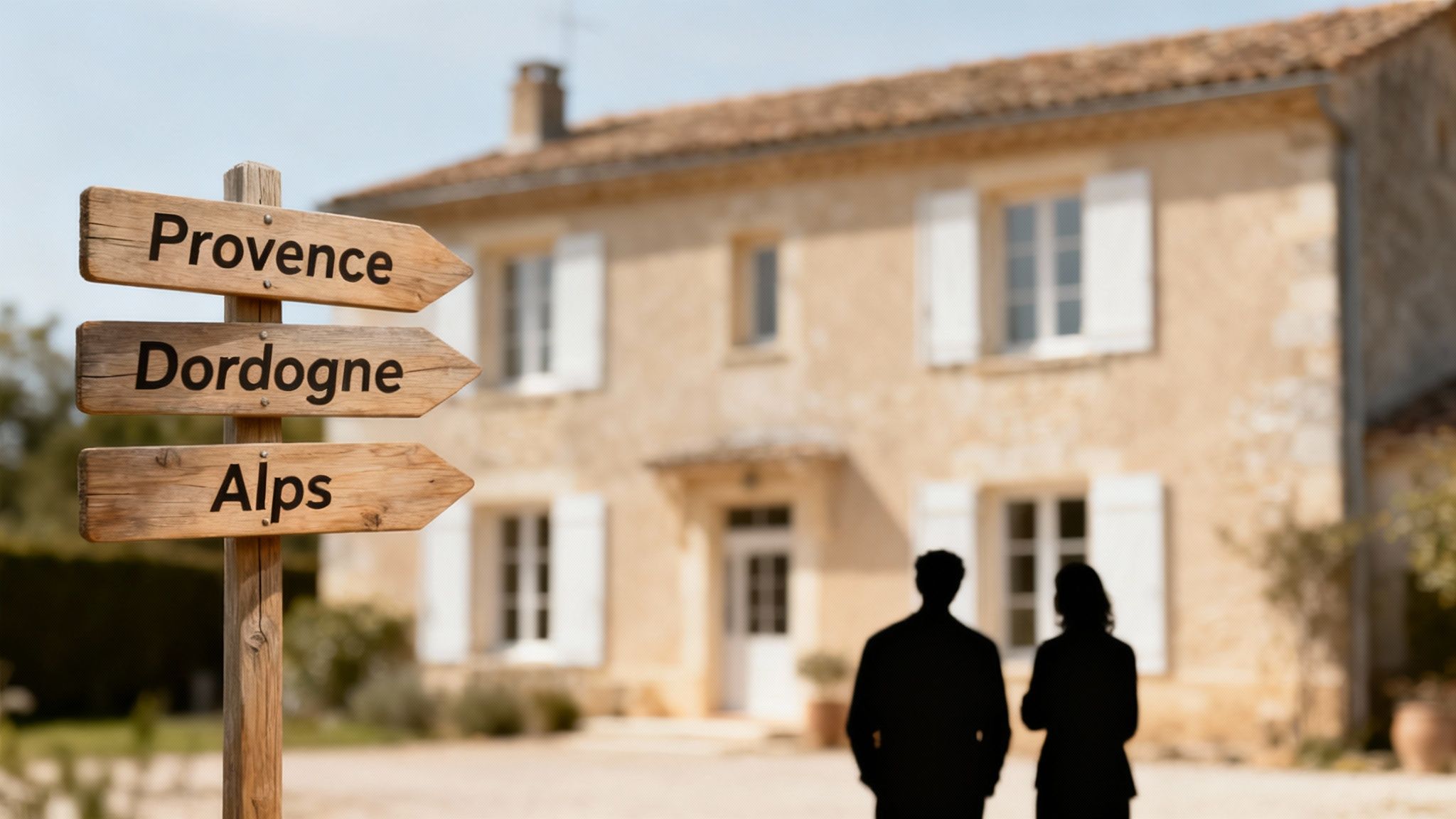
Now for the fun part. With your finances sorted, you can finally start imagining yourself in that modern villa on the Côte d'Azur or the charming country house you've been dreaming of in the Dordogne. This is where the hunt truly begins.
But turning that dream into a reality requires more than just scrolling through pretty pictures. You need a strategy. It's time to move beyond vague ideas and get really specific about what you need versus what would just be nice to have. A well-defined checklist will be your best friend.
Defining Your Must-Haves and Nice-to-Haves
Grab a piece of paper or open a new document and create two columns. In the first, list your absolute non-negotiables. These are the deal-breakers, the things a property must have for you to even consider it.
For instance, your "must-have" list might look something like this:
- At least three bedrooms for visiting family and friends.
- A reliable high-speed internet connection (critical if you're working remotely).
- Walking distance to a local boulangerie for that essential daily croissant.
- A garden or some kind of outdoor space.
Next, in the second column, list your "nice-to-haves." These are the features you'd love but could compromise on if the perfect property came along. Think a swimming pool, a dedicated home office, or a view of a particular landmark. This simple exercise forces you to focus, saving you from wasting countless hours on unsuitable listings.
A clear list of priorities is your best defence against making an emotional decision you might regret later. It keeps your search grounded and empowers you to quickly filter through dozens of listings on platforms like Residaro, focusing only on the homes that genuinely fit your life.
Navigating the Search with Residaro
The French property market can be a bit of a maze. It’s famously fragmented, lacking a single, centralized system like the Multiple Listing Service (MLS) you might be used to in the US. This is exactly where a platform like Residaro becomes invaluable, pulling together extensive listings from all over the country into one place.
You can filter your search by region, property type, and key features, making it easy to explore everything from the Alps to sunny Provence. As you browse, train your eye to look for the important details: the DPE (energy performance rating), the taxe foncière (annual property tax), and high-quality photos that give you a real sense of the space.
Choosing the Right French Region for You
France’s incredible diversity is one of its biggest draws, but it also means you have a big decision to make. The region you choose will shape your entire experience, so it’s worth spending time thinking about the kind of lifestyle you’re truly after.
I've seen buyers thrive in completely different environments, from the sun-drenched fields of Provence to the bustling streets of Paris. To help you get started, here's a quick look at some of the most popular areas.
Comparing Popular French Regions for Property Buyers
This table offers a snapshot of what to expect in different parts of France, helping you narrow down the area that best aligns with your budget and lifestyle goals.
| Region | Typical Property Types | Average Price Range (€/m²) | Best For |
|---|---|---|---|
| Provence | Farmhouses (Mas), villas, village houses | €3,000 - €7,000 | Sunshine, vibrant markets, and a relaxed lifestyle. |
| Dordogne | Stone country houses (Périgourdine), châteaux | €1,500 - €3,500 | History buffs, nature lovers, and rural tranquility. |
| The French Alps | Chalets, modern apartments | €4,000 - €10,000+ | Outdoor enthusiasts, skiing, and mountain life. |
| Paris | Haussmannian apartments, modern flats | €9,000 - €20,000+ | Culture, gastronomy, and the energy of a global city. |
Each region offers a unique slice of French life. Take your time, do some research, and maybe even plan a visit to get a real feel for the places that catch your eye.
The outlook for 2026 remains strong for international buyers, partly thanks to favorable tax policies and a relatively weak euro. Some forecasts show significant growth in key areas; Nice, for example, is projected to see up to 23.4% national growth by 2029, driven by foreign investment and new infrastructure. If you want to dive deeper, you can explore detailed forecasts on the 2026 French real estate market.
Finally, don't underestimate the value of a great local agent. They have on-the-ground knowledge and access to listings you'll never find online. For some tips on finding the right person, check out our guide on how to choose a real estate agent. With a clear vision and the right tools, you’re ready to find that perfect corner of France to call your own.
From Your Offer to Getting the Keys: Navigating the French Purchase Process
So, you’ve found a home that captures your heart. Fantastic! Now the real work begins—the process of actually making it yours.
The French property buying journey is incredibly structured and offers robust legal protection for buyers. But if you're used to a faster, more informal system, its formal, multi-step nature can feel a bit different. Think of it less like a quick negotiation and more like a carefully choreographed legal dance. Every stage is designed for clarity and legal certainty, with a key professional—the notaire—acting as an impartial referee for the whole transaction. Getting your head around this process is the secret to a smooth purchase.
Making the Initial Offer (Offre d'Achat)
Your first move is to put your offer in writing. This is known as the offre d'achat, and it's much more than a casual agreement—it's a legally significant document. Your offer must clearly state the price you're proposing and, crucially, any conditions you want to include. These are your clauses suspensives.
Think of these conditional clauses as your safety net. They give you a legal exit from the purchase without penalty if specific conditions aren't met. The most common ones are:
- Securing a Mortgage: The sale is conditional on you obtaining financing for a certain amount at a maximum interest rate.
- Property Survey Results: The purchase depends on a satisfactory structural survey, which is especially wise for older, rural properties.
- Planning Permission: If you plan on adding a swimming pool or building an extension, this is an essential clause to include.
Once the seller accepts and countersigns your offre d'achat, you've formed a binding agreement. It’s a serious step, which is why it's so important to have your conditions clearly defined from the very beginning.
The Compromis de Vente: Your First Key Contract
After your offer is accepted, you’ll move on to the next major milestone: signing the Compromis de Vente. This is the preliminary sales contract, and it’s far more detailed than your initial offer. A notaire usually drafts it, and it legally binds both you and the seller to the deal, pending the fulfillment of those all-important conditional clauses.
At this stage, you'll need to pay your deposit, or dépôt de garantie. This is typically 5-10% of the purchase price. Don't worry, this money doesn't go straight to the seller. It’s held safely in an escrow account managed by the notaire until the final closing day.
Once the Compromis de Vente is signed by all parties, you, the buyer, get a 10-day cooling-off period (délai de rétractation). During these ten days, you can walk away from the purchase for any reason at all without losing your deposit. The seller, on the other hand, doesn't get this luxury—they are locked in.
The Notaire's Role and the Due Diligence Phase
With the Compromis signed, the notaire's work really kicks into high gear. This is the due diligence phase, and it generally takes around three months to complete. Remember, the notaire is a government-appointed official who represents the state, ensuring every legal box is ticked for both you and the seller.
Their to-do list during this period is pretty extensive:
- Title Search: They meticulously verify that the seller has the legal right to sell the property and check for any liens or claims against it.
- Reviewing Diagnostics: They ensure the seller has provided the complete file of mandatory property surveys, known as the Dossier de Diagnostic Technique (DDT).
- Land Registry Checks: They contact the local planning department (mairie) to check for things like public rights of way or zoning restrictions that could impact your plans for the property.
While a single notaire can handle the transaction for everyone, you are perfectly entitled to appoint your own notaire at no extra cost. This can provide added peace of mind, as they will be there specifically to answer your questions and review documents from your perspective.
The Acte de Vente: Signing Day and Getting the Keys!
The grand finale is signing the Acte de Vente, also called the Acte Authentique. This is the final deed of sale, and the signing takes place at the notaire’s office. Before this can happen, all the conditional clauses from the Compromis de Vente must have been satisfied.
Just before this meeting, you’ll transfer the remaining balance of the purchase price, plus the notaire's fees and taxes, into their escrow account. On the day, the notaire will read the entire deed aloud to everyone present. Once you and the seller sign on the dotted line, the transaction is officially complete. The notaire registers the sale, releases the funds to the seller, and hands you the keys.
Congratulations—you now own a home in France
Budgeting for Taxes, Fees, and Other Costs
When you're buying a property in France, the price you see on the listing is just the starting point. It’s a common rookie mistake to focus solely on that number, but doing so can lead to some serious financial headaches down the road. A smart buyer knows to budget for all the associated costs, from taxes to fees, to get a true picture of the total investment.
The good news? Most of these costs are predictable. With a bit of planning, you can map out your finances accurately and avoid any last-minute surprises.
Deconstructing the Notaire Fees
The biggest single cost you'll face, besides the house itself, is the frais de notaire—the notary fees. This is often misunderstood by international buyers. It's not just a payment for the notaire's time; it’s actually a bundle of taxes and costs that the notaire collects on behalf of the French state.
For most transactions involving older properties, expect these fees to be around 7-8% of the purchase price. So, on a €400,000 home, you’ll need to set aside an extra €28,000 to €32,000. It's a significant chunk of change.
So what's actually inside that 7-8%?
- Property Registration Taxes: This is the lion's share, making up roughly 5.8% of the property's value. Think of it as the government's tax for transferring ownership into your name.
- Notaire's Remuneration (Émoluments): This is what the notaire actually earns for their legal work. The amount is fixed by the state on a sliding scale, so it's not arbitrary.
- Administrative Costs: A smaller portion that covers miscellaneous expenses like land registry searches and other official paperwork.
Key Insight: Don't bother trying to negotiate the frais de notaire. The bulk of it is fixed government tax. A useful tip, however, is that you can hire your own notaire to work alongside the seller's at no extra cost. The single fee is simply split between them, giving you your own trusted advisor in the process.
Factoring in Other Transaction Costs
The notaire's fees are the big one, but a few other expenses need to be on your radar. They might seem small on their own, but they can add up.
First, there's the real estate agent's commission. In France, this can be anywhere from 3-10% of the price. Often, it's already baked into the advertised price, which you'll see noted as frais d'agence inclus (FAI). Always get clarity on this—is the agent's fee included or will it be added on top?
As an international buyer, you also have to think about moving money across borders. Currency exchange fees can take a surprisingly large bite out of your budget. I always advise clients to skip their high-street bank and use a specialist currency transfer service instead. The difference can easily save you thousands.
Finally, there's the property survey. The seller provides a standard set of diagnostic reports called the Dossier de Diagnostic Technique, but this is not a full structural survey. If you're buying an older property (which many dream homes in France are), budgeting €500-€1,500 for an independent building surveyor is one of the smartest investments you can make.
Planning for Ongoing Ownership Taxes
Your financial planning doesn’t end when the sale is complete. Owning property in France comes with annual tax responsibilities.
There are two main taxes you'll need to account for every year:
- Taxe Foncière: This is the land tax. Every property owner pays it, whether you live there full-time, part-time, or rent it out. The amount varies widely based on the property's location and size.
- Taxe d'Habitation: This is a residence tax. While it's been eliminated for primary residences, it's still very much in effect for second homes.
Budgeting for these ongoing costs is just as important as budgeting for the purchase itself. In a market where cities like Lyon and Marseille have seen property price growth of 18.3% and 22.3% respectively from 2024-2026, understanding your total cost of ownership is key to making a sound investment. To get a better feel for the market, you can explore the latest French house price data on Trading Economics.
Ultimately, creating a complete financial picture from day one is the secret to a smooth, successful, and genuinely enjoyable experience of buying your home in France.
Common Questions from International Buyers
Diving into the French property market for the first time? It's completely normal to have a long list of questions. You’re not just learning about real estate—you’re navigating a whole new legal system and getting a feel for local customs. Let's tackle some of the most common queries we hear from international buyers to help you feel more confident.
Can I Buy a House in France as a Non-Resident?
Yes, absolutely. France is remarkably open to foreign buyers, which is a huge part of its appeal. Whether you’re an EU citizen or you're coming from the US, UK, Canada, or elsewhere, there are no legal roadblocks to owning property. You’ll have the exact same property rights as a French citizen.
The real differences pop up in the practical side of things, especially when it comes to money. If you're planning to get a French mortgage, be prepared for the bank to take a very close look at your application. They'll need a mountain of paperwork, including solid proof of your income and a detailed credit history from back home.
A quick tip to make your life easier down the road: open a French bank account early in the process. While you don't technically need one to buy the house, it becomes indispensable for paying utility bills, local taxes, and managing day-to-day expenses once you're the owner.
What Is a Notaire and Do I Need My Own Lawyer?
The notaire is the gatekeeper of every property deal in France. Think of them as a government-appointed legal official whose job is to be a neutral third party. They ensure the entire transaction is above board, legally sound, and that all the necessary taxes get paid. They're the ones who do the title searches, draft the official contracts, and formally register you as the new owner.
Because the notaire represents both the buyer and the seller, their main focus is the legality of the sale, not fighting for your personal interests. For a simple, straightforward purchase, their services are usually all you need.
However, if your purchase is a bit more complicated—maybe it involves tricky inheritance laws or you're planning a massive renovation—it can be a smart move to hire your own lawyer, called an avocat. An avocat works only for you, giving you an extra layer of protection and personalized advice.
Expert Insight: You can actually appoint your own notaire to work with the seller's, and the best part is it doesn't cost you a penny extra. The standard fee is simply split between the two offices. This gives you a dedicated professional looking out for your side of the deal, which is incredibly reassuring for an international buyer.
How Much Deposit Will I Need to Buy a Property?
When you're ready to sign the initial sales contract, the Compromis de Vente, you'll need to pay a deposit, or dépôt de garantie. This is typically between 5-10% of the purchase price. Crucially, this money doesn't go to the seller; it's held safely in an escrow account managed by the notaire until the sale is final.
Now, if you're a non-resident applying for a mortgage, the bank's expectations will be higher. French lenders want to see that you have significant skin in the game, what they call an apport personnel. You should plan on putting down at least 20-30% of the property’s value yourself. Keep in mind, this is separate from the money you'll need for the notaire's fees and other closing costs.
What Are the Mandatory Property Surveys?
In France, the seller is legally required to hand over a hefty file of diagnostic reports called the Dossier de Diagnostic Technique (DDT). This file is your first look under the hood of the property, and it's essential for your due diligence.
The DDT is made up of several key reports:
- Presence of asbestos, lead, and termites: Absolutely critical checks, especially for older buildings.
- Energy Performance (DPE): This grades the home's energy efficiency and can seriously impact its value and your future utility bills.
- Gas and electrical systems: A review of the safety and compliance of these installations.
- Natural risks: This report flags potential issues like flooding or seismic activity in the region.
While the DDT gives you a good overview, it is not a full structural survey. If you're buying an older home or have even the slightest concern about the building's integrity, hiring an independent building surveyor is money very well spent.
Ready to turn your French property dream into a reality? At Residaro, we simplify the search by bringing you an extensive collection of beautiful homes across France, from charming country houses to modern villas. Start exploring our listings today and find your perfect place in Europe. Discover your dream home at https://residaro.com.