How to Assess Property Value - A Practical Guide for European Buyers
Figuring out what a property is really worth is part art, part science. It’s a mix of hard data, the property's physical state, and some key financial calculations. The most solid way to do this? A three-part strategy: look at similar properties that have recently sold, calculate the potential rental income, and estimate what it would cost to build it again from the ground up. This approach keeps your valuation firmly planted in reality, not just wishful thinking.
Building Your Valuation Foundation

Before you even think about crunching numbers or scrolling through listings, you need to get your groundwork right. Consider this your pre-valuation checklist. Getting this part right ensures every step that follows is built on a solid, accurate base. It’s how you’ll sidestep the common mistakes that trip up so many international buyers trying to assess property value.
This prep work is all about understanding the basic principles and getting your hands on the right paperwork. A property's true value isn't just a single number—it's a conclusion you reach after looking at it from several different angles.
The Three Core Valuation Methods
A truly reliable valuation isn't based on a single method. If you only look at one piece of the puzzle, you'll get a skewed view. By combining three distinct approaches, you get a much clearer, more dependable estimate of what a property is actually worth.
- Sales Comparison Approach: This is the go-to method for most residential properties. You simply find recently sold properties (known as "comparables" or "comps") that are as similar as possible to the one you're looking at. This method is powerful because it's based on what real buyers have actually paid for similar homes in that specific market.
- Income Approach: If you're buying as an investment, this is non-negotiable. This approach values the property based on its ability to make you money. You'll analyze local rental rates, factor in potential vacancies, and subtract operating expenses to see how it performs financially.
- Cost Approach: This method answers the question: "What would it cost to build this exact property again today?" You calculate the cost of a similar new building, add the value of the land, and then subtract depreciation for the existing property's age and condition. It's especially handy for new builds or unique properties without many direct comps.
Gathering Your Essential Documents
Your valuation is only as strong as the information you feed into it. To properly analyze a property, you have to collect the key legal and planning documents first. This isn't just busywork; it's a critical part of your research that lays the foundation for an accurate assessment.
For instance, if you're looking in Spain, you'll absolutely need the Nota Simple from the Land Registry (Registro de la Propiedad) to confirm who owns it and check for any debts or liens. In Italy, the Visura Catastale is essential for understanding tax and zoning details. These documents often contain crucial information that can directly impact a property's value.
A property's legal status is just as important as its physical condition. Finding out about a zoning restriction or an unpaid debt early in the process can save you from a massive headache and completely change your valuation.
This foundational research is a core part of proper due diligence. For a much deeper look at the specific paperwork you'll need across different markets, our comprehensive real estate due diligence checklist is a great guide for international buyers.
Once you have these fundamentals sorted, you'll be ready to start analyzing market data with real confidence.
Mastering the Sales Comparison Approach
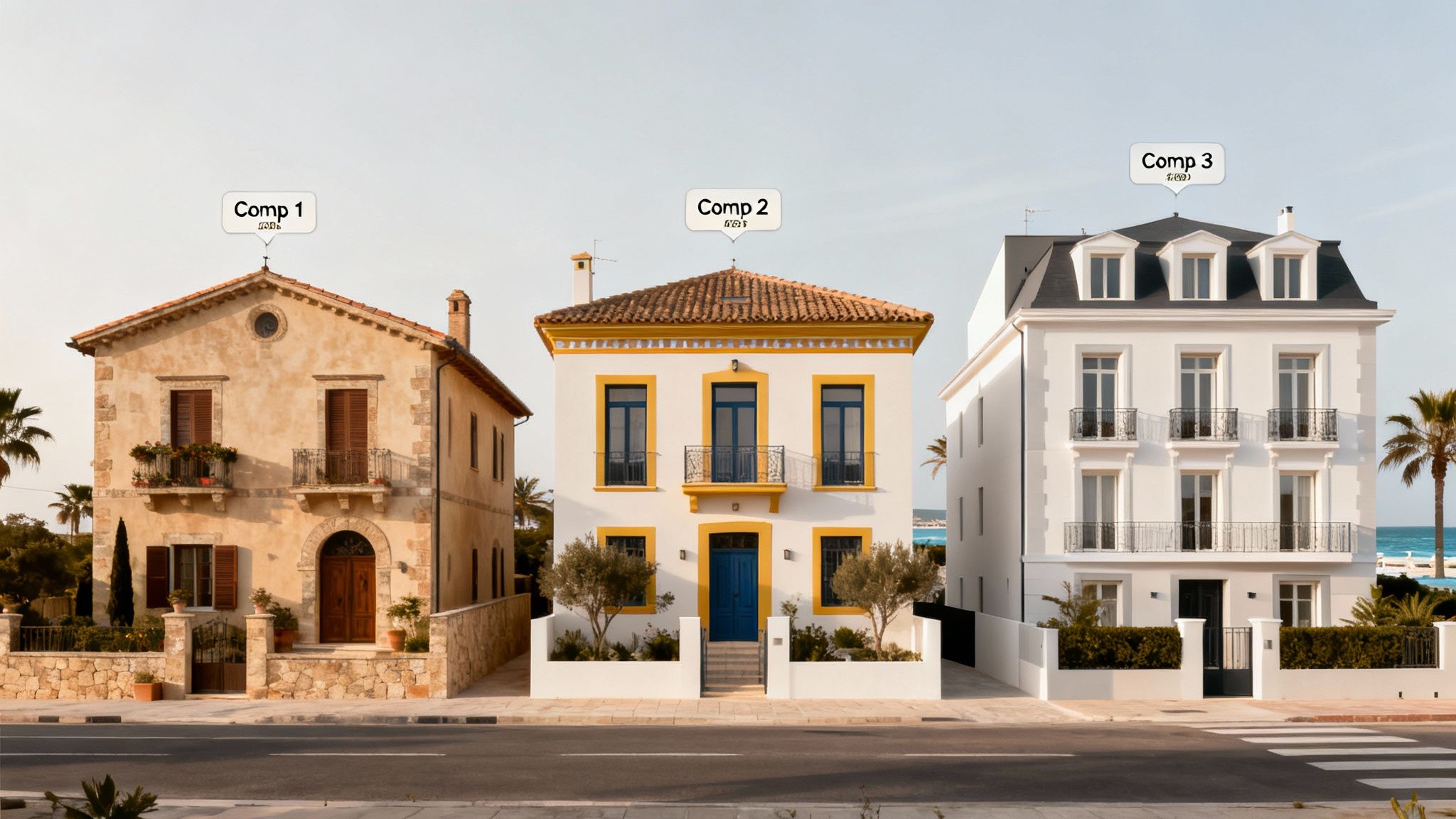 Okay, this is where the real detective work begins. While other valuation methods have their place, the sales comparison approach is often the most direct and reliable way to figure out what a home is really worth.
The idea is simple but powerful: a property’s value is directly tied to what similar properties have recently sold for. This hands-on technique means digging in, finding "comparables" (or "comps"), and analyzing what buyers in that specific market were actually willing to pay. It’s your chance to look past wishful asking prices and get to the hard facts.
Finding Your Key Comparables
First things first, you need to identify the right properties for your analysis. Your goal is to find at least three to five recently sold homes that are as similar as possible to the one you're eyeing. The more recent the sale, the better—it’s a snapshot of the current market mood. I always try to stick to sales within the last three to six months.
When you're searching on platforms like Residaro or local real estate portals, start with these filters:
- Location: Stick to the same neighborhood. For rural properties, a few kilometers is a good radius. A property on the other side of town is not a true comparable, period.
- Property Type: Don't compare a historic farmhouse in Tuscany to a modern new-build, even if they're neighbors. You need to match apples to apples—villa to villa, apartment to apartment.
- Size: Look for homes with a similar number of bedrooms, bathrooms, and overall square footage, typically within a 10-15% range.
A word of caution: Don't fall into the trap of using active listings as your primary comps. Asking prices are what sellers hope to get, not what the market has proven it will pay. Always, always prioritize sold properties for the most accurate data.
This approach has been a cornerstone of real estate appraisal for decades. In major European markets like Spain and France, appraisers access detailed data from platforms similar to the MLS, which can provide 75 to 200 data points per sale. This allows for incredibly transparent comparisons. For instance, in Italy, recent sales of comparable apartments in Tuscany might average €3,200 per square meter. But a specific feature, like a panoramic view or a fresh renovation, can easily swing the final value by 15-20%. If you want to dive deeper, you can find more on property valuation methods and their applications from industry experts.
Making Smart Adjustments
No two properties are identical. This is where you move from simple comparison to true analysis by adjusting the value of your comps to account for any differences. You'll need to assign a realistic monetary value to features that differ between your target property and each comparable.
Let's say you’re looking at a three-bedroom villa in the Algarve, Portugal. You find a similar villa that sold nearby last month, but it has a swimming pool and your target property doesn't. You can't just ignore that. You have to subtract the value of that pool from the comp’s sale price to make it a fair comparison.
This table gives you a practical checklist for how to think about these adjustments.
Comparable Property Adjustment Checklist
Use this checklist to see how key features affect a property's value when comparing it to your target home.
| Feature | Example Adjustment | Why It Matters |
|---|---|---|
| Condition | Comp has a brand-new kitchen; yours is dated. Subtract the estimated value of the renovation from the comp's price. | A modern, updated home will always sell for more. The cost to renovate must be factored in. |
| Location | Comp is on a quiet cul-de-sac; yours is on a busier road. Adjust the comp’s value downwards. | "Location, location, location" isn't a cliché. Proximity to noise, views, and amenities significantly impacts price. |
| Size | Comp is 20 sq. meters larger. Calculate the average price per square meter and adjust accordingly. | Size is a primary value driver, but don't just multiply. The value per square meter often decreases slightly as properties get larger. |
| Amenities | Comp has a private garage; yours only has street parking. Subtract the local value of a garage. | Features like pools, garages, and large gardens add tangible value that must be accounted for. |
Making these adjustments is part art, part science, but getting it right is what separates a guess from an informed valuation.
Looking Beyond the Obvious
Once you’ve adjusted your comps, you'll have an estimated value range for your target property. But a truly great valuation considers the qualitative factors and local nuances that numbers alone can't capture.
Think about a historic designation in a French village—this adds immense charm and value but also comes with strict renovation rules. Or consider the massive premium paid for a direct sea view on Spain's Costa del Sol. This isn't just about the property itself; it’s about the lifestyle and experience it offers.
By building a data-backed case that also weaves in these unique European market factors, you can assess property value with far greater confidence.
Looking at a Property Through an Investor's Lens
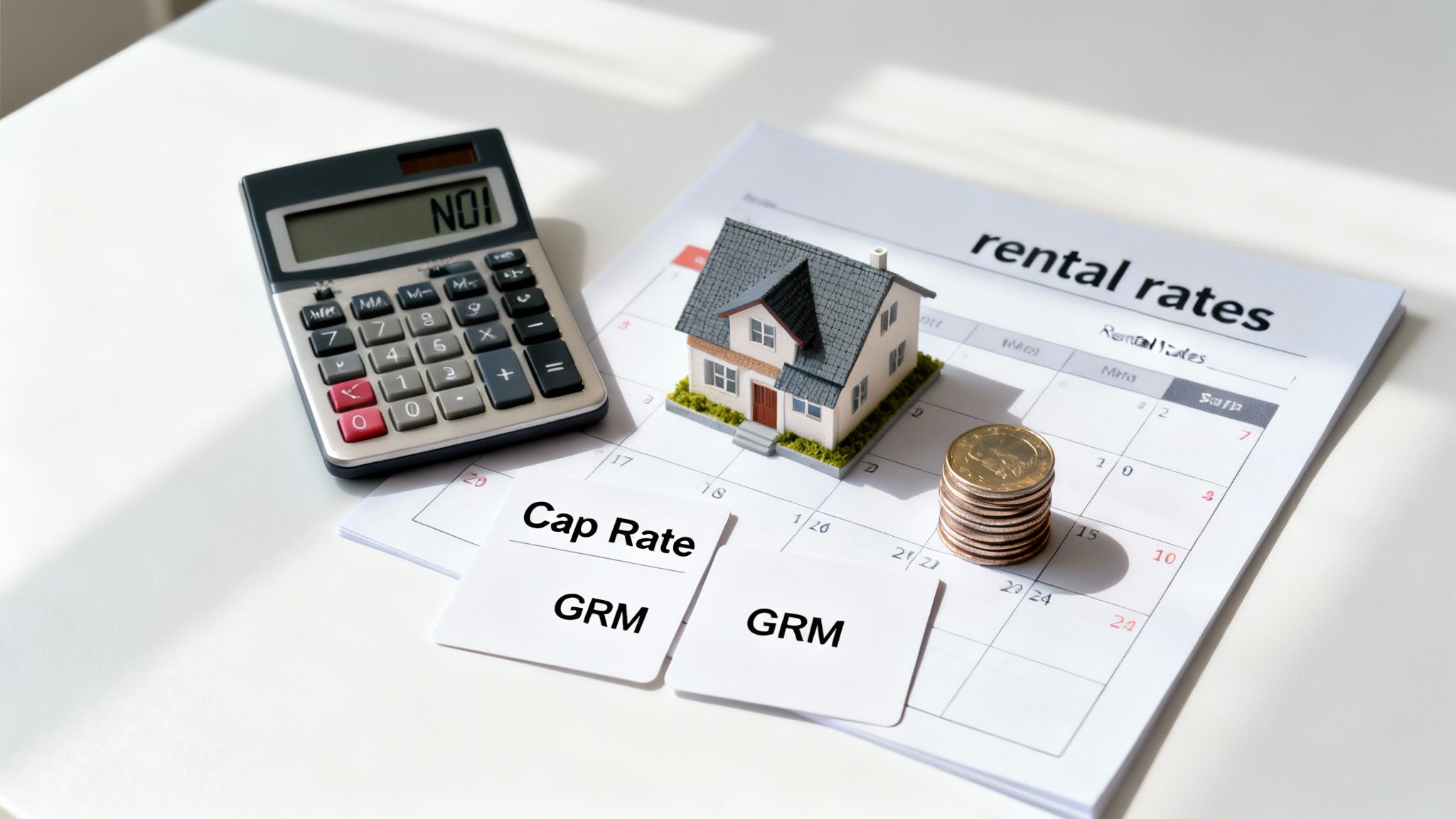
When you're buying a property as an investment, the rules of the game change entirely. Forget what you'd pay to live there yourself. The real question is: how much money can this property make?
This is where the income approach to valuation comes in. It treats the property less like a home and more like a small business. Its value is tied directly to its profitability. Whether you're eyeing a chic apartment in Lisbon or a sprawling villa in Provence, thinking like an investor means focusing on the numbers.
Getting a Grip on the Key Metrics
Before you can crunch any numbers, you need to speak the language of property investment. These terms might seem technical, but they're just tools for measuring a property's financial health.
- Net Operating Income (NOI): This is your property's pure profit before you pay the mortgage. It’s all the income it generates in a year (from rent and other sources) minus all the necessary operating expenses—things like taxes, insurance, and maintenance.
- Capitalization Rate (Cap Rate): Think of this as a way to quickly compare the bang for your buck on different properties. You calculate it by dividing the NOI by the property's market price. A higher cap rate often signals a better return, but it can sometimes point to higher risk, too.
- Gross Rent Multiplier (GRM): This is more of a quick, back-of-the-napkin calculation. Just divide the property's price by its gross annual rent. It gives you a rough idea of how many years of rent it would take to pay off the property, not accounting for any expenses.
These three metrics are the foundation for building a clear, data-driven picture of a property's potential.
How to Calculate Your Net Operating Income
Your first real task is to figure out a realistic Net Operating Income (NOI). This is about more than just looking at the potential rent; it requires a hard, honest look at the real costs of owning the place.
Start by researching what similar properties are actually renting for. Don't just take the seller's word for it. Check current listings and, if you can, talk to local property managers to get a feel for the real market rate.
Next, you have to account for vacancies. No property stays rented 100% of the time. For a seasonal vacation spot like Spain's Costa del Sol, building in a 10-15% vacancy rate is a smart, conservative move to account for off-season quiet periods and tenant turnover.
Now, subtract all your operating expenses from that potential income. This is a critical step. Your list should include:
- Property taxes and insurance
- Utilities (if you're responsible for them)
- Routine maintenance and repairs
- Property management fees
- Any condo, community, or homeowners' association fees
Be brutally honest with your expense estimates. Underestimating costs is the single most common trap for new investors. It can completely sink your projections. I always recommend adding a small buffer for those unexpected "the-boiler-just-died" moments.
Once you subtract these costs from your gross income, you have your NOI. This is the number that truly matters—it's the property's actual earning power. For a more detailed walkthrough, our guide on how to calculate rental yield breaks it down even further.
Using the Cap Rate to Find the Property's Value
With your NOI calculated, you can now use the cap rate to work backward and determine a logical purchase price. The formula itself is straightforward: Property Value = NOI / Cap Rate.
The real skill is finding the right cap rate for the local market. Cap rates vary wildly depending on location, property type, and perceived risk. A prime apartment in a stable, established market like Vienna might trade at a low 3-4% cap rate. In contrast, a property in a developing or more volatile area could have a cap rate closer to 7-8% to compensate for the added risk.
Let's put it into practice. In France's Provence region, rental yields for villas have recently averaged around 4.5%. If a villa there generates €45,000 in NOI per year, and the going cap rate for similar properties is 5%, its value based on the income approach would be €900,000 (€45,000 / 0.05).
It’s also interesting to see how this plays out with taxes. Across Europe, income-based property taxes often use official rental values. According to OECD data, in 60% of 172 countries surveyed, these tax revaluations can lag behind actual market prices by two to five years, which can sometimes skew official assessments.
By leaning on these investment metrics, you can confidently evaluate a property based not on curb appeal or emotion, but on what it's really worth: its ability to generate cold, hard cash.
Accounting for Condition and Renovation Costs
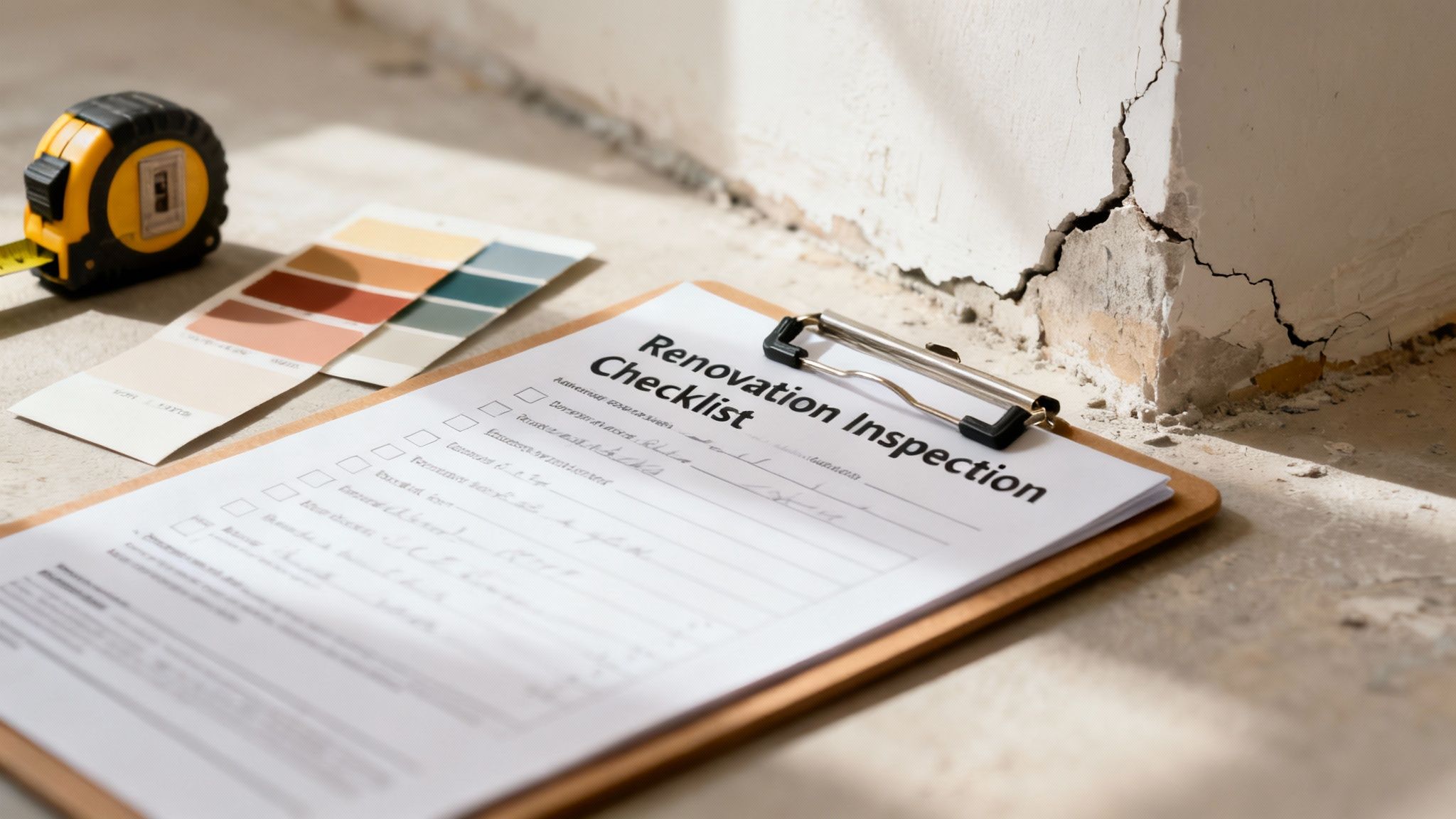
The asking price is just the starting point. A property's true value isn't just about what you see on the surface; it's also about what you don't see. Getting a real sense of what a home is worth means looking past the fresh paint and staging to understand its physical health and the potential costs hiding just out of sight.
This is all about building a complete picture of your total investment. It’s about spotting the warning signs during a viewing, realistically estimating what renovations will cost, and getting a handle on the day-to-day expenses of owning the place. Only then can you know if the price tag truly matches the property's value—and your budget.
Spotting Red Flags During a Viewing
When you walk through a property, you need to train your eyes to see beyond the curb appeal. The most expensive problems often leave the most subtle clues, and they're easy to miss if you're just focused on the layout or the pretty view. Think of yourself as a detective on the hunt for issues.
Keep a sharp lookout for these potential deal-breakers or major budget-eaters:
- Signs of Water Damage: Don't ignore dark stains on ceilings, a persistent musty smell, or paint that’s bubbling and peeling, especially around windows and in basements. Water is a home’s number one enemy.
- Foundation and Structural Issues: Large, jagged cracks in the exterior walls, floors that feel bouncy or sloped, and doors that stick in their frames can all point to serious foundation problems. And that means serious money to fix.
- Outdated Systems: Take a peek at the electrical panel, the plumbing under the sinks, and the heating system. If they look ancient, they probably are. Upgrading these core systems can easily run into the tens of thousands of Euros.
A viewing is your first and best line of defense against hidden costs. If something feels off, even if you can't quite put your finger on why, it’s worth digging deeper. Trust your gut and don't be shy about asking direct questions.
For a more thorough investigation, it's always smart to call in a professional. Understanding what is a property survey and investing in one will give you a detailed health report on the building, which is powerful ammunition when it comes time to negotiate.
Estimating Renovation and Repair Costs
Even a place in pristine condition might need work to match your style. Whether you're dreaming of a full-scale renovation for that French country house or just a simple kitchen update in a Spanish villa, you absolutely must factor those costs into your valuation.
Start by making a list of the projects you want to tackle, from must-haves to nice-to-haves. For each one, reach out and get at least two or three quotes from local contractors. This is critical when you're buying abroad, as labor and material costs can be completely different from what you're used to. For instance, a full kitchen renovation in Italy might cost anywhere from €10,000-€25,000, while adding a swimming pool in Portugal could set you back €20,000 to €40,000 or more.
And whatever you do, don't forget a contingency fund. Setting aside an extra 15-20% of your total renovation budget is a wise move. It's your safety net for those "surprise!" moments that inevitably pop up. Subtracting all these estimated costs from the property's market value gives you a much clearer idea of what it’s actually worth to you.
Understanding Ongoing Ownership Costs in Europe
Your financial commitment doesn't stop once you have the keys. A huge part of assessing a property's value is looking ahead at the recurring expenses that come with owning it. These can vary wildly from one European country to the next.
Here are the main ongoing costs to research and bake into your long-term budget:
- Property Taxes (Impuestos sobre Bienes Inmuebles, Taxe Foncière, etc.): Every country calculates these differently. In Spain, the IBI is based on a "cadastral value," while France's taxe foncière is tied to a theoretical rental value.
- Community Fees (Comunidad, Charges de Copropriété): If you're buying an apartment or a home in a managed complex, you'll pay these monthly or quarterly fees to cover the upkeep of shared spaces like pools, gardens, and elevators.
- Insurance: Homeowners insurance is a must. The cost will depend on the property's value, its location (is it in a flood or wildfire zone?), and any security features it has.
Forgetting to account for these ongoing expenses is how a dream home can quickly become a financial nightmare. Doing your homework on these local costs isn't just a suggestion—it's an essential step in arriving at an accurate, real-world valuation.
Using Technology and Professional Expertise
Your own research is powerful, but you don't have to go it alone. Today’s market is full of tools that can sharpen your analysis and give you a much deeper layer of data. The smartest way to assess a property's value is to blend modern tech with good old-fashioned professional expertise.
It really comes down to knowing which tools to use and, more importantly, understanding where they fall short. Think of it as using technology for the heavy lifting in your initial research, but always relying on human insight for that final, critical judgment call.
The Power and Pitfalls of Automated Valuations
You’ve probably seen online property valuation tools, often called Automated Valuation Models (AVMs). They can spit out an instant estimate of a property's worth, which is incredibly handy for getting a quick snapshot of a market or a specific listing you're eyeing.
So, how do they work? AVMs use algorithms to churn through public records, tax assessments, and recent sales data. They're fantastic for a few things:
- Initial research: A great way to quickly check if a property's asking price is even in the right ballpark.
- Spotting market trends: You can get a feel for general price movements in a neighborhood or city.
- Broad comparisons: They let you sift through a large number of properties in a very short amount of time.
But—and this is a big but—AVMs have significant blind spots. They're essentially doing a mass appraisal, valuing properties based on a limited set of common factors like square footage and location. They simply can't "see" that brand-new kitchen, a leaky roof, or the breathtaking view over the Italian countryside. The more unique a property is, the less reliable an AVM's estimate becomes.
An AVM is a great starting point, but it should never be your finishing line. Use it to inform your research, not to make your final decision. That number it gives you is an estimate, not a definitive valuation.
Thankfully, modern AI and GIS-driven assessments are making huge strides here, integrating massive datasets for much greater precision. This is a game-changer for international buyers navigating Europe's diverse markets. Since the 1990s, these algorithms have evolved to use machine learning on geospatial data—think satellite imagery, flood risks, and proximity to amenities—modeling values with 85-95% accuracy.
For Residaro's listings in Spain and Italy, for example, AI can analyze street views and land use data. It might adjust the value of a Tuscany farmhouse up by 12% just for its vineyard views, all based on hard sales data. This kind of insight can slash overvaluation risks for expats by as much as 25%. You can learn more about how AI is transforming property assessments and its impact on the market.
When to Call in a Professional Appraiser
Technology can take you incredibly far, but there are times when nothing replaces the trained eye of a certified professional. Knowing when to hand the baton from your own analysis to an expert is a crucial skill.
Hiring a certified appraiser (known as a tasador in Spain or perito in Italy) is a very smart move in several key situations:
- Unique or High-Value Properties: If the home has unusual architecture, a historic designation, or a one-of-a-kind location, an AVM is going to struggle. An appraiser knows how to properly value those unique characteristics.
- Major Discrepancies: Let's say your own research points to a value that's wildly different from the asking price. An appraiser provides an impartial, data-backed third opinion that can be invaluable during negotiations.
- For Legal or Financial Reasons: If you're getting a mortgage, finalizing an estate, or need a valuation for tax purposes, a formal appraisal report is almost always required by banks and government bodies.
- Simple Peace of Mind: For what might be the biggest purchase of your life, the cost of an appraisal is a small price to pay for the confidence that you're paying a fair price.
A professional appraisal is so much more than just a number. The appraiser will conduct an in-person inspection, measure the property, document its condition with photos, and perform a deep dive into the most relevant comparable sales. Their final report is a comprehensive legal document that gives you a defensible and thorough valuation of the property's true worth.
Finding a qualified professional usually involves checking with national appraisal associations or, even better, getting a referral from a trusted local real estate agent or lawyer.
Final Checks: Answering Your Top Property Valuation Questions
You've done the research, run the numbers, and narrowed down your options. This is where things get real, and a few critical questions almost always pop up. Let's tackle the common queries that surface at this stage, giving you the clarity you need to move forward with confidence.
Think of this as the final step in turning all that hard work into a solid, actionable valuation. Getting these answers right can be the difference between a good deal and a great one.
How Reliable Are Online Valuation Tools?
Online estimators, often called Automated Valuation Models (AVMs), are a fantastic starting point. They crunch public data and recent sales to spit out a quick, ballpark figure. I always use them for a first-pass reality check when I'm exploring a new area.
But here's the catch: they're algorithms, not appraisers. They can’t see the leaky roof, the brand-new designer kitchen, or that incredible sea view that adds a huge premium. An AVM is at its best with standard, cookie-cutter homes in large developments where there’s tons of similar sales data.
For a one-of-a-kind historic property in the French countryside or a villa with unique architectural details, an online tool will almost certainly miss the mark. In these cases, nothing beats a professional, in-person appraisal to capture the true character and condition of the home.
What Are the Biggest Red Flags During a Viewing?
When you’re walking through a property, your job is to look past the fresh paint and strategically placed furniture. The most expensive problems are often hiding in plain sight if you know what to look for.
Keep your eyes peeled for these big-ticket items:
- Signs of Water: Look for stains on ceilings, a musty smell (especially in basements or closets), or paint that's bubbling or peeling. Water is sneaky, and tracing a leak can get expensive fast.
- Structural Clues: Big, jagged cracks in the walls or foundation are an obvious red flag. Also, pay attention to how the house feels. Do the floors sag? Do doors stick in their frames? These can signal serious, and costly, foundation issues.
- Aging Systems: Take a quick peek at the electrical panel and the plumbing under the sinks. If it all looks ancient, you could be facing a complete (and expensive) overhaul sooner rather than later.
These aren't just minor imperfections. They represent thousands of Euros in hidden costs that directly hammer the property's real value. If your gut tells you something is off, trust it and bring in a professional inspector.
How Do I Adjust for Market Changes?
Using data from past sales is the core of valuation, but a sale from six months ago doesn't tell the whole story. Real estate markets breathe, and you need to account for their movement.
The trick is to get a feel for the local trend. Is the market heating up, cooling down, or staying flat? Local real estate reports or data from national statistics offices can give you the monthly or quarterly price shifts for that specific area.
For example, if prices in a hot neighborhood in Spain have been climbing by 1% per month, you’d need to adjust a comparable sale from six months ago up by 6% to reflect its likely value today. As a rule of thumb, always try to stick with sales from the last three months. Anything older than six months should be treated with a healthy dose of skepticism.
Can I Negotiate if My Valuation Comes in Lower?
Absolutely. In fact, a carefully researched valuation is the most powerful tool you have at the negotiating table.
When you can walk in and show the seller hard data—specific comparable sales, quotes for necessary repairs, and a clear breakdown of how you arrived at your number—the entire conversation changes. You're no longer just "making an offer"; you're presenting a case.
This approach transforms the dynamic from an emotional haggle into a logical, fact-based discussion. It proves you're a serious, informed buyer who has done their homework. An offer backed by data is far more persuasive than a number plucked from thin air, giving you a strong foundation to negotiate a price that reflects the property's true market worth.
Ready to find and value your dream home in Europe? At Residaro, we provide the listings and insights you need to make a confident decision. Explore thousands of properties across France, Spain, Italy, and more. Start your search on Residaro today!