Your Guide to Homes for Sale in the Netherlands
Thinking about buying a home in the Netherlands? It’s easy to see why. The country has a magnetic pull for people from all over the world, thanks to its amazing quality of life, solid economy, and postcard-perfect scenery. Whether you're picturing a historic canal house in Amsterdam or a modern family home in a peaceful province, the Dutch property market has something for everyone.
Getting Started in the Dutch Housing Market
Buying property in another country can feel like a maze of new rules and unfamiliar terminology. But trust me, finding your perfect spot in the Netherlands is completely doable—and incredibly rewarding. This guide is your personal map, designed to clear up the confusion and give you the confidence to navigate the market like a pro. We'll walk through everything, from the latest market trends to getting a mortgage and finally, settling in.
Why Is Everyone Talking About the Netherlands?
The charm of Dutch real estate goes way beyond the beautiful buildings. For international buyers, it’s a smart investment in a country known for its forward-thinking culture, social stability, and fantastic work-life balance. Year after year, the Netherlands ranks as one of the happiest places to live, making it an incredible choice whether you're relocating, investing, or planning for retirement.
So, what’s the big draw?
- A Rock-Solid Economy: You're investing in a country with a strong, resilient economy, which provides a safe foundation for your property.
- Incredible Quality of Life: Top-notch healthcare, great schools, and seamless public transport all add up to a very high standard of living.
- The Ultimate European Base: Its central location and unbeatable transport links make it the perfect hub for business and travel across the continent.
- A Thriving Expat Scene: You’ll find a huge and welcoming international community here, which makes settling in much easier.
What's really special about the Dutch approach is how it blends historic charm with modern convenience. It’s a market that values both long-term growth and a high-quality lifestyle, and that combination is what makes it so appealing to buyers from around the world.
What You'll Learn in This Guide
We’ve designed this guide to take you from beginner to confident buyer. We’ll kick things off with a big-picture look at the market right now, then get into the nitty-gritty of the buying process, step by step. You’ll get to know the key people you'll be working with, like the real estate agent (makelaar) and the civil-law notary (notaris), and what exactly they do. By the time you're finished, you'll be ready to start your search for homes for sale in the netherlands and make smart, informed choices.
Understanding the Current Dutch Real Estate Market
If you’re looking to buy property in the Netherlands, you need a feel for the market’s pulse. After years of a red-hot seller's market where homes were snapped up almost overnight, things are finally starting to normalize. The frenzy is cooling down, and the market is settling into a more balanced, sustainable rhythm.
Think of it like this: the market went from a flat-out sprint to a steady, long-distance run. For buyers, this is fantastic news. It means you have more time to think, more room to negotiate, and less pressure to make a snap decision. The days of crazy overbidding wars are becoming less common, giving you the breathing room to find a place you truly love.
Key Trends Shaping the Market Today
So, what's causing this shift? A couple of big factors are at play. Rising interest rates have definitely cooled some of the intense demand, and the government has been rolling out policies to make housing a bit more affordable. But don't mistake this for a downturn—the fundamental demand for homes for sale in the netherlands is still incredibly strong.
The proof is in the numbers. We’re still seeing a massive number of sales, with nearly 63,000 transactions in the third quarter of 2025 alone. That’s a 15.6% jump from the year before! Experts predict we’ll see somewhere between 233,000-239,000 sales for all of 2026. At the same time, price growth has slowed to a much healthier 3-5.5% annually. This tells us the market is being propped up by real demand from a growing population, not just speculation. You can dive deeper into these trends and statistics over at DutchNews.nl.
The current market is a sweet spot for discerning buyers. While the intense pressure has eased, the market's core strength remains. This provides a unique window to invest in a stable, high-demand area without the extreme competition seen in previous years.
Dutch Housing Market Key Metrics at a Glance
To give you a clear picture, here's a table that breaks down the essential figures and forecasts for the Dutch real estate market. It’s a quick and easy way for international buyers to get a handle on the current conditions.
| Metric | Recent Data/Forecast | Implication for Buyers |
|---|---|---|
| Price Growth | Moderating to a stable 3-5.5% annually. | Less risk of overpaying in a bidding war; more predictable pricing. |
| Transaction Volume | High and stable, with ~235,000 sales expected. | The market is active and liquid, with plenty of properties available. |
| Interest Rates | Higher than in previous years, affecting borrowing power. | It's crucial to secure financing pre-approval early in your search. |
| Regional Variation | Significant price differences between Randstad and other areas. | Great opportunities to find value and affordability outside major cities. |
These numbers paint a picture of a market that's active but much more approachable than it was a few years ago.
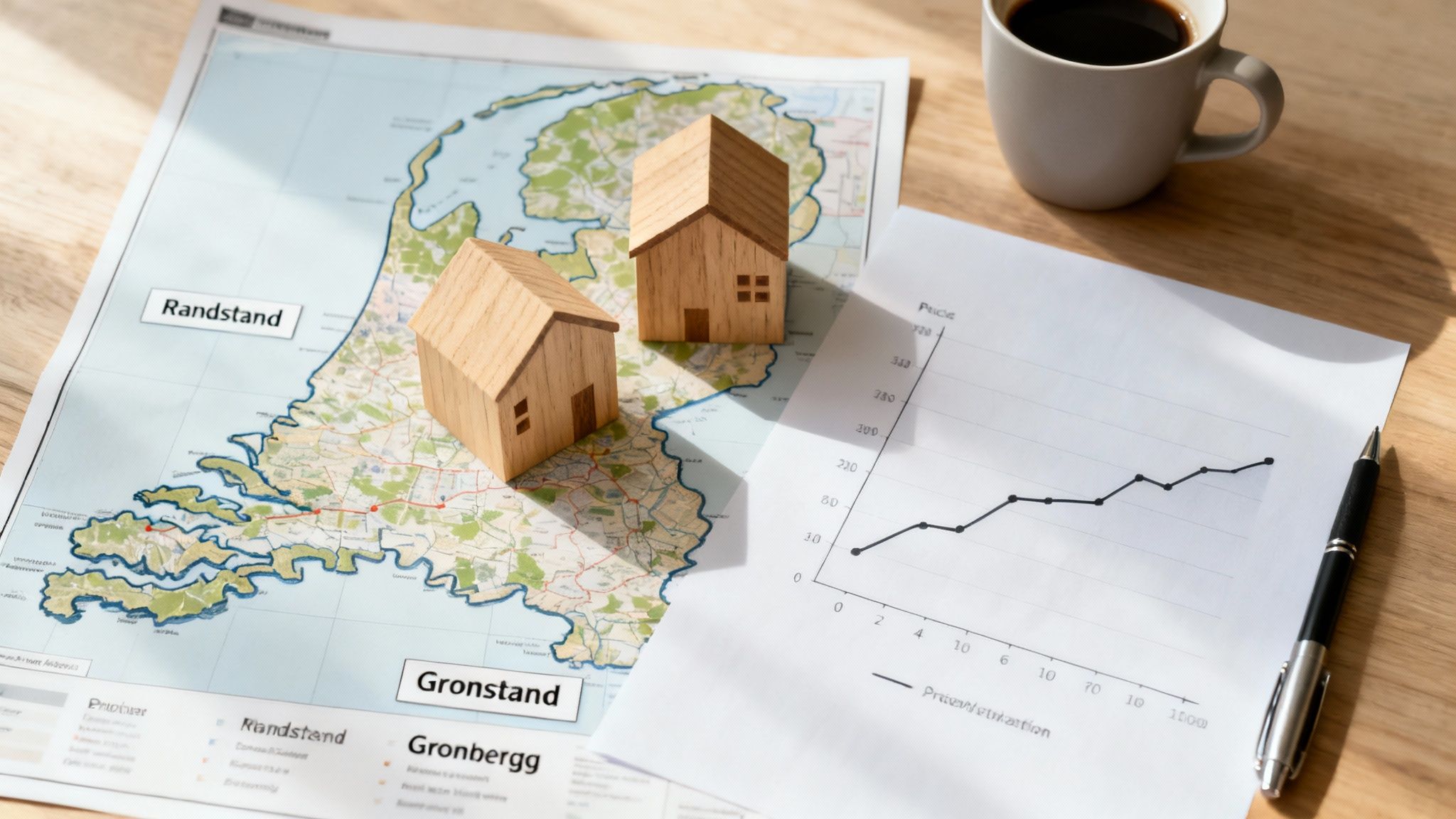
The Randstad vs. The Rest: A Tale of Two Markets
It’s impossible to talk about the Dutch housing market as one single thing. It’s really a collection of smaller, regional markets, and the biggest dividing line is between the Randstad and everywhere else.
- The Randstad: This is the economic powerhouse of the country, covering Amsterdam, Rotterdam, The Hague, and Utrecht. It’s a magnet for international companies and talent, so prices here are the highest. But with high prices comes strong potential for long-term growth. It’s a competitive, fast-paced market.
- Beyond the Randstad: Head out to provinces like Groningen, Friesland, or Limburg, and you'll find a completely different world. You get more space for your money, lower property prices, and a more relaxed way of life. These areas are becoming a hot ticket for people seeking a better work-life balance, especially now that remote work is so common.
Understanding this split is key. It helps you look past the headlines about Amsterdam’s crazy prices and find hidden gems that might be a perfect fit for your lifestyle and budget.
What This Means For You as a Buyer
So, what's the bottom line? This new, more balanced market puts you, the buyer, in a much stronger position. You have more time to do your homework—schedule proper viewings, get inspections done, and actually negotiate the terms of the sale.
With price growth slowing to a more normal pace, you can also feel more confident that you're making a solid investment based on real value, not just hype. By keeping these dynamics in mind, you can start your search for homes for sale in the netherlands with a clear head and a smart strategy.
How to Buy Property in the Netherlands Step by Step
Buying a home in a new country can feel intimidating, but the Dutch have a process that is refreshingly clear and well-regulated. Let’s break it down into a simple roadmap, guiding you from that first exciting search right up to the moment you’re holding the keys to your new home.
The first thing to know is who’s on your team. In the Netherlands, two people are essential: your real estate agent (the makelaar) and a civil-law notary (the notaris). Your makelaar is your boots-on-the-ground expert, helping you find the right place and negotiate the best deal. The notaris, on the other hand, is a neutral legal professional who handles all the official paperwork to make sure the sale is buttoned up and legally sound.
Finding and Viewing Your Dream Home
Your hunt for homes for sale in the netherlands will likely start online, but it’s the in-person viewings where things get real. This is where a purchasing agent, or aankoopmakelaar, is worth their weight in gold. They work exclusively for you, the buyer, pointing out potential red flags during a viewing and helping you figure out what a fair price actually is.
As you start shortlisting properties, it's a good idea to learn how to calculate property value like a pro. While your agent will do the heavy lifting, understanding the basics helps you make a much more informed decision and feel confident in your offer.
Found a place you love? Great! Now it’s time to make an offer.
Making an Offer and Understanding Key Conditions
Putting in an offer here is a formal affair. It's not just about naming a price. Your written proposal, submitted via your makelaar, will also include crucial “get out of jail free” cards known as resolutive conditions (ontbindende voorwaarden). These are clauses that let you walk away from the deal without a penalty if specific things don't pan out.
By far, the most important one is the financing clause (financieringsvoorbehoud). This gives you a window of time, typically four to six weeks, to get your mortgage approved. If for some reason the bank says no, you can legally cancel the purchase.
Your financing clause is a non-negotiable safety net. If you skip it and your mortgage falls through, you could be on the hook for a penalty of 10% of the home's purchase price. Always make sure this is in your offer.
A few other conditions you might want to include are:
- Structural Survey Clause: This lets you back out if a building inspection uncovers major issues that will cost more than a pre-agreed amount to fix.
- National Mortgage Guarantee (NHG) Clause: If you're applying for the NHG, this protects you in case your application is rejected.
From Preliminary Agreement to Final Transfer
Once the seller accepts your offer, you'll sign the preliminary purchase agreement, or koopovereenkomst. Don't let the word "preliminary" fool you—this is a legally binding contract. It locks in the price, the closing date, and all the conditions you agreed on.
After signing, Dutch law gives you, the buyer, a three-day cooling-off period. You can change your mind for any reason at all during these three days. The seller, however, is locked in as soon as they sign.
The final step happens at the notary’s office. On the closing date, you'll sign two main documents:
- The Deed of Transfer (Akte van Levering): This is the document that officially makes the property yours.
- The Mortgage Deed (Hypotheekakte): This formalizes your loan agreement with the bank.
Once the ink is dry, the notaris registers the deeds with the Dutch Land Registry (Kadaster), and it's official—you're a homeowner! Congratulations, here are the keys. If you’re curious about how this compares to other countries, our guide on how to buy property overseas offers a broader perspective.
Financing Your Dutch Home as an International Buyer
For most international buyers, figuring out the financing is the first real step toward owning a home in the Netherlands. The good news? The Dutch system is surprisingly open to foreign buyers, and getting a mortgage is often more straightforward than people assume. At the end of the day, Dutch banks really just want to see that you can reliably make your payments.
To figure that out, they'll look at your job, your income, and your residency status. A permanent employment contract is obviously a big help, but it’s not always a deal-breaker. Plenty of lenders work with expats on fixed-term contracts, especially if you have a solid career history.
What Can You Actually Borrow?
You're going to hear the term Loan-to-Value (LTV) a lot. It's basically the bank's rule for how much they'll lend you based on the home's official appraised value. In the Netherlands, this is a big deal: you can typically borrow up to 100% of the property’s value. On paper, that sounds like you don’t need a down payment for the house itself.
But—and this is a big but—that 100% only covers the price tag of the home. All the other expenses are on you. Things like property transfer tax, notary fees, and advisor costs have to come out of your own pocket. These are called "buyer's costs" (kosten koper), and they typically tack on another 4-6% of the purchase price.
A lot of people think a 100% LTV means you can buy a house with no savings. That’s not true. You absolutely need to have enough cash saved up to cover all the extra purchasing costs to make the deal happen.
A Quick Look at Dutch Mortgages
Once you start browsing homes for sale in the Netherlands, you'll see a couple of main mortgage types pop up. For most new buyers, it comes down to two options, both of which have some nice tax advantages.
- Annuity Mortgage (Annuïteitenhypotheek): This is the most common choice for first-time buyers. Your gross monthly payment stays the same for the entire term. At the beginning, you're mostly paying interest, but as time goes on, more and more of your payment starts chipping away at the actual loan. The initial payments are lower, which helps with cash flow.
- Linear Mortgage (Lineaire Hypotheek): With this one, you pay off the same chunk of the loan principal every single month. Because the loan balance is constantly shrinking, the amount of interest you pay also goes down over time. Your monthly payments start higher but get progressively cheaper, and you'll pay less interest overall.
Deciding which one is right for you really comes down to your personal finances and what you expect in the future. This is where getting some professional advice is a huge help.
Why You Should Use a Mortgage Advisor
You could walk straight into a bank, but for international buyers, working with an independent mortgage advisor (hypotheekadviseur) is a much smarter move. These advisors are specialists who represent you, not a specific bank. They can shop your application around to dozens of different lenders to find the absolute best rates and conditions for your situation, including lenders who are particularly good with expats.
A great advisor will also help you gather all the right documents, make sure your application is as strong as it can be, and guide you through the entire process. Yes, they charge a fee, but the savings and sanity they provide are almost always worth it. For a deeper dive into the numbers, our article on getting a mortgage for foreign property has some extra pointers. Having an expert on your team turns a confusing process into a clear, step-by-step plan.
Exploring the Best Regions to Buy Your Dutch Home
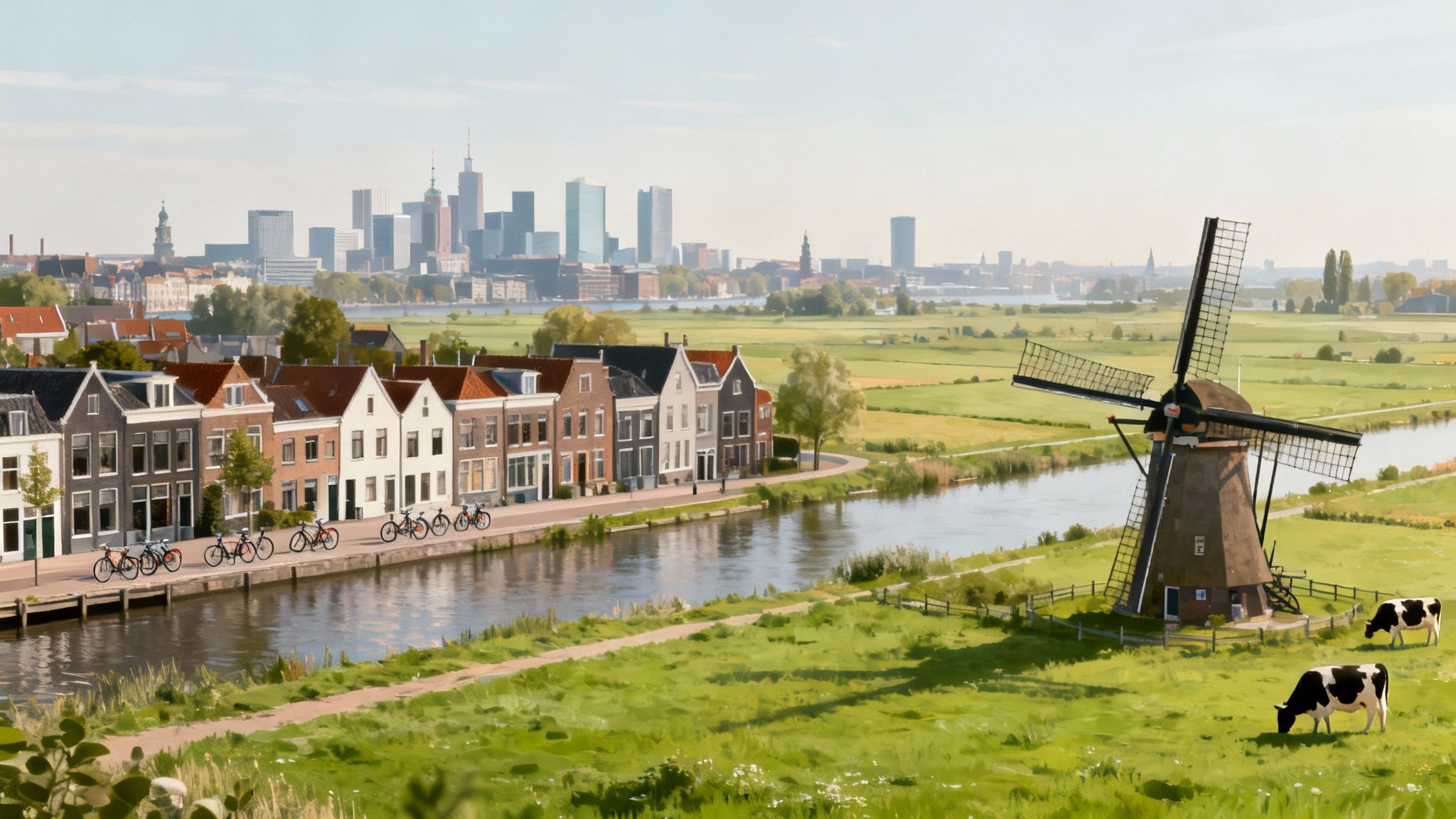
Choosing where to look for homes for sale in the Netherlands is so much more than a financial decision. It’s about finding a lifestyle that clicks with you. The country is a patchwork of diverse regions, each with its own personality—from the electric buzz of the big cities to the quiet calm of the countryside.
Your perfect spot really hinges on what you’re trying to achieve. Are you moving for a career? Looking for a peaceful holiday getaway? Or maybe searching for an affordable place to raise a family? Whatever your goal, there’s a Dutch province that fits the bill. Let’s explore some of the most popular areas for international buyers.
The Dynamic Heart: The Randstad
When most people think of the Netherlands, they’re picturing the Randstad. This is the powerhouse urban area that links Amsterdam, Rotterdam, Utrecht, and The Hague. It’s the nation's economic engine, packed with career opportunities, fantastic amenities, and a thriving international community.
- Amsterdam: The world-famous capital. It’s all about historic canal houses, a deep cultural scene, and an energy that never sleeps. It’s perfect if you thrive in a fast-paced world, but be warned—property prices here are the highest in the country.
- Rotterdam: A city of bold, modern architecture and innovation. Rotterdam feels more contemporary than Amsterdam and is often a bit more affordable. Its massive port and pro-business vibe make it a magnet for professionals.
- Utrecht: Think of Utrecht as Amsterdam’s charming, more laid-back sibling. It’s centrally located, with gorgeous canals and a lively university-town feel. Excellent transport links make it a top choice for families and commuters.
While the Randstad offers undeniable excitement and solid investment potential, it definitely comes at a premium. Even as the market cools slightly, finding a home here is still very competitive.
Coastal Charm and Green Escapes
If your dream home comes with a side of sea breeze or rolling green hills, you'll want to look beyond the major city hubs. The Netherlands has some absolutely stunning natural landscapes that offer a completely different way of life, ideal for a vacation home or a peaceful retirement.
Take Zeeland, for example. This province in the southwest is all about islands, dunes, and picture-perfect coastal towns. It's a haven for anyone who loves water sports or simply wants a serene seaside retreat. Property here is much more accessible than in the Randstad, offering fantastic value for a holiday home.
Another great option is Gelderland, home to the beautiful Veluwezoom National Park. This province is known for its lush forests, historic castles, and homes that come with a bit more breathing room. It strikes that perfect balance between nature and accessibility, making it a favorite for families looking to expand.
"Finding the right region is a matching game. You're not just buying a property; you're investing in a community and a lifestyle. The key is to align the character of the place with your long-term vision."
Affordability and Quality of Life in the North
For buyers who are laser-focused on value and a high quality of life, the northern provinces of Groningen and Friesland are gaining a lot of attention. These regions offer significantly lower property prices without asking you to sacrifice that quintessential Dutch charm.
Groningen is a vibrant student city surrounded by quiet countryside, known for its innovative spirit and packed cultural calendar. Friesland offers a unique landscape of lakes and waterways, making it a paradise for sailing and outdoor adventures. Both provinces have a more relaxed feel and a strong sense of community.
As the market shifts, it's smart to keep an eye on price forecasts. For 2026, major Dutch banks are predicting a more moderate price growth of 4-5%, a significant cooldown from the 8-9% surge we saw in 2025. This stabilization comes after the average home price topped €500,000 in late 2025, creating real affordability challenges. You can dig into more housing price predictions on OHAO.nl. This trend makes the value you can find in the northern regions even more compelling.
Comparing Dutch Regions for International Buyers
To help you visualize your options, this table breaks down the key characteristics of each major region.
| Region | Best For | Average Property Price Range | Key Characteristics |
|---|---|---|---|
| The Randstad | Career-focused professionals, investors, urbanites | €450,000 - €800,000+ | Economic hub, international vibe, high demand, excellent amenities, fast-paced lifestyle. |
| Zeeland | Vacation home buyers, retirees, nature lovers | €300,000 - €550,000 | Coastal living, serene atmosphere, popular for tourism, water sports, great value for second homes. |
| Gelderland | Families, nature enthusiasts, commuters seeking space | €350,000 - €600,000 | Green spaces, national parks, larger homes with gardens, blend of rural and suburban life. |
| Groningen & Friesland | First-time buyers, budget-conscious buyers, community-seekers | €250,000 - €450,000 | High affordability, excellent quality of life, strong community feel, relaxed pace. |
Ultimately, whether you're drawn to the dynamic energy of the Randstad or the peaceful landscapes of the North, the Netherlands offers a place for every kind of buyer.
Settling Into Your New Dutch Life
The keys are in your hand—congratulations! Your search for homes for sale in the Netherlands was a success, but the journey doesn't end at the doorstep. Now comes the exciting part: turning your new property into a real home and easing into the rhythms of Dutch life.
Think of these first few weeks as a "settling-in" period. You'll need to tick off a few essential administrative boxes right away to get yourself officially on the grid. Getting this initial setup handled is the key to everything else, from getting a mobile phone to opening a bank account.
Your Essential First Steps
The Netherlands is known for its well-organized systems, and your first priority is getting registered. It’s a pretty direct process that officially connects you to local services and makes you a resident of your new town or city.
Here’s a simple checklist to get you started:
- Register with the Municipality (Gemeente): This is a must. You have to register your new address within five days of moving in. This is how you get your Citizen Service Number (BSN), a unique ID you’ll need for just about everything.
- Sort Out Health Insurance: Under Dutch law, every resident must have at least a basic health insurance package (basisverzekering) within four months of registering. Don't put this one off.
- Set Up Utilities: Time to get the lights on. You'll need to arrange contracts for gas, electricity, water, and internet. Your real estate agent is a great resource here and can usually point you to the common providers in your area.
- Open a Dutch Bank Account: Life is just so much easier with a local bank account for paying bills and day-to-day spending. For a full walkthrough, check out our guide on how to open a foreign bank account.
Getting these administrative tasks done early is like laying the foundation for your new life. It frees you up to focus on the more enjoyable parts of settling in, like exploring your neighborhood and meeting new people.
Embracing Your New Community
Once the paperwork is out of the way, the real fun can start. Becoming part of your new community is all about diving into the local culture. Start small—visit the weekly market, find the best local bakery, and just go for a walk or bike ride to get a feel for your new surroundings.
For those bringing furry family members along, planning their move is just as important. You can find a dedicated planner to help with the logistics in this guide to pet travel to the Netherlands.
Connecting with people is easier than you might think. Consider joining a local sports club (sportvereniging), signing up for a Dutch language course, or just showing up to neighborhood events. The Dutch are generally very welcoming, and they appreciate it when newcomers make an effort to engage. Taking these simple steps will help you feel at home in no time, turning a successful property purchase into the start of a wonderful new life.
Common Questions We Hear from International Buyers
To wrap things up, let's tackle some of the most frequent questions we get from international buyers. Think of this as a quick-reference guide to give you that extra bit of confidence as you start your property search.
Can a non-EU citizen actually buy property here?
Yes, absolutely. The Netherlands is very open when it comes to property ownership. There are no restrictions based on your nationality, so you don't need to be an EU citizen or even have a residence permit to purchase homes for sale in the Netherlands.
Just remember, owning a home here doesn't automatically give you the right to live in it. Your visa and residency status are a completely separate process, so be sure to get that sorted if you plan on making the Netherlands your long-term home.
What are the real closing costs I should expect?
This is a big one. When you're setting your budget, the asking price is just the starting line. You need to factor in the "buyer's costs" (kosten koper), which aren't covered by your mortgage and come out of your own pocket.
You should budget for an extra 4-6% of the purchase price to cover these fees. The main ones are:
- Property Transfer Tax (Overdrachtsbelasting): This is the biggest chunk, typically 2% of the purchase price if it's going to be your primary home.
- Notary Fees (Notariskosten): Essential for the legal work—transferring the ownership deed and registering your mortgage.
- Valuation Report (Taxatierapport): Your lender will require this to officially confirm the property's market value.
- Real Estate Agent Fees (Makelaarskosten): If you hire a purchasing agent to represent you (which we highly recommend!).
It's crucial to understand that as the buyer, these costs are your responsibility. Building them into your budget from day one is the best way to avoid any nasty surprises when it's time to sign the papers.
As an expat, should I rent first or just buy?
The classic rent vs. buy debate really comes down to your personal plans and how long you see yourself staying. Renting gives you incredible flexibility. It's the perfect choice if you're not sure about your long-term plans or if you want to test out a few different neighborhoods before putting down roots.
On the other hand, buying starts to make a lot more financial sense if you plan to be in the Netherlands for at least three to five years. It’s a chance to build equity, and any increase in your property's value is yours to keep. It turns what would be a monthly rent payment into a solid investment in your future.
Ready to find your perfect Dutch home? Explore thousands of listings and get expert insights with Residaro. Start your journey today at Residaro.com.