Discover Country Houses Italy: Your Complete 2026 Buying Guide
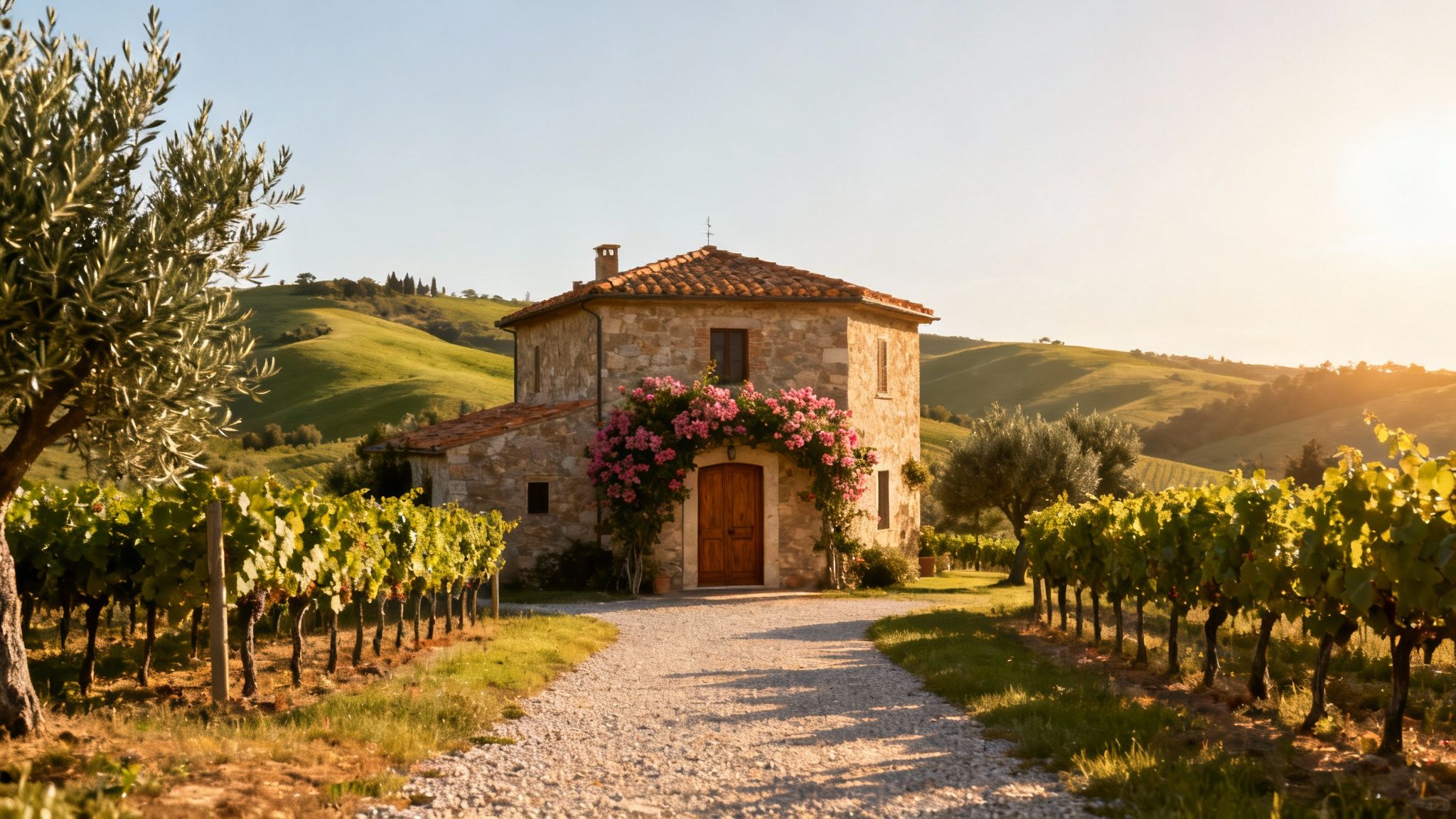
The dream of owning a country house in Italy is a powerful one, and for good reason. It’s a dream that’s more attainable than you might think. Whether you envision a rustic farmhouse needing a loving touch or a grand villa ready for you to move in, the Italian countryside has an incredible variety of properties just waiting to become your personal slice of la dolce vita.
Finding Your Dream Home in the Italian Countryside
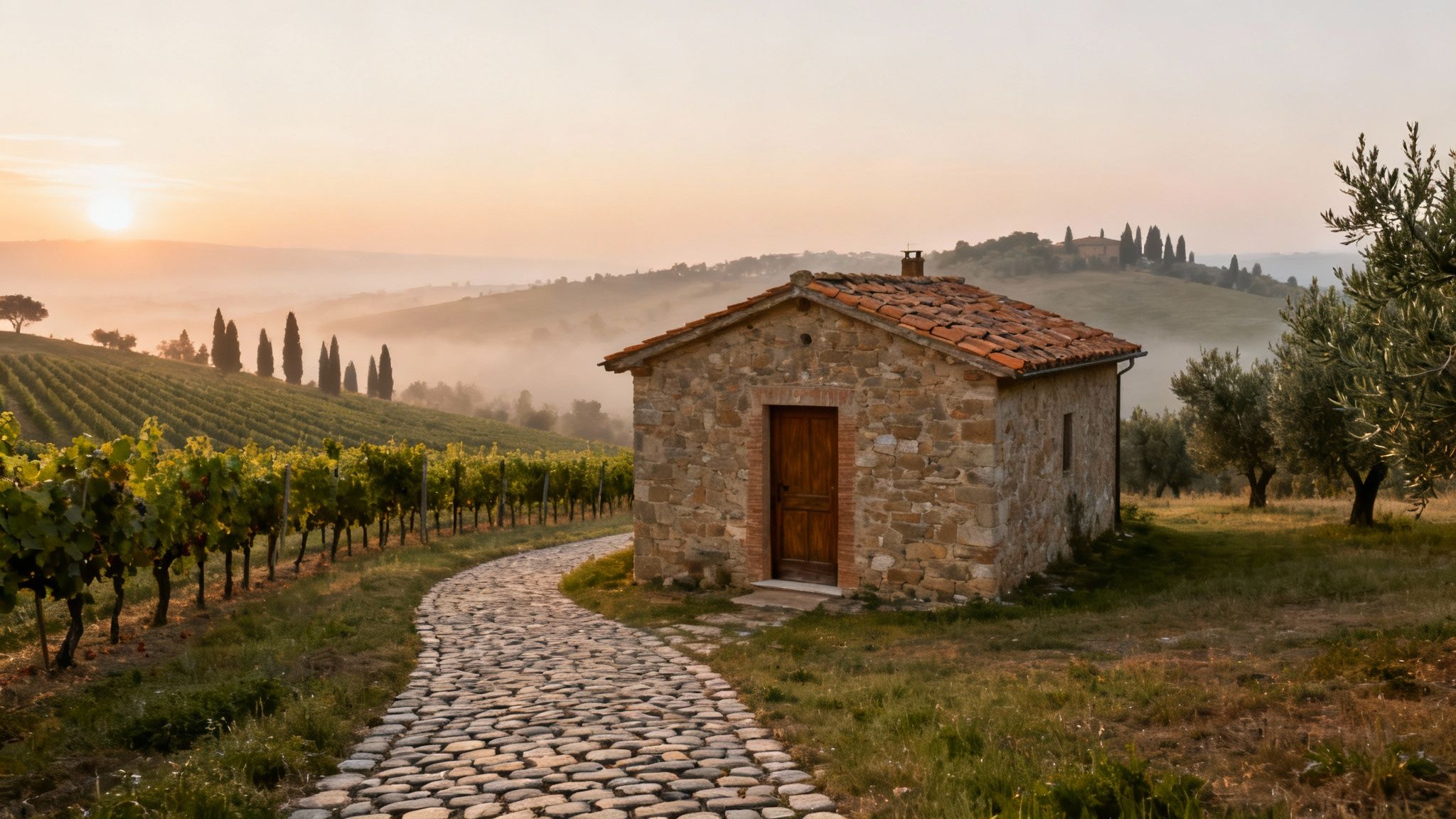
Picture it: you wake up, open the shutters, and look out over rolling vineyards in Tuscany. Or maybe you're in Puglia, breathing in the scent of ancient olive groves. This is where the journey begins for so many people. This guide is designed to take you from that beautiful daydream to the practical, exciting steps of actually buying your own piece of rural Italy.
Our mission here is to light the path ahead, making a process that can seem daunting feel completely manageable. Think of this as your personal roadmap to securing a home in one of the most beloved landscapes on earth.
Setting the Stage for Your Purchase
Before you even start scrolling through property listings, it’s crucial to understand the lay of the land—both literally and figuratively. The Italian property market has its own rhythm and rules, with distinct regional flavors that define the homes you'll find. Getting a handle on these differences is the real first step to a smart purchase.
We’ll walk you through everything you need to know, including:
- Property Types: What's the real difference between a casale (farmhouse) and a masseria (a fortified estate)? We’ll cover these and other unique regional styles.
- The Buying Process: We're going to demystify the legal side of things, breaking down the journey from making an offer to finally getting the keys in your hand.
- Financial Considerations: You’ll learn about the costs that go beyond the asking price, like taxes, notary fees, and how to budget for potential renovations.
This isn't just about buying a building; it's about investing in a way of life. By arming yourself with the right knowledge, you can navigate the entire process with confidence, avoid the common pitfalls, and turn that Italian dream into your reality.
This guide is here to prepare you for every stage of the adventure. And while famous regions like Tuscany will always have a special allure, you can also discover some truly incredible hidden gems in Italy that offer amazing value and a deep sense of authenticity. We want you to feel informed and empowered, from your very first search to the moment you turn the key in your new front door.
Discovering Italy's Regional Country House Styles
To really understand country houses in Italy, you have to appreciate that they are far from one-size-fits-all. Each region’s unique history, climate, and farming traditions have sculpted its architecture. Learning to spot these differences is like learning a local dialect—it opens up a deeper connection to the land and helps you pinpoint the perfect home for the life you want to build there.
Think of these homes as living history. A classic Tuscan farmhouse was the beating heart of a self-sufficient family farm, while a grand Puglian estate was often built like a fortress to defend against pirates. This context is everything; it’s what separates a simple building from a home that truly fits your vision.
So, let's take a little tour through Italy's most iconic country house styles. You'll soon see how to tell a rustic casale from a stately villa and match your dream to the right corner of this incredible country.
Tuscany and Umbria: The Classic Casale
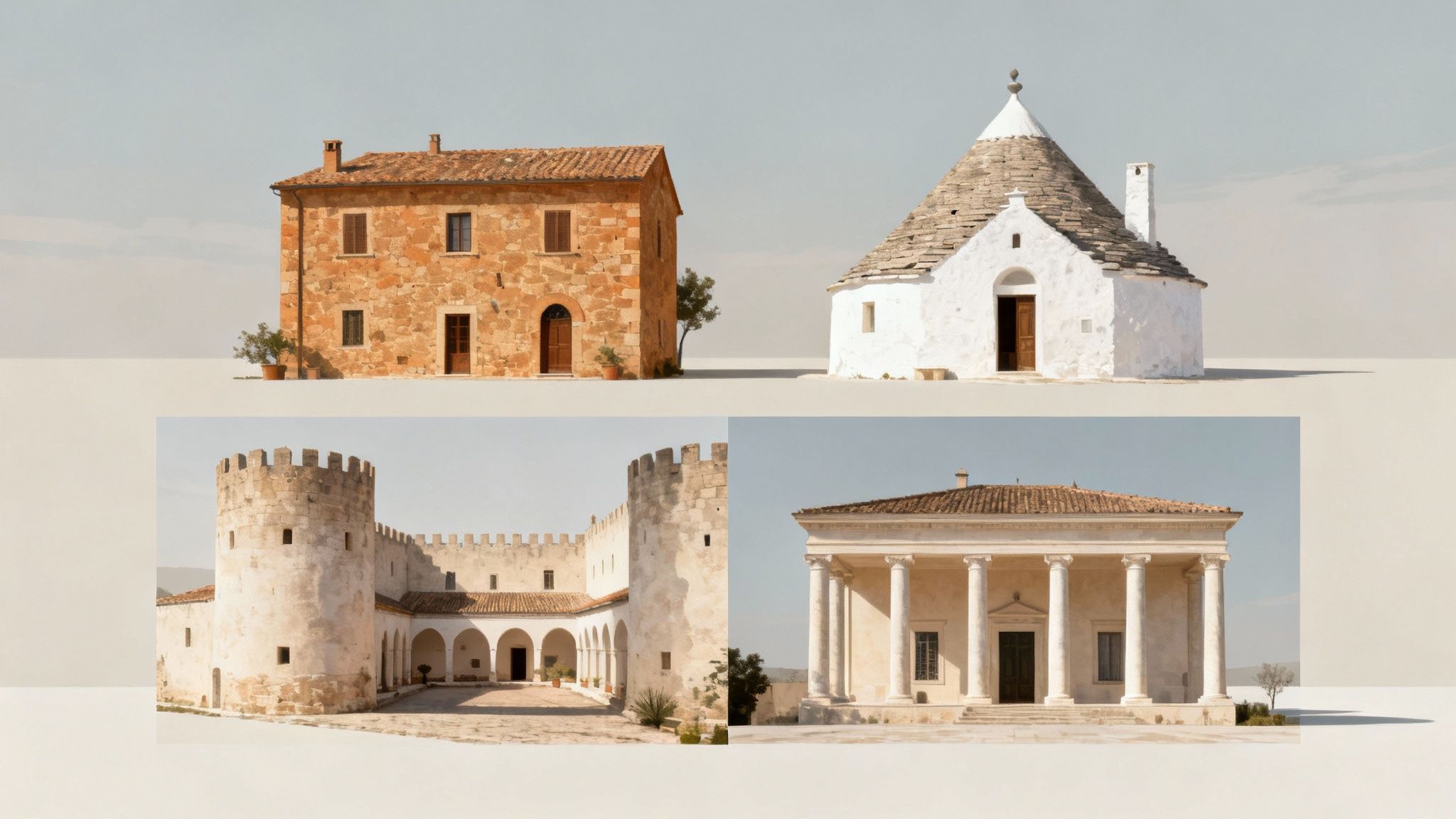
When you close your eyes and picture a country home in Italy, you’re probably thinking of a casale. These timeless farmhouses, scattered across the rolling hills of Tuscany and Umbria, are the quintessential Italian countryside dream. They're built from warm, local stone, crowned with terracotta roof tiles, and defined by heavy, exposed wooden beams inside.
Originally, the casale was a workhorse. The ground floor often housed animals, while the family lived upstairs. Today, that very history and authentic character make them incredibly sought-after properties, ripe for beautiful, sensitive restorations. If you're imagining sipping wine on a terrace overlooking rows of cypress trees, then exploring your options for buying a Tuscan villa is the perfect place to start.
Puglia: The Fortified Masseria and Whimsical Trullo
Travel south to the heel of Italy's boot, and the landscape—and the architecture—transforms. Here in Puglia, you’ll find the masseria, a fortified farmhouse estate, usually built around a central courtyard. Their massive stone walls and imposing presence speak to a past where protection from coastal raids was a part of daily life.
These properties often come with huge olive groves and feel like their own private worlds. They're ideal for anyone seeking space, privacy, and a real sense of grandeur.
Of course, Puglia is also famous for the trullo, a quirky, almost magical dry-stone hut with a cone-shaped roof. What began as simple shelters for farmers or storage sheds have become some of the most charming and desirable homes in the region, especially around the Itria Valley. It's common to find a cluster of trulli linked together to form a surprisingly spacious and completely unique home.
A property's style is more than aesthetic; it's a blueprint for a way of life. A Tuscan casale encourages indoor-outdoor living connected to the seasons, while a Puglian masseria offers a sense of protected, communal privacy within its ancient walls.
It's also worth noting that the south is becoming a hotspot for savvy buyers. Country houses in Italy's southern and island regions are attracting attention for their affordability and growing appeal. Calabria, for example, boasts an average price of just €951 per square meter—the lowest in the nation. Sardinia's rural retreats near the sea command €2,378 per sqm, while Puglia, at €1,422 per sqm, is seeing a surge in popularity.
This is all part of a broader national trend, with house prices growing 4.4% year-over-year. Tellingly, it's existing homes—which often means countryside properties—that are leading the charge at +4.9% growth.
Before we move on, let's look at how these styles compare side-by-side. The table below breaks down the key types of country houses you'll find, their defining features, and where they're most common.
Italian Country House Styles by Region
| House Type | Key Characteristics | Primary Regions | Typical Price Range |
|---|---|---|---|
| Casale | Classic stone farmhouse, terracotta roof, exposed wooden beams. Often multi-story with external stairs. | Tuscany, Umbria | €300,000 - €2,000,000+ |
| Masseria | Large, fortified estate built around a central courtyard. Thick stone walls, often with olive groves. | Puglia | €500,000 - €3,000,000+ |
| Trullo | Unique dry-stone structure with a conical roof. Often found in clusters. | Puglia (Itria Valley) | €150,000 - €800,000 |
| Villa | Elegant, often historic country home with formal gardens and grander architectural details. | All regions (esp. Lakes) | €800,000 - €10,000,000+ |
| Rustico | A property needing total renovation. Can be any style, but implies a "project" house. | Throughout Italy | €50,000 - €400,000 |
This snapshot should help you start to recognize the different personalities of Italian country properties and zero in on the style that feels right for you.
Understanding Key Property Terms
As you start browsing listings, you’ll come across some specific Italian terms over and over. Getting familiar with them will make your search much clearer.
-
Rustico: This literally means "rustic," and in property terms, it refers to a building that needs a complete, and often structural, renovation. It's the ultimate blank canvas for a buyer with a clear vision and a good architect.
-
Villa: While this can sometimes just mean any detached house, a true villa suggests a larger, more elegant country home. These often have historical significance and are usually set within well-tended, formal gardens.
-
Podere: This term refers to a small farm or a plot of land that comes with a farmhouse on it. When you buy a podere, you're not just getting a house; you're acquiring a piece of agricultural land along with it.
A Look at the Italian Countryside Property Market
Getting a feel for the Italian country house market is a bit like learning to read the local landscape. You start to see the nuances, the shifts in terrain, and where the real opportunities lie. Over the last few years, we’ve seen a massive shift—a real sea change—pulling people out of the crowded cities and into the quiet, rolling hills of the countryside. This isn't just a passing fad; it's a deep-seated change in what people want from life.
International buyers, just like many Italians, are on a quest for something more authentic. They're looking for space, a real connection to the land, and a slower pace of life. This has supercharged the demand for rural properties, especially the ones that are a blank canvas, just waiting for someone with a vision. The dream is no longer just about a simple holiday getaway, but about creating a personal sanctuary, a home with a story. It's also brought attention to regions that were once overlooked, opening up some fantastic new possibilities for buyers.
What's Driving this Rural Boom?
So, what's behind this renaissance in the countryside? It’s a mix of global shifts and that unique Italian charm. The rise of remote work has cut the cord for many professionals, making a beautifully restored farmhouse with a solid internet connection a genuine possibility for a full-time home. On top of that, there's a growing desire for "slow living" and a focus on wellness—things the Italian countryside offers in spades.
You can see this trend playing out in the market numbers. In the first half of 2025, Italy's residential property market was incredibly active, clocking in at 373,395 transactions. That’s a hefty 9.5% increase compared to the same period in 2024. What’s really telling is that the non-capital towns—where you find most of these charming country houses—saw an even bigger jump of 9.6%. Prices across Italy also edged up by 4.4% year-on-year, and a lot of that growth came from existing homes (+4.9%), which are exactly the kind of character-filled properties people are eager to renovate. You can dig deeper into the 2025 property market data to see the full picture.
How Prices Vary from Region to Region
Just like the local dialects and pasta shapes change as you travel through Italy, so do property prices. Think of it as a regional wine list: the famous, well-established names come with a premium, while the lesser-known labels can offer incredible value. Tuscany and the northern lakes are still the "Super Tuscans" of the market, with prices that reflect their global reputation and polished infrastructure.
But for a smart buyer, the really exciting story is happening in the regions that are on the rise.
- Puglia: With its iconic masserie (fortified farmhouses) and whimsical trulli, this southern star offers a brilliant mix of stunning coastline and affordable inland properties. It's become a real hotspot.
- Abruzzo: Often called "the green heart of Europe," it serves up rugged, dramatic beauty and some of the best deals you'll find for detached country homes.
- Le Marche: People have been calling it "the next Tuscany" for years, and for good reason. It has similar gorgeous landscapes and historic farmhouses, but the price tag is far more friendly.
Getting your head around these regional price differences is crucial. Your money simply goes further in an emerging area, meaning you could snag a larger property or have more left in the budget for a truly spectacular renovation.
Finding the Hidden Gems
For buyers coming from abroad, the real magic often happens with properties listed as da ristrutturare—meaning "to be restored." These homes need some love, of course, but they offer the perfect combination: a lower purchase price and the freedom to shape the final home into exactly what you want. They are the raw block of marble waiting for you to carve your masterpiece.
The trick is to find a place with "good bones"—a solid structure, a decent foundation, and genuine original features like old stone walls, vaulted ceilings, or a massive walk-in fireplace. A rustico in Umbria or a forgotten casale in Sicily could be the project of a lifetime, transforming from a neglected ruin into your Italian dream house. It takes vision and a good local team, but the reward is a home that's 100% yours, often with its value boosted significantly once the work is done.
The Step-by-Step Italian Home Buying Process

Buying a country house in Italy isn’t just a transaction; it’s a journey through a well-established legal process. For first-timers, especially from abroad, it can look a bit daunting. But don't worry—it's a logical path designed to protect everyone involved.
Think of it as a series of clear, sequential milestones. Each step builds on the last, moving you from an interested visitor to the proud owner of a piece of the Italian countryside. Understanding this flow is key to feeling confident and in control. Let's walk through it together.
Stage 1: Getting Your Italian Tax Code
First things first: you absolutely must get a Codice Fiscale. This is your personal Italian tax identification number, and without it, you can't do anything financially significant in Italy—including buying a house.
Getting one is pretty straightforward. You can apply at an Italian consulate in your home country before you even travel, or visit an Agenzia delle Entrate (tax office) once you’re in Italy. This simple but critical step officially gets you on the grid and allows you to open an Italian bank account, which you’ll definitely want to do.
Stage 2: Making A Formal Offer
So, you’ve found the one—that perfect rustic farmhouse with the olive grove. Now it's time to make a formal, written offer, known as a proposta d'acquisto. This isn't a casual handshake deal; it’s a serious legal document.
Your proposal will state the price you’re offering, your proposed timeline for the sale, and any conditions you might have (like the sale being contingent on a clean survey). You'll submit it along with a small deposit, usually in the form of a cheque (assegno) held by the estate agent. This signals your serious intent. Once the seller signs their acceptance, the proposal becomes legally binding.
The Italian system is designed to protect both buyer and seller through a series of legally binding steps. Unlike in some countries where offers can be retracted easily, once the 'proposta d'acquisto' is signed by both parties, you are legally committed to proceeding.
Stage 3: The Preliminary Contract
The next big step is the compromesso, or preliminary contract of sale. This is a much more detailed agreement that fleshes out everything from the initial offer. It specifies the final price, the completion date, and includes a full description of the property.
At this point, you'll pay a much larger deposit, typically 10% to 30% of the purchase price. The compromesso locks both parties into the sale. If you pull out, you lose your deposit. If the seller backs out, they must return your deposit and pay you an equal amount in penalties. It’s serious business.
For a deeper dive into the nuances of this stage, our comprehensive guide to buying a house in Italy has you covered.
The Key Players On Your Team
Navigating the purchase of one of the many country houses Italy has to offer is not a solo sport. You'll need a solid team of professionals in your corner.
- The Geometra (Surveyor): This is your technical expert. They conduct a full survey to check that the property’s registered plans match its actual state and that it meets all building codes. With older country homes, where undocumented renovations are common, a good geometra is worth their weight in gold.
- The Notaio (Notary): A state-appointed official, the notaio is a neutral party whose job is to oversee the entire transaction. They verify the property's legal title, check for debts or liens, and ensure the final deed is correctly executed and registered. Their role is to guarantee the legality and security of the sale for everyone.
To keep everything straight, here’s a quick checklist summarizing the entire process.
The Italian Property Buying Process Checklist
| Step | Action Required | Key Professional | Associated Document/Outcome |
|---|---|---|---|
| 1. Preparation | Obtain an Italian Tax Code (Codice Fiscale). Open an Italian bank account. | N/A | Codice Fiscale Certificate |
| 2. Making an Offer | Submit a formal written purchase proposal with a small deposit. | Real Estate Agent | Signed Proposta d'Acquisto |
| 3. Due Diligence | Hire a geometra to conduct a technical survey of the property. | Geometra (Surveyor) | Technical Survey Report (Relazione Tecnica) |
| 4. Preliminary Contract | Sign the compromesso and pay a significant deposit (10-30%). | Notaio (Notary) | Registered Compromesso |
| 5. Final Deed | Attend the final signing at the notary's office. Pay the remaining balance, taxes, and fees. | Notaio (Notary) | Final Deed of Sale (Rogito Notarile) |
| 6. Ownership | The notaio registers the sale with the Land Registry (Catasto). | Notaio (Notary) | Official title registration & keys to your new home! |
This table maps out your journey, showing how each professional guides you to the next stage, culminating in you getting the keys to your new home.
Stage 4: The Final Deed
The grand finale is the rogito, or the final deed of sale. This event takes place at the notaio's office with you (or your legal representative), the seller, and the agent. The notaio reads the entire deed aloud to ensure everyone is clear on the terms.
Once all parties sign, you transfer the remaining funds, cover the taxes, and pay the notary fees. And then, the best part: the keys are handed over. The notaio handles the final step of registering the sale at the Land Registry (Catasto), and just like that, the property is officially, legally yours. It’s a moment to pop the prosecco
Bringing Your Italian Country House Back to Life
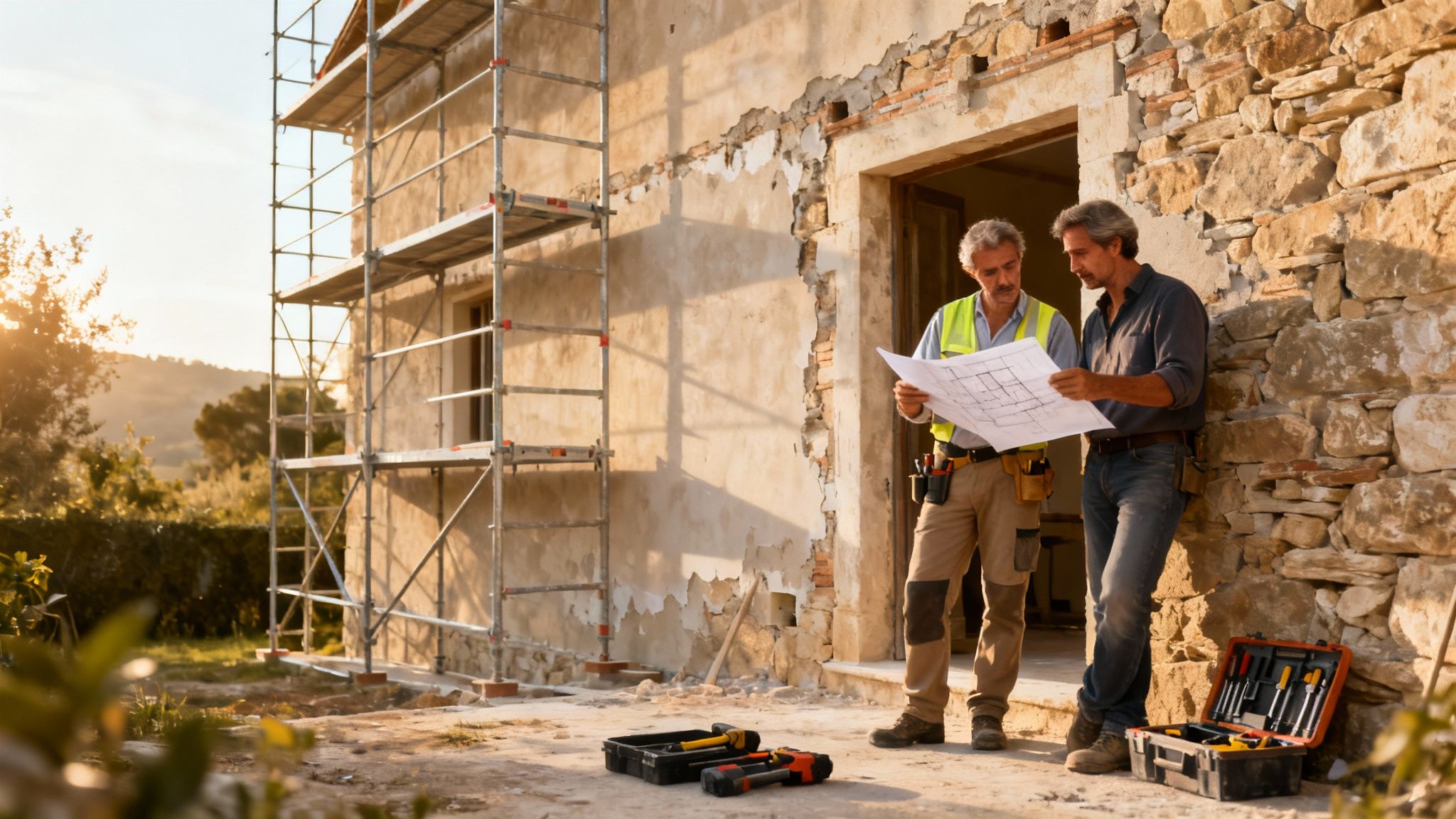
Let's be honest: much of the magic of owning an Italian country house lies in its history. But that history often means the property needs some work. Don't let that scare you. A renovation isn’t just a project; it's your chance to put your personal stamp on a piece of Italy, blending old-world character with your own modern comforts.
Managing a restoration, especially from another country, might seem daunting. But with a smart plan and the right people on the ground, it’s an incredibly rewarding experience. You're not just buying a house; you're becoming its next custodian.
How to Fund the Renovation
First things first: the money. Before you start dreaming about terracotta tiles and rustic wooden beams, you need a clear financial plan. Many international buyers look to Italian banks for a mortgage, and while it's certainly possible, be prepared for a different approach than you might be used to back home.
Banks here can be a bit more conservative with non-resident buyers. They typically offer a lower loan-to-value (LTV) ratio, often around 50-60% of the property’s value. This is where a good mortgage broker who specializes in working with foreign clients becomes invaluable. They know which banks are open to international applications and can guide you through the paperwork maze.
The good news is that the market is on your side. Investment in Italian real estate is booming, hitting €5.15 billion in the first half of 2025 alone—a massive 47% jump from the previous year. This confidence is partly fueled by dropping mortgage rates, which fell from a high of 4.92% in late 2023 to a more manageable 3.71% by November 2024. This trend makes financing a restoration project more accessible than it has been in years. You can get more details about the thriving Italian property market on cushmanwakefield.com.
Assembling Your A-Team on the Ground
You can't be there 24/7, so your project's success completely depends on the team you hire locally. These are the people who will be your eyes, ears, and hands on-site. Two roles are absolutely non-negotiable.
- The Geometra: This is a uniquely Italian role and the most important person on your team. A geometra is part surveyor, part architect, and part project manager. They'll draw up the technical plans, handle the bureaucratic headache of securing building permits, and supervise the construction crew to make sure everything is done to code.
- The Builder (Impresa Edile): Finding a great builder is everything. You need someone with a proven track record of restoring old stone houses, not just building new ones. Ask for recommendations, visit their previous projects, and talk to their former clients. A skilled builder who respects traditional materials is worth their weight in gold.
Your geometra is your most important ally in a renovation. They bridge the gap between your vision, the local builders, and the municipal bureaucracy, ensuring your project stays on track and fully compliant with Italian law.
Dealing with Permits and Uncovering Incentives
Ah, Italian bureaucracy. It has a reputation for a reason, but with a good geometra, it’s perfectly manageable. Any real structural work will require a building permit, or permesso di costruire, from the local town hall (comune). Your geometra will take care of the entire application process for you.
Here's a fantastic bonus: Italy often runs generous government incentive programs to encourage property renovation. These "bonuses" are designed to promote upgrades like improving energy efficiency or seismic safety. They can offer significant tax deductions that cover a large chunk of your renovation costs. These schemes change, so make sure to ask your geometra or commercialista (accountant) what incentives are currently available.
With your financing sorted, a trustworthy team in place, and a clear path through the paperwork, renovating your Italian country house is no longer a pipe dream. It's an exciting, tangible project that will turn a historic building into a home that's uniquely yours.
Common Questions About Buying a House in Italy
Diving into the Italian property market for the first time will naturally bring up a few questions. The process isn't complicated, but it definitely has its own unique rhythm and set of rules. We've put together answers to the most common queries we hear from international buyers, so you can move forward with real confidence.
Think of this as your practical, no-nonsense guide. We’ll tackle the key concerns that can make all the difference between a smooth purchase and a stressful one, from legal must-haves to those sneaky extra costs.
Do I Need to Be an Italian Resident to Buy a Country House?
This is usually the first question on everyone's mind, and the answer is a welcome one: no, you do not need to be an Italian resident. The door is wide open for most international buyers.
If you're a citizen of a European Union country, it couldn't be simpler—you have the exact same property rights as any Italian citizen. It's a completely seamless experience.
For non-EU citizens, including those from the United States, the UK, Canada, or Australia, you can buy property thanks to what are known as "reciprocity agreements." Basically, if an Italian can buy a home in your country, you can buy one in Italy. The single most important first step for any foreign buyer is getting an Italian tax code, the Codice Fiscale, which is a straightforward administrative task.
What Are the Biggest Hidden Costs to Look Out For?
The price you see on the listing is just the starting point. Any savvy buyer knows to budget for the extra costs that come with the territory to avoid any last-minute surprises.
As a solid rule of thumb, you should plan on setting aside an additional 10% to 15% of the property's purchase price. This buffer will cover all the taxes and professional fees, ensuring you’re financially prepared for the whole transaction.
Here’s a quick rundown of the main costs you'll run into:
- Purchase Tax: This will be either the Imposta di Registro (for a resale home) or VAT, known as IVA (if you're buying a new build from a developer).
- Notary Fees (Notaio): These usually land somewhere between 1% and 2.5% of the property price.
- Real Estate Agent Commission: Expect to pay between 3% and 4%, plus VAT.
- Land Registry Taxes: These are smaller fees for officially registering the property deed in your name.
And for those charming country houses Italy is famous for, especially the ones that need a little love, it's smart to have a renovation contingency fund of at least 20-25%. This will help you handle any unexpected structural or technical issues that pop up.
How Long Does the Buying Process Typically Take?
In Italy, good things take time, and that definitely applies to buying property. It’s not an endlessly long process, but it’s more deliberate than what you might be used to in other countries.
From the moment your offer is accepted to the final signing of the deed, you can expect the entire process to take between two and four months.
Once you sign the preliminary contract (compromesso), your professional team—especially your geometra and notaio—gets to work on the due diligence. They comb through every legal and physical detail of the property. The final step is the rogito, the final deed that officially makes you the owner. The timeline often depends on how well-organized the property's paperwork is, which really highlights why it’s so important to hire a great team from day one.
Can I Get a Mortgage in Italy as a Foreigner?
Yes, getting a mortgage in Italy as a non-resident is absolutely possible, but you'll need to do some prep work. Italian banks tend to be more cautious with foreign buyers and usually have stricter requirements.
You should be ready for a lower loan-to-value (LTV) ratio, which is typically around 50% to 60% of the property’s assessed value. In plain English, that means you'll need a larger down payment than a resident buyer would.
To apply, you’ll have to provide a full set of your financial documents, like proof of income and a statement of your assets. The best approach is to partner with a mortgage broker who specializes in helping international clients. They know the system inside and out, can introduce you to the right banks, and will make the whole application process a lot smoother.
Ready to find your own piece of the Italian countryside? At Residaro, we specialize in connecting buyers with beautiful properties across Europe. Start your search for country houses in Italy today and let us help you turn your dream into a reality.