Finding the Cheapest Property for Sale in Italy
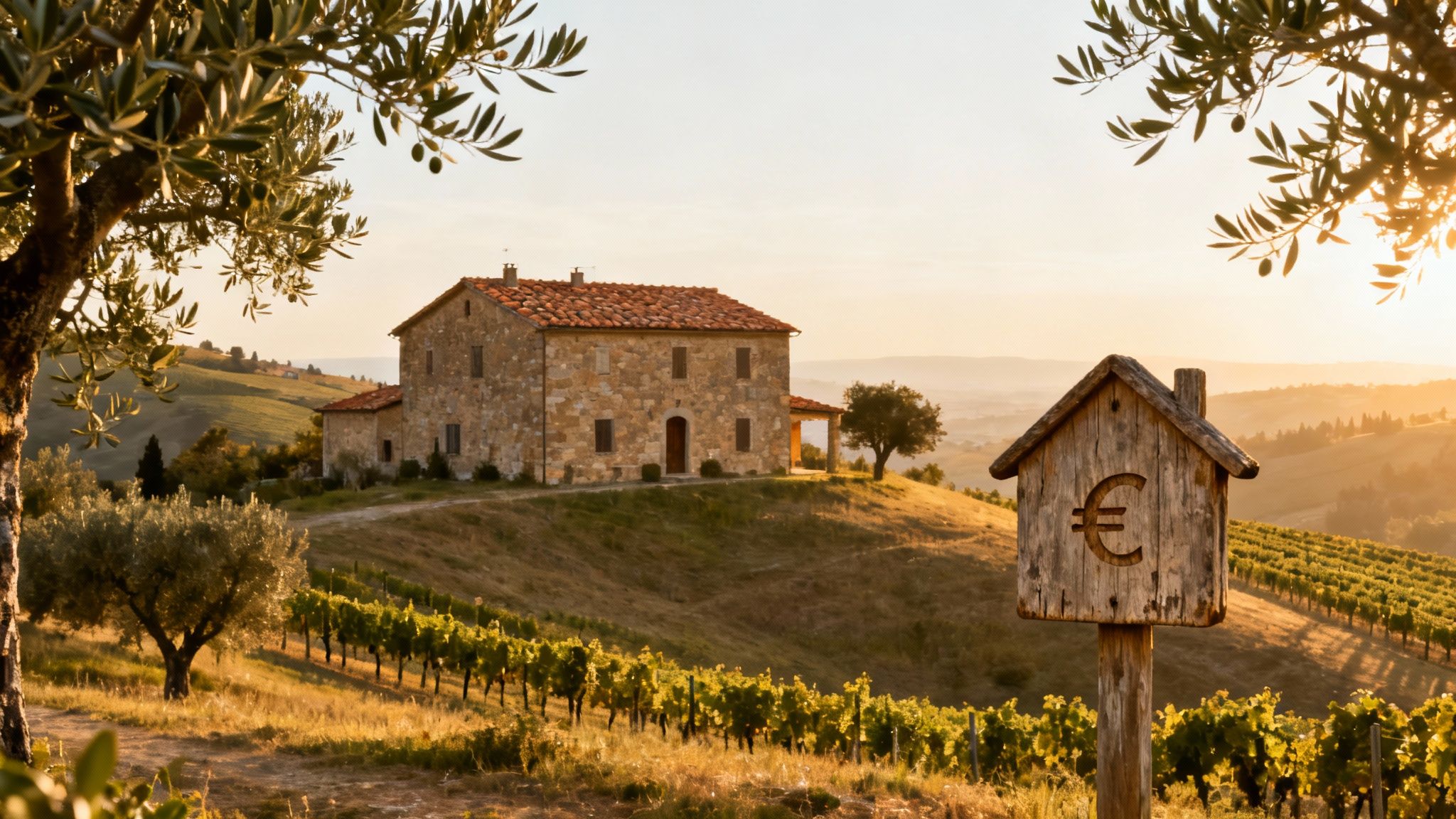
Imagine this: you're sipping your morning espresso on a sun-drenched terrace, the warm Italian air on your skin, and you didn't have to drain your life savings to get there. It sounds like a daydream, but for buyers who know where to look, finding the cheapest property for sale in Italy is a very real possibility. The secret isn't a secret at all—it’s about heading south to regions like Sicily, Calabria, and Abruzzo, where you can find homes for a fraction of what they’d cost in Tuscany or Lombardy.
Your Italian Dream Home Is Closer Than You Think
This guide is your map to finding that little slice of la dolce vita on a budget. We'll get into everything, from rustic country homes (known as rustici) needing a bit of love, to those headline-grabbing €1 houses that have caught the world's attention. Believe me, nabbing an affordable property in Italy isn't about luck; it's about knowing exactly where—and how—to focus your search.
The first step on this journey is understanding that the Italian property market is a unique beast. Unlike the more uniform markets in other countries, Italy’s is intensely regional. You could find a two-bedroom apartment in Milan that costs ten times more than a house of the same size in a beautiful Sicilian village. It’s this exact imbalance that creates incredible opportunities for foreign buyers.
Setting Realistic Expectations for Your Search
The real key to success is matching your dream with what's actually on the ground. You will absolutely find properties listed for under €30,000, but they almost always need a significant amount of work. It helps to think of the purchase price as just the down payment. The real investment, both in time and money, comes from turning a place with good bones into your own personal retreat.
To keep your search grounded, you'll need to answer a few core questions:
- Location: Are you dreaming of coastal views, rolling hills, or the cobbled streets of a medieval town?
- Property Type: Is a move-in-ready apartment your goal, or are you excited by the idea of restoring a historic townhouse or a rustic farmhouse?
- Renovation Budget: How much are you realistically prepared to spend on repairs and updates?
For many people I've worked with, the low price is only part of the appeal. The real magic is in the chance to breathe new life into an old building—to own a piece of Italian heritage and shape it into something that’s completely your own.
To give you a head start, the table below breaks down the most common types of budget-friendly properties and the best places to look for them.
Affordable Italian Property at a Glance
| Property Type | Typical Price Range (€) | Best Regions to Find Them | Ideal For |
|---|---|---|---|
| Ruin or Rudere | €1 - €20,000 | Sicily, Abruzzo, Molise | The ultimate DIYer ready for a full-scale restoration project. |
| Village Townhouse | €15,000 - €50,000 | Calabria, Puglia, Le Marche | Buyers wanting to be part of a community with amenities nearby. |
| Small Farmhouse (Rustico) | €30,000 - €80,000 | Umbria, Le Marche, Piedmont | Those seeking a countryside escape with land and renovation potential. |
| Move-in Ready Apartment | €40,000 - €90,000 | Abruzzo, Calabria | Anyone looking for a lock-up-and-leave holiday home without major work. |
This gives you a solid starting point for where your budget might take you.
Your Essential Toolkit for Finding Bargains
To navigate this exciting market effectively, you need the right tools in your corner. Modern platforms like Residaro have become essential for sifting through thousands of listings to uncover those hidden gems. They let you filter by region, set up price alerts, and easily compare properties across Italy’s most affordable areas. Throughout this guide, we'll walk you through exactly how to use these tools to your advantage, turning a daunting search into a focused and successful hunt for your dream home.
Finding Italy's Most Affordable Regions
If you're dreaming of an Italian home but your budget doesn't quite stretch to Tuscany or the Amalfi Coast, I've got good news. Forget the premium price tags of Rome, Florence, and Venice for a moment. The real bargains, the hidden gems, are found in the sun-drenched south—a region the Italians affectionately call the Mezzogiorno, or "midday."
This is where the hunt for the cheapest property in Italy truly begins.
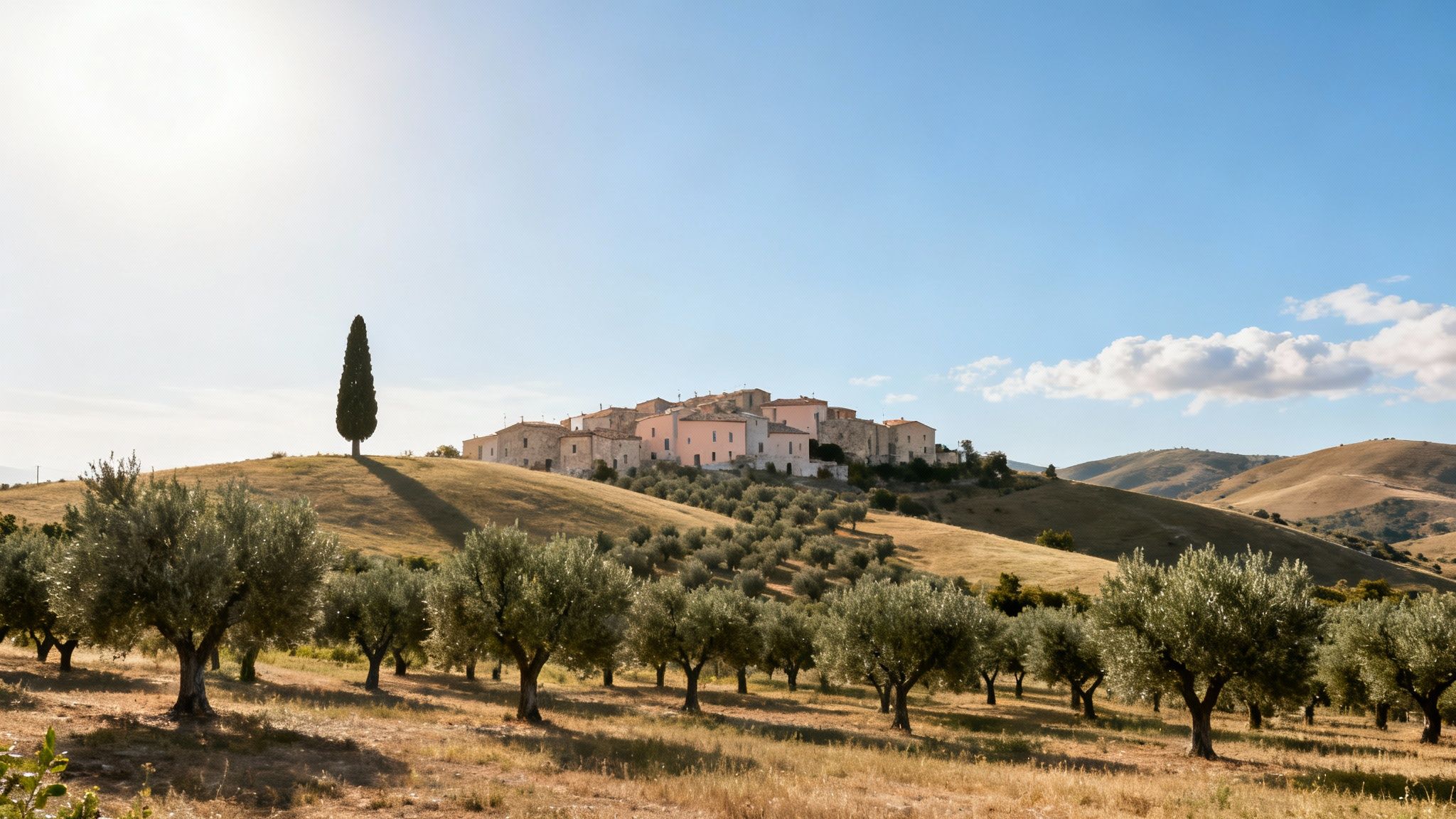
Down south, life moves at a different pace, and thankfully, so does the property market. We're talking about places where your money goes much, much further than you'd imagine. You’re not just buying a property; you’re buying into a whole different way of life. Let's take a tour of the top five regions where you can find a genuine Italian bargain.
Sicily: The Island of Incredible Value
As the largest island in the Mediterranean, Sicily is a world of its own. From the dramatic slopes of Mount Etna to its ancient ruins and stunning coastline, the variety is staggering. It’s a place bursting with culture, phenomenal food, and—most importantly for us—some seriously low property prices.
Sicily consistently comes out on top as one of the most affordable places to buy a home in the entire country. In provincial capitals like Caltanissetta or Ragusa, you'll see prices for apartments and small townhouses that honestly seem too good to be true.
Calabria: The Untamed Toe of the Boot
Right at the southern tip of the Italian peninsula, you'll find Calabria. This is a land of rugged mountains and dramatic coastlines, a place with a fierce, proud soul. It’s less polished for tourism than other southern spots, which has kept property prices on the floor, especially once you head inland.
If you’re willing to explore beyond the main coastal towns, you can find village homes and renovation projects for prices that are some of the lowest in Western Europe. It's perfect for the adventurous buyer who wants an authentic Italian experience, far from the tourist trail.
Abruzzo: The Green Heart of Europe
Tucked between the Apennine Mountains and the Adriatic Sea, Abruzzo really does offer the best of both worlds. A third of the region is protected as national parks, making it a paradise for nature lovers. But it's also home to beautiful medieval towns and long, sandy beaches.
Property here is a touch more expensive than in the deep south, but it still represents fantastic value. Think rustic stone houses in mountain villages or small seaside apartments perfect for a holiday getaway. If you want to explore this idea further, you might like our guide on the cheapest places to live in Italy.
Molise: Italy's Hidden Gem
Often called Italy’s best-kept secret, Molise is the country's second-smallest region and is frequently overlooked by buyers. It's a peaceful, sparsely populated landscape of rolling hills, ancient castles, and sleepy villages where time seems to have slowed right down.
Because it's so far off the beaten path, Molise has some of the most tempting property prices you'll find anywhere. This is the place for someone who truly wants to escape it all and sink into a quiet, rural Italian lifestyle.
Puglia: The Heel of the Boot
Puglia has definitely become more popular over the last decade, with its iconic cone-roofed trulli and whitewashed coastal towns. While prices in famous spots like Alberobello have climbed, there are still pockets of real affordability. You just have to know where to look—usually inland or further down the Salento peninsula.
The region offers a wonderful blend of rustic charm and coastal living. You can still find small apartments in historic town centers or countryside homes needing a bit of love, all without the hefty price tags of Italy's more famous regions.
The price gap between Italy's north and south isn't just a small difference; it's a chasm. It’s a fundamental reality of the market, and the latest data shows just how wide it is.
Southern Italy has firmly cemented its reputation as the country's most affordable real estate market. As of July 2025, Sicily is leading the pack. Provincial capitals like Caltanissetta are seeing properties average just €674 per square meter, with Ragusa close behind at €712 per square meter.
Other southern cities also offer incredible value: Reggio Calabria averages €793 per square meter, and Taranto in Puglia sits around €927 per square meter. To put that into context, even an "affordable" city in Tuscany, like Arezzo, will set you back €1,684 per square meter—more than double the price. This massive regional disparity creates an incredible opportunity for buyers from abroad to get so much more for their money. You can read more about these Italian property market trends on Idealista.it.
What Kind of Cheap Italian Property Are You Looking For?
When you first dip your toes into the market for the cheapest property for sale in Italy, you'll find it's less about a single type of house and more about a whole spectrum of opportunities. Each one comes with its own unique personality, set of challenges, and potential rewards. Figuring out which one fits your dream—and your wallet—is the first crucial step.
Think of it like buying a second-hand car. Are you after a reliable daily driver that just needs a good clean? A classic that needs a full engine rebuild? Or a basic, no-frills model you can customize yourself? The same logic applies to these wonderfully affordable Italian homes.
Let's walk through the main categories you'll come across.
Case da Ristrutturare: The Classic Renovation Project
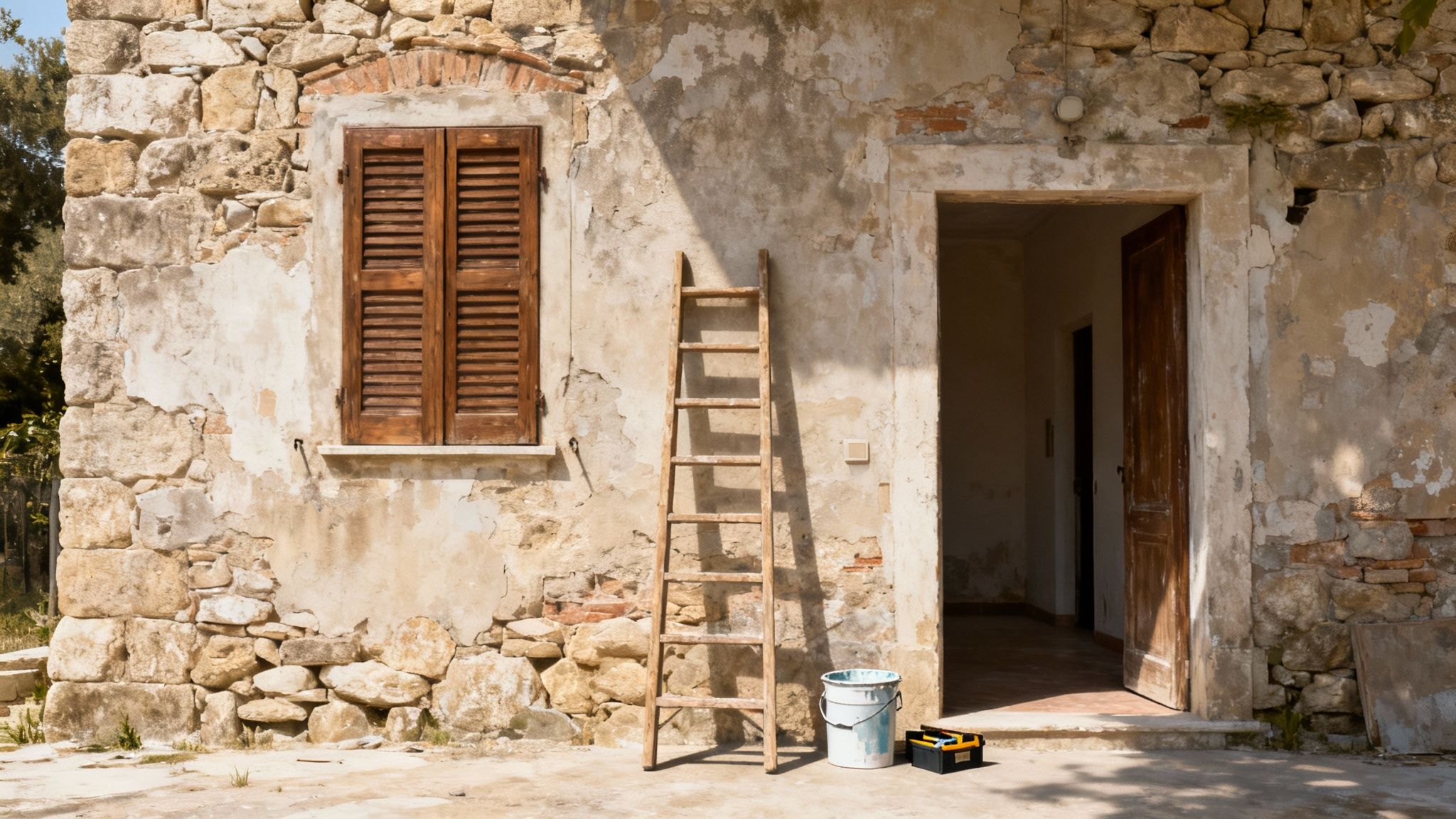
This is the phrase you'll see everywhere: "houses to renovate." These properties are the bread and butter of the budget market. They usually have good bones—solid stone walls, a decent roof—but the inside is a time capsule. Expect outdated wiring, ancient plumbing, and layouts that just don't work for modern life.
For many buyers, this is the sweet spot. You get a much lower purchase price, but you aren't starting from a pile of rubble. It’s your chance to play architect, knock down a few walls, pick your own tiles, and ultimately add a ton of value to the property.
If you're excited by the idea of putting your own stamp on a place without having to rebuild it from scratch, this is your category.
Rustici: The Rural Dream
A rustico is exactly what it sounds like: a rustic stone farmhouse or an old country building, often sitting on a small plot of land. These are the properties that spark daydreams of a quiet life in the Italian countryside, maybe with a few olive trees or a small vineyard. They are dripping with charm—think exposed stone, chunky wooden beams, and incredible history.
Be warned, though: a rustico is often a much bigger undertaking than a simple village house. Many have stood empty for decades and might need serious structural work, brand-new utility connections, and a complete gut renovation. It's a true labor of love.
A rustico isn't just a building; it's a piece of local history. The goal is to bring it back to life, honoring its past while giving it a future. This requires vision, a healthy dose of patience, and a realistic renovation budget. The reward? A home with character that simply can't be replicated.
Centro Storico Apartments: At the Heart of It All
If you dream of being part of a real Italian community, an apartment in a centro storico (historic town center) is a fantastic choice. These are typically small-to-medium-sized flats tucked away inside centuries-old buildings, just steps from the local cafe, morning market, and bustling piazza.
It's entirely possible to find apartments in pretty good shape for under €50,000, especially in southern towns. You might not get a garden, but you get the ultimate convenience and a genuine "lock-up-and-leave" property that’s perfect for a holiday home.
Case a 1 Euro: The Truth Behind the Hype
Ah, the famous "1 Euro Homes." Let's be clear: this is a brilliant marketing strategy by small towns to fight depopulation. And yes, you really can buy a house for the price of a cappuccino. But that symbolic euro is just the tiny tip of a very large financial iceberg.
Here's the reality of buying a €1 home:
- You Must Renovate: The deal is contingent on you submitting a full renovation plan and finishing the work within a strict timeline, usually about three years.
- It's a Big Investment: The real cost is in the renovation, which can easily run from €20,000 to over €100,000, depending on how derelict the property is.
- Fees Aren't Included: You're on the hook for all the legal and notary fees, which will add up to a few thousand euros.
- A Security Deposit is Required: Most towns demand a deposit, often around €5,000, which you'll get back only if you complete the renovation on schedule.
These schemes are designed for serious, committed renovators who are passionate about helping to revive a community. It's a massive project, not a cheap holiday home. The initial price tag is a hook, but the total investment is very real.
How to Navigate the Italian Buying Process
Buying a house in Italy isn't the bureaucratic nightmare some people fear. It's a structured, logical process with a clear path from A to B. Think of it less like navigating a maze and more like a well-rehearsed play with specific scenes and a cast of characters, each with a vital role.
Understanding this roadmap is the key to feeling confident and in control. You’ll see exactly what happens, when it happens, and who you need on your side to guide you to the final curtain call—the moment you get the keys.
Assembling Your A-Team
Before you even think about making an offer, you need to get your team in place. Honestly, trying to snap up the cheapest property for sale in Italy without local experts is just asking for trouble. These three people are non-negotiable.
- Real Estate Agent (Agente Immobiliare): This is your scout on the ground. A good agent doesn't just find listings; they understand the local market and can be a huge asset during negotiations. Make sure they are licensed and officially registered with the local Chamber of Commerce.
- Surveyor (Geometra): You could argue this is the most important person on your team. A geometra is a uniquely Italian, multi-talented technical expert. They’ll inspect the property for structural problems, dig through records to ensure all building work was done with the proper permits, and check that the floor plans on file actually match the house. This last part is a massive deal, as discrepancies in old homes are incredibly common.
- Notary (Notaio): The notaio is a government-appointed public official who acts as a neutral third party. Their job is to ensure the entire transaction is legal and above board. They run title searches to confirm the property is free of debts or claims, oversee the legal transfer, and officially register the new ownership. You literally cannot buy a property in Italy without one.
The Three Big Steps to Ownership
The journey to owning your Italian dream home really boils down to three key stages. Each one is marked by signing a document that locks in the deal and moves you one step closer to the finish line.
Step 1: Your Codice Fiscale and the Purchase Offer
First things first, you need a codice fiscale—an Italian tax identification number. You can't do anything official without it, from opening a bank account to signing a contract. It's free and you can get one from the Italian consulate in your home country or from an Agenzia delle Entrate office once you're in Italy.
With your codice fiscale in hand, you’re ready to make a formal written offer, the proposta d'acquisto. This isn't a casual "I'll give you X for it." It's a formal document laying out the price and any conditions, like the sale being dependent on a clean surveyor's report. You’ll usually put down a small deposit (€1,000 to €5,000) to show you’re a serious buyer. Once the seller signs it, you've got a legally binding agreement.
The proposta d'acquisto is far more than a simple offer—it’s the first binding contract. Once signed by both you and the seller, you are both legally committed to moving forward. Trying to back out now can cost you.
Step 2: The Preliminary Contract, or Compromesso
Once your offer is accepted, the next major milestone is signing the compromesso, or preliminary contract. This is a much beefier document, typically prepared by the notaio or your agent. It spells out every last detail: the final price, the closing date, a full description of the property, and confirmation of its legal status.
This is also when you'll pay a significant deposit, usually 10% to 30% of the purchase price. This is called a caparra confirmatoria, and it has real teeth. If you pull out of the deal after signing the compromesso, you forfeit the entire deposit. But if the seller backs out? They have to pay you back double your deposit. It keeps everyone honest.
Step 3: The Final Deed of Sale, or Rogito
This is the grand finale. The rogito is the final, official act of sale, and it always takes place at the notaio's office with you and the seller present (or your legal representatives). The notaio will read the entire deed aloud, word for word, to make sure everyone understands and agrees to every clause.
Here, you'll pay the remaining balance for the house, plus all the taxes and fees. Once all the signatures are on the page, the notaio takes care of registering the transfer of ownership with the state. And that's it—congratulations, you now officially own a home in Italy!
For a more detailed look, learn more about the complete process of buying a house in Italy in our comprehensive guide.
Budgeting for the True Cost of Your Property
That rock-bottom price tag on a charming Italian ruin is exhilarating, isn't it? But it's crucial to see it for what it is—the first chapter of your financial story, not the final page. Too many first-time buyers get so fixated on the initial asking price that they completely overlook the closing costs and potential renovations, which often end up being the biggest part of the investment.
Think of the purchase price as the down payment on the dream. To actually live in it, you'll need to account for all the other ingredients: taxes, professional fees, and repair costs. Planning for these from the very beginning is the only way to make sure your Italian adventure doesn't turn into a financial nightmare.
Decoding the Closing Costs
Once you reach the final step of the sale—the deed signing known as the rogito—you'll pay the outstanding balance on the house plus a whole slate of mandatory fees and taxes. As a rule of thumb, expect these to add anywhere from 7% to 15% of the property’s declared value to your total outlay.
Here’s a realistic breakdown of what you'll be paying for:
- Purchase Taxes: This is the main chunk. You'll encounter the imposta di registro (registration tax), imposta ipotecaria (land registry tax), and imposta catastale (cadastral tax). The good news? They're calculated on the property’s official cadastral value, which is almost always much lower than what you actually paid for it.
- Notary Fee (Notaio): In Italy, a notary is legally required to oversee the sale. Their fee is often a percentage of the property value and can range from €1,500 to €5,000, depending on the complexity of the sale.
- Agent Commission (Provvigione): If you found your property through an agent, they’ll get their commission at closing. This typically runs from 3% to 4% of the purchase price (plus VAT), and it's often split between you and the seller.
Building these costs into your budget isn't optional. For a €40,000 property, you should have at least another €4,000 to €6,000 ready to go just for these closing expenses.
Facing the Reality of Renovation Costs
When you’re looking at the cheapest properties in Italy, especially rural farmhouses (rustici) or old village homes, renovation isn't a possibility—it's a certainty. Decades of neglect often mean the wiring, plumbing, and structural basics need a complete overhaul. This is where a cold, hard look at your budget becomes your best friend.
The real bargain isn't just the cheap purchase price. It’s finding a property where the combined cost of the house and the renovation is still a great deal compared to a move-in-ready home. That total number is your true investment.
The smartest thing you can possibly do is hire a local geometra (a type of surveyor/project manager) or builder to inspect the property before you buy. They can give you real-world quotes for the necessary work, giving you a full financial picture before you commit.
To help you get a sense of what to expect, the table below breaks down some typical costs for major renovation jobs. Keep in mind that prices vary wildly depending on the region and the quality of materials you choose, but these figures are a solid starting point for your calculations.
Estimated Renovation Costs in Italy
| Renovation Task | Estimated Cost Range (€) | Key Considerations |
|---|---|---|
| Complete Roof Repair/Replacement | €15,000 - €30,000+ | Non-negotiable for structural integrity. Costs depend on size and materials like traditional terracotta tiles. |
| New Electrical System | €4,000 - €8,000 | Old wiring is a common and dangerous issue. This covers a new fuse box, sockets, and a full rewire to meet modern safety codes. |
| New Plumbing System | €5,000 - €10,000 | This job often involves a new boiler, all new pipes, and connections for the kitchen and bathroom(s). It's essential. |
| Bathroom Modernization | €3,000 - €7,000 | Includes new fixtures (toilet, sink, shower), tiling, and labor. A modern bathroom adds enormous comfort and value. |
| Kitchen Installation | €4,000 - €12,000+ | Covers cabinets, countertops, a sink, and basic appliances. Your choice of finishes is what really drives the final cost here. |
| Window and Door Replacement | €500 - €1,500 per unit | New double-glazed windows make a huge difference in energy efficiency and security. Traditional wooden frames can cost more. |
Once you add these renovation estimates to the purchase price and closing fees, you'll finally know the total capital you really need. This detailed approach is what separates the dreamers from the successful buyers, ensuring your budget covers the entire journey from that tempting listing price to a livable, beautiful home.
Finding and Evaluating Deals on Residaro
Now that you have a good handle on which regions and property types fit your dream (and budget), it’s time for the fun part: the hunt. This is where a specialized search platform is your best friend. Think of Residaro as your secret weapon, designed to cut through the noise and zero in on those incredible Italian property bargains that others miss.
Instead of getting lost on dozens of different local Italian websites (and battling with Google Translate), you can use a single, powerful set of filters. This saves an enormous amount of time and lets you focus only on the listings that truly fit the bill, whether that's a stone ruin in Abruzzo for under €30,000 or a little townhouse in a Sicilian village.
Mastering the Search Filters
The real trick to uncovering a gem is getting smart with the search filters. Don't just set a maximum price and call it a day. The magic happens when you layer different criteria.
For example, you could focus your search on a specific region like Calabria, filter for "house" as the property type, and set your price bracket from €10,000 to €40,000. This immediately eliminates thousands of irrelevant listings and brings the hidden opportunities to the surface.
This is what a targeted search looks like in action on Residaro.
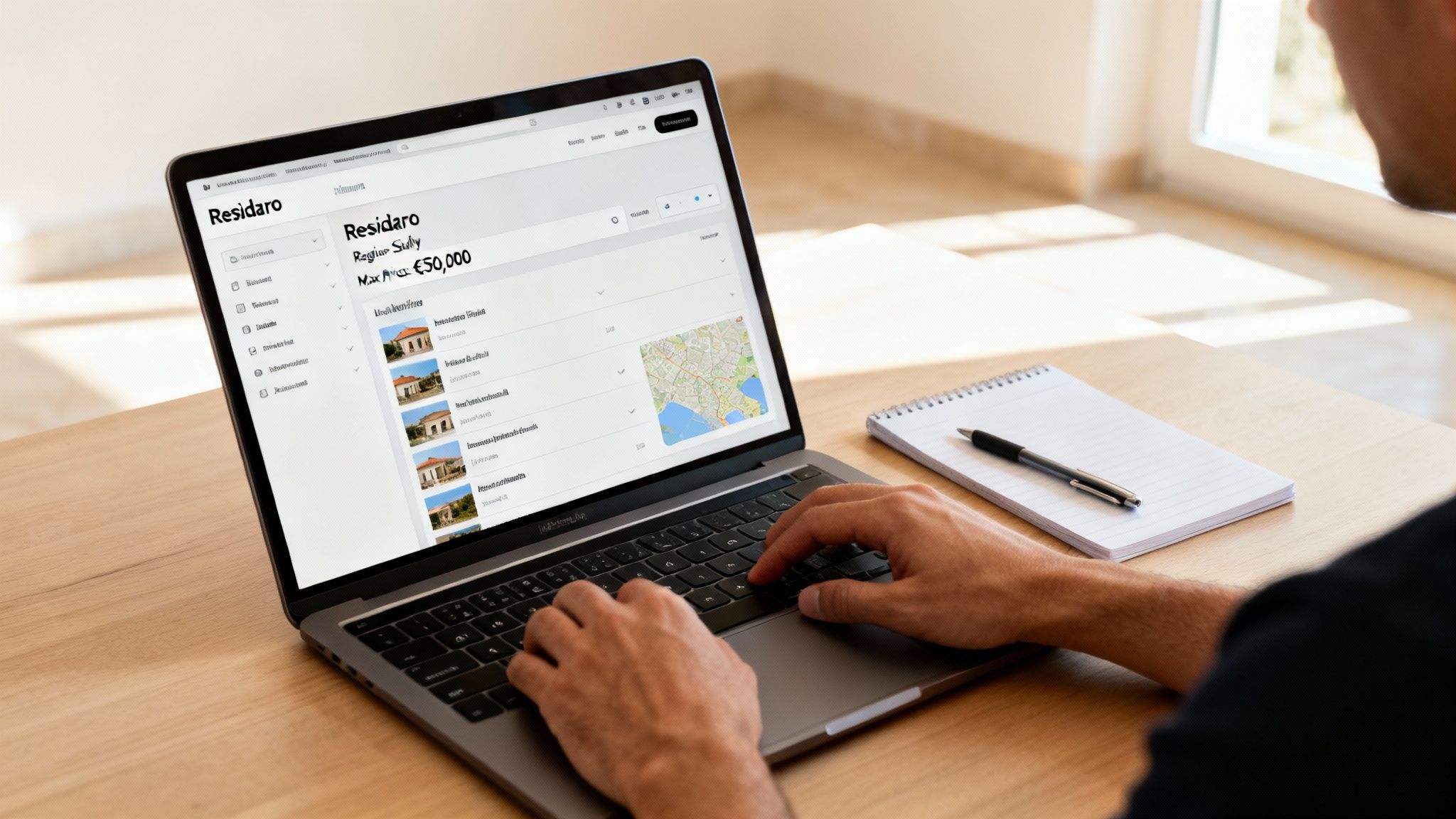
You can see how combining the right filters instantly narrows the results to show you exactly the kinds of affordable homes you're looking for.
Reading Between the Lines of a Listing
Once you have a handful of promising properties, it’s time to put on your detective hat. You can learn an incredible amount about a property from its online listing long before you even think about booking a flight.
A great listing shows you everything, warts and all. A vague one hides things. Pay close attention to what isn't shown or mentioned—that’s often where the biggest renovation costs are hiding.
Keep your eyes peeled for these make-or-break clues in the photos and descriptions:
- Photo Quality and Quantity: Are there just a few dark, blurry photos? That's a huge red flag. A serious seller will provide at least 10-15 clear, well-lit pictures that show you every room, the outside, and any land included.
- Signs of Water Damage: Scan the photos for dark stains on ceilings or walls. Pay special attention to corners and the areas under windows. Water damage often points to a leaky roof or serious structural issues, which are never cheap to fix.
- The State of the Roof: Get up close and personal—zoom in on those exterior shots. Do the terracotta tiles look neat and tidy, or are they a jumble of cracked and missing pieces? A new roof can be one of your single largest renovation expenses.
- Vague Descriptions: Be wary of phrases like "needs modernization" or "full of character." Often, this is just a polite way of saying "prepare for a total gut job." You want listings that give you specific details, especially about the state of the plumbing and electrics.
Learning to be a sharp online investigator will help you quickly filter out the duds from the genuine deals. You can start putting these skills to the test right away by browsing hundreds of properties for sale across Italy and see what you can find.
Got Questions About Buying Property in Italy? We've Got Answers
Stepping into the Italian property market for the first time, especially when you're hunting for a real bargain, is bound to bring up some questions. It's totally normal. Getting straight answers is the best way to move forward feeling confident and prepared. Let's walk through some of the most common things international buyers ask.
Can a Foreigner Actually Get a Mortgage in Italy?
The short answer is yes, but it’s not as straightforward as it is for Italian citizens. Banks here are understandably more cautious with non-resident buyers. You’ll find they typically offer a lower Loan-to-Value (LTV) ratio, usually capping it at around 50-60% of the property's assessed value. This means you’ll need to have a much larger down payment ready to go.
When you apply, be prepared to show a mountain of financial paperwork from back home. A great move is to get pre-approved for a loan before you even start seriously looking. It gives you a rock-solid budget and shows sellers you're a serious contender. My advice? Find a bilingual mortgage broker who knows the ropes for expat clients—they are worth their weight in gold.
Are Those 1 Euro Home Deals for Real?
They are absolutely real, but the name is a bit misleading. You aren't just buying a cheap house; you're signing up for a massive renovation project. These are programs run by small towns to combat depopulation, and they come with strings attached. You have to commit to a full restoration, usually within a tight two or three-year deadline.
The €1 price tag is really just a hook. The real cost is in the mandatory renovation, which can easily run from €20,000 to over €100,000. On top of that, you have legal fees and a security deposit, often around €5,000, that you get back once the work is done.
So, think of it as buying a project, not a property. It's a fantastic opportunity, but it’s for people who are truly ready for the work and financial commitment involved.
Do I Have to Speak Italian to Buy a House?
You don’t need to be fluent, but knowing some basic Italian will make your life so much easier, especially if you're looking in the rural south where English isn't as common. For the actual legal process, it's non-negotiable: you need a professional team—your agent, lawyer, and surveyor—who are bilingual.
Italian law has a built-in protection for you. If you aren't fluent, the final deed of sale (the rogito) has to be officially translated for you. Alternatively, it can be read aloud by an official translator right there in the notary's office. This is to make absolutely certain you understand every single word of the contract you’re about to sign.
What's the Deal with Annual Property Taxes?
The main property tax you'll hear about is IMU (Imposta Municipale Unica). But here’s the great news: if the property is your primary residence (prima casa) and isn't officially classified as a luxury home, you are completely exempt from paying it.
If you’re buying a second home or a holiday getaway, then you will have to pay IMU. The rate is set by the local municipality and is based on the property’s cadastral value—which is a government-assessed value that's usually much, much lower than the actual market price. You'll also pay a local waste tax, called TARI, no matter how you use the property.
Ready to turn these answers into action and find your perfect spot in Italy? On Residaro, you can filter through thousands of listings in Italy's most affordable regions to uncover the hidden gems that match your budget and your dream. Start your search on Residaro today.