Buying vs Renting Pros and Cons for International Buyers in Europe

At its heart, the debate between buying and renting is a classic trade-off. Buying a home in Europe is about planting roots and building long-term wealth. Renting, on the other hand, is about freedom—the flexibility to move and lower upfront financial hurdles. Your best path depends entirely on what you value more right now: stability and equity, or the agility to relocate without the strings of ownership.
Comparing Your Options in the European Market
For anyone looking to move abroad, whether to Spain, Portugal, or Italy, this is the first major decision you'll face. It’s a choice that ripples through your finances, lifestyle, legal standing, and future plans. Getting this right is crucial, whether you're an expat, an investor, or just searching for that perfect vacation home.
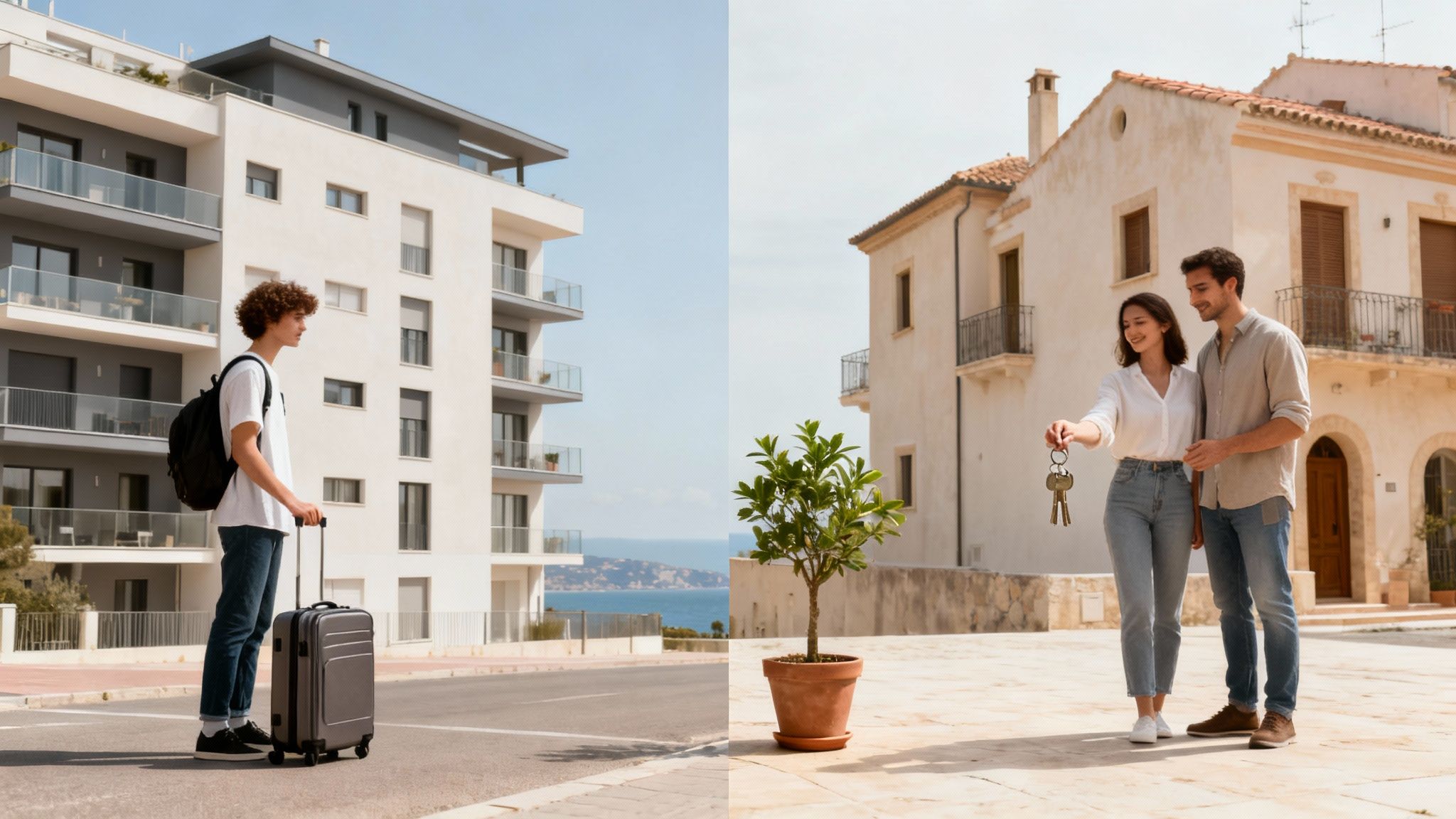
Buying a property is a serious commitment, tying you to a specific place. But with that commitment comes real stability, the total freedom to make a space your own, and the chance to build significant wealth as the property appreciates. If you see yourself staying put for at least a few years, ownership almost always makes more financial sense in the long run.
Renting, however, offers a level of mobility that ownership just can't match. It’s the perfect setup for digital nomads exploring new cities, professionals on temporary assignments, or anyone who simply wants to test the waters in a new country before making a big purchase. As a renter, you sidestep the headaches of property taxes, surprise maintenance bills, and the huge down payment needed to buy.
Key Decision Drivers
To figure out what’s right for you, you have to look at how each choice fits with your life and financial goals. For instance, if you're an expat dreaming of a villa in Portugal, buying could be a fantastic investment.
Across major European markets like France, Italy, and Spain, home prices are projected to grow by a steady 1.6-1.8% in 2026. This growth can easily outpace rent increases, meaning you're actively building wealth. Plus, with mortgage rates in Spain and Italy expected to fall, getting into the market is becoming more affordable. You can find more details in our guide to European market trends and forecasts to see how these shifts might work in your favor.
To help you see the bigger picture, let's break down the main arguments side-by-side.
Buying vs Renting at a Glance
This table offers a quick snapshot of the fundamental trade-offs you'll be weighing.
| Decision Factor | Advantages of Buying | Advantages of Renting |
|---|---|---|
| Financial Outlook | Builds long-term equity and personal wealth through property appreciation. | Lower upfront costs and predictable, fixed monthly expenses. |
| Lifestyle & Stability | Offers a sense of permanence, stability, and the freedom to renovate. | Provides maximum flexibility to relocate for work or personal reasons. |
| Responsibilities | Full responsibility for all maintenance, repairs, and property taxes. | Landlord handles maintenance and repairs, offering a hands-off experience. |
| Commitment Level | A significant long-term financial and geographical commitment. | Short-term commitment, typically based on a one-year lease agreement. |
Ultimately, this table highlights the core tension: ownership provides long-term financial upside at the cost of immediate flexibility and responsibility, while renting offers freedom and simplicity without the benefit of building equity.
Analyzing the True Financial Cost of Your Decision
It’s tempting to boil the buy-versus-rent debate down to a simple question: Is a monthly mortgage payment more or less than a monthly rent check? But that’s just scratching the surface. The real financial story unfolds over years, shaped by a complex mix of upfront cash, ongoing responsibilities, and the potential for long-term wealth creation.

For anyone looking to buy, especially from abroad, the first major hurdle is the initial cash required. Renting, by comparison, lets you get your foot in the door with far less capital.
The Initial Financial Hurdle
Buying a property demands a significant amount of money before you ever turn the key. For international buyers, these costs can come as a bit of a shock.
- Down Payment: This is the big one. Expect to put down anywhere from 10% to 30% of the property’s price, depending on the country and your residency status.
- Closing Costs: This is a catch-all term for various fees that can tack on an extra 5% to 15% to the purchase price. Think property transfer taxes (like Spain's Impuesto de Transmisiones Patrimoniales or ITP), notary fees, and legal help.
- Initial Repairs & Furnishings: A rental comes ready to go. A home you buy is your own blank canvas—and you’re responsible for furnishing it and fixing anything that needs immediate attention.
Renters have it much easier upfront. You’re typically looking at a security deposit—often one to three months' rent—and your first month's payment. That’s it. This lower barrier to entry is a huge plus for renting.
Ongoing Expenses Beyond the Monthly Payment
Once you’re in, the financial paths of owning and renting diverge even more. Homeowners need to be prepared for a wider, and often less predictable, set of costs.
Your mortgage is just the beginning. As an owner, you also have to budget for annual property taxes, homeowners' insurance, and sometimes community fees for shared amenities. The real wild card, though, is maintenance. A good rule of thumb is to set aside 1-2% of your home's value every year for repairs and upkeep.
Renters, on the other hand, live a life of financial predictability. Your primary responsibility is the rent. The landlord handles property taxes, fixes the leaky roof, and maintains the building. While your rent might go up when the lease renews, your month-to-month costs are far more contained.
To paint a clearer picture, let's break down the numbers for a hypothetical €400,000 property in a mid-range European market. This table illustrates just how different the financial commitments are over a five-year period.
Financial Breakdown: Buying a €400,000 Property vs. Renting
| Cost Category | Buying Example | Renting Example |
|---|---|---|
| Upfront Costs | €80,000 (20% Down Payment) + €40,000 (10% Closing Costs) = €120,000 | €4,500 (3 Months' Security Deposit) + €1,500 (First Month's Rent) = €6,000 |
| Monthly Housing Payment | €1,610 (Mortgage on €320k @ 3.5%) | €1,500 (Monthly Rent) |
| Other Monthly Costs | €150 (Taxes/Insurance) + €100 (Community Fees) + €333 (1% Maintenance Fund) = €583 | €50 (Renter's Insurance) |
| Total Monthly Outlay | €2,193 | €1,550 |
| Total 5-Year Outlay | (€2,193 x 60) + €120,000 = €251,580 | (€1,550 x 60) + €6,000 = €99,000 |
| 5-Year Equity Built | €38,000 (Principal Paid) + €40,800 (2% Annual Appreciation) = €78,800 (minus selling costs) | €0 (No equity is built) |
As you can see, while the monthly outlay for buying is higher, a significant portion of that money is building your personal wealth through equity and appreciation—a benefit renters simply don't get.
Long-Term ROI and Building Wealth
This is where buying truly shines, especially if you plan on staying put for a while. Renting is a straightforward transaction: you pay for a place to live. Buying is an investment.
Every mortgage payment is split into two parts: interest for the lender and principal that chips away at your loan. That principal portion builds equity—your actual ownership stake. As the years go by, you pay down the mortgage and the property (hopefully) appreciates in value, turning your home into a powerful financial asset.
Owning a property is one of the most reliable ways to build personal wealth. It acts as a forced savings plan while the asset itself appreciates, creating a powerful financial engine that renting cannot replicate.
Homeownership can even generate income. You could rent out a spare room or, if it’s purely an investment, the entire property. If you're considering this route, you need to know what to expect. You can learn more by checking out our guide on how to calculate rental yield.
Looking ahead, the long-term case for buying seems poised to get even stronger. With European mortgage rates expected to stabilize after 2025, buyers could see their monthly payments fall by 10-15%. Renters will see no such relief. Owning also provides a natural buffer against inflation, which is a massive advantage in markets like Germany and the UK where construction costs are climbing.
Historically, the numbers speak for themselves. A €400,000 property that appreciates at a modest 2% per year could be worth over €200,000 more in two decades. It's this potential for long-term growth that often makes buying the smarter financial move, despite the higher upfront costs.
Comparing Lifestyle Flexibility and Long-Term Stability
When you get past the spreadsheets and financial models, the debate over buying versus renting becomes deeply personal. It's really about the kind of life you want to live. This decision is a classic tug-of-war: the liberating freedom of renting pulling against the deep-rooted security of putting down stakes. Neither choice is inherently better—they just fit different chapters of our lives.

The Unmatched Freedom of Renting
The biggest draw for renting is its agility. It’s tailor-made for people whose lives are in motion, whether you're chasing a career or just following your curiosity.
The beauty of renting lies in its minimal commitment. You can pack up and explore a new city, take on a temporary work contract abroad, or even just switch neighborhoods with little more than a month's notice. For certain lifestyles, that flexibility isn't just a nice-to-have; it's essential.
Think about these real-world scenarios:
- The Digital Nomad: An entrepreneur planning to spend six months soaking up the sun in Lisbon and the next six exploring Berlin’s tech scene needs to be able to move without friction. Renting is the only thing that makes sense. For a closer look at this lifestyle, our guide on the best cities for digital nomads shows just how renting makes it all possible.
- The Expat on Assignment: A corporate executive gets transferred to Milan for a two-year project. The last thing they need is the hassle of buying a property they'll just have to sell again soon. Renting gives them a ready-made home base so they can hit the ground running.
- The Vacation Seeker: Someone dreaming of a long summer on the French Riviera can simply rent a villa for the season. You get to live like a local without the monumental financial and legal headaches of actually owning property there.
For anyone browsing Residaro's Italian country houses for a seasonal escape, renting is a clear winner. Renters also neatly sidestep market pressures, like recent housing development drops in Spain, Portugal, and Germany. They also avoid surprise costs, like property taxes—which can hit 1-2% of a home's value each year in Italy—and the dreaded call about a broken boiler.
The Deep Security of Homeownership
Buying a home, on the other hand, is an act of planting roots. It offers a powerful sense of permanence and stability that renting can rarely replicate. This isn't just a feeling; it translates into real, tangible benefits for those focused on the long haul.
For starters, you have total control. Want to knock down a wall for an open-plan kitchen, plant a sprawling vegetable garden, or paint the living room a wild color? It's your call. This is how a house truly becomes a home—a space that reflects who you are.
For many, the psychological comfort of knowing their housing costs are predictable and that they are building a tangible asset for their future is the most compelling reason to buy. It's a feeling of security that extends beyond finances.
This stability is especially crucial for families. Owning your home means your kids can grow up in one place, attend the same schools, and build friendships that last a lifetime. The predictability of a fixed-rate mortgage payment provides incredible peace of mind for long-term financial planning, especially when compared to the constant threat of annual rent hikes.
Ultimately, you’re not just paying for shelter. You’re investing in a stable future for yourself and the people you care about.
Understanding European Legal and Residency Implications
For an international buyer, the debate over buying versus renting in Europe goes well beyond simple finances. It's a decision loaded with legal and residency consequences, especially when navigating the intricate web of EU and national laws. The path you choose can fundamentally shape your legal status, your rights, and your future in a new country.

Renting is legally straightforward. Your relationship with the property is defined by a lease agreement. As a tenant, your job is to pay rent and look after the place. In return, you get some solid protections—most countries have laws that limit rent hikes and spell out clear eviction rules, giving you a stable home without the headaches of ownership.
But here’s the catch: a rental contract almost never leads to long-term residency or citizenship. It positions you as a temporary resident. That’s perfectly fine for a short-term assignment, but it does little for those hoping to put down permanent roots.
Ownership as a Pathway to Residency
This is where buying property changes the game entirely. For non-EU citizens, owning a home can be a powerful tool for unlocking long-term residency. Several European countries have created programs specifically to draw foreign investment through real estate.
These "Golden Visa" programs offer a direct link between a significant property investment and residency permits for you and your family.
- Spain's Golden Visa: This program requires a real estate investment of at least €500,000. In return, you and your family gain residency, with the possibility of citizenship after a decade.
- Portugal's Golden Visa: The rules have changed, and direct residential purchases in popular areas no longer qualify. However, you can still get on the residency track by investing in commercial property or certain real estate-linked funds.
- Italy's Investor Visa: This option grants residency to those making a significant investment, which can include putting capital into Italian companies involved in real estate development.
Owning property in Europe is more than a financial investment; for many non-EU citizens, it's an investment in their future legal status, offering a tangible route to long-term stability and integration that renting simply cannot provide.
This elevates the buying versus renting question from a financial choice to a strategic one. Renting gives you simplicity, but buying can give you a permanent place on the continent.
Navigating Country-Specific Legal Obligations
The legal duties of homeowners and tenants are worlds apart in Europe, and you need to understand these differences. When you buy, you’re not just getting a set of keys; you’re plugging into a country’s legal and tax framework.
For instance, if you want to buy property in Italy, you first have to get a codice fiscale (an Italian tax code), even if you don't live there. It's a non-negotiable step before you can even think about signing a purchase agreement. The legal transfer of the property itself, known as conveyancing, is a meticulous process involving notaries and rigid protocols. You can learn more about what property conveyancing involves to see just how critical this stage is for securing your rights.
Inheritance laws can also throw a wrench in your plans. France, for example, has "forced heirship" rules. This means a portion of your estate, including your French property, must go to your children, no matter what your will says. It’s a crucial detail for anyone thinking about their legacy.
Compare that to the renter's world, which is much simpler. Your main legal document is the lease. While tenancy laws differ—Germany is known for having some of the strongest tenant protections in Europe—your responsibilities are mostly limited to what’s in the contract. You’re shielded from property taxes, inheritance laws, and the complex web of regulations that govern property sales, making renting a much lighter legal lift.
So, Which Path Is Right for You?
After all the financial modeling and lifestyle analysis, it really boils down to one question: what's the right move for you? There’s no magic formula here. The best decision is deeply personal, shaped by your own goals, timeline, and unique situation as an international buyer.
Instead of just recapping pros and cons, let's walk through a few real-world scenarios. See if one of these profiles sounds like you—it can bring a lot of clarity to your own decision.
The Investor: Targeting Rental Yields in Sweden
Imagine you're an investor living outside the EU. Your goal is simple: generate passive income from European property. You're focused on maximizing your return on investment (ROI) through rental income and long-term appreciation. You have the capital for a down payment and you're not intimidated by the process of owning property abroad.
For this profile, buying is the clear winner. Renting doesn't even enter the conversation because it offers zero investment return. By purchasing a flat in a high-demand rental market like Stockholm or Gothenburg, you start building equity immediately. Better yet, your tenants are effectively paying down your mortgage while the property (hopefully) grows in value. It’s the only path that aligns with an investment-first strategy.
When your main objective is financial growth, renting is essentially paying off someone else's mortgage. Ownership is how you build an asset, hedge against inflation, and create a new income stream.
The Retiree: Putting Down Roots in Spain
Now, let's picture a couple from North America looking to retire on Spain’s sunny Costa del Sol. They aren't thinking about ROI; their priorities are stability, community, and creating a permanent home to enjoy for the next 15-20 years. They want the freedom to renovate, plant a garden, and truly make a place their own.
For the retiree, buying is without a doubt the better option. Renting just can’t provide the long-term security they need. A landlord could sell the property or hike the rent, forcing a stressful and unwanted move. Ownership gives them the deep-rooted stability they’re looking for, a predictable mortgage payment, and the freedom to customize their home. It becomes a true legacy, not just a temporary address.
The Expat Family: Prioritizing Stability in France
Think about an expat family with school-aged kids, moving to Lyon for a long-term job assignment—say, five years. Their top priority is a stable, consistent environment for their children. They need to be in a specific school district and want to avoid the chaos of moving if a lease isn't renewed.
This one is a bit more nuanced, but buying often has the edge here. Five years is often near the financial break-even point, but the non-financial benefits are huge. Owning their home means no landlord can force them to move and uproot their kids from their school and friends. That kind of stability and peace of mind can easily outweigh the purely financial side of the calculation.
The Digital Nomad: Chasing Ultimate Flexibility
Finally, let’s consider a young professional working remotely while exploring Europe. Their plan is six months in Lisbon, a year in Berlin, and then who knows—maybe a few months in the Italian countryside. Their core value is freedom: the ability to pack up and move to a new country with almost no strings attached.
For the digital nomad, renting is the only choice that makes sense. The sheer hassle and transaction costs of buying and selling property every year would be a financial and logistical nightmare. Renting gives them the agility they need to live like a local in different cities without the heavy commitment of ownership. It’s a perfect match for a lifestyle built on mobility and exploration.
Your Personal Decision Checklist
To help bring it all home, ask yourself these questions. Your answers should point you in the right direction.
- How long are you planning to stay? If it’s less than five years, the high entry and exit costs of buying usually make renting more sensible. For longer stays, buying becomes a powerful way to build wealth.
- What’s your primary goal? Are you chasing financial returns, personal stability, or total flexibility? Your core motivation is the single most important factor.
- Are you financially ready for ownership? This means having a 20-30% down payment saved, plus another 10-15% set aside for closing costs, taxes, and a "just-in-case" fund for repairs. If not, renting is the smarter move until you are.
Frequently Asked Questions
When you're weighing whether to buy or rent in Europe, the big picture is important, but it's the specific details that often make or break the decision. Let's tackle some of the most common questions that pop up for international buyers.
What’s the Typical Breakeven Point for Buying vs. Renting in Europe?
This is the million-dollar question, isn't it? The point where buying actually becomes cheaper than renting isn't a single number, but a range. In major hubs like Lisbon, Madrid, or Paris, you're generally looking at 7 to 12 years.
Why so long? It's a mix of property price growth, how fast rents are rising, and the hefty upfront costs of buying. If you're planning to put down roots for a decade or more, buying almost always comes out on top financially. But if your timeline is shorter, those initial transaction fees can make renting the smarter, more economical move.
Can a Non-Resident Get a Mortgage in a European Country?
Absolutely, but be prepared for a different process than you might be used to back home. Countries like Spain, Portugal, and France are quite open to lending to non-residents, but the banks are understandably more cautious.
You'll almost certainly need a larger down payment, often in the 30-40% range. Lenders will also want to see a rock-solid credit history from your home country and verifiable, consistent income.
It's not just about the paperwork; it's about building a case. Lenders need total confidence in your ability to pay. This is where working with a mortgage broker who specializes in international clients can be a game-changer. They know how to navigate the system and present your application in the best possible light.
The higher down payment means the initial financial hurdle is significantly bigger for non-residents, so it’s something to plan for well in advance.
What Are the Biggest Hidden Costs of Buying European Property?
The sticker price is just the beginning. The real budget-buster can be the transaction costs, which many first-time European buyers underestimate. You should budget an extra 5% to 15% of the property’s value to cover these.
Here’s where that money typically goes:
- Property Transfer Taxes: This is usually the largest chunk and varies wildly between countries and even regions.
- Notary and Legal Fees: These are non-negotiable costs for making the sale legally sound and getting it registered.
- Agent Commissions: If a buyer's agent is helping you, their fee will be part of the final tally.
And it doesn't stop once you have the keys. Ongoing "hidden" costs include annual property taxes, community fees if you're in an apartment building, and homeowners' insurance. A good rule of thumb is to set aside 1-2% of the property's value each year for maintenance and repairs. Getting these numbers into your spreadsheet is crucial for a true apples-to-apples comparison.
Ready to see what's out there? At Residaro, we take the complexity out of finding your ideal European property. You can explore curated listings across Spain, Portugal, Italy, and more, all tailored to your investment goals and lifestyle. Start your journey with Residaro today.