Buy Apartment in Milan: A Complete Expat Guide

If you're an international buyer looking to purchase an apartment in Milan, you're in for an exciting journey. The key first steps involve getting an Italian tax code (Codice Fiscale), opening a local bank account, and finding a trusted notary (notaio). On average, you can expect property prices to hover around €5,500 per square meter, with transaction costs tacking on an additional 10-15% to the final price.
This guide is designed to walk you through every practical step of that journey.
Why Milan Is an Essential Hub for Expats

Before we get into the nitty-gritty of contracts and closing costs, let’s talk about why Milan continues to draw in buyers from all over the world. It’s more than just Italy’s capital of fashion and finance. Milan is a city that buzzes with energy, blending economic muscle with a cultural scene that makes for an incredible quality of life. This powerful mix makes buying property here both a smart lifestyle move and a solid investment.
What keeps the city's property market so strong? A steady stream of international professionals, students, and digital nomads who need a place to live. This constant demand fuels a healthy rental market and supports steady appreciation in property values, especially for those smaller, well-located apartments that are always sought after.
Understanding the Market Pulse
Milan’s real estate scene is as diverse as it is dynamic. You can find yourself charmed by the historic, cobblestoned streets of Brera or captivated by the sleek, modern skyscrapers in Porta Nuova. Every neighborhood has its own distinct personality, which means you can genuinely find a spot that fits your personal taste and financial plans.
For many people I've worked with, Milan hits that perfect sweet spot between authentic Italian culture and global opportunity. You get the stability of a strong economy alongside world-class art, design, and food that make everyday life feel special.
To really get a feel for the market, it helps to know what makes it tick:
- Economic Stability: As Italy's economic powerhouse, Milan attracts major foreign investment and corporate headquarters. This creates a stable job market that directly fuels housing demand.
- Cultural Richness: The city is packed with iconic landmarks, incredible museums, and a thriving arts scene. It's a quality of life that appeals to a truly global audience.
- Rental Demand: With a huge student population and a constant influx of young professionals, there's always strong demand for rental properties. This makes buy-to-let investments a particularly appealing option here.
Your Roadmap to Ownership
Think of this guide as your roadmap. I’ve laid it out to demystify the entire process of buying property in Milan, breaking down each stage from your initial search to the final post-purchase checklist. My goal is to give you the practical, step-by-step advice you need to buy with confidence.
While we're focused on Milan, it’s always smart to see how it stacks up against other Italian cities. For a wider view, check out our guide on the best cities to live in Italy. Understanding the bigger picture often reinforces just why Milan remains such a prime destination for expats and investors.
Decoding the Milan Real Estate Market
Before you get swept away by Milan's charming courtyards and historic architecture, it's crucial to get a handle on the numbers. To make a smart investment here, you have to think like a local expert—that means digging into the data on sales, pricing trends, and that all-important tug-of-war between what's for sale and what people actually want to buy. Things like mortgage rates and inflation aren't just abstract economic concepts; they directly impact how much you can afford and the future value of your property.
Milan’s property market has a reputation for being strong and resilient, but it has its own quirks. For instance, there’s often a real disconnect between the apartments available and the ones everyone is searching for. This creates some interesting pricing dynamics, and if you know what to look for, you can use it to your advantage. Getting a feel for these details gives you a realistic view of the market's health and helps you spot the genuine opportunities.
Key Market Indicators to Keep on Your Radar
A few key metrics can give you a pretty clear snapshot of what’s happening on the ground. Transaction volume is a big one—it tells you how busy the market is. When sales are up, it’s a good sign of buyer confidence. If they dip, it might mean things are starting to cool off.
Price evolution is obviously another critical piece of the puzzle. As of mid-2025, the city-wide average is hovering around €5,500 per square meter, but that number can swing wildly from one neighborhood to the next. You also can't ignore financing. The cost and availability of mortgages are what really fuel the market. When interest rates are low, more buyers jump in, which helps keep prices stable and even pushes them up.
A Data-Driven Snapshot of Milan's Market
A quick look at recent data shows just how dynamic the city is. In the first quarter of 2025, Milan recorded 5,505 residential sales, which is a solid 7.1% increase compared to the previous year. This really highlights the city’s lasting appeal as Italy's economic powerhouse, especially when you see it outperforming some national trends. This buzz is part of a wider positive trend across Italy, where better financing options have become a major incentive for buyers. You can dive deeper into the complete analysis of Italy's H1 2025 real estate market trends to see how Milan fits into the bigger picture.
This flurry of activity also tells us a lot about what buyers are looking for right now:
- Smaller is popular: Over 65% of transactions were for apartments under 85 square meters, a sweet spot for young professionals and investors.
- New builds matter: New construction made up 9.5% of all sales. That’s well above the national average and shows how Milan is leading Italy’s construction comeback.
- Financing is king: A massive 53.5% of all purchases were backed by a mortgage, largely thanks to average interest rates dropping to a more manageable 3.22%.
These numbers paint a clear picture: with borrowing costs down and inflation getting under control, more people feel ready to buy an apartment in Milan.
Milan's market is a tale of two realities. On one hand, you have incredibly high demand for certain property types, like three-room apartments. On the other, the available inventory doesn't always match. This supply-demand imbalance is what creates both challenges and opportunities for buyers.
The Supply and Demand Puzzle
If there’s one thing that truly defines the Milanese market, it’s the gap between what buyers are desperate for and what’s actually listed for sale. The most sought-after property type right now is the three-room apartment, or trilocale, which accounts for 37% of all buyer inquiries. The catch? The market is often full of larger, four-room apartments instead.
This mismatch directly affects prices. When a certain type of apartment is scarce but in high demand, its value gets pushed up, even if the broader market is stabilizing. As an international buyer, this is where you need to be strategic. You might find a much better deal by considering a slightly larger apartment than you initially planned or by exploring an up-and-coming neighborhood where the supply-demand pressure isn't quite so intense. Understanding these subtle market forces is really the key to making a great buy in such a competitive city.
Choosing Your Milan: Finding the Right Neighborhood

When you decide to buy an apartment in Milan, you're not just choosing a property; you're choosing a lifestyle. Every neighborhood, or quartiere, has its own distinct personality. The perfect spot for a young creative who thrives on nightlife is worlds away from what a family needs with parks and quiet streets.
Getting this choice right is the single most important part of your property journey. From the art-drenched cobblestones of Brera to the sleek, glass towers of Porta Nuova, where you live will shape every part of your Milan experience. Let's walk through some of the city's most popular areas to find your perfect match.
The Historic and High-End Heart of Milan
If you’re drawn to classic Milanese elegance, look no further than Brera and the Quadrilatero della Moda (the Fashion District). Brera is the city's artistic soul, a charming maze of cobbled lanes filled with independent boutiques, art galleries, and hidden courtyards. It's where historic charm meets a truly sophisticated culture.
The Quadrilatero, on the other hand, is the undisputed capital of high fashion, offering an exclusive and prestigious lifestyle. The properties here are often stunning apartments tucked away in grand historic palazzi, and they command some of the highest prices in the city. Buying here is as much a lifestyle statement as it is an investment in stable, long-term value.
Let's be clear: Milan is Italy's priciest residential market, with the city's average apartment price hitting €4,986 per square meter in early 2025. In ultra-prime districts like the Quadrilatero, top-tier properties have skyrocketed from €25,000 per square meter in 2021 to nearly €39,000 by 2024. This reflects a national trend where existing homes saw a 4.9% price jump, showing just how much demand there is for character properties in prime locations. You can dive deeper into Italy's property price history on Global Property Guide.
Modern and Dynamic Districts
For those who prefer a contemporary beat, Isola and Porta Nuova are the modern face of Milan. Isola, once a gritty working-class area, has blossomed into one of the city's trendiest hubs, known for its vibrant street art, artisan workshops, and innovative food scene. Its proximity to the business district makes it a magnet for young professionals.
Porta Nuova is Milan’s gleaming business district, defined by architectural icons like the Bosco Verticale (Vertical Forest). This neighborhood is all about modern apartments with high-end amenities, beautiful green spaces, and direct access to major train and metro lines. It’s the ideal choice for buyers who prioritize convenience, new construction, and a forward-thinking atmosphere.
Authentic Charm and Bohemian Vibes
If you’re after a more laid-back, authentic Milanese experience, you’ll feel right at home in Navigli or Porta Romana. The Navigli district is famous for its picturesque canals, which come alive every evening as the bars, restaurants, and vintage shops lining the waterways fill up. It has a distinctly bohemian energy that’s a huge draw for expats and students.
Porta Romana strikes a wonderful balance between residential calm and city vibrancy. It’s a well-established neighborhood filled with beautiful period buildings, bustling local markets, and great transport links. This area tends to attract both families and professionals who appreciate its authentic community feel.
"When choosing a neighborhood, think about your daily routine. Do you want to walk to a morning market, or do you need a quick metro ride to the financial district? Your lifestyle should be the primary guide in your search."
The Buy-to-Let Perspective
For investors, Milan's rental market is incredibly compelling. As Italy's economic powerhouse and a major university city, Milan has a constant flow of high-quality tenants, from international students to corporate executives on assignment. The average rental yield in Milan sits around a healthy 5.44%, though this can swing quite a bit depending on the neighborhood and apartment type.
Here’s a quick breakdown of who rents where:
- Students: Areas near the universities, like Città Studi and Bicocca, are always in demand.
- Young Professionals: Isola, Navigli, and Porta Romana are consistently popular choices.
- Executives & Expats: High-end tenants are often looking in Brera, City Life, and Porta Nuova.
Short-term rentals can yield higher returns, especially in central areas packed with tourists, but they also demand more hands-on management. For many international investors, long-term rentals offer a more stable, passive income, making them a fantastic way to buy an apartment in Milan for steady, reliable returns.
Milan Neighborhood Snapshot Buyer's Guide
To help you narrow down your search, here's a quick comparison of some of Milan's most sought-after neighborhoods. Think of it as a cheat sheet to match your budget and lifestyle goals with the right location.
| Neighborhood | Average Price (€/sqm) | Best For | Typical Rental Yield |
|---|---|---|---|
| Brera | €10,000 - €15,000+ | Luxury living, art, culture, historic charm | 3% - 4% |
| Porta Nuova/Isola | €8,000 - €12,000 | Modern lifestyle, young professionals, tech | 4.5% - 5.5% |
| Navigli | €6,000 - €8,500 | Bohemian vibe, nightlife, creatives | 5% - 6% |
| Porta Romana | €7,000 - €9,000 | Families, authentic city life, professionals | 4% - 5% |
| Quadrilatero | €15,000 - €39,000+ | Ultimate prestige, high fashion, blue-chip | 2.5% - 3.5% |
Of course, prices are always shifting, and great deals can be found everywhere. But this should give you a solid starting point for focusing your search on the areas that truly resonate with what you're looking for in a Milanese home.
The Purchase Process for International Buyers
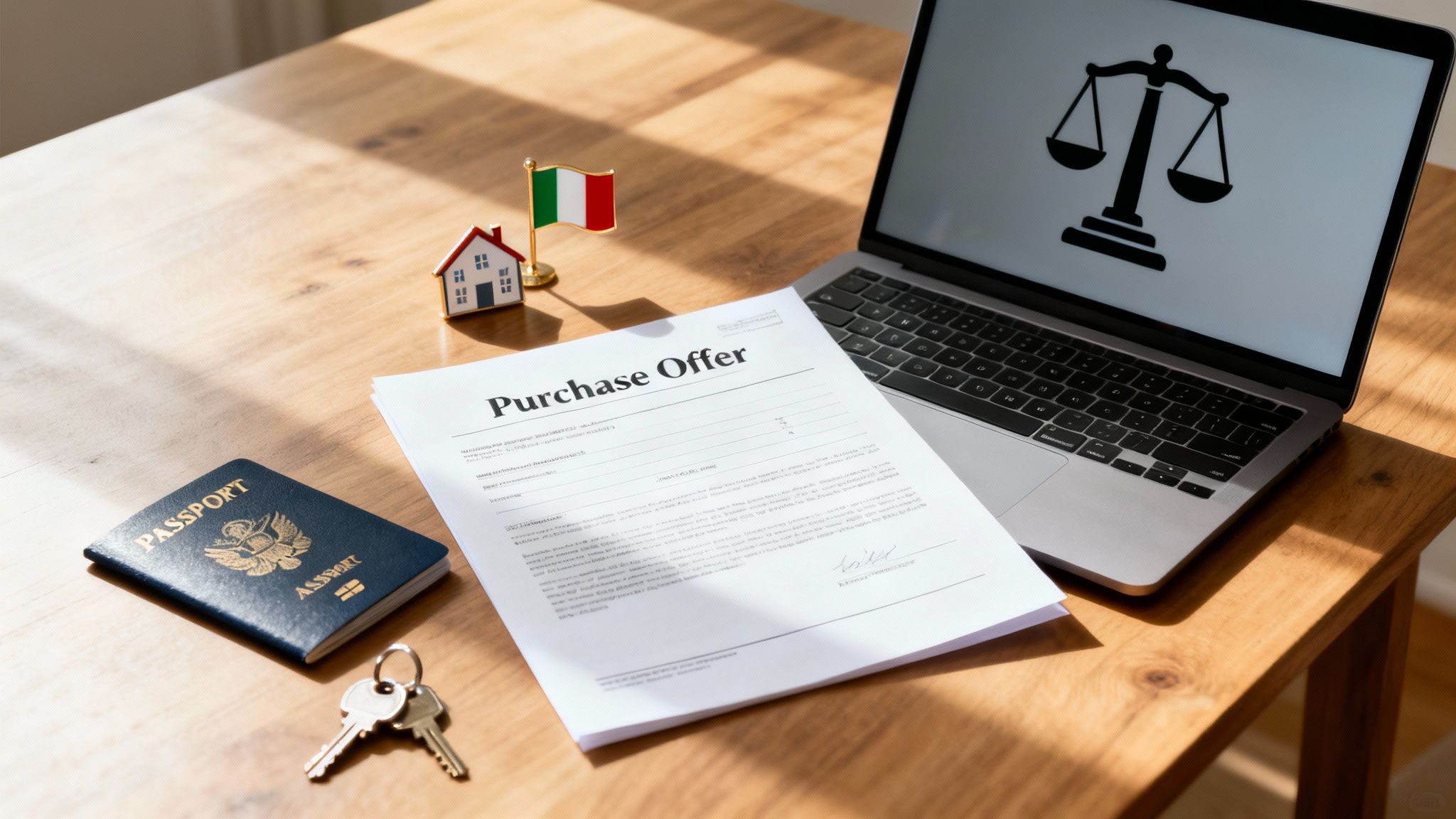
From the outside, the Italian property-buying process can seem a bit daunting, especially for international buyers. But in reality, it's a well-trodden path with clear legal milestones designed to protect everyone involved.
The system isn't about navigating complex legal battles; it’s about methodical preparation and ensuring all the boxes are ticked. Think of it as a journey with a clear beginning, middle, and end, overseen by a public official—the notary—who ensures everything is done by the book. Knowing what to expect at each turn helps you move forward with confidence and avoid the common slip-ups.
Your First Essential Steps
Before you even think about making an offer, there are two crucial pieces of paperwork you'll need to sort out. Honestly, getting these done early will save you a world of headaches later.
-
Get Your Codice Fiscale. This is your personal Italian tax ID number, and you can't do much of anything financially in Italy without it. The easiest way to get one is to apply at an Italian consulate in your home country before you even fly out.
-
Open an Italian Bank Account. While you don't need it to make the initial offer, it’s absolutely essential for transferring the deposit and the final purchase amount. It also makes life much easier for paying future utilities and condo fees.
My advice? Start these processes as soon as you get serious about buying. Having them ready means you can pounce on the perfect apartment without any bureaucratic delays.
Crafting the Offer and Preliminary Contract
So, you've found the one. The formal process kicks off with a written offer, the proposta d'acquisto. This document lays out your offer price, the proposed closing date, and any other conditions. You'll usually include a small goodwill deposit, maybe 1% to 3% of the offer, to show the seller you're serious.
Once the seller accepts, things get real with the compromesso, or preliminary contract. This is a huge milestone.
The compromesso is a legally binding agreement locking both you and the seller into the deal. Once you sign this, backing out becomes incredibly difficult and costly. It's truly the point of no return.
At this stage, you'll put down a significant deposit, typically between 10% and 20% of the purchase price. The compromesso spells out every last detail of the sale—the final price, the closing date, and a confirmation that the property is free of any debts or legal claims.
The Central Role of the Notary and Due Diligence
In Italy, the notaio (notary) is king. They are a neutral, state-appointed official whose job is to make sure the sale is 100% legal, verify everyone's identity, and witness the signing of the final deed. The notary technically works for the state, but they are chosen and paid for by you, the buyer.
Before you get to the final signing, the notary conducts some serious due diligence:
- Title Searches: Confirming the seller actually has the legal right to sell.
- Lien Checks: Making sure there are no mortgages or other claims against the property.
- Permit Verification: Ensuring the apartment's registered floor plan matches reality and all building permits are in order.
While the notary handles the legal side, I always recommend hiring your own surveyor (geometra) for a physical inspection, especially with older buildings. It’s an extra layer of protection.
Financing Your Milan Apartment
Getting a mortgage in Italy as a non-resident is definitely doable. Just be prepared for lenders to ask for a larger down payment, often around 30% of the property’s value.
The market has been quite active; in early 2025, a surprising 53.5% of transactions were financed with mortgages, thanks to some attractive interest rates. Getting pre-approved for a loan before you make an offer gives you a massive advantage. For a deep dive into this topic, check out our guide on how to get a mortgage for a foreign property.
The Final Deed and Ownership Transfer
The grand finale is the rogito notarile—the final deed of sale. This all happens at the notary’s office with you (or your legal proxy), the seller, and any bank reps. The notary reads the entire document aloud to make sure there are no misunderstandings.
Once everyone signs, you transfer the remaining balance of the purchase price, plus all the taxes and fees. The notary then officially registers the new deed with the land registry.
And just like that, the keys are in your hand. The apartment is officially yours.
Assembling Your Milan Dream Team
Let's be blunt: trying to buy an apartment in Milan from thousands of miles away without a local team is a bad idea. It's a surefire way to encounter stress, confusion, and expensive mistakes. The Italian property system has its own rhythm and quirks, and you need people on the ground who speak the language—both literally and figuratively.
Think of your team as your personal board of directors for this investment. They’ll be your eyes and ears, navigating the cultural and legal landscape to protect your interests. Getting the right people in your corner is the single most important step you'll take.
Finding the Right Real Estate Agent
Your first hire, and arguably your most critical partner, is a solid real estate agent (agente immobiliare). A great agent in Milan does far more than just show you properties. They're your source for real-time market intelligence, your lead negotiator, and your connector to other trusted professionals. For anyone buying from abroad, being bilingual and having a proven track record with international clients isn't a bonus—it's a must.
When you're interviewing agents, don't be shy. Ask direct questions to see if they really know their stuff:
- "Walk me through your experience with non-resident buyers." You want to hear them talk about handling things like remote viewings, international money transfers, and getting a tax code (codice fiscale).
- "Which specific neighborhoods do you work in most, and why do you think they'd work for me?" This question quickly separates the true local experts from those who just read market reports.
- "Can you confirm you're registered with the Chamber of Commerce?" You can also ask about professional associations like FIAIP or ANAMA. This is a basic legitimacy check.
The right agent will feel like a strategic partner. They'll listen more than they talk and focus on your goals, not just on pushing their latest listings to make a quick commission.
The Notary: Your Official Deal-Sealer
In Italy, no property changes hands without a notary (notaio). This is a non-negotiable part of the process. A notary is a public official appointed by the state who acts as a neutral party to ensure the entire transaction is legal and airtight. You, the buyer, are responsible for choosing and paying them.
Their job is incredibly detailed. The notary will:
- Verify the seller's identity and confirm they have the legal right to sell.
- Run a deep title search to make sure there are no hidden mortgages, liens, or claims against the property.
- Check that the property's official records and floor plans match the reality and comply with all building codes.
While the notary handles these crucial legal checks, they aren't your personal lawyer. Their job is to execute the legal requirements of the sale, not to negotiate on your behalf or provide tailored advice. For that, you might want to consider the distinct role of an international real estate lawyer, who can offer an added layer of protection focused solely on your interests.
Expert Tip: Don't just go with the first notary your agent suggests. Ask for a few recommendations, do a quick search on their reputation, and make sure they have experience dealing with foreign buyers. Clear communication is key.
Why You Need a Surveyor (Geometra)
The notary confirms the apartment is legally clean, but a surveyor (geometra) tells you if it's physically sound. This is a step many international buyers skip, and it's a huge mistake, especially in a city like Milan with its gorgeous but often very old buildings.
A geometra performs a full technical inspection, looking for problems you'd never spot on a walkthrough. Their report covers everything from the building's structural health to the state of the plumbing and electrical systems, and even its energy efficiency rating.
This inspection might cost a few hundred euros, but the peace of mind it provides is priceless. If they uncover a significant issue, their report becomes a powerful tool for negotiating a lower price or even walking away from a potential money pit. Your agent can connect you with a trusted, independent geometra for an unbiased report.
Post-Purchase Checklist: You've Got the Keys, Now What?

Congratulations, you have the keys! The final deed, or rogito, is signed, and that beautiful Milanese apartment is finally yours. It’s an incredible moment, but as anyone who's done this will tell you, the work isn't quite over. Now begins the practical side of setting up your new life.
This checklist will walk you through the essential admin tasks that follow the closing. Getting these things sorted out quickly will save you a world of headaches later on, letting you settle in and actually enjoy the property you worked so hard to buy an apartment in Milan.
Your Immediate To-Do List
Those first few days are all about making your ownership official and getting the lights on. While your notary handles the official property registration, there are a few things you need to tackle personally to get everything up and running.
First up, if you're planning on living here, you'll need to register your new address at the local registry office, the Anagrafe. This is a mandatory step for anyone establishing residency. It’s also a good time to double-check that all the property records are officially and correctly in your name.
Next, you'll need to get your utilities sorted. This isn't automatic in Italy; you have to reach out to the providers and get the accounts transferred into your name.
- Electricity and Gas (Luce e Gas): You’ll need your Italian tax code (Codice Fiscale), a copy of your deed (rogito), and—if you can get it—the previous owner's account info. Having those details makes the transfer, known as a voltura, go much more smoothly.
- Water (Acqua): This works much the same way and is handled by the local municipal water company.
- Internet and Phone (Internet e Telefono): Shop around with providers like TIM, Vodafone, or Fastweb to see who has the best service in your building. A heads-up: installation can sometimes take a couple of weeks, so it’s smart to get the ball rolling on this as soon as you can.
Understanding Your Ongoing Costs and Taxes
Owning a property in Milan means budgeting for more than just the mortgage. These recurring costs are just part of the deal in Italy, and knowing what to expect from day one will prevent any nasty surprises down the line.
Your main ongoing expenses will be condominium fees and annual property taxes. The easiest way to handle these is to set up direct debits from your Italian bank account so you never have to worry about missing a payment.
One of the biggest adjustments for foreign buyers is getting their head around the spese condominiali. These fees aren't just for cleaning the lobby; they can cover everything from the concierge's salary to the building's central heating. I always advise clients to ask for a detailed breakdown so they know exactly where their money is going.
Here are the key expenses you'll need to plan for:
- Spese Condominiali (Condo Fees): These are monthly or quarterly payments that cover the general upkeep and administration of the building. The cost can vary dramatically depending on the services offered, like a doorman, elevator, or shared garden.
- IMU (Annual Property Tax): This is the main municipal property tax. The good news? If the apartment is your primary residence (prima casa), you're usually exempt unless it’s officially classified as a luxury property. For second homes or investment properties, however, IMU is an annual certainty.
- TARI (Waste Tax): This is a separate local tax that pays for garbage collection. The amount is typically calculated based on the size of your apartment and how many people live there.
A Few Extra Steps for Investors
If you decided to buy an apartment in Milan purely as a rental investment, your to-do list has a couple of extra, very important items. Milan's rental market is strong, with typical yields hovering between 3-5%, but turning that potential into profit requires smart management and sticking to the rules.
First, you need to decide: will you manage the property yourself or hire a professional? For most international investors, handing it over to a local property manager is a no-brainer. They'll handle the tenant screening, rent collection, and late-night maintenance calls, all while making sure your contracts are compliant with Italian law.
Speaking of contracts, you’ll need to get familiar with Italian rental agreements. There are several types, and each comes with different rules on duration, rent increases, and how you can end the tenancy. The most common is the "4+4" contract, which gives both you and the tenant long-term security. This is where a good property manager or legal advisor really earns their keep—they'll help you pick the right contract for your specific goals.
Common Questions About Buying Property in Milan
Jumping into a property purchase in another country always comes with a lot of questions. Even when you have a good grasp of the process, those small, nagging uncertainties can feel like big roadblocks. Let's clear up some of the most common questions we hear from international buyers looking at Milan.
Think of this as your final checklist to make sure you're moving forward with total confidence. Getting these details right—from visas to taxes—is what makes the difference between a stressful purchase and a smooth one.
Do I Need a Visa to Buy an Apartment in Milan?
This is probably the most frequent question we get, and the answer often surprises people. No, you don't need a special visa or residency to buy property in Italy.
Italy operates on a principle of reciprocity. Put simply, if an Italian citizen is allowed to buy property in your country, then you're allowed to buy property in Italy. This covers most people from places like the USA, UK, Canada, and Australia. You can buy an apartment in Milan as a non-resident, which makes things refreshingly straightforward whether you're looking for an investment or a second home.
Must I Be in Milan for the Closing?
It's a great experience to be there for the final signing—the rogito—but we all know that's not always possible with international schedules. Thankfully, the Italian legal system is well-prepared for this scenario. The solution is a Power of Attorney, known as a procura.
You can grant a trusted representative, usually your lawyer, the legal authority to sign all the final documents in your place.
This isn't just any Power of Attorney; you'll need a procura speciale drafted specifically for the property purchase. It has to be prepared by a notary and legally validated in both your country and Italy, which often involves getting an apostille stamp. It's a standard, secure practice for handling a purchase from overseas.
What Is a Typical Mortgage Deposit for Non-Residents?
Getting a mortgage in Italy as a non-resident is definitely doable, but expect banks to be a bit more conservative. They see a bit more risk with foreign buyers, so they typically ask for a larger down payment to hedge their bets.
Here’s what you should be ready for:
- Loan-to-Value (LTV) Ratio: Most lenders will cap their loan at a maximum of 70% of the property's official appraised value for non-residents.
- Required Deposit: That means you’ll need to have at least 30% of the purchase price ready in cash. In some cases, banks might even ask for up to 40%.
A pro tip: getting pre-approved for your mortgage before you start making offers puts you in a much stronger negotiating position. It proves to sellers that you're a serious buyer with the funds ready to go.
What About Capital Gains Tax If I Sell?
Thinking ahead to a future sale is smart. If you sell your Milan apartment for a profit, you could face a capital gains tax, or plusvalenza, as it's called in Italy. But there are some key rules you need to know.
Generally, this tax only comes into play if you sell the property within five years of buying it. If you do, the tax rate on your profit can be as high as 26%.
However, there's a huge exception: you are exempt from capital gains tax if the apartment was your primary residence (prima casa) for most of the time you owned it. This is a critical distinction for anyone planning to actually live in Milan versus those buying purely as a short-term investment.
Ready to turn your dream of owning a Milan apartment into a reality? At Residaro, we connect international buyers with exceptional properties across Italy and Europe. Explore our curated listings and find your perfect home today at https://residaro.com.