Residency Requirements for Spain: A Complete Guide for Expats

So, you’re dreaming of a life in Spain. That's the easy part. The next step—figuring out the residency requirements—is where things can get a bit tricky. At its core, it comes down to proving you have enough money to support yourself, have solid health insurance, and don’t have a criminal record. No matter if you're planning to retire, work from your laptop, or invest, Spain has a specific path just for you.
Your Path to Spanish Residency Explained
Thinking about Spanish residency can feel overwhelming at first. The bureaucracy, the paperwork, the unfamiliar terms—it's easy to get lost. But if you break it down, the process is much more logical than it seems. Think of this guide as your roadmap, clearing up the confusion from the very start.
It's a lot like planning a big move. You first decide why you're going by picking the visa that matches your life circumstances. Are you a retiree with a pension? An investor with capital? Or a digital nomad with a remote job? Once you know your route, you start "packing" by carefully gathering every single document on the checklist. Finally, you arrive and handle the local registrations to make it all official.
Understanding the Core Pathways
Spain has created several distinct routes for non-EU citizens to gain legal residency, each built for a different kind of person. To help you get started, here is a quick overview of the most popular options.
Spanish Residency Pathways at a Glance
| Residency Pathway | Ideal For | Core Requirement |
|---|---|---|
| Non-Lucrative Visa | Retirees and those with passive income not planning to work in Spain. | Proof of stable, non-work income (e.g., pensions, investments). |
| Golden Visa | Investors making a significant financial commitment in Spain. | A qualifying investment, most commonly €500,000 in real estate. |
| Digital Nomad Visa | Remote workers, freelancers, and online entrepreneurs. | Proof of stable remote income from non-Spanish clients/employers. |
These are the main doors into Spanish residency for many people. Each one has its own specific financial thresholds and document requirements, which we’ll dive into. But before you get too deep, it’s vital to understand the difference between being a tourist and a resident, which all starts with the Schengen 90/180 rule.
The ultimate goal for most people isn't just a one-year visa; it's long-term stability. Getting the requirements right from day one is what sets you up for success, paving the way for eventual permanent residency or even citizenship down the road.
The Long-Term Vision
For most non-EU nationals, the path to Spanish citizenship takes 10 years of continuous legal residence. It’s a marathon, not a sprint. This journey involves consistently renewing a valid permit, like the Non-Lucrative Visa, which requires applicants to show they have at least €28,800 in passive income each year.
This well-trodden path has proven popular—by the early 2020s, Spain had granted citizenship to over 2.7 million people.
This guide is here to give you the confidence and clarity to begin your own journey. If you happen to be moving from the United States, our dedicated guide on how to https://residaro.com/blog/move-to-spain-from-us offers even more specific advice.
Choosing the Right Visa for Your Move

Picking the right visa is hands down the most critical step in your journey to living in Spain. Think of it like this: each visa is a specific key designed for a particular door. Trying to use the wrong one won't just slow you down—it will stop you in your tracks.
For most non-EU citizens, the path to Spanish residency narrows down to three popular options: the Non-Lucrative Visa, the Golden Visa, and the Digital Nomad Visa. Each has its own set of rules, financial hurdles, and paperwork, so let's dig into the details to figure out which one is the right fit for your life.
The Non-Lucrative Visa for Passive Income Earners
The Non-Lucrative Visa (NLV) is the classic route for anyone who can afford to live in Spain without working there. It’s perfect for retirees, people with a healthy savings account, or those who live off investments and rental income. The entire application hinges on one thing: proving you have enough money to support yourself.
So, what does "enough" actually mean in the eyes of Spanish authorities? The magic number is tied to a national benchmark called the IPREM (Indicador Público de Renta de Efectos Múltiples).
To get the green light, you have to show that you have access to at least 400% of the annual IPREM. If you're bringing family, you’ll need an extra 100% of the IPREM for each person.
- For the main applicant: You'll need 400% of the IPREM.
- For each dependent: Add another 100% of the IPREM.
The IPREM gets updated every year, so the exact euro amount changes, but the formula stays the same. You'll need to gather bank statements, pension letters, or investment portfolio summaries to prove you've got the funds covered for the entire year.
A word of warning from experience: simply having the money isn't enough. You have to present it perfectly. A common pitfall is submitting documents that aren't formatted or translated exactly as the consulate demands. Your paperwork has to be flawless.
The Golden Visa for Investors
If you have significant capital to invest, the Golden Visa has traditionally been a much faster and more flexible pathway to residency. The most common way people have qualified is by purchasing real estate worth at least €500,000.
However, you need to be aware of a major potential change. The Spanish government has announced its intention to get rid of the property investment option for the Golden Visa. While it hasn't become law just yet, it's a clear signal that this route may close soon. It's absolutely vital to check the latest official government announcements before you even think about buying a property for this purpose.
Other investment routes may remain available:
- €2 million in Spanish government bonds.
- €1 million in shares of Spanish companies or held in Spanish bank accounts.
- A significant investment in a business project that creates jobs or boosts the local economy.
The biggest draw of the Golden Visa has always been its flexibility. You barely have to spend any time in Spain to keep it active, which is ideal for investors who want a foothold in Europe and Schengen Area travel freedom without committing to living here full-time.
The Digital Nomad Visa for Remote Professionals
Spain’s Digital Nomad Visa is the answer to the modern work-from-anywhere movement. It’s specifically for freelancers, remote employees, and business owners whose income comes from outside of Spain. This visa finally gives a clear legal path for remote workers to settle in Spain without navigating grey areas.
The main financial requirement is showing a stable income of at least 200% of Spain's monthly minimum wage (SMI). For a single person, that works out to a steady income of more than €2,500 per month. You can learn more by exploring this Mastering Digital Nomad Visa Requirements: A Global Guide.
Here are the essentials you’ll need to prove:
- Proof of remote work: A contract with a non-Spanish company or proof you’ve been freelancing for international clients for at least three months.
- Professional experience: A university degree or a minimum of three years of professional experience in your field.
- Clean criminal record: Just like with other visas, you’ll need to provide a background check from any country you've lived in recently.
Comparing Key Spanish Residency Visas
Choosing between these visas really comes down to where your money comes from and what you want your life in Spain to look like. To make it easier, here's a side-by-side look at the core differences.
| Visa Type | Minimum Financial Proof | Work Rights | Path to Permanent Residency |
|---|---|---|---|
| Non-Lucrative Visa | 400% of IPREM (approx. €28,800/year) | No work allowed in Spain (passive income only) | Eligible after 5 years of continuous residence |
| Golden Visa | €500,000+ investment (property route pending changes) | Full work rights for investor and family | Eligible after 5 years (with minimal stay requirements) |
| Digital Nomad Visa | 200% of SMI (approx. €2,520+/month) | Work remotely for non-Spanish clients/employers | Eligible after 5 years of continuous residence |
Ultimately, whether you're planning a quiet retirement, managing your investments from a sunny terrace, or plugging into a new digital nomad hub, Spain has a residency route that can work for you. The key is understanding which one aligns with your goals from the very beginning.
So, You're Ready to Apply: Your Step-by-Step Guide
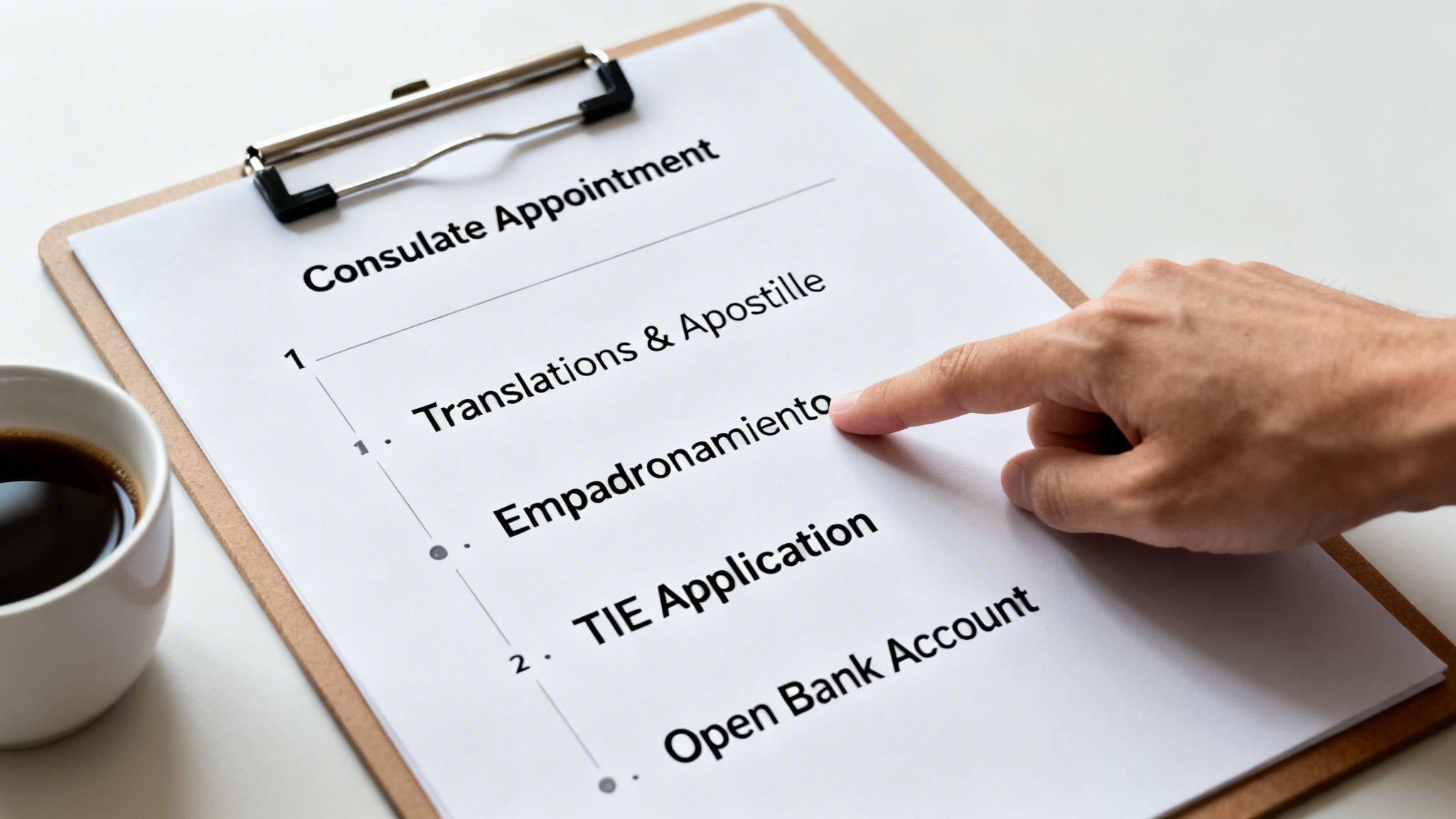
Once you’ve locked in the right visa for your situation, the real journey begins. The application process is a tale of two halves: the first part happens in your home country, and the second unfolds after you land in Spain. Think of it as a detailed travel plan—you have to hit each checkpoint in the right order for the whole trip to work.
Breaking it all down into a clear, chronological roadmap makes the process feel much less intimidating. When you know exactly what’s needed and when, you can sidestep the common mistakes and move forward with real confidence.
Phase One: The Prep Work Before You Leave
The foundation for your new life in Spain is laid long before you even think about packing. This first phase is all about putting together a perfect application for your local Spanish consulate or embassy. Let me be clear: there's no room for error here. Even a tiny mistake can set you back weeks or months.
Here are the big tasks on your to-do list:
-
Snag That Consulate Appointment: Honestly, this can be the trickiest part. Appointment slots fill up incredibly fast, so you need to book as far in advance as possible. Get familiar with your specific consulate's website and booking system.
-
Become a Document Master: Create a master checklist tailored to your visa type. This list will be your bible, covering everything from your passport and proof of funds to your criminal background check and health insurance.
-
Handle Translations and Apostilles: This step is absolutely critical and so often overlooked. Any official document that isn't in Spanish (like your birth certificate or FBI background check) must be translated by a sworn, government-certified translator. On top of that, many documents need an Apostille of The Hague—a fancy international stamp that proves they're legit.
A word of warning from experience: don't just get a standard translation or forget the Apostille. Spanish officials are sticklers for this. Submitting improperly certified documents is one of the quickest ways to get your application denied.
Phase Two: Hitting the Ground Running in Spain
Congratulations, your visa came through! You’ll have a 90-day visa stamped in your passport, which is your golden ticket into Spain. But don't get too comfortable just yet. This initial visa is just temporary, and the clock starts ticking the moment you arrive.
Once you’re in Spain, you have a few essential administrative tasks to knock out within the first month. These steps are non-negotiable for converting that temporary visa into a proper residency permit.
Key In-Country Registrations
Your first few weeks will be a whirlwind of appointments. To get your legal status squared away and start your new life properly, here’s what to focus on:
-
Empadronamiento (Town Hall Registration): This is your first and most important stop. You have to register at your local ayuntamiento (town hall) to get on the municipal census, called the padrón. This certificate is the key that unlocks everything else, from getting your TIE card to signing up for healthcare. You'll need a place to live first, and our guide to a long-term rental in Spain can help you tackle that crucial first step.
-
Applying for the TIE Card: The Tarjeta de Identidad de Extranjero (TIE) is your official foreigner's ID card. You have 30 days from arrival to book an appointment with the national police, get your fingerprints taken, and formally apply for this card. The TIE is your proof that you are a legal resident.
-
Opening a Spanish Bank Account: While you likely used an international account to show your financial means, opening a local Spanish bank account is a must for practical daily life. It makes paying bills, setting up utilities, and managing your money so much easier.
Getting these steps right—both at home and upon arrival—ensures your residency is set up correctly from day one. It’s the groundwork that makes future renewals and, eventually, permanent residency possible.
Exploring Special and Accelerated Residency Pathways
Beyond the usual residency routes, Spain has a few unique pathways that can make a world of difference for people with specific family or national ties. Think of them as shortcuts. These special options are Spain's way of acknowledging historical connections and keeping families together, often dramatically cutting down the time and paperwork needed to settle here for the long haul.
Getting to know these alternatives is smart. They could be the key to fast-tracking your journey to permanent residency or even citizenship, so let's walk through the most important ones.
Fast-Track Citizenship for Ibero-American Nationals
This is probably one of the biggest game-changers in Spanish immigration. If you're a citizen of certain countries with deep historical roots in Spain, you get to skip most of the long wait for citizenship.
Nationals from Ibero-American countries (that’s most of Latin America, including places like Argentina, Mexico, and Colombia), the Philippines, Andorra, Portugal, and Equatorial Guinea have a huge advantage. Instead of the standard ten-year wait, they can apply for Spanish citizenship after just two years of living here legally. This is all thanks to shared history and language. To qualify, you just need to keep your residency status active, avoid long trips abroad, and pass a basic exam on Spanish culture and society. You can learn more about how this works on this detailed guide.
The Family Reunification Process
Keeping families together is a big deal in Spain, and the family reunification visa is proof of that. If you've been a legal resident for at least one year (and have permission to stay for at least one more), you can start the process of bringing your immediate family over to join you.
So, who qualifies? The rules are clear:
- Your spouse or civil partner.
- Your children under 18, or older dependent children with health conditions that prevent them from caring for themselves.
- Your parents or parents-in-law over 65, but only if you can prove they depend on you financially.
The heart of a successful family reunification application comes down to two things: proving you can support everyone without needing public assistance and having a home that’s big enough for the whole family.
Keeping an Eye on Evolving Immigration Policies
Spain’s immigration rules aren’t set in stone. They change to reflect what's happening socially and economically. Just look at the recent migrant amnesty, a major policy move designed to give legal status to hundreds of thousands of undocumented people who were already living and contributing here.
Now, an amnesty isn't a route for new expats or property buyers, but it says a lot about Spain's practical approach. These kinds of policies can influence everything from the job market to housing, and they show that the government is willing to adapt. Understanding this bigger picture helps you navigate your own residency journey. And for anyone thinking about working remotely, it’s worth checking out our guide on the digital nomad visa requirements, which is another perfect example of a recent policy shift.
At the end of the day, these special pathways show that the residency requirements for Spain can be surprisingly flexible, especially if your personal history connects you to the country.
From Temporary Resident to Spanish Citizen
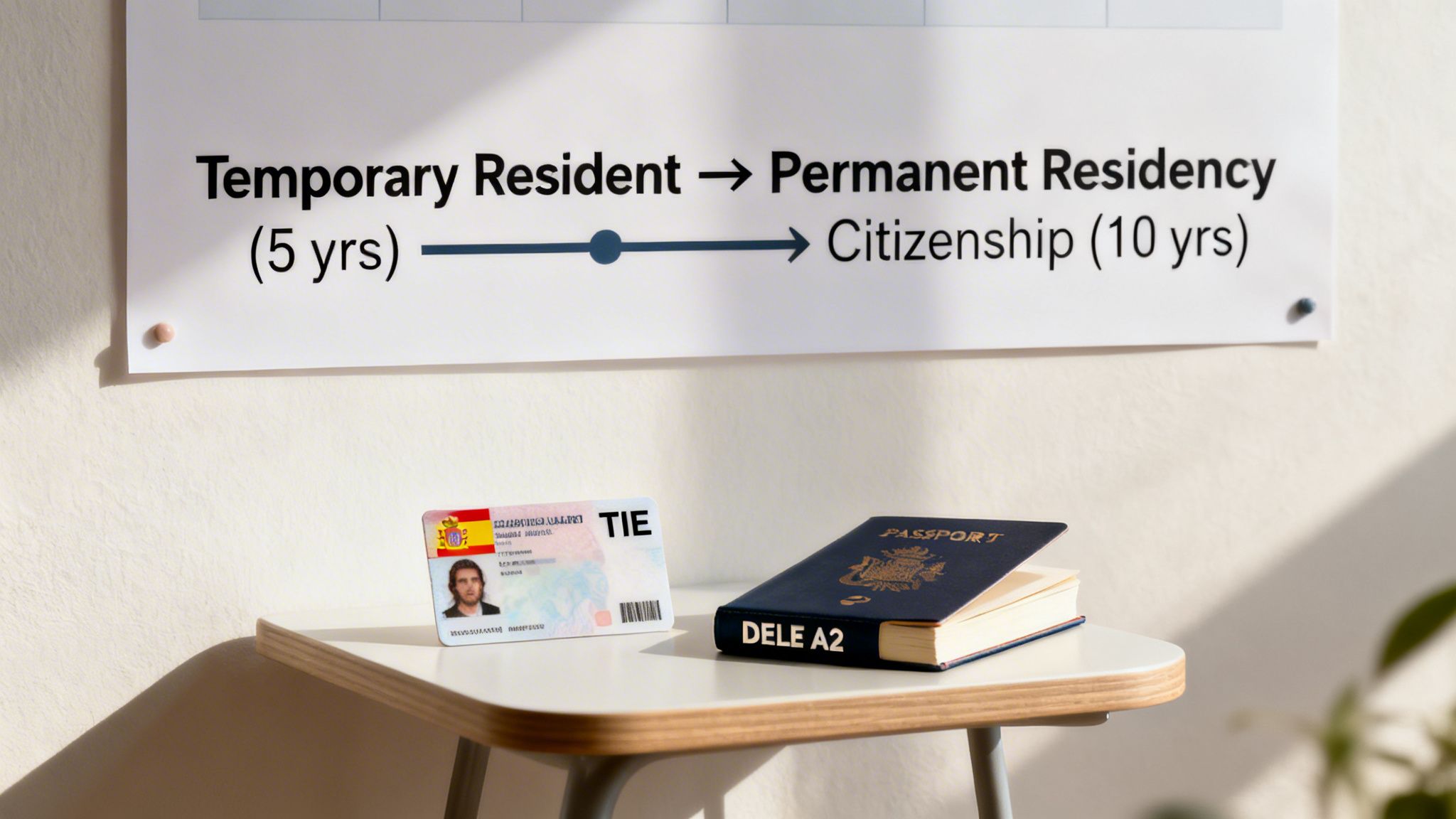
Getting that first visa is a huge win, but it's really just the starting line. Think of your time in Spain as a clear progression: you start as a temporary resident, work your way up to a long-term one, and eventually, if you choose, become a full Spanish citizen. That first year is all about laying the groundwork for your future here.
Each step on this path comes with its own set of rules and milestones. Staying legal means renewing your permit on schedule. It’s basically a check-in with the Spanish authorities to show you’re still meeting the original conditions of your visa, and it’s this paper trail that builds your case for more permanent status down the road.
The Renewal Cycle From Temporary Permits
Most first-time residency permits, like the popular Non-Lucrative Visa, are valid for just one year. As you approach the end of that year, you'll need to apply for a renewal. As long as everything is in order, you'll typically be granted a two-year extension.
You’ll repeat this process, going from your initial one-year card to a two-year card, and then renewing for another two years. The main thing officials want to see at each renewal is that your circumstances haven't changed.
- Consistent Financial Means: You have to prove you still have enough money to support yourself without taking a job in Spain.
- Continuous Health Coverage: Your private health insurance policy needs to be up-to-date and comprehensive.
- Residency Adherence: You must show that you've actually lived in Spain for the minimum required time during your permit's validity.
This 1+2+2 year cycle is the standard tempo that gets you to the five-year mark, which is a major turning point.
Achieving Long-Term Residency After Five Years
Once you’ve lived in Spain legally and continuously for five years, you can apply for long-term residency (residencia de larga duración). This is a game-changer. It gives you the right to live and work in Spain indefinitely, putting you on nearly equal footing with a Spanish citizen.
The key here is the word "continuously." To qualify, you can't have been out of Spain for more than 10 months in total over the entire five-year period. On top of that, no single trip outside the country can last longer than six months.
Securing long-term residency means you're finally off the renewal treadmill. It gives you a real sense of security and solidifies your place in Spain, letting you plan for the long haul without visa expiry dates hanging over your head.
The Final Step: Spanish Citizenship
For those who see their entire future in Spain, citizenship is the ultimate goal. The standard route requires 10 years of continuous legal residency—that’s the five years to get long-term residency, plus another five on top of that.
The citizenship application is a much bigger deal than a simple residency renewal. You'll have to prove you’ve truly integrated into Spanish society.
- DELE A2 Language Exam: You’ll need to pass an official exam to show you have a basic grasp of the Spanish language.
- CCSE Cultural Exam: This test quizzes you on your knowledge of Spanish culture, history, and how the government works.
- Clean Criminal Record: You must have a clean slate, both in Spain and any other country you've lived in.
While 10 years is standard, some people can fast-track the process. For instance, citizens of Ibero-American countries can often apply after just two years. Meeting these residency requirements for Spain is what finally turns your status from expat to a full-fledged citizen with a Spanish passport in hand.
Understanding Your Financial and Tax Obligations
Moving to Spain and becoming a legal resident is about more than just finding the perfect property. You’re also plugging into a new financial world, and the biggest change you'll face is becoming a Spanish tax resident.
It all boils down to one simple, non-negotiable rule: the 183-day rule. If you live in Spain for more than 183 days in a single calendar year, the Spanish government considers you a tax resident. That's it. It’s a hard line in the sand.
Once you cross that 183-day mark, your financial obligations shift dramatically. As a tax resident, you're required to declare your worldwide income to the Spanish tax authority, the Agencia Tributaria. That means everything—your pension, investment dividends, rental income from a property back home—all of it falls under their jurisdiction. Non-residents, on the other hand, only pay tax on income they earn in Spain.
Key Taxes Every Resident Should Know
Getting a handle on your new financial life means getting to know a few key taxes. As a property owner and resident, these are the main ones that will be on your radar.
- IRPF (Income Tax): This is the progressive tax on your yearly income. The rates climb with your earnings and can vary a bit depending on which region you live in.
- Patrimonio (Wealth Tax): A tax on your net worldwide assets. It sounds intimidating, but the allowances are quite generous, so in reality, most residents don't end up paying it.
- IBI (Property Tax): Think of this as the Spanish equivalent of council tax. It's a local tax paid annually to your town hall (ayuntamiento) for owning property.
There's also a fantastic tax break for certain high-earning professionals called the Beckham Law. If you qualify, it lets you be taxed like a non-resident for your first six years. This means you pay a flat rate only on your Spanish-earned income, which can lead to some serious savings.
The switch to becoming a Spanish tax resident can catch a lot of people by surprise. Getting professional tax advice before you make the move is probably the smartest investment you can make. It helps you stay compliant and sidestep any expensive headaches down the road.
It’s also smart to keep an eye on how broader immigration policies might affect things. For example, Spain's recent migrant amnesty—one of the largest in Europe—is set to grant legal status to up to 500,000 people to help fill labor shortages. While this won't change the residency rules for property buyers, it’s bound to have a ripple effect on local housing and rental markets. You can read more about Spain's evolving immigration policies here.
Got Questions? Let's Talk Spanish Residency
Getting your head around the different residency rules in Spain can feel a bit overwhelming. Let's clear up some of the most common questions people ask, so you can move forward with a clear plan.
Can I Work Remotely on a Non-Lucrative Visa?
This is a big one, and the answer is a firm no. The Non-Lucrative Visa (NLV) is built on one core principle: you cannot engage in any professional work or economic activity in Spain.
Think of it as a "retirement" or "sabbatical" visa. All your income must be passive, flowing from things like investments, pensions, or substantial savings. If your plan is to work online for clients or companies outside of Spain, you’re looking at the wrong visa. The right one for that is the Digital Nomad Visa, which was designed specifically for remote workers.
How Long Can I Be Out of Spain and Keep My Residency?
This is where you need to be careful, as the rules change depending on how long you've been a resident.
- During your first five years (temporary residency): You can't be out of Spain for more than six months within any one-year period.
- Once you have long-term residency (after five years): The rules get a bit more generous. You can't be away from the European Union for more than 12 consecutive months. Also, your total time outside the EU over the last five years can't add up to more than 30 months.
Staying within these limits is absolutely critical. We've seen people get their renewal applications rejected for this reason alone, which means their clock for permanent residency gets reset back to zero.
Do I Need to Speak Spanish to Get a Visa?
For your initial residency application, the answer is no. You don't have to prove any Spanish language ability to get a Non-Lucrative, Golden, or Digital Nomad Visa.
However, if your long-term goal is to become a Spanish citizen, that's a different story. You'll need to pass two specific tests:
- The DELE A2 Spanish language exam, which demonstrates a basic conversational ability.
- The CCSE cultural knowledge test, which covers Spanish society, history, and government.
So, while it's not needed upfront, starting to learn the language from day one will make your life in Spain infinitely better and keep the door to citizenship open.
Is Private Health Insurance Really Mandatory?
Yes, for almost every non-EU residency path, having comprehensive private health insurance is non-negotiable. This is one of the pillars of the Spanish residency requirements.
Your policy has to come from an insurance company that's authorized to operate in Spain, and it must offer coverage that’s just as good as the public health system. Most importantly, it can't have any co-payments or deductibles. You'll need to show proof that you're covered for your entire first year.
Ready to find your perfect home in Spain? At Residaro, we simplify your search for European real estate. Explore our curated listings and start your journey today.