How to Ship Furniture Overseas - The Definitive Guide
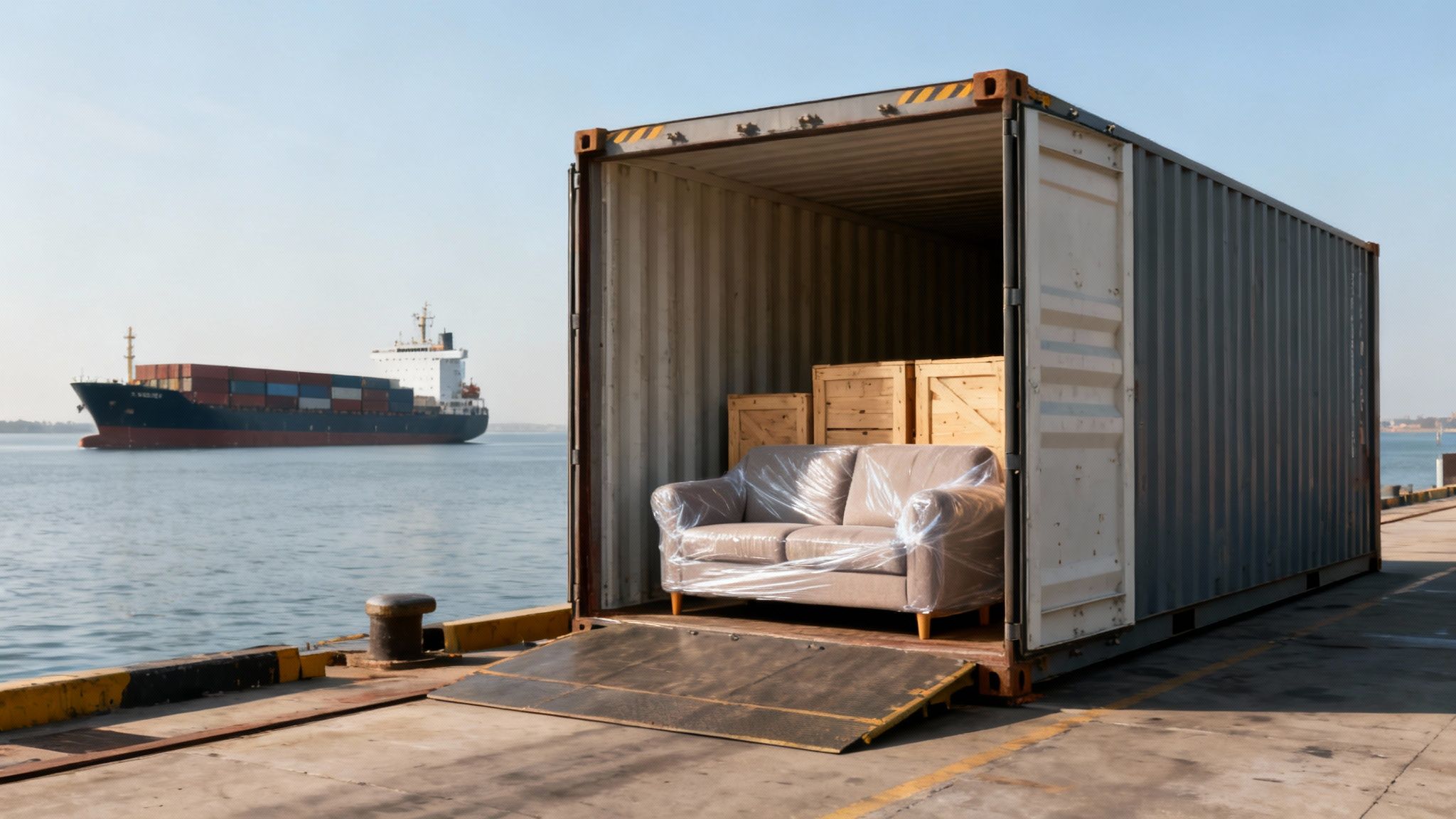
Moving furniture overseas can feel like a massive puzzle, but it really boils down to a few key decisions: picking your shipping method, getting solid quotes, packing everything securely, and navigating the paperwork. It takes some forethought, but with a clear plan, you can get your belongings from point A to point B without all the stress.
Your Essential Pre-Shipment Checklist
Let's be honest, shipping your entire life across an ocean is a big deal. The best way to tackle it is by breaking it down into smaller, manageable pieces. This isn't just about logistics; it's about making smart decisions right from the start.
The first, and arguably most important, step is deciding what’s actually worth the trip. It's tempting to take everything, but that's rarely the most cost-effective choice.
- High-Value or Sentimental Pieces: Absolutely. Your grandmother's antique dresser, custom-built furniture, or that piece of art you love? Those are the items that make a new house feel like home. They’re worth the effort.
- Inexpensive or Standard Items: That IKEA bookshelf you've had since college? Or the mattress you were planning to replace soon anyway? It's almost always cheaper to sell or donate these and just buy new ones when you arrive.
- Appliance Compatibility: This is a big one. A U.S. refrigerator won't just plug into a European wall. You need to check the voltage and plug types for every single appliance. Shipping a 2,000-watt U.S. appliance might require a bulky, expensive converter, making it completely impractical.
Key Planning Milestones
Once you've sorted your "keep" pile from your "leave" pile, the real planning begins. This is where you map out the nuts and bolts of the move. A huge part of this, especially for those coming from the States, is getting a handle on the rules of your new country. For example, our guide on how to move to Spain from the US dives into the specific customs requirements that can make or break your shipment.
I see this all the time: people completely underestimate the timeline. Door-to-door sea freight can easily take 8-12 weeks. Add in potential customs delays, and you should really start the planning process at least three to four months before you need your things.
Getting this initial phase right sets the stage for everything else. It’s not just about putting stuff in boxes. It's about making smart financial choices. When you approach shipping companies with a detailed inventory and a clear idea of what you need, you’ll get much more accurate quotes and avoid those nasty last-minute surprises. This prep work ensures your most treasured belongings are tracked and accounted for every step of the way.
Choosing Between Sea and Air Freight
One of the first big decisions you'll face when moving furniture overseas is whether to send it by sea or by air. This choice is a cornerstone of your entire plan, fundamentally shaping your budget, timeline, and even how you pack. It’s easy to boil it down to “slow and cheap” versus “fast and expensive,” but there’s a bit more to it, especially when your life’s possessions are on the line.
Ultimately, three things will steer you in the right direction: your budget, how quickly you need everything, and just how much stuff you’re actually moving. Think of it like a simple decision tree.

As you can see, your priorities tend to point you toward a clear answer. If cost is your main concern, the path almost always leads to the ocean. If you’re racing against the clock, you’ll be looking to the skies. Let's dig into what that means in the real world.
The Case for Sea Freight: Your Workhorse Option
For most international moves, especially when a whole house is involved, sea freight is the go-to for a reason. It's the only way to move a large volume of goods without completely blowing your budget. The sheer capacity of modern container ships makes it incredibly efficient, connecting major ports around the globe on surprisingly regular schedules.
But "sea freight" isn't a one-size-fits-all solution. You’ll have two main choices here:
- Full Container Load (FCL): This is where you get your very own 20-foot or 40-foot steel box. It's the perfect choice if you’re moving a two-bedroom apartment or more. The big advantage? Your container is sealed at your old home and isn't opened again until it clears customs on the other side, giving you an extra layer of security.
- Less than Container Load (LCL): If you're only shipping a few key pieces—maybe an antique dining set, a few pieces of art, and some boxes—you can share container space with other people. Your items are professionally crated and loaded into a shared container.
LCL is definitely easier on the wallet for smaller shipments. The trade-off is that it can take a little longer since the container has to be consolidated and then de-consolidated at the destination port, which also means a bit more handling.
When to Consider Air Freight
Think of air freight as the express courier service for your belongings. The main reasons to choose it are speed and security. A shipment can cross the globe in a few days, not weeks or months. This speed comes at a premium, of course, so it’s usually reserved for specific, high-priority situations.
When does paying 5 to 10 times more than sea freight actually make sense?
The rule of thumb is to use air freight when the cost of not having an item is greater than the cost of shipping it.
For instance, say you’re a designer who needs a specialized drafting table to start work at your new overseas job. Waiting a month for it to arrive by sea could mean a month of lost income. In that scenario, the high shipping cost becomes a smart business investment.
Another great example is shipping a child’s bed, favorite toys, and familiar bedding ahead by air. It can make a world of difference in helping them feel settled and secure from the very first night in a new country. It’s a strategic choice that pays off in emotional well-being, not just dollars and cents.
Making the Final Decision
For many people, the best solution isn't an either/or choice. A hybrid approach often works brilliantly. You can ship the bulk of your household—the sofas, bookshelves, and general clutter—in a sea container to keep costs down.
At the same time, you can send a smaller, curated shipment by air. This "essentials" box might contain key kitchen items, a couple of weeks' worth of clothes, bedding, and your home office setup.
This way, you get the best of both worlds. You have what you need to live comfortably as soon as you land, turning those first few weeks into a productive and pleasant settling-in period instead of a waiting game. It’s the cost-efficiency of sea freight combined with the immediate convenience of air.
Decoding Shipping Quotes and Insurance
Getting your first international shipping quote can be a bit of a shock. You’re often faced with a wall of text, packed with confusing line items and industry jargon. It’s almost impossible to figure out what you’re actually paying for. But learning to read between the lines is the only way to compare apples to apples and avoid a surprise bill on moving day.
A good, transparent quote should map out the entire journey for your belongings. It's not just about the price for the boat or plane ride; it has to account for every step at the beginning and end of the trip.
What to Look for in a Shipping Quote
When that quote lands in your inbox, resist the urge to just scroll to the bottom line. The real story is in the details. A reputable company will itemize everything, giving you a clear, door-to-door picture of the costs.
Here’s a breakdown of what you should see:
- Origin Charges: This is everything that happens before your stuff even hits the water. Think container costs, trucking it to your old house for loading, and then hauling it to the port or airport.
- Freight Charges: This one's straightforward—it's the main charge for the actual sea or air transit. For ocean freight, this will likely be the biggest single cost on your bill.
- Destination Charges: Once your shipment arrives, a whole new set of fees kicks in. This bucket includes everything from port fees and terminal handling charges to customs clearance and the final truck journey to your new home.
- Customs Brokerage: You're paying a professional to handle the mountain of paperwork required to get your belongings into the country. It’s a service you don’t want to skimp on, as it’s critical for a smooth process.
Be wary of any quote that seems too good to be true. A common pitfall is a cheap "port-to-port" offer. This leaves you on the hook for all the destination charges and forces you to navigate the complexities of customs and final delivery all by yourself. It’s a recipe for stress and unexpected expenses.
Always insist on a "door-to-door" quote. It’s the only way to get a realistic budget that covers all foreseeable costs, from your old front door to your new one.
The Non-Negotiable Role of Insurance
If there’s one corner you absolutely cannot cut, it’s insurance. People are often floored when they learn how little protection they get by default. Under international maritime law, a carrier’s liability might be capped at a mere $500 per container. That’s it. Whether you’re shipping a priceless antique collection or a few boxes of books, the payout is the same. That won't cover the cost of a single decent sofa, let alone a house full of furniture.
This is exactly why marine cargo insurance is essential. It's your financial safety net, protecting the actual value of your goods against loss or damage while they're in transit. This isn't an upsell; it's a fundamental part of any secure international move.
When you start looking at policies, you’ll generally find two main options:
- All-Risk Insurance: This is the most comprehensive coverage you can get. It protects your belongings against almost anything, except for a few specific exclusions listed in the policy. For a household move, this is almost always the right choice.
- Total Loss Only: Just as it sounds, this policy only pays out if the entire shipment is destroyed—say, the ship sinks. It’s significantly cheaper, but it offers zero protection against partial damage, which is a far more likely scenario.
The key to making your insurance work for you is to accurately declare the value of your items on an inventory list. This "valued inventory" is precisely what the insurance company uses to calculate a payout if you need to make a claim. It feels like a tedious task, but taking the time to list the replacement value for everything you own is your best defense.
For those setting up a second home, the nuances of property protection are even more critical. Our guide on insurance for holiday homes dives deeper into safeguarding your property abroad. Ultimately, the right policy can turn a stressful, high-stakes process into a well-managed and protected one.
Navigating Customs Paperwork and Regulations
Let's be honest, the mere mention of customs paperwork is enough to give anyone a headache. It's the bureaucratic heart of international shipping, where one tiny mistake on a form can leave your prized possessions stuck in port, racking up frustrating and expensive delays.
But it doesn't have to be that way. With a bit of foresight and a methodical approach, you can put together a flawless set of documents that will see your shipment clear customs without a hitch. Think of it as creating a passport for your furniture—every detail has a purpose and getting it right is non-negotiable.
Assembling Your Core Documents
While the specifics vary from one country to another, a handful of documents are standard for almost any international move of personal belongings. Your shipping company will walk you through the process, but knowing what these forms are and why they matter puts you in the driver's seat.
- Bill of Lading (B/L): This is the big one. It's the master document issued by the shipping carrier that serves as a contract, a receipt for your goods, and proof of ownership. You literally can't claim your container at the destination without it.
- Detailed Packing Inventory: This isn't just a simple list for your own reference; it's an official declaration for customs. You need to itemize the contents of every single box, including a brief description and an estimated value. Vague descriptions like "kitchen stuff" are a major red flag for customs officials and will invite scrutiny.
- Shipper's Declaration Form: This is your sworn statement to the authorities, officially confirming that the shipment contains used personal household goods and declaring its total value.
Getting the level of detail right on your inventory is crucial. For instance, don't just write "Box 1 - Kitchen." A proper entry would look more like, "Box 1 - Kitchenware (6 plates, 6 bowls, cutlery set), Value: $150."
Understanding Duty-Free Entry
One of the biggest financial wins when moving abroad is that most countries let you import used personal effects duty-free. This can save you a small fortune, but it's not automatic—you have to meet strict criteria.
Typically, you need to prove two main things:
- Prior Residency: You have to show you've lived in the country you're leaving for a minimum time, which is usually at least 12 consecutive months.
- Prior Ownership: The items you're shipping must have been owned and used by you for a certain period, often at least six months, before you ship them.
A classic rookie mistake is shipping brand-new items still in their original packaging. To a customs agent, this screams "resale," not "personal use," and can easily trigger a hefty bill for import duties and taxes.
To back up your claim for duty-free status, be ready with supporting documents. Things like old utility bills or a rental agreement prove your residency, while receipts for any newer-looking furniture or electronics can help establish ownership history.
Researching Restricted and Prohibited Items
What you can't ship is just as important as what you can. Every country maintains a list of items that are either banned outright or heavily restricted. Doing your homework here is non-negotiable if you want to avoid fines, confiscation, or having your entire container flagged for a time-consuming inspection.
Commonly restricted items often include:
- Certain types of untreated wood that might harbor pests.
- Alcohol and tobacco, which are almost always hit with high taxes.
- Firearms and ammunition, which require a mountain of special permits.
- Plants, soil, and many food products.
The rules are always changing, too. For example, with roughly 60% of global trade happening within regional economic blocs like the EU, you're often navigating a unified but complex set of regulations. You can get a sense of how evolving trade patterns affect the furniture market at World Furniture Online.
Given how complex import laws and international property rights can be, getting expert advice is a smart move. Our guide on finding an international real estate lawyer offers great insight into securing professional help. A little due diligence upfront ensures your shipment is fully compliant and saves you from major headaches down the road.
Professional Packing for International Transit
When you’re shipping furniture across an ocean, you need to think differently about packing. This isn’t a weekend move across town. Your belongings are about to embark on an industrial-strength journey—lifted by cranes, stacked high in a container, and sailing through who-knows-what kind of weather for weeks.
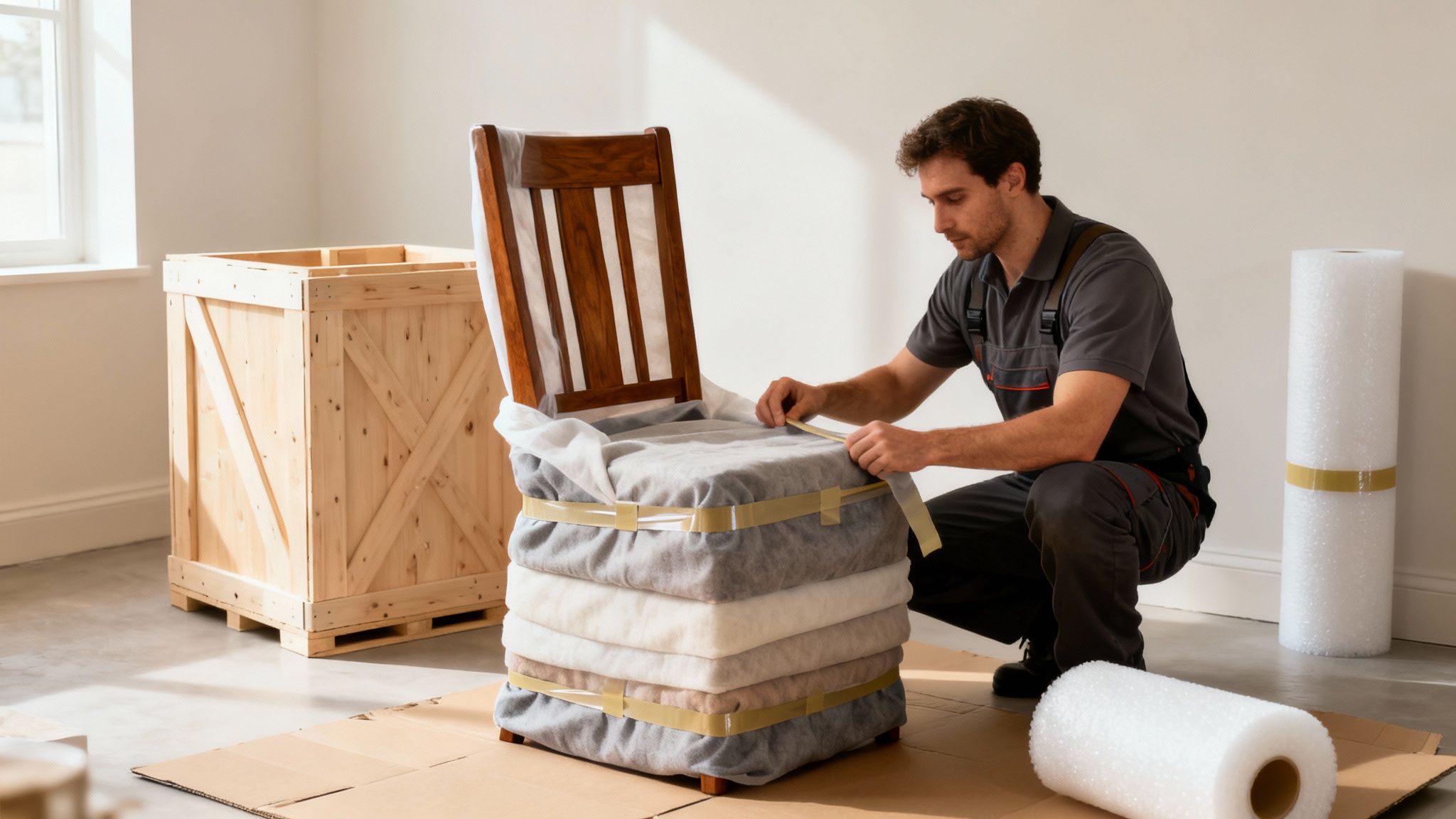
Proper, professional-grade packing is the only real defense your furniture has. Think of it this way: the goal is to create solid, tightly-packed blocks inside your container that can't shift or jiggle, no matter how much the ship rocks and rolls. Poorly packed items don't just risk damaging themselves; they can become projectiles that wreck everything else around them.
Essential Materials and Techniques
Forget the standard moving boxes and bubble wrap from the local hardware store. For an international shipment, you need to step up your game with industrial-quality supplies.
- Multi-Layer Furniture Blankets: These are the real deal—thick, padded blankets that provide serious cushioning, far superior to the thin quilts you might use for a local move.
- Corrugated Cardboard Sheets: After wrapping an item, an outer shell of corrugated cardboard adds a crucial layer of puncture resistance.
- Shrink Wrap: This stuff is your best friend. It compresses all the padding, keeps drawers shut, and seals everything off from dust and moisture.
- Custom Wooden Crates: For that antique mirror, glass dining table, or priceless piece of art, don't even think twice. A custom-built crate is a non-negotiable investment in its survival.
One of the smartest things you can do is disassemble everything you can. Take the legs off tables, detach headboards, and remove any part that sticks out. This makes pieces less awkward and drastically reduces the chance of something snapping off in transit. Just be meticulous: put all the nuts and bolts in a clearly labeled bag and tape it securely to the main furniture piece. You’ll thank yourself later.
The DIY vs. Professional Packing Dilemma
This is a big one. Do you roll up your sleeves and pack yourself, or do you hire the pros? It's a classic battle of cost versus risk. Going the DIY route can definitely trim the upfront bill, but it's a gamble you need to think about carefully.
Here's a critical piece of insider knowledge: Most marine cargo insurance policies will offer very limited (or zero) coverage for damage to items inside boxes marked "Packed by Owner" (PBO). From the insurer's perspective, they have no way of knowing if you did a good job, so it's a risk they're not willing to take.
Professional movers are trained specifically for the rigors of sea freight. They understand weight distribution inside a container, how to brace furniture so it doesn't budge, and exactly how much padding to use. That expertise is really what you're paying for, and it often saves you money in the long run by preventing heartbreaking damage.
If your budget is screaming for a compromise, look into a hybrid approach. You can tackle the non-breakables yourself—books, clothes, linens, that sort of thing. Then, leave the big, valuable, and fragile pieces to the professionals. Your dining room set, that beautiful armoire, and all your electronics are best left in their expert hands. This way, you save a bit of cash without risking your most cherished possessions on their long journey.
The Final Mile: Delivery and Unpacking at Your New Home
After weeks, maybe even months, your furniture has finally arrived. It’s cleared customs and is ready for that last leg of the journey from the port or warehouse to your new front door. But how it gets there isn't just a simple drop-off; you have a couple of important choices to make that will affect your budget and your first few days of settling in.

Most shipping companies will present you with two very different delivery scenarios. Knowing what you're signing up for is key.
Curbside vs. White-Glove Service
-
Curbside Delivery: Think of this as the no-frills, DIY option. It's the most cost-effective choice, where the delivery truck pulls up and drops your container or pallet at the nearest accessible spot—usually your driveway or the curb. From that point on, you are entirely on your own. That means unloading every box, hauling it inside, unpacking, and getting rid of all the pallets and packaging.
-
White-Glove Service: This is the all-inclusive, stress-free alternative. A professional moving team doesn't just drop things off; they carry everything inside, place furniture in the rooms you designate, unwrap it all, handle basic assembly (like putting legs on a table or setting up a bed frame), and best of all, they clean up and haul away the mountain of packing debris. It costs more, but after an exhausting international move, it can be worth every penny.
Your Most Important Job: The Delivery Day Inspection
This is it. The single most crucial moment for protecting yourself if something went wrong in transit. Before you even think about signing the delivery receipt (often called a Bill of Lading), you have to inspect your shipment. Once you put your signature on that document without noting any issues, you are legally accepting the goods in the condition they arrived, which can make it almost impossible to file a successful insurance claim later.
Don't let the delivery crew rush you. Their job is to get a signature and move on. Your job is to protect your belongings. Politely but firmly insist on taking the time you need to check everything over. This is your one and only chance to document damage.
Here's what to do, step-by-step:
-
Start with the Outside: Before unwrapping a single thing, examine the boxes, crates, and wrapping. Look for any signs of trouble—crushed corners, deep gouges, tears, or water damage. Note any of these observations directly on the delivery receipt before signing.
-
Unwrap and Inspect High-Value Items: You don't have to unbox everything on the spot, but you absolutely should open your most fragile or valuable pieces. Unwrap them and check all surfaces—front, back, and underneath—for any new scratches, dents, or cracks.
-
Take Pictures of Everything: Your phone is your best friend here. Snap photos of the damaged packaging before you open it. Then, take clear, well-lit pictures of any damage you find on the furniture itself. These photos are invaluable evidence for an insurance claim.
-
Be Incredibly Specific: Don't just write "Box damaged." Be descriptive. On the delivery receipt, write things like, "Deep 6-inch scratch on top of oak dining table," or "One leg of leather armchair cracked at base." The more detail, the better.
Only sign the paperwork after you've completed a thorough check and documented every single issue. This simple act of diligence is the best way to ensure you're covered if any of your furniture had a rough journey.
Common Questions About Shipping Furniture Overseas
Even with the best-laid plans, a few nagging questions are bound to pop up when you're thinking about how to ship furniture overseas. Let's tackle some of the most common ones we hear from people just like you, so you can move forward with confidence.
Is It Cheaper to Ship Furniture or Buy New?
This is the big one, isn't it? The honest answer is that it really comes down to the specific piece of furniture.
If you're talking about inexpensive, flat-pack items, you'll almost certainly save money by selling them and buying new when you arrive. The shipping cost for a basic bookshelf from IKEA, for example, will likely be more than what you paid for it.
On the other hand, for high-quality pieces, family heirlooms, or that custom-made dining table you adore, shipping is often the smarter move both financially and emotionally. The best way to decide is to get a few shipping quotes and compare that total to what it would cost to buy a similar-quality item in your new country. And don't forget the sentimental value—some things are just priceless.
How Long Does Sea Freight for Furniture Take?
When shipping by sea, patience is key. The actual time your container spends on the water, from port to port, is usually between four to eight weeks.
But that's not the whole story. The full door-to-door timeline is quite a bit longer. When you add in packing, trucking to the port, customs clearance, and final delivery, you should plan for a total transit time of eight to twelve weeks, sometimes even longer. This can all be affected by your specific route, how busy the ports are, and how quickly customs officials work at your destination.
Can I Pack My Own Boxes for an International Move?
You absolutely can, but you need to know what you're getting into. Shipments with boxes marked "Packed By Owner" (PBO) have a higher chance of being pulled aside for a full customs inspection. This can lead to annoying delays and extra fees you didn't budget for.
The bigger issue, though, is insurance. Most marine insurance policies will not cover damage to items inside boxes you packed yourself, or the coverage will be extremely limited. Insurers can't verify how well you packed, so they won't take on the risk. If you're shipping anything fragile or valuable, letting the professionals handle the packing is a smart investment.
What Items Are Prohibited in International Shipments?
For safety and legal reasons, some items are a definite no-go in any international shipment. This list nearly always includes:
- Hazardous materials like paints, aerosol cans, batteries, and many cleaning supplies.
- Perishable foods, live plants, and soil.
- Liquids, especially alcohol, which usually has its own hefty import taxes.
- Firearms and ammunition, which require a mountain of special permits.
Beyond these universal rules, every country has its own quirky list of restricted or prohibited items. This could be anything from certain types of untreated wood to cultural artifacts or even specific electronics. Before you pack a single box, get a detailed list of prohibited items for your destination country directly from your shipping company. It’s the only way to be sure you won’t have your things confiscated at the border.
Planning your move to Europe? Let Residaro help you find the perfect place to call home. Explore our extensive listings of beautiful properties across Spain, Italy, France, and beyond at https://residaro.com.