How to Finance a Vacation Home The Smart Way

Financing a vacation home is probably more straightforward than you think. Most people go one of three routes: a standard second home mortgage, tapping into their primary home's equity, or making a cash purchase. The key thing to remember is that lenders see these properties differently than your main residence, so getting your finances in order is the first real step to getting the keys to your getaway.
Your Guide to Vacation Home Financing
When you're buying a vacation home, you're playing by a different set of financial rules. Lenders see a second home as a greater risk—after all, if someone hits a rough patch financially, they're more likely to stop paying for the vacation spot than the house they live in. Because of this, you can expect the qualification standards to be tougher.
This shift in risk means you'll face more scrutiny. Lenders will want to see solid proof that you can comfortably carry two mortgages without stretching yourself too thin.
Key Differences from Primary Home Loans
It really helps to see things from the lender's point of view. Here are the main differences you’ll run into when you start looking for financing:
- Bigger Down Payments: You might get a primary home with as little as 3-5% down, but that's not the case here. For a vacation home, expect to put down 10% to 20%, sometimes even more. A larger down payment shows you're serious, lowers the lender's risk, and often gets you a better interest rate.
- Tougher Credit Score Hurdles: Lenders will be looking for a credit score of at least 680. To get the best possible rates, you'll really want to be in the 740+ range.
- Lower Debt-to-Income (DTI) Ratios: Your DTI—which is just your total monthly debt payments divided by your gross monthly income—is a huge deal. Lenders will put this number under a microscope, and they generally want to see it stay below 43%, even after adding the new mortgage payment.
Before you get too deep in the weeds, it's a good idea to see the main financing paths laid out side-by-side. The best route for you really comes down to your personal financial picture—how much cash you have on hand, how much equity you have, and your overall comfort level. If you're still on the fence, our guide on whether you should buy a vacation home can help you think through the decision.
A quick heads-up from experience: Lenders care a lot about how you plan to use the property. A true "second home" is for your personal use, while an "investment property" is mainly to generate rental income. Your answer will change your loan terms and down payment requirements, so be clear about your intentions from the start.
Vacation Home Financing Options at a Glance
To help you get a clear map of the financial landscape, I've put together a quick comparison table. Think of it as a cheat sheet for figuring out which financing method might be the best fit for you.
| Financing Method | Typical Down Payment | Interest Rate | Best For |
|---|---|---|---|
| Second Home Mortgage | 10% - 25% | Slightly Higher | Buyers who want a separate, traditional loan for their vacation property. |
| HELOC / Cash-Out Refi | N/A (Uses Equity) | Variable or Fixed | Homeowners with significant equity in their primary residence. |
| Cash Purchase | 100% | N/A | Buyers with liquid funds seeking a simple transaction and negotiating power. |
Each of these paths has its pros and cons. A traditional mortgage keeps your properties financially separate, using your home's equity can be a flexible and lower-cost option, and of course, cash is king if you're looking for simplicity and a strong negotiating position.
Getting the Keys: Your Main Financing Options
Alright, you've done the dreaming, and now it's time to talk money. Figuring out how to finance your vacation home can feel overwhelming, but it really boils down to a few core strategies. The best path for you will depend entirely on your financial picture, how comfortable you are with risk, and what your long-term plans are.
Let’s get into the nitty-gritty of how people actually make this happen.
The Traditional Route: A Second-Home Mortgage
The most straightforward approach is to get a conventional second-home mortgage. Think of it just like the mortgage on your primary residence, but with a few extra hurdles. Lenders see a second home as a bit riskier, so they tighten the requirements.
You should plan on a larger down payment. While you might get away with 10%, putting down 20% or more is the real sweet spot. It helps you dodge private mortgage insurance (PMI) and usually unlocks better interest rates. Speaking of rates, expect them to be a touch higher than for a primary home, often by about 0.25% to 0.75%.
This is a great option if you like to keep your finances neatly separated. Your vacation home has its own loan, and it doesn't get tangled up with your primary residence. To pull this off, though, your finances need to be in great shape. We're talking a strong credit score (aim for 740+) and a low debt-to-income (DTI) ratio to get the most favorable terms.
Using the Equity in Your Current Home
If you've been a homeowner for a while, you've likely built up some serious equity. Putting that value to work is one of the smartest ways to fund a second home. The two main ways to do this are with a Home Equity Line of Credit (HELOC) or a cash-out refinance.
A HELOC is basically a credit line that uses your home as collateral. You get approved for a set amount and can draw from it as needed, only paying interest on what you actually borrow. It's incredibly flexible, making it perfect for covering a down payment or even the entire purchase if your equity is high enough.
Some things to keep in mind with a HELOC:
- Variable Interest Rates: The rate isn't fixed, so your payments can change over time. This is a crucial risk to be aware of.
- Draw and Repayment Periods: Typically, you get a 10-year "draw period" to use the funds, followed by a "repayment period" to pay it all back.
- Lower Closing Costs: Upfront fees are usually much lower than with a traditional mortgage.
The other option is a cash-out refinance. Here, you replace your existing mortgage with a new, larger one and pocket the difference in cash. This can be a brilliant move if you can also lock in a lower interest rate on your primary mortgage, letting you knock out two birds with one stone.
Expert Insight: Before you jump on a cash-out refi, do the math on your breakeven point. Closing costs can run 2-5% of the new loan. You need to be sure the long-term savings from a lower rate will more than cover those upfront costs.
The Ultimate Advantage: Paying with Cash
If you're in a position to make an all-cash offer, you're in the driver's seat. It's the cleanest and fastest way to buy a property, letting you sidestep the entire mortgage process—no applications, no appraisals, no underwriting headaches.
Going in with cash gives you some serious firepower:
- Serious Negotiating Power: Sellers love cash offers. They're simple and far less likely to fall through, which often gives you the leverage to negotiate a better price.
- Zero Interest Payments: Over the years, you'll save a massive amount of money that would have otherwise gone to interest.
- Instant Ownership: The property is 100% yours from day one.
Of course, paying with cash only makes sense if it doesn't wipe out your savings. You never want to leave yourself without a solid financial safety net for emergencies or retirement.
The good news for everyone is that the mortgage market is showing signs of life. Projections show the single-family mortgage market, which includes vacation homes, is expected to grow, with total originations forecasted to hit $2.2 trillion in 2026. This trend points toward more lending options and potentially better rates for buyers. You can explore the complete mortgage forecast on MBA.org to see the full analysis.
Getting Past the Gatekeepers: What Lenders Look for in a Second Home Buyer
When you're ready to finance a vacation home, remember that you're playing a slightly different game than when you bought your primary residence. Lenders view a second home as more of a luxury and, therefore, a higher risk. They need to be absolutely certain you can handle the financial weight of two properties without breaking a sweat.
The first and most obvious hurdle is the down payment. Forget the low-down-payment options you might see for first-time homebuyers. For a vacation property, you’ll need more skin in the game. Plan on putting down at least 10%, but the magic number is really 20% or more. Hitting that 20% threshold is key—it often helps you dodge private mortgage insurance (PMI) and unlocks the most competitive interest rates.
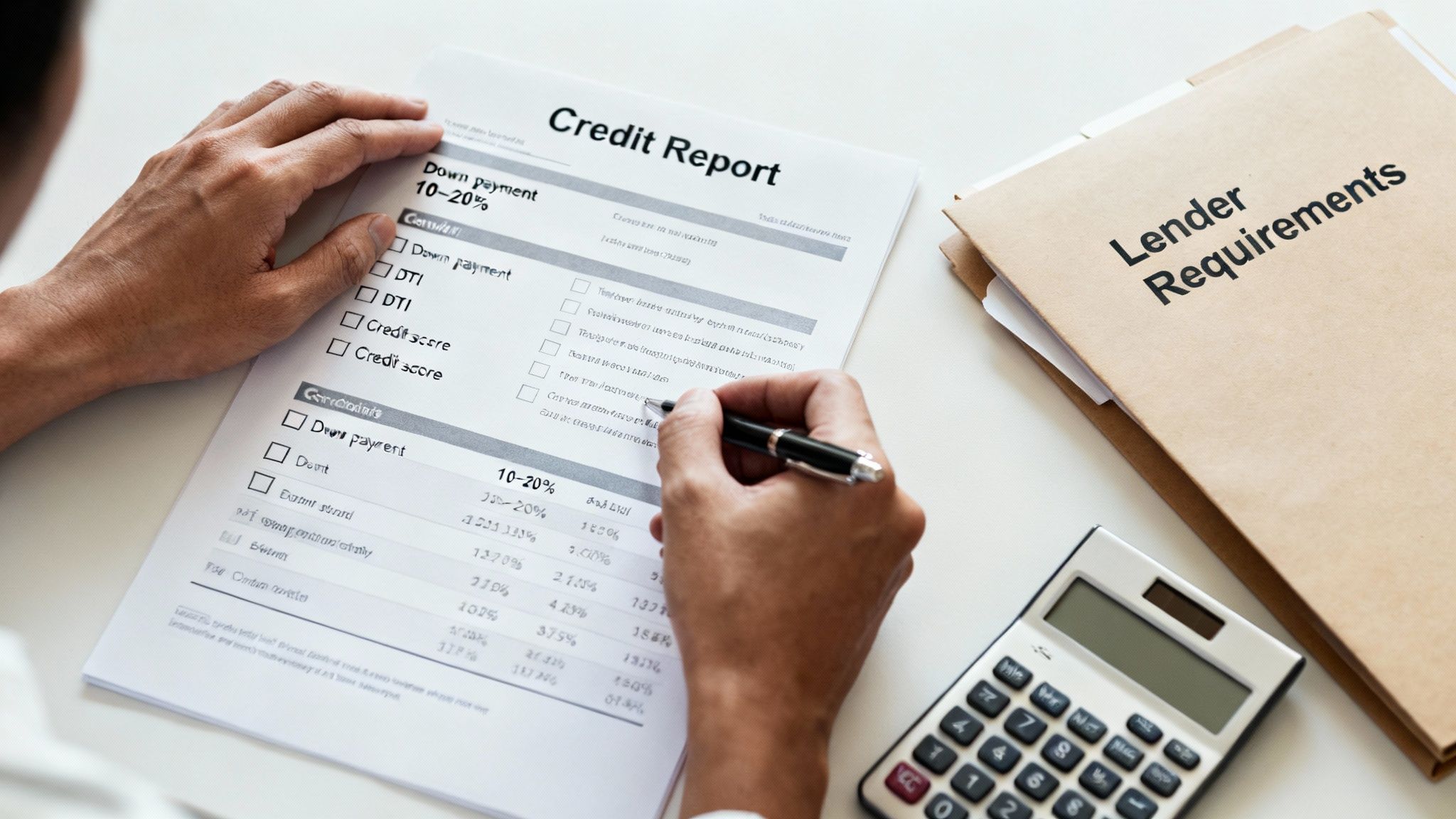
This upfront investment directly influences your loan-to-value (LTV) ratio, which is just the loan amount compared to the home's official appraised value. A 20% down payment gets you to an 80% LTV, a benchmark that tells lenders you're a serious, financially sound borrower. A lower LTV means less risk for them and almost always translates into better loan terms for you.
Beyond the Down Payment: The Three Pillars of Qualification
While the down payment is a big deal, lenders dig much deeper into your financial life. They generally focus on three other core metrics to decide if you qualify.
First up is your credit score. This number is their shorthand for your track record as a borrower. For a second home, you’ll likely need a score of 680 or higher to even be considered. But if you want the best rates the market has to offer, you should be aiming for 740+. It’s always a good idea to check your credit report well before applying to catch and fix any errors.
Next, they’ll scrutinize your debt-to-income (DTI) ratio. This is a simple calculation: your total monthly debt payments (your existing mortgage, car loans, student loans, credit card payments) divided by your gross monthly income. With the new vacation home mortgage added in, lenders want to see this number stay below 43%. Some are even more conservative and look for a DTI under 36%.
Let's make that real. Say your gross monthly income is $10,000. To stay under the 43% DTI cap, your total monthly debt obligations—including both mortgages—couldn't exceed $4,300. Running this calculation yourself is a great way to ground your budget in reality.
Finally, you'll need to prove you have ample cash reserves. This is your financial cushion. Lenders need to see that you have enough liquid cash to cover the mortgage payments on both your homes for several months, just in case life throws you a curveball. Be ready to show statements proving you have two to six months of payments for both properties sitting in a bank or investment account.
To give you a clearer picture, here’s a quick rundown of what lenders are looking for when you walk through their door.
Lender Qualification Checklist for a Second Home
| Requirement | Typical Benchmark | Why It Matters |
|---|---|---|
| Down Payment | 10% minimum, 20%+ preferred | Reduces lender risk and often eliminates the need for PMI, securing you a better interest rate. |
| Credit Score | 680+, with 740+ for best rates | Demonstrates a history of responsible borrowing and financial reliability. |
| Debt-to-Income (DTI) | Under 43% (including new mortgage) | Shows you can comfortably manage all your debts without being overextended. |
| Cash Reserves | 2-6 months of payments for both homes | Proves you have a financial safety net to handle unexpected income loss or emergencies. |
Meeting these benchmarks is the surest way to a smooth and successful application process.
How to Strengthen Your Financial Profile
If you look at this list and feel you're not quite there, don't sweat it. There are concrete steps you can take to make your application far more attractive.
- Attack High-Interest Debt: The fastest way to improve your DTI is to pay down credit card balances or other personal loans. This can also give your credit score a nice little bump.
- Get Your Paperwork in Order: Don't wait for the lender to ask. Gather your last two years of tax returns, recent pay stubs, and a few months of bank and investment statements ahead of time. Being organized makes the whole process less stressful.
- Press Pause on New Debt: In the months before you apply for a mortgage, avoid financing a new car or opening new credit cards. Any new inquiry or liability can negatively affect your credit score and DTI at the worst possible moment.
Taking the time to get your financial house in order beforehand is one of the smartest things you can do. It not only boosts your odds of getting approved but also ensures you're in a position to lock in the best terms possible for your dream vacation home.
Calculating the True Cost of Ownership
The sticker price on your vacation home is just the opening act. If you really want to know whether you can afford your dream getaway, you have to look far beyond the initial purchase price and figure out the total cost of ownership. This is where so many new second-home buyers get tripped up.
Thinking about these ongoing expenses from the get-go is what keeps your dream retreat from turning into a source of financial stress. It’s all about creating a realistic, sustainable budget that accounts for everything—from the predictable monthly bills to those inevitable surprise repairs.
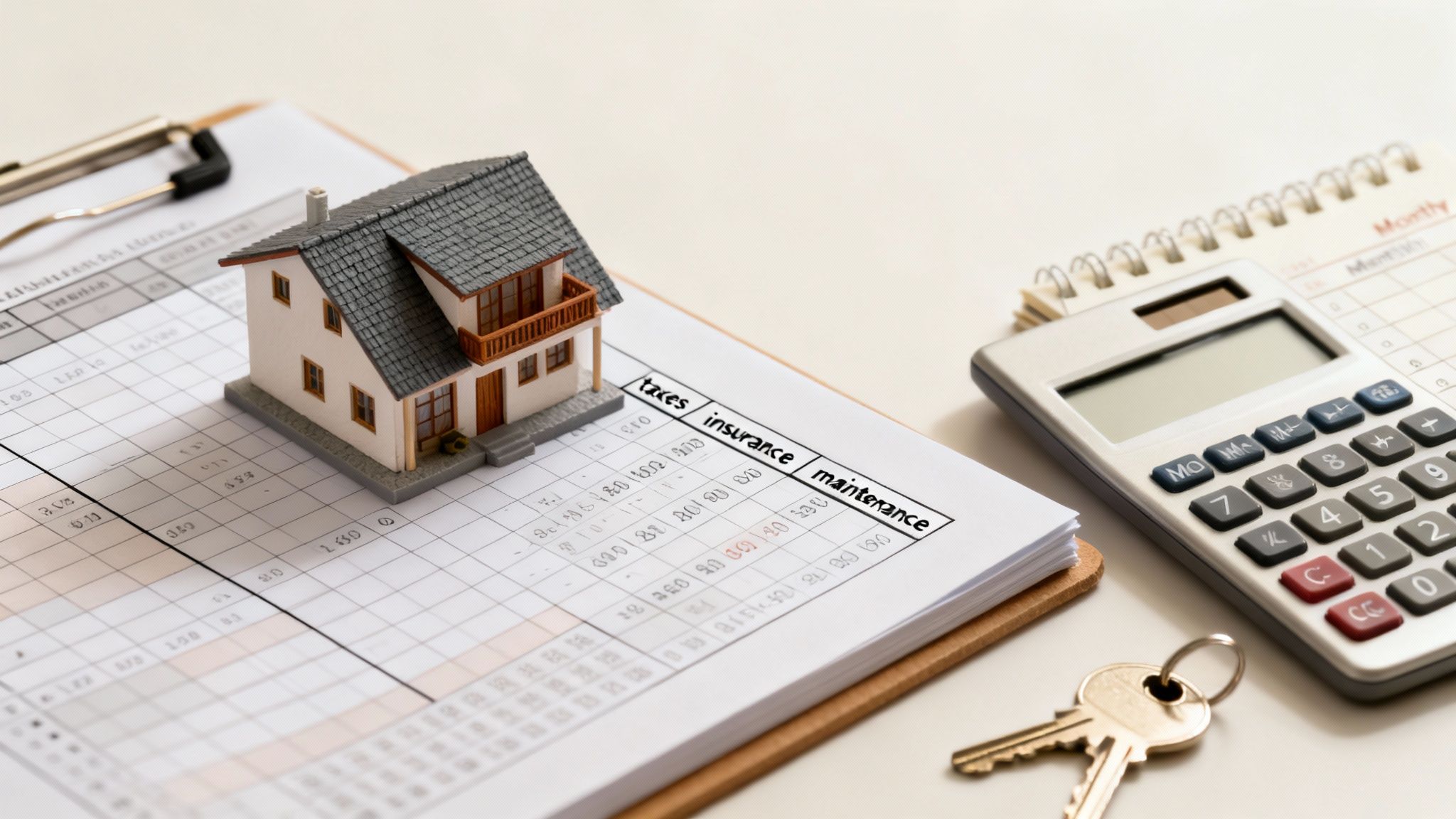
This means sitting down and adding up all the monthly and annual expenses tied to the property. It’s the only way to get a clear, honest picture of your financial commitment beyond the mortgage payment.
Breaking Down the Ongoing Expenses
Your monthly mortgage—the principal and interest—is just one slice of the pie. A solid budget has to include a whole host of other recurring costs that can add up faster than you think.
Here's a quick checklist of the essentials you need to factor in:
- Property Taxes: These can vary wildly from one place to the next. A beachfront property in a popular tourist area might have significantly higher taxes than a quiet cabin in the mountains. You absolutely must research the local tax rates for any property you're seriously considering.
- Homeowners Insurance: Insuring a second home almost always costs more, often 15% to 20% more than for your primary residence. Lenders view a property that sits empty for periods as a higher risk, and that gets reflected in your premiums.
- Utilities: Even when you’re not there, you’ll have baseline bills for things like electricity, water, gas, and internet. These keep the lights on and the pipes from freezing, making them a non-negotiable cost.
- HOA or Condo Fees: If your property is part of a planned community, these fees are mandatory. They cover shared amenities and maintenance, but they can be a major monthly line item.
Missing just one of these can throw your entire budget off track, so it's critical to get accurate estimates before you commit.
Budgeting for the Unpredictable
Beyond the fixed bills, the real test of a vacation home budget is how well it handles the unexpected. I’m talking about long-term upkeep and those out-of-the-blue repairs that always seem to happen at the worst times.
A smart rule of thumb I've seen work time and again is to set aside 1% to 2% of the home's value each year specifically for maintenance. So, for a $400,000 property, that's an extra $4,000 to $8,000 a year for everything from a leaky roof to a broken dishwasher.
Don't treat maintenance as an 'if'—treat it as a 'when.' Having a dedicated savings account for these expenses means a surprise repair bill is just a manageable event, not a full-blown financial crisis.
And if you plan to rent out the property to help cover some of these costs, you’ve got another layer of expenses to think about.
Factoring in Rental-Related Costs
Turning your vacation home into a part-time rental introduces a whole new set of financial variables. The income can be a massive help, but you have to budget for the costs of running what is essentially a small hospitality business.
Here’s what you need to account for:
- Property Management Fees: Unless you live nearby and want a second job, hiring a professional manager is a must. They handle bookings, cleaning, and guest issues. Expect to pay them 10% to 15% of your gross rental income.
- Marketing and Listing Fees: Platforms like Airbnb and Vrbo charge service fees to list your property. You might also want to spend a little on professional photos to make your listing stand out.
- Turnover Costs: Between each guest, there are costs. Think cleaning services, restocking essentials like soap and toilet paper, and professional laundering for linens.
These rental-specific costs directly eat into your profit margin. If you're banking on this income, you need to know exactly what your net profit will be. We've put together a detailed guide on exactly how to calculate rental yield for your property. Building a detailed budget that accounts for these variables is the key to making sure your investment performs the way you expect it to.
Using Rental Income to Your Advantage
For a lot of us, a vacation home is more than just a getaway—it's a financial asset waiting to be put to work. Renting it out when you’re not there is a brilliant way to cover a huge chunk of your ownership costs, from the monthly mortgage payment to those inevitable upkeep expenses. Suddenly, your property isn't just a line item in your budget; it's an investment that pays for itself.
This strategy has become so popular that lenders are now taking notice. If you can build a strong case for your property's earning potential, you become a much stronger candidate for a loan.
How Lenders Actually Look at Rental Income
When you’re applying for that second-home mortgage, don't assume lenders will ignore the cash your property could generate. Many are willing to factor in projected rental income, which can be a game-changer for your application.
No, they won't count every single dollar you hope to make. But what they do count can give your debt-to-income (DTI) ratio the boost it needs to get you across the finish line.
Typically, a lender might consider up to 75% of the home's projected gross rental income. That 25% buffer is their way of accounting for the realities of being a landlord—things like vacancies, unexpected repairs, and other operating costs. To get them to consider this income, though, you can't just throw out a number. You need proof.
You’ll have to back it up with solid documentation, like:
- A Professional Rental Appraisal: This is a formal estimate from a licensed appraiser on what the property could realistically rent for.
- Real-World Comps: Show them the data. Pull listings from Airbnb or Vrbo for similar properties in the area to prove the going rate.
- A Property Management Agreement: If you’ve already signed with a management company, their rental projections carry a lot of weight.
Here’s how it plays out: Let's say you're eyeing a chalet where similar places are pulling in $3,000 a month. The lender might agree to add 75% of that—or $2,250—to your qualifying income. That extra buffer can make all the difference in meeting their DTI requirements.
Run Your Vacation Home Like a Business
To make this work, you have to shift your mindset. You're not just a homeowner anymore; you're an entrepreneur. Your property is the product, and your guests are the customers. This means getting strategic about everything from pricing to marketing to make sure the money keeps coming in.
First things first: get to know the local market's rhythm. A ski-in/ski-out cabin in the Alps has a completely different peak season than a beachfront villa in Spain. Understanding this seasonal demand is key to setting dynamic pricing. You can charge top dollar when everyone wants to visit and offer attractive deals to fill rooms during the quieter months.
The demand is definitely there. The global vacation rental market is on a tear, projected to be worth around $97.85 billion by 2025. This tells us travelers are actively seeking unique, personal lodging experiences. To really capitalize on this, you need to understand your specific market's revenue potential. You can dig deeper into the vacation rental market on StayFi.com to see how these trends could shape your investment.
Don't Forget the Tax Man
Bringing in rental income means you have new tax responsibilities to think about. But it's not all bad news—you also get to claim some pretty significant deductions that can seriously lower your tax bill. The key is to keep flawless records from day one.
Every dollar you earn from renting has to be reported to the tax authorities in the country where your property is located. On the flip side, you can deduct a whole host of expenses tied to that rental activity.
Common write-offs often include:
- Mortgage interest
- Property taxes
- Homeowners insurance
- Property management fees
- Utilities and maintenance
- Marketing and booking platform fees
The rules can get tricky, especially since they often depend on how many days you use the property yourself versus how many days it’s rented. This is also where the big question comes in: should you aim for short-term vacationers or a long-term tenant? We explore this in our guide comparing Airbnb vs. long-term rental strategies.
At the end of the day, using rental income is an incredibly powerful tool. It not only helps you afford the vacation home you’ve been dreaming of but transforms it into a productive asset that can grow with you.
Common Questions About Financing a Vacation Home
Buying a vacation home is exciting, but the financing part can feel like a whole new world. The rules are different, the stakes can feel higher, and you want to be absolutely sure you’re making a smart financial move. Let's walk through some of the most common questions that pop up when you're navigating this process.
Are Interest Rates Higher for a Vacation Home?
Yes, they almost always are. Lenders see a second home as a slightly bigger risk. Their thinking is pretty straightforward: if you hit a financial rough patch, you'll fight to keep your primary home but might let the vacation property go.
To offset that risk, you can expect an interest rate that's about 0.25% to 0.75% higher than what you'd get for your main residence. The exact number really depends on your financial picture, but a hefty down payment—think 20% or more—goes a long way toward getting you a better rate.
Can I Just Call It an Investment Property?
You can, but be prepared for a completely different conversation with your lender. It's a different type of loan with a much tougher set of rules. It all boils down to how you plan to use the place.
- A Second Home is primarily for your personal enjoyment. You might rent it out for a couple of weeks a year, but it’s your getaway spot.
- An Investment Property is bought with the main goal of making money from rent. You're the landlord, not the vacationer.
Lenders take this distinction very seriously. For a true investment property, they'll demand a bigger down payment, often 20-25% at a minimum, and will expect a top-tier credit score. The lending standards are just plain tougher.
A Word of Caution: Never misrepresent how you plan to use the property just to get a lower rate. That's considered mortgage fraud, and it can land you in serious legal and financial trouble.
What Credit Score Do I Need to Qualify?
There’s no single magic number, but most lenders want to see a credit score of at least 680 before they’ll even consider a mortgage for a second home.
But just meeting the minimum isn't the goal. To really get the best rates and terms, you should be aiming for a score of 740 or higher. Because lenders see more risk in these loans, your credit history carries a lot of weight. If your score is in the high 600s, it’s often worth spending a few months paying down credit cards and cleaning up your report before you apply.
How Much Do Market Conditions Matter?
They matter a great deal. The overall economy and mortgage rate trends have a huge impact on your financing costs and the market itself. When rates climb, the market tends to cool off, which can sometimes give buyers more negotiating power. When rates fall, demand surges, and you might find yourself in a bidding war.
The vacation home market is especially sensitive to these swings. For example, the market took a big dip in 2025, with second-home mortgages hitting a 20-year low as rates ticked up. This actually created a fantastic window of opportunity for buyers who were ready to act. Inventory shot up by roughly 33% year-over-year, giving them more choices and more leverage. Timing your purchase with an eye on these trends is a key part of the strategy. You can dive deeper into how market shifts created this unique buying opportunity on HomeQualified.com.
What's This "Type A" vs. "Type B" Property I've Heard About?
This is a classification some lenders use, especially for properties in seasonal areas. It really comes down to whether the home is usable all year round.
- Type A: This is a four-season, year-round home. It has permanent heating, plumbing, and is accessible 12 months a year. These are the easiest to finance and often get terms similar to a primary home.
- Type B: This is a seasonal property. Think of a rustic cabin with no permanent heat source or a cottage on a road that closes in the winter. Lenders see these as riskier and often require a higher down payment, sometimes 10% or more, just to get started.
It's a small detail that can have a big impact on your down payment and financing options, so it's always smart to ask a potential lender how they classify the property you have your eye on.
Ready to find that perfect European retreat? At Residaro, we connect international buyers with incredible properties across Spain, Italy, France, and beyond. Explore our curated listings and start making your vacation home dream a reality. Find your dream property on Residaro.com.